IONA MILLER
  • Home
  • PUBLICATIONS
  • ARTICLES 2017
    • MAJOR ARCANA
      • ARCANA VIDEOS
    • MYTHIC FORMS
      • NUIT
      • GEN-ISIS
      • SOBEK - Wild Psyche
      • KYBELE
      • Helios Uplifter
      • HELIOS TITAN
      • Aphrodite
      • THANATOS
    • ART & TRAUMA
    • PAINTING
    • DAIMON
    • ANIMA MUNDI
    • WORLD WEARY
    • INTERIORIZED VISION
    • TRANSFIXED
    • REFLECTIONS
    • CREATIVE APPROACH
    • SELF-EXPLORATION
    • SELF KNOWLEDGE
    • THEURGY
    • ART & SOUL
    • ESOTERICS
    • INDIVIDUATION
    • LABYRINTH
    • JUNGIAN QABALAH
    • THE BEAD GAME
    • DUNE MYTHS
    • NEW AGE CRITIQUE
    • PHILOSOPHERS STONE
    • BLACK MADONNA
    • ST. GERMAIN Film
    • DRAGON ARCHETYPE
    • TOTAL ECLIPSE
    • PROJECTS
      • PSYCHE
      • Sobek
      • Athena 2018
      • Ares
      • Apollon
      • Horus
    • Afterlife
    • Transformation
    • Transgressive Forces
    • Wisdom Light
    • Sacred Sex
    • TARANTISM
  • ABOUT
  • GENEALOGY
    • Here Be Dragons Home
      • DRAGONTREE
      • Myth Ancestors
      • EGYPT
      • Grail
      • CATHARS
    • 100 Generations
    • Kindred Spirits
    • Ancestors
    • Lineage
    • XX
  • GNOSIS
  • HEALING
    • Metaphors
    • Holo Healing
    • Microvibrations
  • Mind-Body
    • BODY & SOUL
  • Io Art
  • FRONTIER SCIENCE
    • SEDLAK
    • Pineal DMT
    • Bioholography
    • The Field
    • Holographic Archetypes
  • DREAMS
    • Dreamwallker
  • SACRED GEOMETRY
    • QABBALAH
      • DIAMOND BODY
  • ALCHEMY
    • PRIMA MATERIA
  • VIDEOS
  • ARCHIVES
    • Climate 2020
  • Journal
  • Contact
  • Wrestling Thanatos
  • Innate Imagery
  • SIRIUS RISING
  • UFO
  • OANNES
  • DREAMHEALING
  • SELF THERAPY
  • ART SOUL
  • PSYCHE
  • XYZ
  • EVENT HORIZON
  • HADES
  • Thanatos Myth
  • Home
  • PUBLICATIONS
  • ARTICLES 2017
    • MAJOR ARCANA
      • ARCANA VIDEOS
    • MYTHIC FORMS
      • NUIT
      • GEN-ISIS
      • SOBEK - Wild Psyche
      • KYBELE
      • Helios Uplifter
      • HELIOS TITAN
      • Aphrodite
      • THANATOS
    • ART & TRAUMA
    • PAINTING
    • DAIMON
    • ANIMA MUNDI
    • WORLD WEARY
    • INTERIORIZED VISION
    • TRANSFIXED
    • REFLECTIONS
    • CREATIVE APPROACH
    • SELF-EXPLORATION
    • SELF KNOWLEDGE
    • THEURGY
    • ART & SOUL
    • ESOTERICS
    • INDIVIDUATION
    • LABYRINTH
    • JUNGIAN QABALAH
    • THE BEAD GAME
    • DUNE MYTHS
    • NEW AGE CRITIQUE
    • PHILOSOPHERS STONE
    • BLACK MADONNA
    • ST. GERMAIN Film
    • DRAGON ARCHETYPE
    • TOTAL ECLIPSE
    • PROJECTS
      • PSYCHE
      • Sobek
      • Athena 2018
      • Ares
      • Apollon
      • Horus
    • Afterlife
    • Transformation
    • Transgressive Forces
    • Wisdom Light
    • Sacred Sex
    • TARANTISM
  • ABOUT
  • GENEALOGY
    • Here Be Dragons Home
      • DRAGONTREE
      • Myth Ancestors
      • EGYPT
      • Grail
      • CATHARS
    • 100 Generations
    • Kindred Spirits
    • Ancestors
    • Lineage
    • XX
  • GNOSIS
  • HEALING
    • Metaphors
    • Holo Healing
    • Microvibrations
  • Mind-Body
    • BODY & SOUL
  • Io Art
  • FRONTIER SCIENCE
    • SEDLAK
    • Pineal DMT
    • Bioholography
    • The Field
    • Holographic Archetypes
  • DREAMS
    • Dreamwallker
  • SACRED GEOMETRY
    • QABBALAH
      • DIAMOND BODY
  • ALCHEMY
    • PRIMA MATERIA
  • VIDEOS
  • ARCHIVES
    • Climate 2020
  • Journal
  • Contact
  • Wrestling Thanatos
  • Innate Imagery
  • SIRIUS RISING
  • UFO
  • OANNES
  • DREAMHEALING
  • SELF THERAPY
  • ART SOUL
  • PSYCHE
  • XYZ
  • EVENT HORIZON
  • HADES
  • Thanatos Myth
Search
Picture
"Follow in the footsteps of your ancestors, for the mind is trained through knowledge. Behold, their words endure… follow their wise counsel." --"The Book of Kheti," The Husia: Sacred Wisdom of Ancient Egypt

"The ancestral part is given to us by our body, we take over the life of our ancestors in that way. It is the terrace of life because it is here that life renews itself." --Carl Jung, ETH Lecture, 12 July 1935, Page 240.

“We are continually overflowing toward those who preceded us, toward our origin, and toward those who seemingly come after us. ... It is our task to imprint this temporary, perishable earth into ourselves so deeply, so painfully and passionately, that its essence can rise again “invisibly,” inside us. We are the bees of the invisible. We wildly collect the honey of the visible, to store it in the great golden hive of the invisible.” "It is fortunate if something of the ancestors lives on in it and continues to be loved and protected; only then does the past become fruitful and effective." --Rilke, Early Journals
Picture
THE LONG SELF
The story of a life does not always start with birth and end with death....

"All human lives are so profoundly and intricately entwined—those dead, those living, those generations yet to come—that the fate of all is the fate of each, and the hope of humanity rests in every heart and in every pair of hands.“ -Dean Koontz


DROP ROOTS
Genealogy is a Descent, a Katabasis
into the Psychic Labyrinth

…a descent into the cave of initiation and secret knowledge, a model for deep self-descent toward healing.
Picture
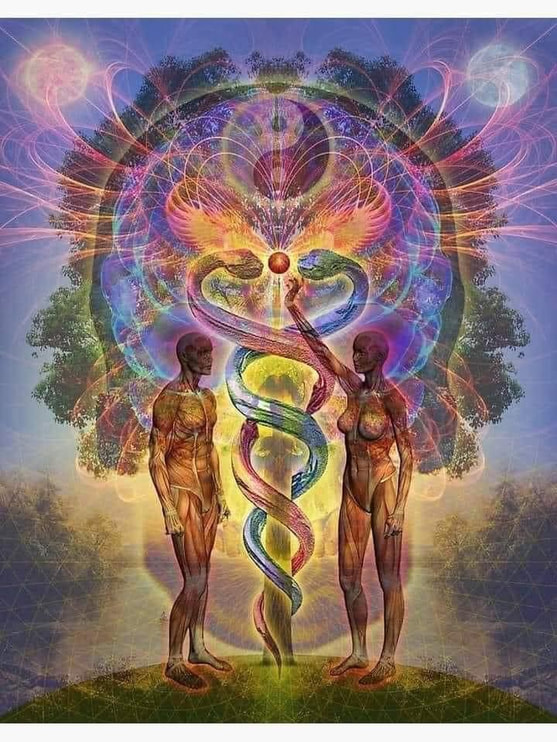
‎"Let there be no doubt that I am the assemblage of our ancestors, the arena in which they exercise my moments. They are my cells and I am their body. This is the favrashi of which I speak, the soul, the collective unconscious, the source of archetypes, the repository of all trauma and joy. I am the choice of their awakening. My Samadhi is their Samadhi. Their experiences are mine! Their knowledge distilled is my inheritance. Those billions are my one." --Frank Herbert, The God-Emperor of Dune, p. 260.

 "Journal of Psychologists", October 2020:
Excerpt: ′′ Th. Gaillard progressively clarifies his intention to show, in addition to the efficiency of unconscious transmissions on behaviors, the tragic consequences of the lack of knowledge of original symbolic legacies, especially the faults and crimes attributable to heads of bloodlines. Meaning in the mythological universe considered here, blood debts cannot not be paid, on any floor of genealogy. But also, what Sophocle's text shows (quoted by Gaillard) is that conditions exist for the outcome of the tragedy not to be dramatic, fatal. They want to intervene at some point, in one of the characters in the generation channel - in this case at Oedipe - from restorative conducts of remorse or autopunition. This is what happens at the end of the mythological narrative, when Oedipus (after assuming the role of scapegoat), a refugee at Theseus, after dying his eyes, becomes the spiritual father and the wise counselor of him, somehow accessing symbolic fatherhood. It seems important notion at the heart of Sophocle's message and thought, taken over by Gaillard.
~Carl Jung, Dream Analysis Seminar, Page 304

"Psychologically, the central point of a human personality
is the place where the ancestors are reincarnated.
"
~Carl Jung, Dream Analysis, Page 304


"The ancestral part is given to us by our body, we take over the life of our ancestors in that way. It is the terrace of life because it is here that life renews itself." ~Carl Jung, ETH Lecture 12 July 1935, Pages 240.


"Unfinished business cannot be resolved by going back in time. Indeed, our business with the dead will always feel unfinished if we try to meet them in a past which they no longer inhabit. From the imaginal point of view the dead are not in history. On the contrary, it is history which is in the dead. Our lives are haunted not so much by what once *was* as by *how* what was is and shall be. As the dead speak to us in our dreams and fantasies, the pas manifests itself in the present where it can enact itself in novel ways." --Greg Mogenson, Greeting the Angels: An Imaginal View of the Mourning Process, p. 29

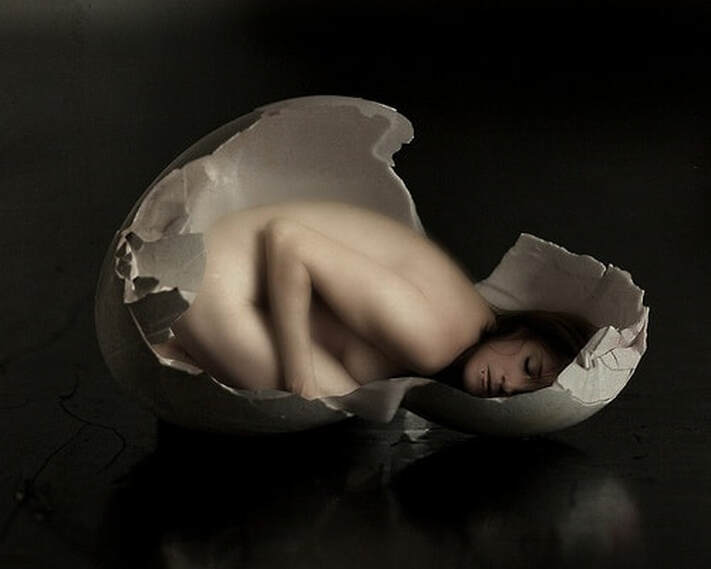
“All the eggs a woman will ever carry form in her ovaries while she is a four-month-old fetus in the womb of her mother. This means our cellular life as an egg begins in the womb of our grandmother. Each of us spent five months in our grandmother’s womb, and she in turn formed in the womb of her grandmother. We vibrate to the rhythm of our mother’s blood before she herself is born, and this pulse is the thread of blood that runs all the way back through the grandmothers to the first mother.”
~ Layne Redmond, When the Drummers were Women


"We do not die alone," James Hillman says. "We join ancestors and all the little people, the multiple souls who inhabit our night world of dreams, the complexes we speak with, the invisible guests who pass through our lives, bringing us the gifts of urges and terrors, tender sighs, sudden ideas."

"Unfinished business cannot be resolved by going back in time. Indeed, our business with the dead will always feel unfinished if we try to meet them in a past which they no longer inhabit. From the imaginal point of view the dead are not in history. On the contrary, it is history which is in the dead. Our lives are haunted not so much by what once *was* as by *how* what was is and shall bee. As the dead speak to us in our dreams and fantasies, the pas manifests itself in the present where it can enact itself in novel ways." --Greg Mogenson, Greeting the Angels: An Imaginal View of the Mourning Process, p. 29

"The less we understand of what our fathers and forefathers sought, the less we understand ourselves, and thus we help with all our might to rob the individual of his roots and his guiding instincts, so that he becomes a particle in the mass, ruled only by what Nietzsche called the spirit of gravity." -Carl Jung, Memories, Dreams, Reflections
Picture
Archetypal Genealogy

Jung contended we can make no progress with ourselves until we become "very much more acquainted" with nature, our own nature, and that of the Other. Genealogy is one opportunity to do so.

Geneology is a soul science.
That the reality of the soul is capable of expressing "intelligible" statements does not mean they are "understandable".

Understanding is the virtual place where the infinite hermeneutics come into play and interface. The image instead characterizes the nature of the soul, (the image is Soul). It is already intelligible in itself because of the language with which the soul weaves the web of existence, welcomes it and expresses itself. James Hillman tells us that the images are not "ours"; instead we belong to them.

Depth Genealogy is an approach with its own roots in Jungian and archetypal psychology, Transgenerational Integration, phenomenology, genetic genealogy, the arts, and other relevant areas. It is a soulful approach, attuned to the Earth, Nature, and Feminine with an eye for the imaginal, the ecological, the embodied, and mythological.

We cannot describe symptoms without acknowledging the human origins of the ecological crisis. Our way of understanding human life and activity has gone awry, to the serious detriment of the world around us.

Beliefs organize our experience and condition our experience and interpretation of sensed presence. You can't unperceive a perception once perceived, but you can erroneously project, interpret, or concretize it. However we attribute 'sensed presence' or 'liminal entities' we know that they are evoked potentials, rather than literal beings, but they exhibit phenomenological qualities that carry meaning.


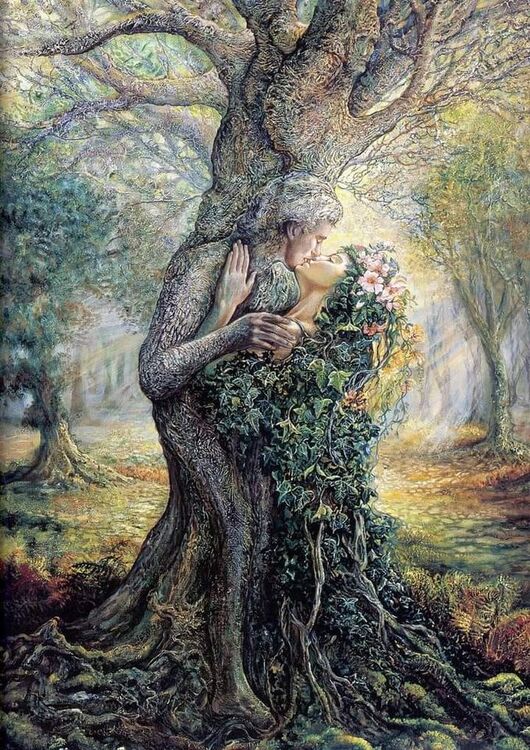
In the genealogical journey our lineage descent becomes an initiatory experience of the depths of the human psyche and collective unconscious. Genealogy is a firm foundation for self-knowledge and any spiritual practice. Our ancestors become living presences informing our lives and being -- our relationship with the past, present, and future and the great cycle of life -- birth, death, and rebirth.

"To give birth to the ancient in a new time is creation."
~Carl Jung, Liber Novus, Page 311


The soul path is often associated with the setting sun (and thus the direction of west), the descent to our earthy roots, into the wildness of the soil and the soul, a journey into the underworld, a voyage into darkness or shadow.

"If we surrendered to earth’s intelligence we could root down ascendant, like trees." Our spiritual growth is meant to go toward the fertile darkness and the glorious light, each of us having the opportunity to bridge earth and heaven—the underworld and the upper world—through the trunks of our middle world lives.

Rilke saw the intrinsic value of darkness: "You darkness from which I come, I love you more than all the fires that fence out the world, for the fire makes a circle for everyone so that no one sees you anymore."


In soul retrieval power is restored to the individual who has experienced soul loss. Soul loss is a shamanic term used to describe the loss of vital life force experienced in trauma, often linked to family of origin trauma. Lack of conscious connection to this source cuts us off from that which births and sustains us. We become detached and dissociated, losing our soul connection to the Sacred Feminine.

We must do the re-membering in order for the ancestors to inform our lives and to drink from the deep well within. Our approach includes many disciplines: archaeology, anthropology, linguistics, genetics, history, mythology, comparative religions, psychology, poetry, and the visual arts.

Ancestor retrieval is information retrieval. Like alchemists of old, we become miners of data, trying to turn raw information and literature narratives into meaningful 'gold'. Extraction of characteristics from text is one of the main tasks in text mining. Family relationships help link people across different genealogical documents and sources.
Picture
Picture
LIVING ANCESTORS
The Long Self & Long Body:

Breathing Life Into the Past


"So turn to the dead, listen to their lament and lovingly take care of them. Don't be the dazzled spokesperson, there are prophets who eventually stone themselves. But we seek redemption, so we need to deeply respect what is done and accept the dead, who have long immemorial floating in the air and in the guise of bats dwell under our roof. Something new will be built on the old, and it will multiply the meaning of what has been accomplished. So you will redeem your poverty into what is accomplished by turning it into the richness of the future. The best way to start the day." --C.G.Jung, Red Book


Do I feel very strongly that I am under the influence of things or questions which were left incomplete and unanswered by my parents and grandparents and more distant ancestors. It often seems as if there were an impersonal karma within a family, which is passed on from parents to children. It has always seemed to me that I had to answer questions which fate had posed to my forefathers, and which had not yet been answered, or as if I had to complete, or perhaps continue, things which previous ages had left unfinished. ~Carl Jung; Memories, Dreams, Reflections; Pages 233-234.

Katabasis
A meaningful katabasis into the cave of initiation and secret knowledge is for the restoration of the whole person. The dead become an imaginal presence, "the growing understood as descent in the world, becoming useful to it and contributing to form, requires that it is descend in the world that is under the world. To be an ancestor, a benefactor, a conservative and a mentor you must have knowledge of the shadows, being trained "from the dead" (from past things, which have become invisible and however continue to vivify our life with their influence). The "Dead" return as ancestors, especially in moments of crisis, when we feel lost. Then the dead "yes", offering a deeper knowledge and support. Having already fallen, they know the chasms; there their extraordinary resources. They don't need to come back literally in the form of voices and visions, because they are already palpable in anything tends to jump down, on any occasion we are not up to. They are the gravity force of the psyche." --James Hillman

Do not situate the presence of the dead in the
―parapsychology of spiritism, the theology of afterlife, the morality of rewards, and the scientific fantasies of biochemical chance or evolution‖ (Hillman, 1979a, p. 67), but in the psychology of soul.

"For nothing is fixed, forever and forever and forever, it is not fixed; the earth is always shifting, the light is always changing, the sea does not cease to grind down rock. Generations do not cease to be born, and we are responsible to them because we are the only witnesses they have. The sea rises, the light fails, lovers cling to each other, and children cling to us. The moment we cease to hold each other, the sea engulfs us and the light goes out." James Baldwin

This is a depth psychological approach to Ancestry, mythic,
symbolic and metaphorical, not metaphysical, religious, or literal.

Our genealogy is that Tree and cosmic center that keeps us connected and balanced, and upon which we can ascend and descend in a way that keeps deep time, the transcendent, and our family of flesh alive within us. Genetic testing is revealing suppressed identity.


Our genealogies are living systems, which are constantly expanding and correcting. We work with others on the World Tree to create the most accurate droplines we can, and correct as we go, breaking brick walls and lopping off obsolete branches. The tree continues to grow.

Like an arborist, we understand the deep interweaving growth, and just how much time such development takes (for trees, sometimes centuries) and how ecologically interconnected events and lives are. Our relationship really seems to exist in a kind of ancestral tree-time. New routes through life are found; tree intelligence sends signals out through the roots. Tree existence can be lived with warmth and an intimate sense of one’s inner core.


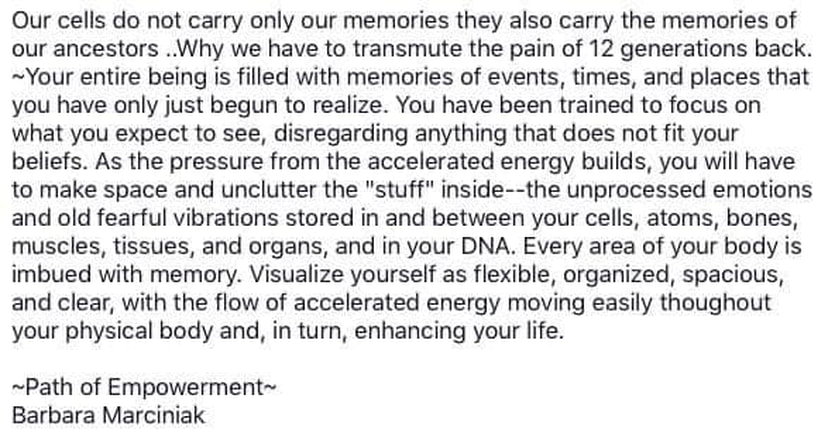
Our unconscious still functions like it did four million years ago. We have discovered that trauma can be passed between generations. The epigenetic inheritance theory holds that environmental factors can affect the genes of future generations. Chemical tags acting like Post-its can latch onto our DNA, switching genes off and on.

Such complexes are usually deeply unconscious, alienating, and distorted. Our legacy conditions us. The conscious and unconscious minds don't speak to one another; they don't even speak the same language. So, we tend to reenact experiences our families have not integrated.

Integration proceeds by perceiving and acknowledging our ancestors with our conscious minds, including our intergenerational wounds and trauma and the weight of the transgenerational history. It is a processing leading toward wholeness.

Jung says, "Take pains to waken the dead. Dig deep mines and throw in sacrificial gifts, so that they reach the dead." (Liber Novus, Page 244). Our genealogy is a psychic treasure house of latent wisdom
Picture
THE SOUL OF THE FAMILY
"Life is lived forward but understood backwards."
- Kierkegaard


"The richest knowledge of the tree includes both myth and botany." Outside the creature, nothing can be known, out of Pleroma, there is nothing to know." --Gregory Bateson

Genealogy is a written testament to the endurance of the archaic. Breath is life -- in Latin, Hebrew and Greek, 'breath' means 'soul.' The breath of life is the vital force which animates the body and shows itself in breathing. In ancient Greek medicine, each of the four humors became associated with an element. Blood was the humor identified with air, since both were hot and wet. And blood means kin.

A Jungian approach to genealogy is not a requirement for practice, but it is a valid approach with its own coherence. Archetypal psychology is a legitimate 'ground' for an aesthetic, phenomenological approach to genealogy. It is a trustworthy framework for understanding a more holistic genealogical process, with a clear sense of humanness or personhood, and irreal and quasi-real experience -- intangibles produced by psyche itself.

'Any student of magic who reaches beyond the superficial levels will have realized that magic is somehow concerned with genetics. Our ancestors, from whom we inherit our magic as well as our physical characteristics, were most concerned to perpetuate certain blood lines that held special abilities. If the Grail legends are considered in this light, they are found to be replete with indications of genetic magic, especially aimed at spiritual regeneration attuned to physical regeneration.' - John Matthews, At the Table of the Grail.
Picture
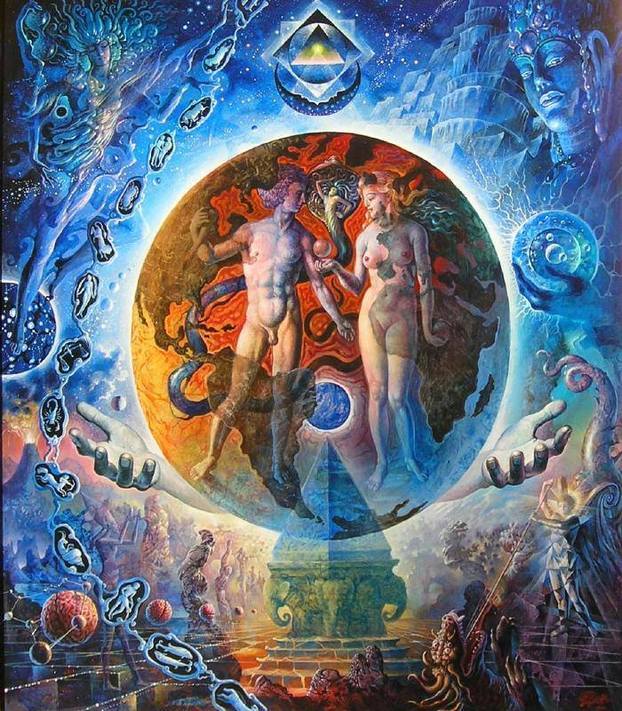
Above: Otto Geiss - The Allegory of Genesis, 1995
Picture
Picture
Picture
Picture
Picture
Picture
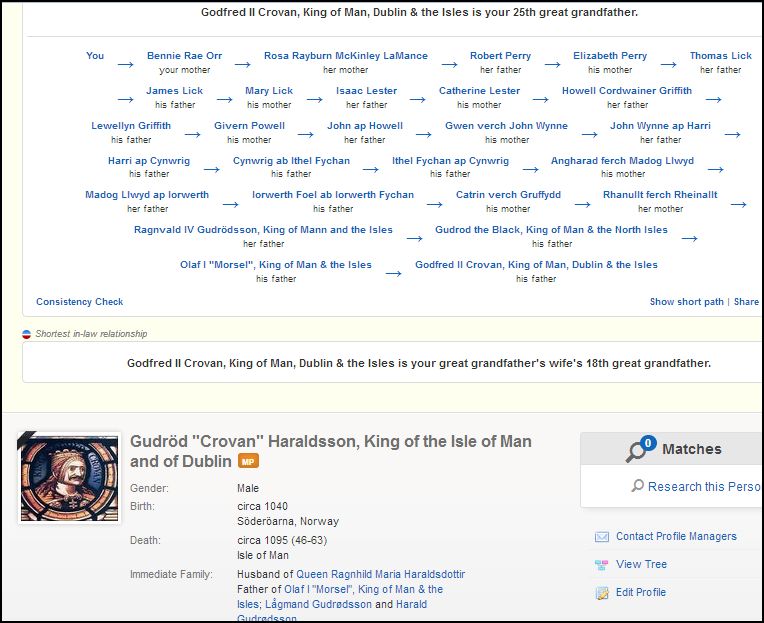
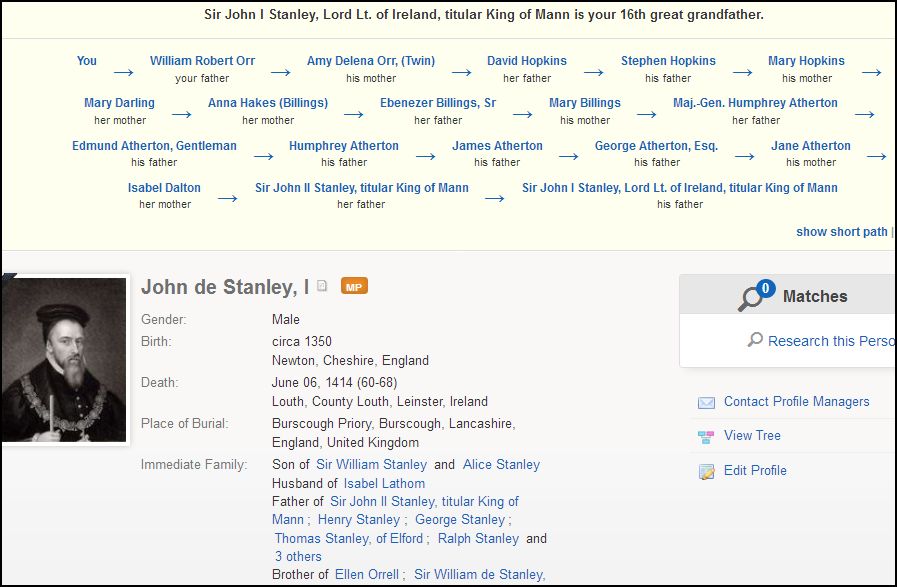
 https://www.ancient-origins.net/artifacts-other-artifacts/mysterious-fairy-flag-clan-macleod-and-its-legendary-protective-powers-020884 Godfred established himself as the King of Mann in 1079, and the MacLeods are said to claim descent from him.
Picture
https://jungiangenealogy.weebly.com/ancestral-gnosis.html


Nisargadatta: "Within the prison of your world appears a man who tells you that the world of painful contradictions, which you have created, is neither continuous nor permanent and is based on a misapprehension. He pleads with you to get out of it, by the same way by which you got into it. You got into it by forgetting what you are and you will get out of it by knowing yourself as you are."

When we join the Great Majority, we become part of the landscape around us.

******
http://www.greenmedinfo.com/blog/game-changing-study-epigenetic-memories-are-passed-down-14-successive-generations
Epigenetic Memories are Passed Down 14 Successive Generations


The past of our ancestors lives on through us: Groundbreaking research illustrates how parental experience is not only epigenetically imprinted onto offspring, but onto an unprecedented number of future generations. Rather than occurring over the elongated time scale of millions of years, genetic change can transpire in real biological time through nanoparticles known as exosomes.

Until recently, it was believed that our genes dictate our destiny. That we are slated for the diseases that will ultimately beset us based upon the pre-wired indecipherable code written in stone in our genetic material. The burgeoning field of epigenetics, however, is overturning these tenets, and ushering in a school of thought where nurture, not nature, is seen to be the predominant influence when it comes to genetic expression and our freedom from or affliction by chronic disease.


THE FAMILY LONG BODY
Approaching the Ancestors
We begin our genealogy knowing there is an art of approaching. We may yearn for that which we cannot name; we may find unspeakable secrets. Jung spoke of it poetically, "
Take pains to waken the dead. Dig deep mines and throw in sacrificial gifts, so that they reach the dead. Reflect in good heart upon evil, this is the way to the ascent. But before the ascent, everything is night and Hell." (Liber Novus, Page 244).


When you step into your own Hell, never think that you come like one suffering in beauty; or as a proud pariah, but you come like a stupid and curious fool and gaze in wonder at the scraps that have fallen from your table. (Liber Novus, Page 262).

But the deepest Hell is when you realize that Hell is also no Hell, but a cheerful Heaven, not a Heaven in itself, but in this respect a Heaven, and in that respect a Hell. (Liber Novus, Page 244).

Our approach is framed with emotionally dependent perspectives, psychophysical reactions, and perceptual filters.
We become absorbed by the emotions we are feeling. Shifts in neurohormone levels affect our consciousness. They may manifest as interference patterns, psychosomatics or what might be called soma-signficance.
Sometimes we "carry on" the maladies of our parents or grandparents within ourselves long after their passing. More than genetic or epigenetic  inheritance, perhaps that is one way of keeping them with us.

Soma-Significance
Our bodies are simply connected with an intuitive sense of meaning, in all its implications and possibilities. Our structure encodes the recent and deep past. The physical and its significance are in no way separate but two aspects of a non-dual reality. So, some arising emotions may 'belong' to us while others arise from an empathic identification with our ancestors, or even fusions of their energies. They may appear in the pre-sensory, sensory elements and images in our dreams.


Proprioception is how we perceive ourselves physically -- our own individual orientation, moment to moment. It is how we grasp or sense of the relative position of neighboring parts of the body and strength of effort being employed in movement. Sensory information contributes to the sense of position of self and movement.

Expressing emotions amplifies them. So we can also unlock significance by moving intuitively, by "letting go," and seeing how that feels and what it brings up. That movement itself is a primal image that communicates information not only to our senses but our entire being. It helps us sense stimuli arising within the body regarding position, motion, and equilibrium.


Contemplation of our family tree provokes reflection on our destiny. We look to the beginning to reveal the end, since like a hologram or fractal each part reveals the whole. The initial condition is archetypal. This alchemy of multigenerational marriage bridges has come down to us in the present -- as our unique embodied being. Jung cautions that, "Individuals who believe they are masters of their fate are as a rule the slaves of destiny." (Letters Vol. II, P. 520-523)

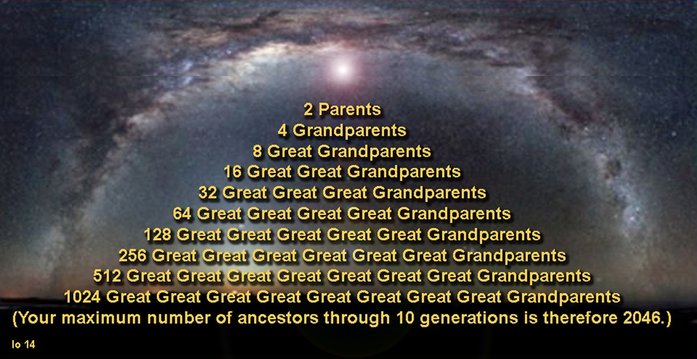
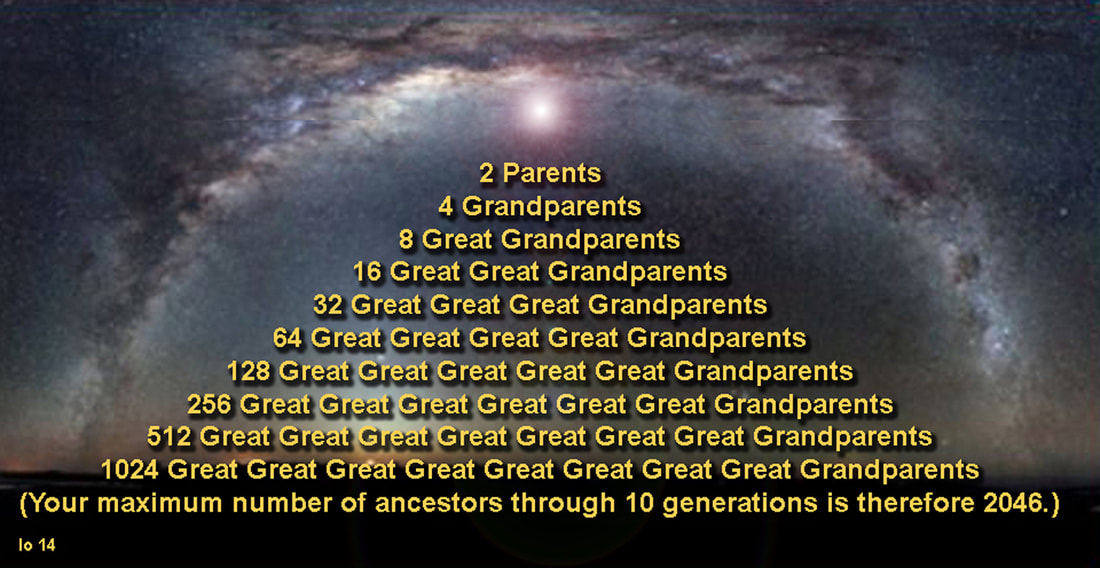
Connection to Source is the basis of creation, which manifests something unique from formless nothing. In our mundane existence we can lose sight of the wonder of life. Genealogy manifests the marriage of matter and psyche. Our family tree is a forest doubling in numbers each generation we go back.

Those who have passed are often passed over.
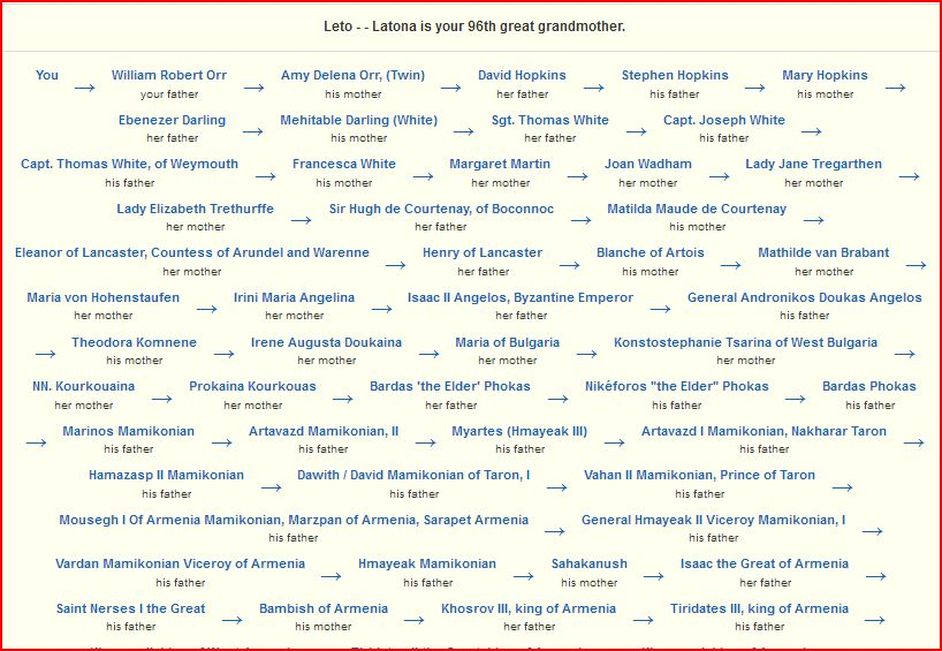
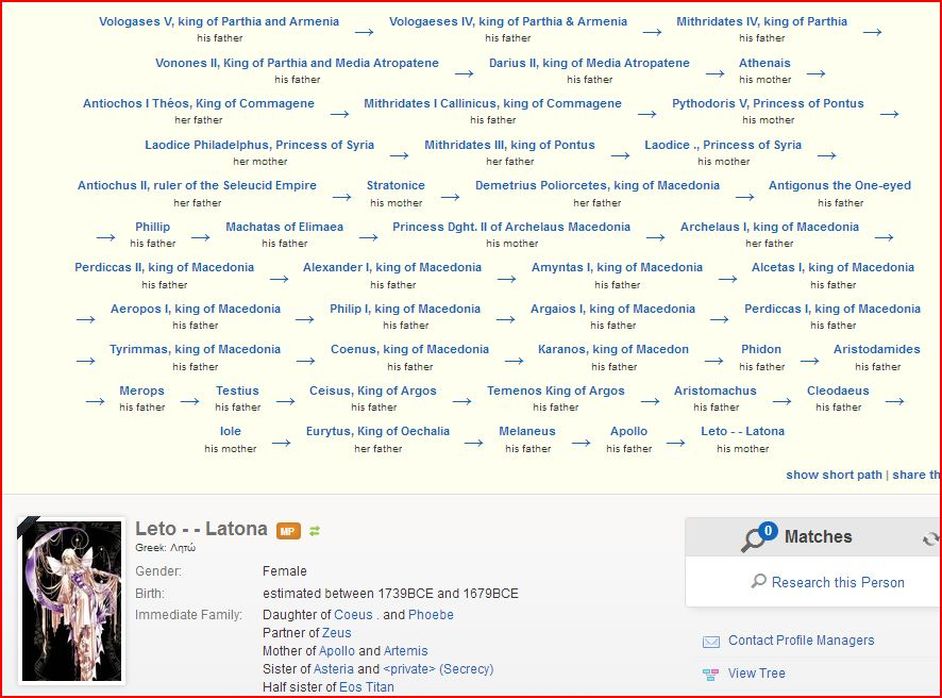
Recognizing them, we recognize the reality of the psyche. We contain multitudes. By the medieval period, they number in the thousands, and tens and hundreds of thousands. They outnumber themselves, leading to the phenomenon of 'pedigree collapse,' when ancestors repeat in multiple lines of our descent. Collectively, they are nevertheless our particular way of descending into the cosmos and life and carrying it forward.

Increasing knowledge of self can come by knowing the Others within and renewing ruptured relationships. We can draw an analogy between the ascending and descending pathways of our psychobiology and genealogy. Emotions have bodily effects.

"Threshold events" occur when information that was formerly profoundly unconscious arises within our somatic, emotional, mental, or spiritual perceptions. Once we can locate sensations in the body, we can get a metaphor for what that experience is "like," engaging our imaginal faculty.


Multiple streams of consciousness can participate in one perspective that frees us of our amnesia. Somato-sensory pathways are information channels. The somatosensory system is the part of the sensory system concerned with the conscious perception of touch, pressure, pain, temperature, position, movement, and vibration, which arise from the muscles, joints, skin, and fascia. Self-organizing systems of mind-body communication across all levels from the cellular-genetic to the psychosocial and behavioral affect our psychobiology and natural or spontaneous healing.

It isn't about belief but directing our awareness to a different transderivational level of the system. Richness of interactions allows systems as a whole to undergo spontaneous self-organization and reorganization at all levels. We emphasize the need to deal with illness at formative levels, i.e., at the organism's initial conditions -- perinatal states, as suggested by Grof, Tart, and Mindell.  At subtle levels outer structure is only a passing reflection of this continuing deep inner evolution.

An incoming communication we cannot make any sense of whatsoever is an integral part of processing language, and of attaching meaning to communication.
How we ask the question determines the information we get. For example, we can create association rather than dissociation.

One approach is to drop into the body and get a sensation for where a feeling is, following it around, if necessary. Sensory responses are evoked potentials. When we detect a response we have a place to begin noticing, remembering, and processing. At the threshold level we have a 50-50 chance of detecting our response as attention or distraction. We may feel it weakly or even wonder if we felt it at all. This way we can reactivate pretty much any feeling we've ever had or that lives in us with a new level of sensation and connection in the present. We become aware of issues by their somatic, energetic, and emotional components.

https://jungiangenealogy.weebly.com/ancestral-gnosis.html
Picture
Picture
Consciousness does not mean individual awareness. The larger concept includes the personal unconscious and collective mind, conscious and unconscious -- the union of the serpent (subconscious) with the eagle (super conscious). Consciousness is the bottomless pit of the indivisible whole. It means the world. In the most inclusive sense it is cosmic consciousness. The mind's nature is primordial awareness, practiced by mystics and sages from time immemorial.

New archaeological finds have helped us discover human hybrid interbreeding among the archaic and extinct hominins. Genome analysis suggests there was cross-species interbreeding between modern humans, Neanderthals, Denisovans and additional unknown archaic populations, perhaps as far back as Homo Erectus.

We are in no way separate from Nature and our nature is archetypal.
We discover how to orient ourselves in the tidal pathways of the unconscious. We see that our shadows and strengths fall into archetypal patterns -- the timeless parts of ourselves we act out unconsciously.  Our genealogical maps help us find our way into the deep unconscious and our greatest possible treasure -- our inner gold.


Self-Awareness
We are always telling and remembering and forgetting our stories and those of our near and distant families. Primary in that telling is the tale of from whom we descend through archetypal process and relationship. The primary issues are ‘to be or not be’ and ‘to belong or not to belong.' Our inherent way of expressing is our flow state, our gift, and fulfillment of our personal myth.

We need to both identify and integrate our ancestral legacy in our trials of descent. Without it we may remain stuck in the wasteland of alienation, dissociation, and existential crisis rather than integrating our unconscious heritage and history. We can find our missing qualities in our genealogy.

To figure out what is happening in the present, we need to figure out something of the past. However, we imagine so many things to be true and so many to be false, we simply don't know what is 'real' or not. Life comes from your imagination and what you imagine to be real.
Picture
SOUL GENEALOGY
https://ionamillersubjects.weebly.com/soul-genealogy.html

The soul is an internal mirrror, but also a window on the world by which we see ourselves, Anima Mundi. The firm quality of innate knowledge inherent in people is received from heaven-this is "heaven." The original adaptable quality of innate capacity is received from earth-this is "earth."


Transgenerational Legacies
FINDING NEW KINSHIP STRUCTURES & LOYALTIES
by Iona Miller, 2017


 "For indeed our consciousness does not create itself it wells up from unknown depths. In childhood it awakens gradually, and all through life it wakes each morning out of the depths of sleep from an unconscious condition. It is like a child that is born daily out of the primordial womb of the unconscious." ~Carl Jung, CW 11, pp. 569 f.

Family is a commonality, of shared background, experience and needs. Our consciousness shapes our history as we negotiate our lives. With the power of deep learning, it arises from fathomless convoluted networks of intermingling ancestors, human and pre-human, for millions of years. A wise heart journeys past the layers of fears, memories of hurt, and projections to the most tender places of our being -- the still point of inner listening.

Our genealogy is our natural History. Our psychogenealogy is the natural history of our soul. There is another kind of primordial human in us that responds to a transgenerational approach to the family tree. Jung called it 'the two million year old man," the instinctive self, rooted in nature.

An integrated approach roots us in both past and present, as a common model for real life and consciousness that foster transgenerational bonds, transformation, and integration. Both Transgenerational Integration (TI) and genealogy are full of rich themes to explore, including family ties, legacies, parenting, matriarchy and patriarchy (
Gaillard).

In The Undiscovered Self, Jung poses a challenge that is relevant to psychogenealogy in terms the urgency of recovering our ancestral heritage:


"We are living in what the Greeks called the right time for a “metamorphosis of the gods,” i.e. of the fundamental principles and symbols. This peculiarity of our time, which is certainly not of our conscious choosing, is the expression of the unconscious man within us who is changing. Coming generations will have to take account of this momentous transformation if humanity is not to destroy itself through the might of its own technology and science."

The Transgenerational Integration Movement is developing such awareness for both therapists and the general population. Part of that school of thought is an active psychological approach to genealogy and the ebb and flow of life itself, whether self-initiated or in the therapeutic relationship.

TI has its own genealogy rooted in the works of Freud, Jung, Fromm, and others. It also draws on established conceptual models from family therapy, including the genogram. It does not suggest a radical paradigm shift to different tenets or fundamental assumptions, say, about the nature of reality -- changing initial conditions and/or assumptions. It amplifies existing therapeutic channels. However, it helps account for errors and anomalies in the old or waning and competing paradigms and provides greater clarity and a higher information ratio.

All knowledge has gaps, and our self-knowledge is no exception. Climbing our family tree helps us fill in some of those gaps with myth, symbol, history, and immediate experiences of the power of presence and healing transformation. An occurrence can appear and be understood as a material event or a psychological experience, depending on the attitude, faith, and worldview of the observer.

We can take a liminal stance and engage in imaginal conversations with our ancestors. Psychology is a 'study of the soul,' so a psychological approach to our family tree means working that tree with a focus toward its effect on our soul, and honoring the 'transgenerational laws' that have been neglected in modern culture. The object of the psychological approach is the inside subject engaged with psyche.

To be engaged with the psyche, inevitably means to be engaged with the ancestors:


"There is one ego in the conscious and another made up of unconscious ancestral elements, by the force of which a man who has been fairly himself over a period of years suddenly falls under the sway of an ancestor." (Jung, 1925 Seminar, pg 38.)

"Therefore there are gates and walls, showing the aspiration is not to be dead and buried in the mandala, but to function through the mandala." (Jung, Visions Seminar, Page 265.)

Subject and psyche reflexively fold back upon one another fusing subject and object on the unus mundus or psychoid level. The family tree graphically represents this vast process, and merely hints at its complexity. At the psychoid (psychophysical) level the unconscious domain is the deep wisdom of nature -- our connective consciousness of nature and our nature.

In a way the collective unconscious is merely a mirage because unconscious, but it can be also just as real as the tangible world. (Jung, 1925 Seminar, Page 40)

"As soon as one begins to watch one’s mind, one begins to observe the autonomous phenomena in which one exists as a spectator, or even as a victim." (Jung, 1925 Seminar, Page 40.)

Genealogy is a reflexive discipline. Your family tree opens a vast inner realm of ancient, living symbols -- your ancestors. We yearn toward eternity, longing for connection. It begs the question,  "are we comfortable in the presence of the disembodied?"

The Absence & the Presence
Genealogy is the domain of subtle bodies, neither this nor that. Now a
presence it  then eludes our grasp, shows itself and hides itself, reveals and conceals itself. Disembodied spirits are a conceptual category, rather than an ontological 'reality' or delusion from beliefs or religion. Ontology is a branch of metaphysics that deals with the nature of being, the essence of being. But ontology is only the study of anything under the aspect of its being, of what is involved in its existing.

In the psychological context, ontology itself is a mythologizing activity. It is not an ultimate but can have consequences: (1) Ontological security is achieved by routinizing relationships with significant others, and actors therefore become attached to those relationships. (2) Worldview implodes in Ontological Catastrophe. (3) Ontological anarchy insists no "state" can "exist" in chaos, that all ontological claims are spurious except the claim of chaos. In effect, chaos is life. All mess, all roiling energies, all protoplasmic urgency, all movement—is chaos.

Undecidability
What kinds of things actually exist? Meta-questions include: What is existence? and What is the nature of existence?  We ask, "What is the nature of the universe?" or "Is there a god?" or "What happens to us when we die?" or "What principles govern the properties of matter?" The entangled nature of quantum entities provides a plausible theory for how our ancestors might 'appear' in our own very material psychophysiology.


Bateson names the connection between opposites with a paradoxical image borrowed from C. G. Jung, who in turn took it from ancient Gnosticism -- ''pleroma/creatura.'' This image implies the idea that the fundamental connection is not between two substances, mind and matter. Rather, mind is the pattern and fabric, texture and weave (pleroma) in all matter (creatura). This is the psychophysical essence of psyche, or soul.

We can try to
ground our heuristics on firm metaphysical and epistemological foundations. The ontological argument claims to establish the real (as opposed to abstract) existence of some entity with some a priori 'proof.' In its general meaning, ontology is the study or concern about what kinds of things exist - what entities there are in the universe. Such questions are moot speaking of a dead or discarnate, and therefore, 'non-existent' being.


The basic question of ontology is “What exists?” The basic question of metaontology is: are there objective answers to the basic question of ontology? Here ontological realists say yes, and ontological anti-realists say no. (Chalmers) But we don't need to answer or have faith in any ontology to pursue psychogenealogy. We don't need to believe in 'ghosts' for an epistemology of the sacred.

Metaphor is the logic of psyche. We have countless metaphors of appearance and disappearance. It doesn't matter that our ancestral spirits are discarnate, because they 'matter' in terms of psyche, which is indistinguishable from matter -- our matter. One effect of this is psychophysical symptoms rooted in transgenerational issues.

Spirits are not ontological or metaphysical facts, but imaginal realities. The psychological or therapeutic approach does not require ontological speculation or meta-questions. We perceive them as epistemological metaphors, or 'how we know what we know' and what it's 'like,' which awakens their psychophysical aspects.


We can explore metaphors. They act as a bridge, imaginative propositions, even epistemic intuition. They use a story or illustration to see alternative ways of looking at something. Every culture and religion uses these types of stories, analogies, and parables to improve understanding, make a point more memorable, and help us make positive changes.

The internal/external metaphor is foundational. Metaphors assist transformation. 
A metaphorical scheme effects a reorganization. Interrelating conceptual, perceptual, and biological metaphors enables a cycle of transformation. They are inherently irrational but unconsciously 'make sense.'

Much of our thinking is a matrix or complex web of metaphors. Emotive metaphors are feelings transformed into a metaphorical equivalent. It is sustained throughout the work and functions as a controlling image. Metaphors deepen the information. The questions used to develop a metaphor develop space not time.

A metaphor awakens conceptions with more force and grace than 'common' language. An epistemological metaphor is personal and unique, translating a feeling or thought into a form that can travel through time to its original.


Zhuangzi metaphorically puts forth three meta-questions or fundamental questions in epistemology: 1) as an epistemic subject, do I know I myself? 2) Among epistemic subjects, do I know others? 3) What can I know about the world?


Virtual Agents
Epistemology is a knowledge creation metaphor. References to virtual agency are metaphorical, beyond body, death, and social identity. Epistemological metaphors are a gateway to the subconscious, as are dreams, symptoms, and our family tree.

Content-free therapy can be done through metaphor, rather than through directly reliving trauma thereby avoiding re-traumatizing.
Metaphors act as a means for the psyche to represent experiences of personal significance in symbolic ways. Metaphoric expressions are tied to some unconscious or implicit aspect of our experience.

Metaphor does something in relation to our understanding. Beyond rhetoric, metaphor is rooted in some quality of the world as it is. Metaphor functions like a dream or symptom in the sense that it simultaneously expresses material from different psychic levels -- topographical, structural, and dynamic.

Metaphor use and exploration gives us a way of linking our experiences across diverse times and situations.
In genealogy, history uses veils as epistemological metaphors, reflecting the conception of reality dominant in each respective epoch.

Social Presence in Sacred Space
In our transgenerational work we can extend that self-inquiry, asking ourselves 'where do I feel that in my body', and 'how do I know it's happening when it happens' to develop dynamic images and metaphors of 'what it is like' for process work. It's a functional approach that is used because it works as a
tool for exploring personal meaning, fundamental to insight-oriented psychotherapy.

Disembodied Soul
Personifying is a way of making subjective experience, passionate identification, and indwelling images more tangible through conversation and relationship in symbolic form. Hillman (1975) called it “an epistemology of the heart, a thought-mode of feeling.” It imagines what’s inside, outside, and makes this content alive, personal, and even divine. Jung claimed that the inside is the outside, the outside is the inside; the claim is that psyche is matter and matter is psyche.

Theoretical Grounding
The scientific search for knowledge is the search for Truth and Beauty, appealing to both spirit and soul.  To know facts is to survive; not to know, or to assess one's environment wrongly, is to lose the fight for survival.  With the examination of the sources, nature, and accuracy of our knowledge, we begin to develop epistemic awareness, a more informed understanding of what we know and don't know. 

We are faced with two serious epistemological problems: (1) How can we determine which facts are true? and, (2) How can we determine which facts are important?  Our minds are the comparator and interface as we navigate through internal and external realities.

Denial is a complex “unconscious defense mechanism for coping with guilt, anxiety and other disturbing emotions aroused by reality.“ Even skepticism and solipsistic arguments – including epistemological relativism – about the existence of objective truth, are generally a social construction.


Rebirth is synonymous with restoring the true history of our origins and integrating our transgenerational inheritance, somewhere between the loss of what we thought we knew and true self-knowledge.

The soul generates images unceasingly. The soul lives on images and metaphor, especially epistemological metaphors--how we know what we know. These images form the basis of our consciousness. All we can know comes through images, through our multi-sensory perceptions. So, this soul always stays close to the body, close to corporeality, to what "matters."


Jung's basic ideas about the unity of knowledge and existence are in principle synonymous with the Platonic tradition, alchemy, Qabala and Gnosticism. Plato treated the end product of the evolution of mathematical concepts, (a fixed system of idealized objects), as an independent beginning point of the evolution of the "world of things." This concrete form of philosophy was determined by the nature of Greek mathematics.

These philosophies seek to reconcile the actual condition with a hypothetical distant ideal, which expansively incorporates both personal and universal dimensions. It is an inward-oriented epistemology. By intuitive perception we can consciously reiterate the laws of Nature and mind which are equivalent to the archetypes themselves.


Going back to the question of fantasizing, if once the resistance to free contact with the unconscious can be overcome, and one can develop the power of sticking to the fantasy, then the play of the images can be watched. ~Carl Jung, 1925 Seminar, Page 38.

The Soul’s Code, James Hillman’s best-selling book, sets out a new theory based on an old idea: Plato’s understanding that the soul of each of us is given a unique daimon before we are born, and it has selected and image or pattern that we live on earth. Hillman’s acorn theory is about calling, about character, about innate image. To uncover our unique, innate image he urges us to set aside the psychological frames that are usually used and mostly used up. They do not reveal enough. Instead, the acorn theory dares us to envision biography in terms of beauty, mystery and myth. It challenges the prevalent paradigm that reduces biography to genetics and environment. It lifts the pall of victim mentality and posits a psychology of childhood that embraces pathology as well as imagination.
Picture

GENEALOGY

FAMILY OF ORIGIN
Here Be Dragons

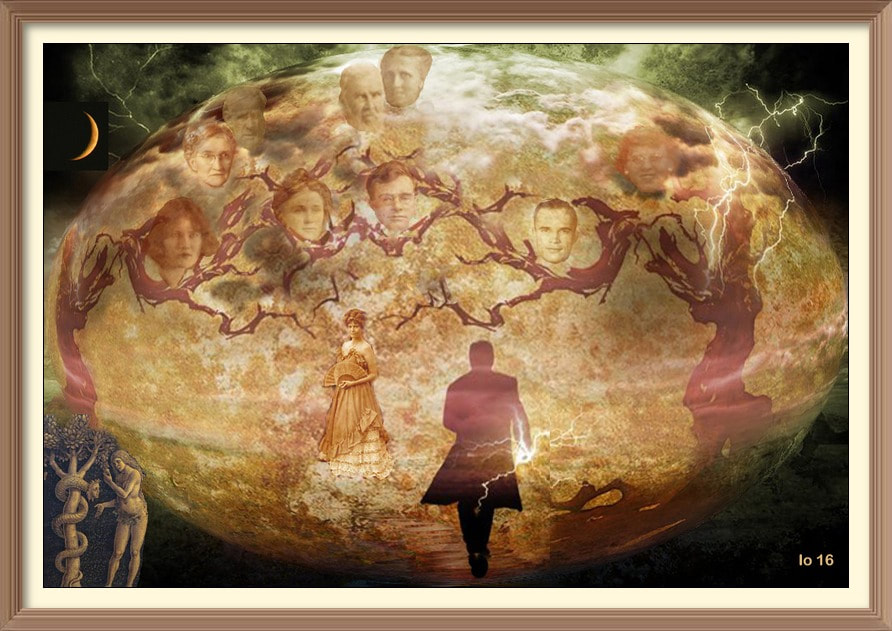
An Unconscious Pact Between the Dead & the Living
"The dead and the living, those awake and those sleeping, the young and the old are one and the same in us; the one moved from its place is the other, and the other returned to its place is one." --Heraclitus
Picture
...“give your daughters difficult names. give your daughters names that command the full use of tongue. my name makes you want to tell me the truth. my name doesn’t allow me to trust anyone that cannot pronounce it right.”
― Warsan Shire


PIECES OF YOURSELF
Genealogy As Primal Symbol

Ancestral Reality


“I believe we have been robbed of our true biography – that destiny written into the acorn – and we go to therapy to recover it. The innate image can’t be found, however, until we have a psychological theory that grants primary psychological reality to the call of fate."
--James Hillman


"How can I put the pieces of my life together in a coherent image? How can I trace the background to my story? To Discover the innate image, we must set aside the generally used psychological patterns - and for the most worn." --James Hillman

“In general, emotional ties are very important to human beings. But they still contain projections, and it is essential to withdraw these projections in order to attain to oneself and to objectivity. Emotional relationships are relationships of desire, tainted by coercion and constraint; something is expected from the other person, and that makes them and we unfree. Objective cognition lies hidden behind the attraction of the emotional relationship; it seems to be the central secret. Only through objective cognition is the real coniunctio possible.”
--C. G. Jung, Memories Dreams and Reflections, pp. 296-297.


Aside from the symbols used within genealogy, the Family Tree itself is a foundational symbol of one's living connections to life, to history, and to transformation. It is the "prime symbol" of gestation and prima materia -- the archetypal human being. To mix metaphors, when it comes to our 'entangled branches,' we have to "read between the lines."

The symbolical names of the prima materia all point to the anima mundi, Plato's Primordial Man, the Anthropos, and mystic Adam.  Adam Kadmon is the "man of light" and therefore identical with the alchemical filius philosophorum.  Paracelsus says of this astral man, "the true man is the star in us...for heaven is man and man is heaven, and all men are one heaven, and heaven is only one man."

The ancient teachings about the Anthropos assert that God, or the world-creating principle, was manifested in the form of a "first-created" man, usually of cosmic size, such as Prajapati, Purusha, and Metatron.

The Primordial Man is the means for conquering darkness, and shares his role with a feminine being, Sophia, who coexisted with him in the Gnostic Pleroma. The Cosmic Man or archetypal man is both macrocosm and microcosm and contains the Feminine or anima within himself.  Technically it is a hermaphroditic figure, recapitulating the entire evolutionary process. 

The Anthropos originates in Manichaean doctrine. It is akin to the true man of Chinese alchemy, which like the Anthropos is akin to God. This inner man remains partly unconscious because consciousness is only part of a man and cannot comprehend the whole. But this whole man is always present.

Psychic content  becomes conscious when it possesses a certain energy-charge, or it sinks back into unconsciousness. This "Man[Woman]" is an indescribable, intuitive or mystical experience which demonstrates the continuity of this idea over the millennia. In later centuries there was a relationship between Christ, the Son of Man and this cosmogonic Man. 


In alchemical philosophy it corresponds to the homunculus and lapis, the product of the hieros gamos, Royal Marriage. According to Jungian, Edward Edinger, the anthropos has been likened in Gnostic texts to a corpse, "buried in the body like a mummy in a tomb." 

The mummy is symbolically identical with the original man or anthropos, and is thus an image of the Self and the product of mortificatio--the incorruptible body that grows out of the death of the corruptible seed. It corresponds to the alchemical idea that death is the conception of the Philosopher's Stone. 

From its death, the "child of the philosophers" is born--the Philosophical Stone. The regenerated king in alchemy corresponds to the cosmic Anthropos, the First Man.  He is the inner, spiritual, psychic man created in the image of the Nous.

The alchemist experienced the Anthropos in a form that was imbued with a new vitality, freshness and immediacy--psychic totality. It has a complex Egyptian, Persian and Hellenistic background--Homo Maximus.


Primary Relations
It is an epic picture story book. It is a text, showing the
relation between signs and the things to which they refer; their signified content, or meaning. It is a discourse on your specific and mythic ancestry -- your ground in pure and limitless space. Each ancestor is a sign deployed in space and time to produce "texts", whose meanings are construed by the mutually contextualizing relations among them. As a conceptual model it helps us conceive the whole.

The self-referential symbol fully represents the whole of which it is a part -- more than a romantic symbol or allegory. There are ordinary people and "giants" of history who felt an intense desire to achieve great deeds and heroic immortality.


"Let there be no doubt that I am the assemblage of our ancestors, the arena in which they exercise my moments. They are my cells and I am their body. This is the favrashi of which I speak, the soul, the collective unconscious, the source of archetypes, the repository of all trauma and joy. I am the choice of their awakening. My Samadhi is their Samadhi. Their experiences are mine! Their knowledge distilled is my inheritance. Those billions are my one." --Frank Herbert, The God-Emperor of Dune, p. 260.

The symbol is the middle way along which the opposites flow together in a new movement, like a watercourse bringing fertility after a long drought.
~Carl Jung, CW 6, Para 443.


Childlikeness or lack of prior assumptions is of the very essence of the symbol and its function. ~Carl Jung, CW 6, Para 442
Picture
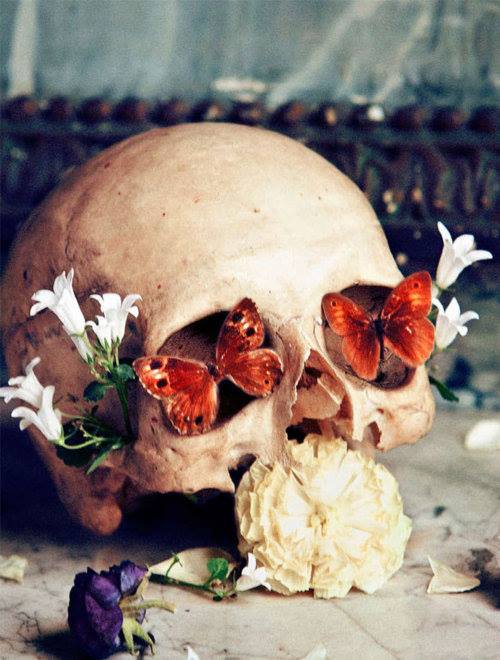
Txema Yeste

"You are immortal; you’ve existed for billions of years in different manifestations, because you are Life, and Life cannot die. You are in the trees, the butterflies, the fish, the air, the moon, the sun. Wherever you go, you are there, waiting for yourself." ~Don Miguel Ruiz


Original Awareness
Our antic biophysical background has been easier to ascertain than the physics of the soul, though many have tried in transpersonal psychologies and the field of Consciousness Studies. Some suggest quantum and even subquantal descriptions of primordial consciousness, which could be described as identical with or inherent in matter.

Consciousness does not mean individual awareness. The larger concept includes the personal unconscious and collective mind, conscious and unconscious --
the union of the serpent (subconscious) with the eagle (super conscious).
Consciousness is the bottomless pit of the indivisible whole. It means the world. In the most inclusive sense it is cosmic consciousness. The mind's nature is primordial awareness, practiced by mystics and sages from time immemorial.

New archaeological finds have helped us discover human hybrid interbreeding among the archaic and extinct hominins. Genome analysis suggests there was cross-species interbreeding between modern humans, Neanderthals, Denisovans and additional unknown archaic populations, perhaps as far back as Homo Erectus.

We are in no way separate from Nature and our nature is archetypal.
We discover how to orient ourselves in the tidal pathways of the unconscious. We see that our shadows and strengths fall into archetypal patterns -- the timeless parts of ourselves we act out unconsciously.  Our genealogical maps help us find our way into the deep unconscious and our greatest possible treasure -- our inner gold.


Self-Awareness
We are always telling and remembering and forgetting our stories and those of our near and distant families. Primary in that telling is the tale of from whom we descend through archetypal process and relationship. The primary issues are
‘to be or not be’ and ‘to belong or not to belong.' Our inherent way of expressing is our flow state, our gift, and fulfillment of our personal myth.

We need to both identify and integrate our ancestral legacy in our trials of descent. Without it we may remain stuck in the wasteland of alienation, dissociation, and existential crisis rather than integrating our unconscious heritage and history. We can find our missing qualities in our genealogy.

To figure out what is happening in the present, we need to figure out something of the past. However, we imagine so many things to be true and so many to be false, we simply don't know what is 'real' or not. Life comes from your imagination and what you imagine to be real.

Raising Cain
Those who have not done their own genealogies think some of the claims about conventional genealogical results are utterly fallacious. But if you draw your own lines past a certain era, you find the rumors are indeed 'true,' no matter what that means in terms of symbolic and psychological realities. Naturally, such fabled lines are not literally so.

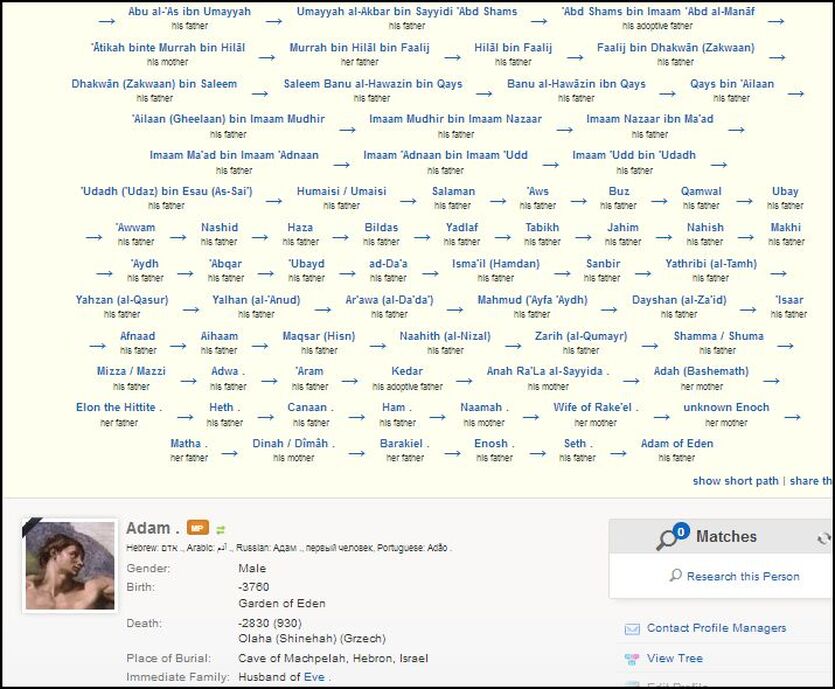
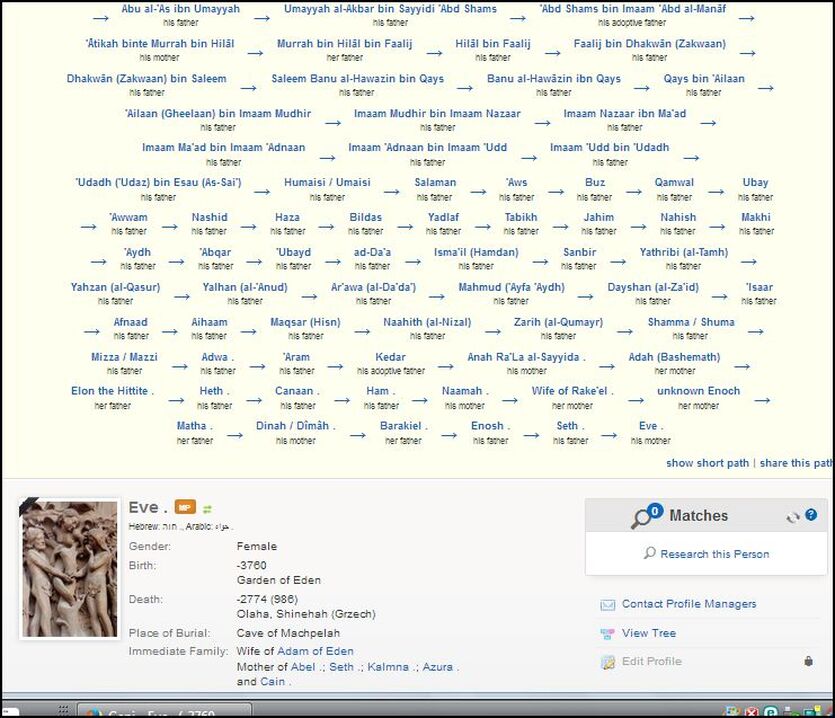
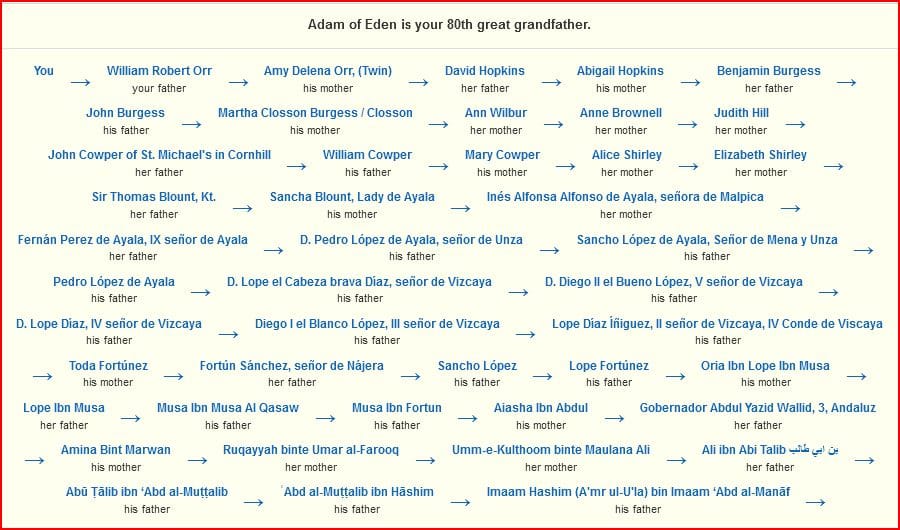
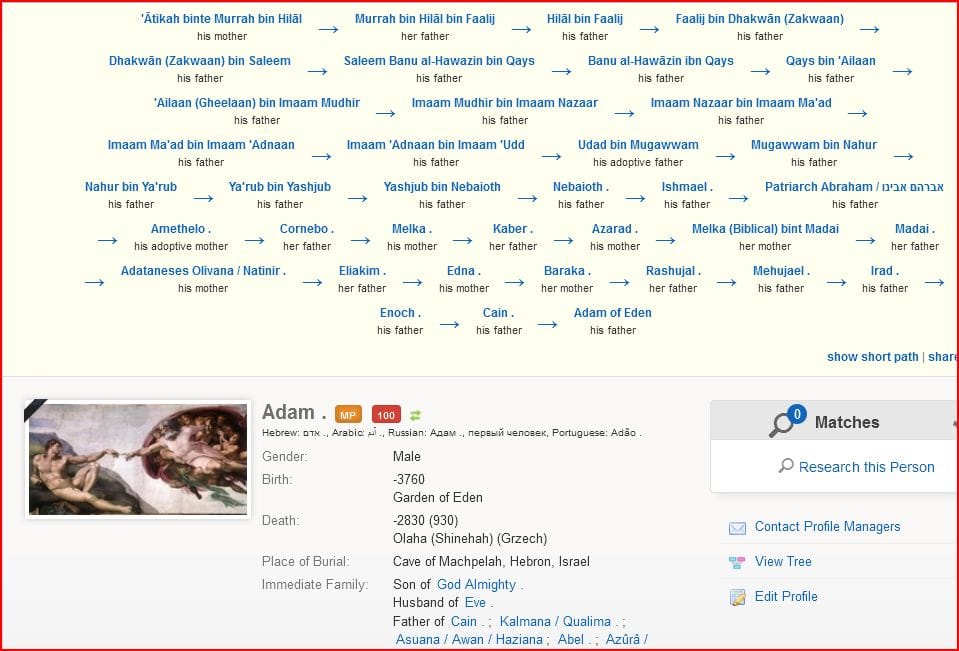
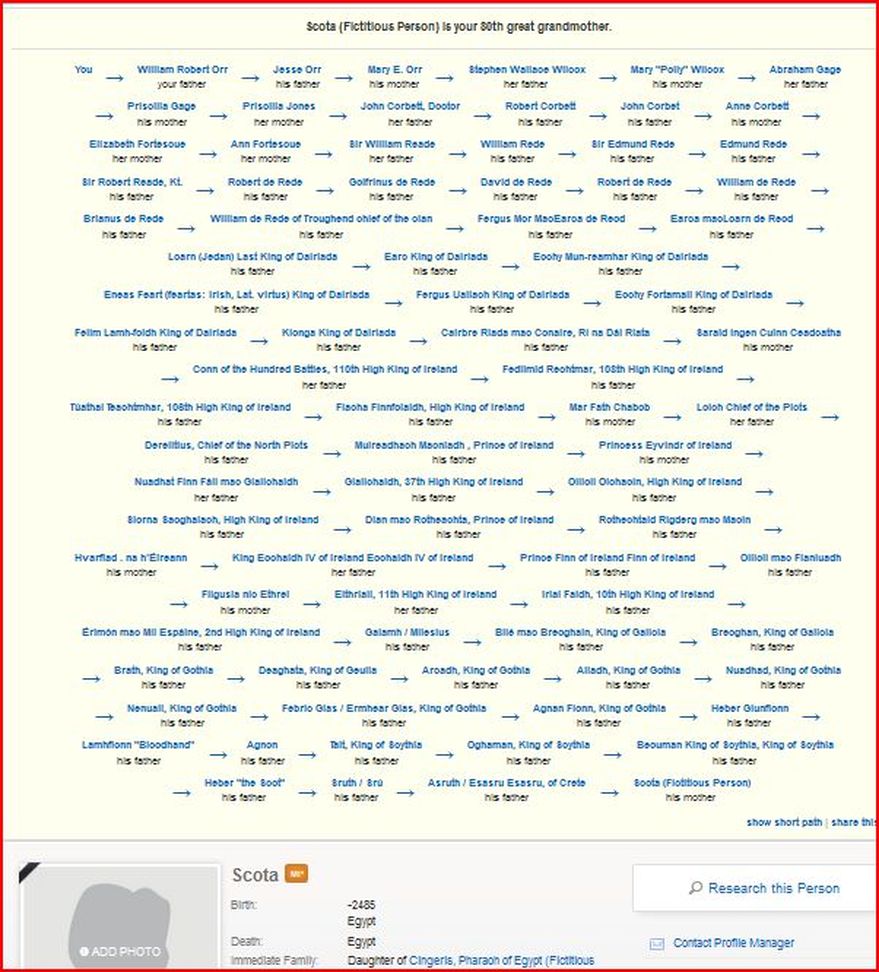
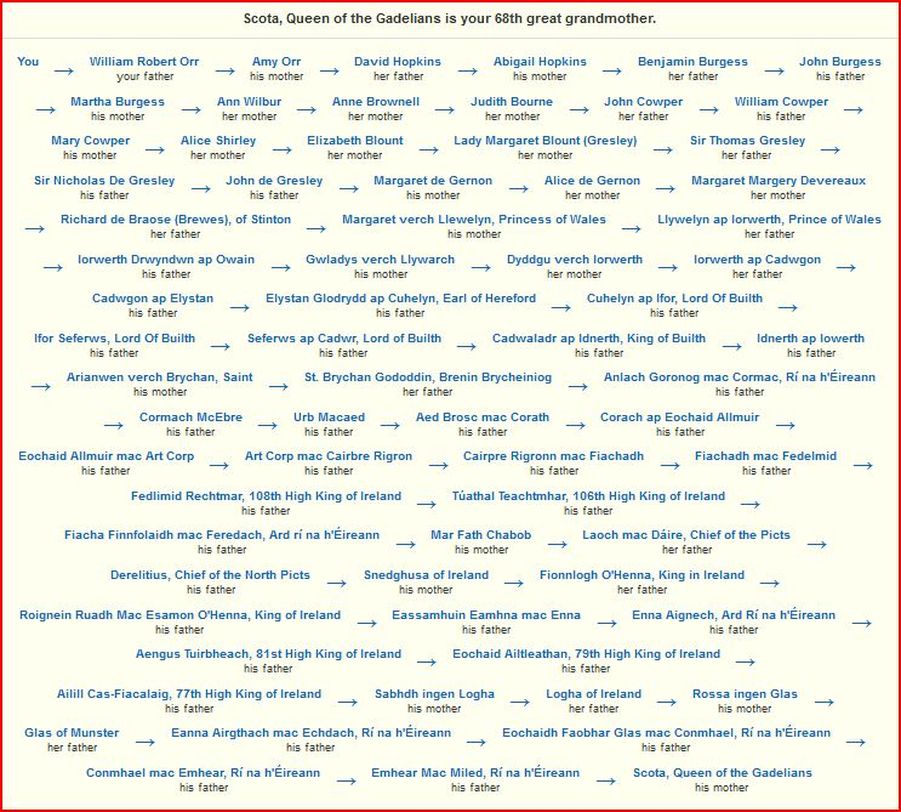
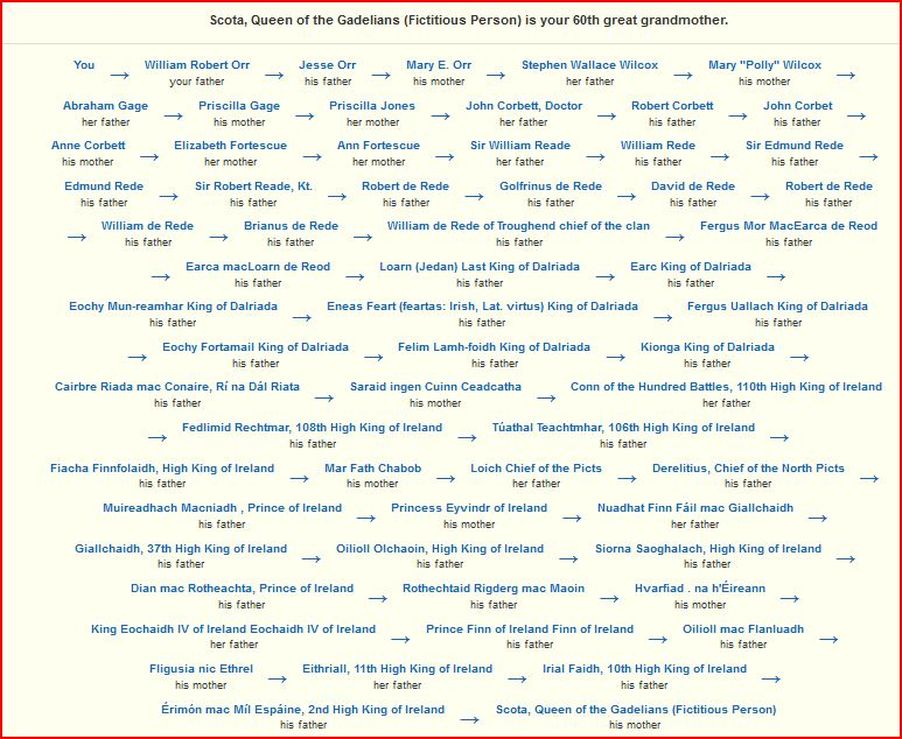
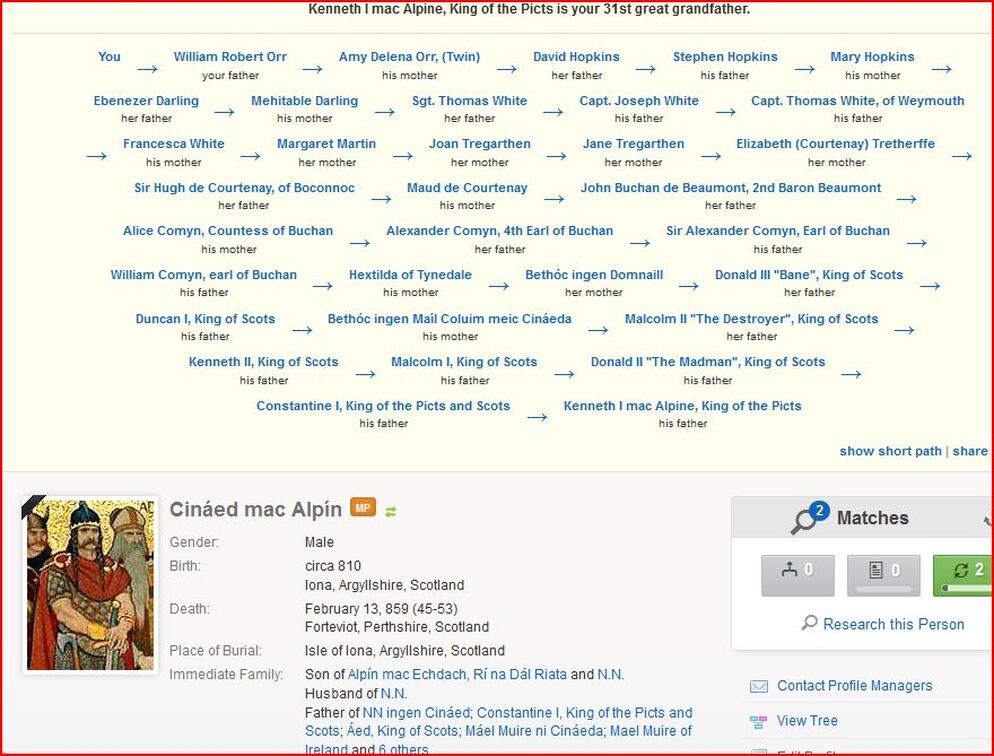
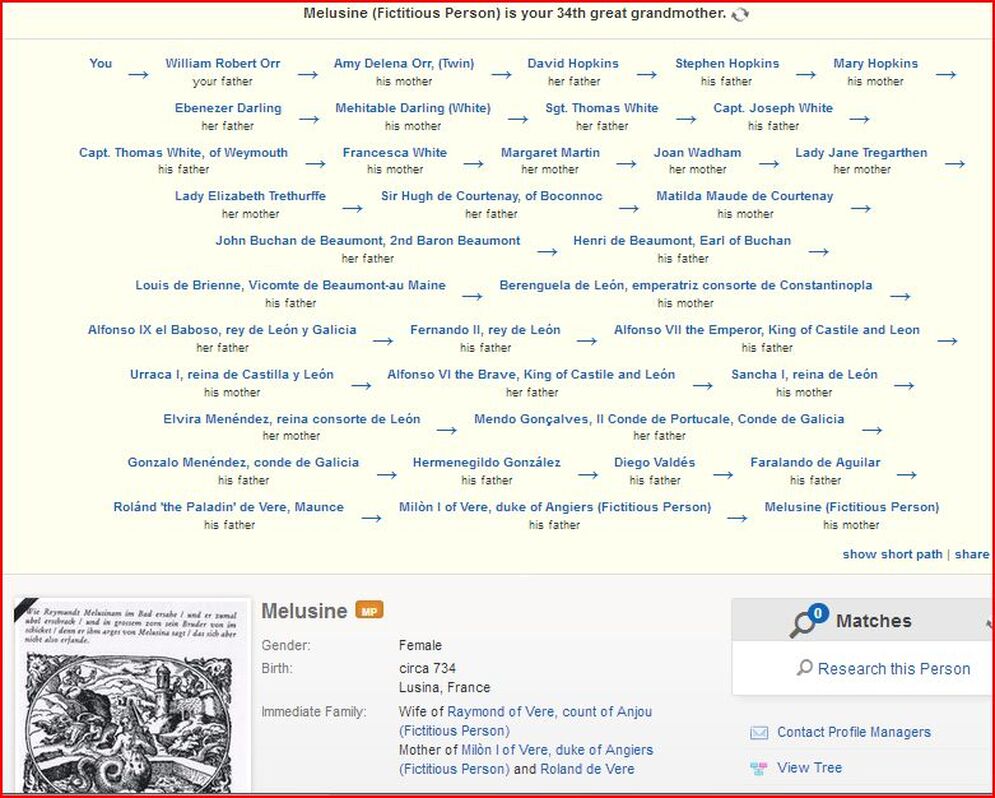
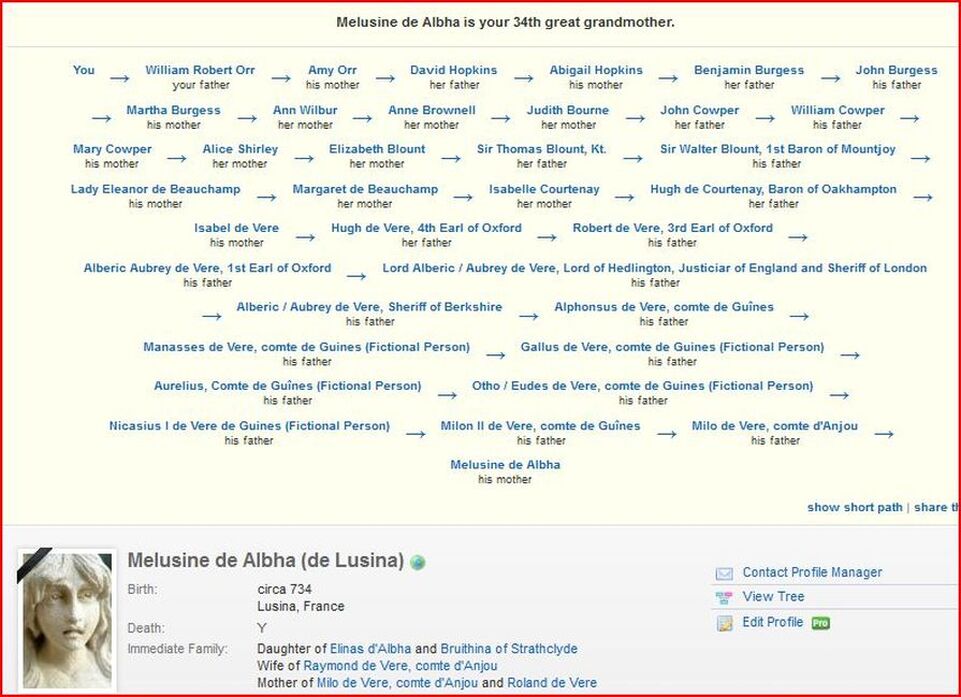
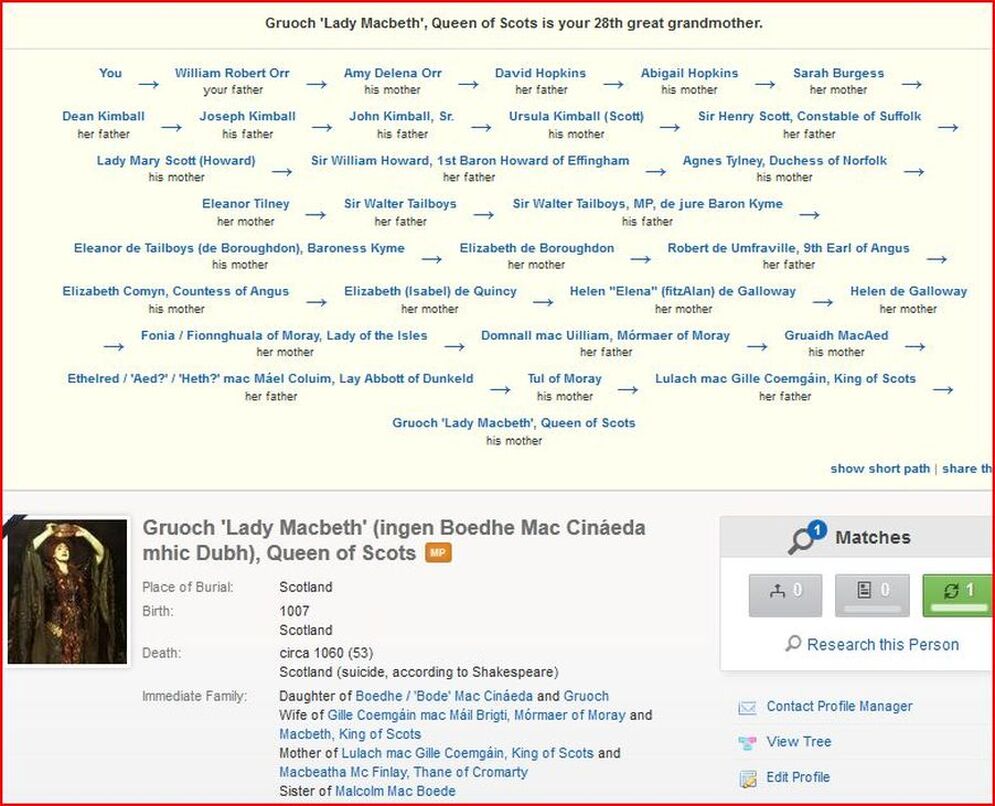
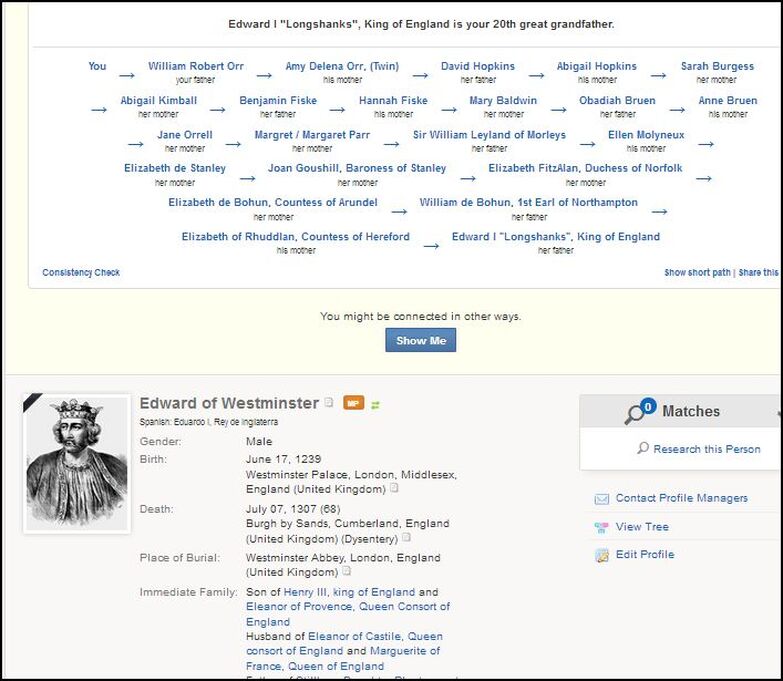
Though you or I can "raise Cain" in our drop lines, there is no way to document such mythic descent. Yet, these are the ancestors of our souls, of our psyche, including Sumerian Kings, Egyptian Pharaohs, Trojan Lords, Jewish Kings, Viking Warriors, Merovingian Kings, Russian Tsars, Scottish Royalty, British Royalty, Moors, Habsburgs, etc.

Our society is oriented primarily around
father and mother, patriarch and matriarch --the King or Queen archetype and basis of unconscious tensions and hidden value judgments. They give life to the archetypal Child, the new consciousness, creativity, and archetypal Seeker. When two people really unite, their inner and outer worlds merge, whether in gnosis or shared folly. Gnosis is a Mystery because its revealed truth can only emerge from direct experience. Therefore, it remains a secret that cannot be told, because it is a numinous experience -- a naked encounter with the divine.

We come upon our ancestors unawares as we 'dig up' our connections with them. If we aren't forewarned we may be shocked to find royals in our lines. The King or Queen can bless us, knight us, and make us feel special and a valuable part of the whole as no other archetype can. This may change our sense of self-identity forever. It can bring new insight, understanding, and comprehension, but may also lead to emotional flooding and an invasion of the unconscious as ego inflation.

We proceed along quite normally, logging commoner and noble spouses and their ancestors, then suddenly the atmosphere changes. Geography moves to imaginal landscapes.

Genealogy is a place of exchange not only with ancestors, but between humans and a variety of supernatural creatures of mixed human and legendary lineage. Such creatures inherit different nature's from their parents, but they still draw their identity from the family unit.

Atavisms
The whole of evolution is within us and recapitulates in uterine life. D
evelopment of an organism (ontogeny) expresses all the intermediate forms of its ancestors throughout evolution (phylogeny). Atavism is the regressive tendency to revert to ancestral type -- an evolutionary throwback or reversal. The word atavism is derived from the Latin atavus -- a great-grandfather's grandfather -- or generally, an ancestor. An anatomical atavism is a vestigial structure, or morphological anomaly.

Atavism is the reappearance of a lost character specific to a remote evolutionary ancestor and not observed in the parents or recent ancestors.
Left-over traits from a distant evolutionary ancestor can reappear long after they disappeared generations before. Perhaps inherited genetic mutations, deformities, and birth defects were confounded with mythic beings.

Supernatural tales have their liminal settings, mythical characters, inter-species romances, and close family connections. The otherworld and the ordinary intermingle. This is the gloss of imaginal vision that co-exists with ordinary reality -- our desires, phantasms, and projections.


But it is not the family ties nor the romantic fairy tale appeal of such inclusions but their psychic necessity that makes them a legitimate part of our pedigree -- even if disowned, repressed, or 'fictionalized' by modern genealogical corrective trends. We enter the underworld when we cross the threshold dividing the rational and historical from the irrational and legendary.

We find curious hybrids, from fairies to godforms with supernatural romances, curses, and royal marriages in liminal spaces beyond mortal ken. Sometimes such creatures with their disturbing transformations enter a lineage as the result of a familial curse.

It is transmitted to descendants in repeating cycles of suffering, heartbreak, betrayals, separation, mourning, and death. This raises the specter that such demonic behavior is related to medieval descriptions of mental illness and mood disorders, such as schizophrenia, bipolar, narcissism, or borderline issues.

Some genealogists want to expunge supernatural characters and liminal settings from the World Tree, but we do so at our peril -- cutting of psyche from its own imaginal roots. Naturally, to claim we literally descend from pixies, elves, fairies, dragons, serpents, gods or goddesses sounds preposterous, and must be contextualized as imaginal.

The irreconcilable dual nature of human and bestial ancestry demands we work that out for ourselves, so it not turn monstrous. Ours is a very complicated and nuanced family full of by-gone cultural dreams that still inhabit and inform our films and literature.

http://scholarlycommons.obu.edu/cgi/viewcontent.cgi?article=1073&context=honors_theses

Family Wisdom
Our original awareness of ourselves is that of a family member, born of our ancestors through our parents into the House of our descent. We carry the First-Person perspective (self, body, self-reference) even though we may be the last of our line. But we can hardly claim self-knowledge if we remain unconscious of our unseen forebears from both a genealogical and symbolic approach. Along with our strengths we pass on our human weaknesses.

We may have different intentions as we begin our genealogical work, but despite our approach transgenerational EFFECTS will begin emerging spontaneously as a natural consequence of stirring the unconscious. Real time effects, seen and unforeseen always trump original intentions or will which has nothing to do with it.

Unconscious forces may amplify or draw attention to dynamics already in action -- chaotic relationships, addictive patterns, psychophysical symptoms, etc. as well as unconscious determinism and mythic dynamics. We may or may not notice similar patterns in our close ancestors, such as star-crossed lovers or maternal fusion/absent father.

How could we have something so life-changing, so valuable within and not even realize we have it? The persistent state of unconsciousness keeps them secret, keeps them hidden from us. These spontaneous effects contain elements of transgenerational  family problems and its inherent wisdom and healing potential. They remain an integral part of our lives through their effects on our psychophysical being -- avoidance, repression, denial, stress, blame, discomfort. Are we stuck or just ancestrally challenged?

How You Came To Be
We each have a way we put together the fragments that make up our lives — their flotsam and jetsam, highs and lows, meaningful and slight details, shrieking and weeping, big and small news, reminders of the family's past, with events and how they impact us. Who welcomed death when it came? But linear time is a persistent illusion -- a cultural artifact.

We could imagine switching off the default mode network so
the brain itself receives a denser spectrum of consciousness. The unconscious or ancestral field is actually just such a vast spectrum of information that we’re just not seeing, but it is always there. Each and every ancestor is there if we but tune into their essence, their nature, and their relationships -- not in a supernatural but an informational way.

The inner forms the outer, pulsating out in manifestation. Primordial awareness is an externalization of our existing internal patterns. The ancient Greeks perceived immersive time and linear perspective somewhat differently, seeing the past before them and the future behind. The past was ahead of them -- already manifested -- where they had eyes to see, not a by-gone event buried in the past. In symbol and myth the past is not the past.

So, through genealogy we can see and face the past head on. Without knowing who we are, we remain somewhat blind looking either forward or back. The ancients moved into the future facing the past, not the unknown future which cannot be seen. The future was behind, enveloping them, manifesting through them, stalking them relentlessly like death.

The anxieties of heredity mirror the fears and conflicts of society at any given time. Stains from the past raise questions about intergenerational or collective responsibility. Are we somehow marked by ancient violence, deprivation, or abundance? How does each generation shape and alter that story, hereditary character, and moral inheritance?

Transferred Guilt
Ancestral Fault?
Original sin? Missing the mark? The concept of inherited guilt and delayed punishment is archaic, appearing in the Torah, Bible, and Greek tragedy. Divine punishment of innocent descendants is an interaction of human action and divine order. Deferred punishment implies its inevitability. The perverted family is doomed to pass on its toxic inheritance until or unless someone takes on the great work of raising the pattern to consciousness.

Are we liable for the personal errors and transgressions of our ancestors? Do the gods hold us accountable?
They play a leading role in the sense that Jung mentions, that the gods have become diseases. Doesn't each generation  suffer in succession with or without family misfortune? Does our past mean moral debt, culpability, menace, shame, dishonor, grief, and distress? What is the hereditary character of human unhappiness and in what way is it 'divine punishment'? How can we "face it"?

Legacy of Misfortune
How and where do we hold the pain of the old transgressions? That anguish of the past has a remarkable grip on contemporary society as systemic crisis and inherited liability. Are some houses accursed? Any family 'curse' -- originating in a prayer for vengeance -- is more likely to mean inherited guilt, genetic corruption, or persistent unexplained adversity. Disaster, calamity, and ruin can also strike blindly.

Ancestral fault is a core idea of Greek literature. 'The guiltless will pay for the deeds later: either the man's children, or his descendants thereafter', said Solon in the sixth century BC, a statement echoed throughout the rest of antiquity. This notion lies at the heart of ancient Greek thinking on theodicy, inheritance and privilege, the meaning of suffering, the links between wealth and morality, individual responsibility, the bonds that unite generations and the grand movements of history. From Homer to Proclus, it played a major role in some of the most critical and pressing reflections of Greek culture on divinity, society and knowledge. The burning modern preoccupation with collective responsibility across generations has a long, deep antecedent in classical Greek literature and its reception.
(Gagne)

Why do we even endorse our belief in ancestral fault?
Probably because it appeals individually and collectively as an explanation for misfortune as punishment. Perhaps it gives meaning to adversity -- vague traces in distant historical records or dramatic tragedies. Besides its social functions, the cultural notion of ancestral fault also has its own coherent and inconsistent poetics -- how the idea is presented and what role it plays as we mine and reconstruct it.

As we write our genealogical story, we turn to the past even as the past returns to us. Facing it squarely, we are in the present, facing the past, while the unseen future, being unknown, is behind us. It depends if we are looking at event time or narrative time -- relative conceptualizations.

Physicist John
Wheeler suggested reality grows out of the act of observation, and thus consciousness itself is "participatory." He also considered information the most fundamental building block of reality. He thought the universe should be seen as a self-synthesized information system: a self-excited circuit that is developing through a (closed loop) cycle.

His experiments led to the idea that human observers may not only determine the present, but also may influence the past. According to Wheeler, ultimate mutability is the central feature of physics, and the meaning of reality can only be established if there is a universal knowledge field, that transcends physical past, present and future.

("The Universe as a Cyclic Organized Information System:
John Wheeler’s World Revisited", Dirk K.F. Meijer
)


Future Behind, Past In-Front
Time metaphor is a spatial (spatio-temporal) language. Marshall McLuhan said, "We look at the present through a rear-view mirror. We march backwards into the future." He reiterated the ancient Greek perspective. They stood in the present moment with the past receding away from them back toward the Golden Age as their point of reference, rather than the future. So, sequence is a relative position along a path -- a relationship of figure to Ground (the moment of utterance). Ego may play the role of Ground in directionality, but it is the directionless unconscious that is the primordial Ground.


What Is Unconscious Remains Timeless
In ancient Greece, Plato and Aristotle agreed that the past is eternal.
  Ancestral fault included inherited guilt and divine punishment.  The Greek word for 'revealed' actually means 'reappear,' like rivers and streams that flow underground and spring forth again. The course remains invisible until it reappears to sight.

Only the ideology of progress flipped the magnetic poles of our psyches. The past is no reliable guide to a future that is the main locus of our attention. We need to rethink how we construct our stories of duration and how we conceive our relationship to it. Stories anchor the present and seem to give our preferred futures some substance and pull.

Time doesn't only belong to events, because psychological time is open and all events are real. In the epistemic modality, there is no past or future but possibility, necessity, and evidentiality. Only our expression of past tense creates evidential markers.

Temporality is a modality. What time we are present in depends on which world we are in.
That is, in the genealogical domain our world is now as it was in 50 BCE, a product of linguistic relativity and tenseless language. In Kabbalah, “time” is a paradox and an illusion. Both the future and the past are recognized to be simultaneously present.

This purposefully fissured quality opens us to the heights and depths of our being, light and dark, accessible and opaque, concrete and abstract. Such stories may be drizzled in sadness and despair, while others remain profoundly unconscious until we find and walk through the threshold of our genealogy.

Our own family tree and our unique descent from the roots of mankind reveals the instinct, opinion, and knowledge of original thought. Rational comes from 'ratio' - from relationship. The bones of our mother are the stones of the Earth. The body of the Earth and her water is our water, our body, as primordial as it ever was.


Picture
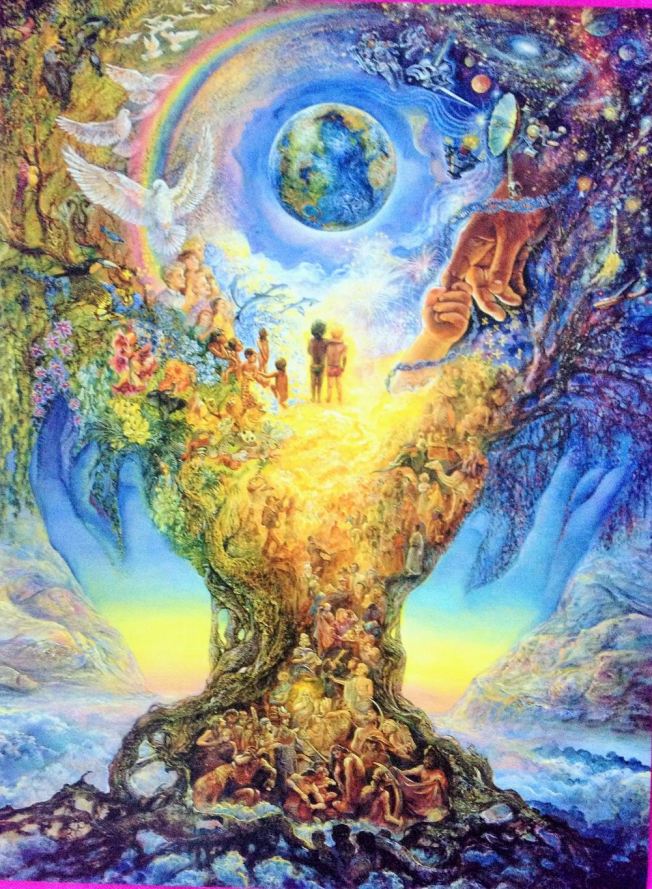
tree of peace josephine wall
AN ECOLOGY OF SOULS
The Aesthetic Paradigm in Genealogy

“...it is only as an aesthetic phenomenon that existence and the world
are eternally justified
...” --F. Nietzsche, 1872


"I am convinced that there is only one basic Order - which appears as logical or mathematical to our cognitive intuition, aesthetic to our emotional intuition, and moral to the volitional or conative. And it is essentially numinous."
--Sir Cyril Burt


"The Spirit speaks in a poetic way, but the man understands it literally. ...The richest understanding of the sacred becomes available when the metaphorical and the literal are brought together without denying either kind of truth..."
--Gregory Bateson


"The impact of an archetype, whether it takes the form of immediate experience or is expressed through the spoken word, stirs us because it summons up a voice that is stronger than our own. Whoever speaks in primordial images speaks with a thousand voices; he enthralls and overpowers, while at the same time he lifts the idea he is seeking to express out of the occasional and the transitory into the realm of the ever-enduring. He transmutes our personal destiny into the destiny of mankind, and evokes in us all those beneficent forces that ever and anon have enabled humanity to find a refuge from every peril and to outlive the longest night. That is the secret of great art, and its effect upon us."
(C. G. Jung, On the Relation of Analytical Psychology to Poetry; CW, Vol. 15)
Picture
TRUEBORN
Archetypal Aesthetics in Genealogy

"I am. Lo, I am alive"

Symbols are the currency of consciousness.
Henry Stapp calls consciousness "the felt quality of the manipulating actions of these symbols upon one another."
Symbols refer to reality, and the anthropomorphizing, personification and projection of aspects of ourselves onto reality. Misunderstood, symbols are abstract ideas that enslave our minds.

Symbolism comes from trying to relate ourselves to reality, self-knowledge, and nature to understand ourselves and reality.
First is reality. Second is knowledge from perception. Third are symbols of that knowledge from reality.

General human symbols:
Father, mother, grandfather, grandmother, son, daughter, sister, brother, child, wise old man, magician, king, queen, prince, princess, knight, teacher; the human heart, the human hand, the eye, the egg. Birth, growth, marriage, death and rebirth, rejuvenation, or resurrection.  The real purpose of religious ceremonial is to revivify.


"You may have, say, a religious attitude, which means an attitude of great totality, so that you receive the next leaf that falls from the tree as a message from God, and it works." (Carl Jung, Visions Seminar, Page 919.
)

"Good and bad must always be united first if the symbol is to be created.
The symbol can neither be thought up nor found; it becomes.
Its becoming is like the becoming of human life in the womb.
Pregnancy comes about through voluntary copulation.
It goes on through willing attention.
But if the depths have conceived, then the symbol grows out of itself
and is born from the mind, as befits a God."

~Carl Jung, Liber Novus, Page 311.
Picture
DEPTH GENEALOGY
"From a barren list of names we learn who were the fathers or mothers, or more distant progenitors, of the select few, who are able to trace what is called their descent from antiquity." (Smollett, Tobias (1798).)

"Hypothesis: in a sharp crisis, that bears in some way on species survival,
an individual may spontaneously merge with his ancestors AND descendants
and become, for a time, a single amplified entity." --
Ken Thomas


"Go to bed. Think of your problem. See what you dream.
Perhaps the Great Man, the 2,000,000-year-old man, will speak...

If you are not interested in your own fate, the unconscious is.
There is a mountain of symbolism. ...
The Great Man is something that reacts.

Analysis is a long discussion with the Great Man--
an unintelligent attempt to understand him.
It, the Great Man, can at one stroke put an entirely different face
on the thing — or anything can happen.
In that way you learn about the peculiar intelligence of the background;
you learn the nature of the Great Man.
You learn about yourself against the Great Man—against his postulates.
This is the way through things, things that look desperate and unanswerable.

The unconscious gives you that peculiar twist that makes the way possible.
The way is ineffable.

One needs faith, courage, and no end of honesty and patience.
You have added things you didn't dream of--
a new aspect of yourself and of the world.

If you are dishonest, you are nothing for your unconscious.
This you cannot regulate, or it would be misused.

It is not a conviction, not an assumption.
It is a Presence. It is a fact. It is there.
...

You have got to accept what the unconscious produces,
and you have to understand its language.
It is Nature, and it has to be translated into human forms.
"
(Jung, C.G. Jung Speaking: Interviews and Encounters, Pages 359-364)


Depth Perception

Today's world is complex. We may be disheartened by the current state of the world, including nasty politics, signs of eco-collapse, and relentless culture wars. Genealogy can be part of the re-enchantment of our world, an oasis or refuge honoring the heart and soul of our family's living emotional memory.

Genealogy is a natural and cultural artifact. A genealogy is a record of the descent of a person or group from an ancestor. Death fascinates us, and probably always has. It is a sniper that can strike anywhere, anytime and constantly informs us of our mortality. The oldest extant epic, Gilgamesh, directly addresses the question of why death exists and the yearning for immortality.

In our family tree our 'depth perception' refers to how many generations are known to us, and how keenly we perceive the essence of each of their lives (face recognition) in our family history. The self emerges from seed fulfilling character and calling in our identity -- the innate genius of creativity and sublimity.

Living in touch with what our ancestors symbolize in the emotional language of the unconscious roots us in a far greater whole.
The ancestors are an untapped potential to illuminate the perceptual/cognitive processes that underlie archetypal aesthetic experiences and complexity.

In genealogy we engage the unconscious and tend the living image. Our hunger is for connection, not more food, money, or status. When we know our ancestors we live in unbroken continuity with the past. This is grounding down to the molecular level.

Ideally, depth connections throughout deep time might help us to  overcome stumbling blocks, move through loss, find deeper meaning and interpersonal connection, and function at our optimal potential. We break through ancient walls, listening to the archaic hum of the ancestors, what their souls are saying,  that reminds us of the collective buzzing of bees.

Joseph Cambray, Provost of Pacifica, said, “So much of human suffering is very intimately tied up with non-conscious levels that it’s hard to imagine we could ameliorate symptoms without a depth perspective.”

Jung's "Great Man" can also appear as the Great woman -- Anima Mundi, the ancient worldview. It is the hermaphroditic fusion of all our ancestry into an omnipotent archetypal figure of soul and spirit.

Throughout much of human history, ancestors were revered and frequently visited in caves and barrows. People sat in these natural resonant echo chambers, chanting and drumming hypnotically and opening their altered psyches to the possibility of communication with the Beyond – voices of eternity.

People died so young, this youthful population needed shamanic guidance, needed primal wisdom. We are learning to understand that our immature culture can benefit by rooting ourselves in deep time and the wisdom of eternity. We still dream at night of connecting somehow with our departed loved ones. We are unconsciously entangled with our ancestral soul, but psychically dissociated.


Chopping Wood & Carrying  Cosmic Water
Water is the great symbol of the primordial unconscious. And we are its water-bearers. We carry the ancestral psyche much like the bloodline. The dragon or serpent is another symbol of the universal unconscious, the psychic field, and renewal. It impregnates itself by biting its own tail. The depths conceive.


A feminine symbol, water also signifies emotions or psychic energy, fertility, growth, creative potential, new life, or healing. An integrative approach includes memory reconsolidation to maintain, strengthen, modify and stabilize memories of the unconscious and long-term memory. Our ancestors remain amnesiac agents as long as we are unconscious of them as a kinship system.

Psychologically, water means spirit that has become unconscious. The way of the soul leads to the water, to the dark mirror, the world of invisible perception, that reposes at its bottom. This water is no figure of speech, but a living symbol of the dark psyche. We descend into our depths, into that well of souls and perhaps return with a bit of its healing bounty.


The Tree, watered by the unconscious roots, is the great symbol of humanity. In the tree metaphor,
these root systems that lie far beneath the surface of the Earth, which are just as extensive as the trunks and branches we have growing in plain view. We don't just look at the tree superficially, but examine its entire structure — perhaps, a metaphorical "chopping wood" -- including belief systems and subconscious patterns of thinking formed from birth.

We all "carry water" for the divine in our manifest embodiment -- not only in the fluids of our bodies, but the fluidity of the psyche and our epigenetic memories. But how many of us incorporate the numinous realms of the psyche—meaning the unconscious, spiritual beliefs, dream life, the imagination, our connection to mystery, myth, archetype and the natural world?

How do we function in society, what bonds us to one another, what causes our psychoses and neuroses, and what helps us to individuate and become the people we were meant to be? The Depth Approach includes
Dual Process Theory and The Frame Problem, and some consequences for our research.

Dual Process Theory recognizes that the human mind has two disparate modes of thinking - Subconscious Intuitive Understanding on one hand and Conscious Logical Reasoning on the other. The depth perspective "frame" in this case is provided by genealogy.
There is an aesthetic harmony to the layout of our genealogical displays, or grids, which comes in a variety of forms.

Combined Perspectives
Psychological life is aesthetic life. Aesthetics is an artistic philosophy. It makes us permeable to the image, mobilizes us internally and enables imaginative activity through a form of observance.

Imagery evokes a perceptual response -- an aesthetic response, a participatory way of knowing, re-membering, and reconnecting with soul and identity. In the phenomenological
aesthetic paradigm, Hillman asserts that images derive autonomy and operate according to their own will, similar to gods.

The nature of Beauty is an immediate revelation of things as they are: unity, line, rhythm, tension, elegance -- communion of the soul with the mysteries of inner and outer world -- the naked awareness of divine self-revelation in a community of living presence. Traces of ancient art and adornment show aesthetics -- the felt-sense of form and beauty -- is inherent in the primal mind.

For example, we can be so caught up by beauty that everything stops in aesthetic arrest -- a seizure by the tremendum. We reflexively gasp for air in awe and wonder that precedes any thoughts or cognitive framing. "I breath, therefore I perceive."
Aesthetics is a method of externalizing something of the inner quality of life, fusing the transcendent with the immanent, the personal with the impersonal, the inner with the outer.

Genealogy is an aesthetic discipline. Our ancestral practice has an inherently aesthetic base; we perceive them through our aesthetic sensibilities. We instinctually long for beauty; it affects the soul and can heal or restore our psychological senses. Aesthetics reveals spiritual and psychological significance. The depths of something helps us feel and make sense of our experiences.

Deep Primal Engagement
Ancestors appear as self-presenting, expressive forms that speak to us.
We imbibe and re-dignify the soul and spirit of our early ancestors across time and place. Their communion with us asserts the fundamental continuity of our primal consciousness, imbued with the natural force of the mythic by our faithful attention.

The image remains as the face of things as they are when all else perishes -- a psychological aesthetic with patterns of meaning. This isn't formal aesthetics but an opportunity to "see through" to greater significance, to distinguish something from the shifting quality of the vortex of morphing imagery.

James Hillman said, “Aesthetics in this primordial sense involves sensing the things of the world in their particularity and being affected by the many ways things present themselves.” Bioevolutionary aesthetics includes the cognitive spectrum of sensation, perception, conceptualization, and thought as well as the basic emotions, pain, and sexuality.

Aesthetic space makes way for the beauty that presents itself to us. We pause, take a moment to notice and appreciate the particulars of some thing, and enter aesthetic space, increasing our awareness of larger patterns of purpose. Our aesthetic response may express as transformation.

Conversely,
aesthetic frustration or oppression affects our bodily feeling, our emotional well-being, and we must ward ourselves from their influence--the despair they produce, and the exhaustion, outrage, repulsion, insult, if not assault, and a heightened irritability.

We deny our aesthetic responses by closing down our senses, our perceptions; we anesthetize ourselves -- we just go numb as in anesthesia.
But ugliness, pain, or disgust can also jar us awake with a conscious shock, calling our attention to soul.

"If the aesthetic is seen in contrast to the anaesthetic - or numbness, it can be understood more correctly as ‘enlivened being'. Reclaiming the aesthetic in this way enables us to understand the link between the aesthetic and responsibility: response-ability not as a moral imperative, but as the ability to respond." (Shelley Sacks, UN Summit on Culture and Development, Stockholm 1998)

We can cultivate a capacity to open ourselves to 'the other' in all its forms. We bring our own sense of deep aesthetics to ancestral relationships, knowing that each of our living cells carries the experience of billions of years of experimentation by its ancestors. We can have an aesthetic appreciation of each life.

About 1/3 - 1/2 of each of the psychological types seem to enjoy genealogy. The 'analysts' (Intuitive and Thinking)
enjoy a rigorous, fact-based treasure hunt through their ancestry. The visionary 'diplomats' (intuitive and feeling) are curious, imaginative, on the lookout for secrets, hidden meanings and new possibilities.

Conservative 'sentinels' (observant and judging) like to preserve order and security, are often focus on the bonds of family and the importance of history.
Goal-oriented 'explorers' (observing and prospecting) tend to stick to the facts and have practical applications in the future - the past and the present are prologue.

Genealogical Heritage
An ancestor or forebear is a parent or (recursively) the parent of an ancestor (i.e., a grandparent, great-grandparent, great-great-grandparent, and so forth). Ancestor is "any person from whom one is descended. In law the person from whom an estate has been inherited."


Direct-line research refers to genealogy research focused on one's direct-line ancestors. We follow both surnames at each generation (i.e. paternal and maternal lines), back as far as records allow. Family history, rather than just genealogy, includes extended families (biological marital, sociological)
that often interact significantly with our own lines.

When our genealogy expresses more than one line of descent from a given ancestor, then it exhibits segmentation or branching. This is a "segmented genealogy."
A segmented genealogy starts with a single parent and shows the relationship of children to each other. This kind of genealogy will have both a horizontal and vertical element to it.

If we go back 300 years, we have roughly 3,000 ancestors. Going back a thousand years results theoretically in billions of ancestors, more people than ever lived on the face of the earth! In reality, the same ancestors will show up in multiple places in your family tree as you have multiple lines of descent from many of these people.

"Linear genealogy" expresses only one line of descent, linking the genealogy to an older ancestor or group. Both segmented and linear genealogies exhibit depth (number of generations) and a sort of "cartography" of the unconscious. That map may lead us toward our greatest possible treasure–our inner gold -- the knowledge in our bones.

Maybe we also find a bit of fool's gold along the way. Family stories provide wonderful insights into the lives of our ancestors. However, not all family stories are true. Many such stories are fictional. Yet, even the stories that are either entirely or part fiction may contain clues to facts. Good genealogical practice requires that we admit the fiction to mine for its nuggets of truth.

In the domestic sphere, linear genealogy relates individuals to other individuals and kinship groups. They also function in the political and legal sphere to legitimate rulers, express progress, and support claims to recognition, status or power.

Some lines pass through or end (or begin) in legends or mythic figures.
Already in the fifth century, the Macedonian kings claimed descent from Perdiccas, who descended from Temenos, a king of Argos; and he was great-grandchild of Hyllus, the son of Heracles.


Woden is consistently placed at nine removes from the founder of a dynasty. But is that the god, or Odin the man? In the 13th century, the Icelandic historian Snorri Sturluson wrote that Odin came to worshiped as a god, but he was originally a famous warrior who led his people out of Troy and into Scandinavia. Or was he?

In the 13th century, the Danish historian Saxo Grammaticus wrote that Odin was a sorcerer from Byzantium. The other gods there stripped Odin of his rank and power, then banished him. He fooled the people of Scandinavia into worshiping him as a god. The old kings of Wessex and Mercia claimed him as ancestor.

Paul Henri Mallet (1730-1807) might have been the first to formulate explicitly the idea that the historical Odin was a man named Sigge Fridulfsson. He says, "His true name was Sigge, son of Fridulph; but he assumed that of Odin, who was the Supreme God among the Scythians." Mallet's version claims, Sigge (also known as Odin) was an ally of Mithradates, a Persian king defeated by the Romans. (Mallet, Northern Antiquities, 1770, 1809).

On the other hand,
as many as 3 million men worldwide may be descendants of the Irish warlord, Niall of the Nine Hostages, who was who was the Irish “High King” at Tara, the ancient center of Ireland from A.D. 379 to A.D. 405. A 2003 study found that 8 percent of all Mongolian males are the descendants of Genghis Khan, sharing his Y chromosome. The Khan family may have as many as 16 million descendants in Asia today.


Even metaphorically, the most prestigious of all possible ancestry is descent from divinity itself.  Descent from antiquity (DFA) is the project of establishing a well-researched, generation-by-generation descent of living persons from people living in antiquity. It is an ultimate challenge in genealogy. No prospective DFA is accepted at this time.

Irish legends and subsequently Scottish lines, claim royal descent from Milesius, King of Spain, husband of Scota, Princess of Egypt. The Welsh also have legends, which claim descent from Noah, while Charlemagne, the father of all European nobility, claims descent from Adam. Sometimes totems represent descent from Dragons, Lions, Eagles, or Serpents.

Hellenistic dynasties, such as the Ptolemies, claimed descent from gods and legendary heroes. In the Middle Ages, major royal dynasties of Europe sponsored compilations claiming their descent from Julius Caesar, Alexander the Great, in particular the rulers of Troy. As propaganda, these claims glorified a royal patron by trumpeting the antiquity and nobility of his ancestry.

These descent lines included both mythical figures and outright fiction, much of which is still widely perpetuated today.
The odds of royal ancestry are overwhelming. Virtually all people with European ancestry are descended from the usual royal suspects of 1000+ years ago.

Seeing ourselves in our archetypal nature helps us recognize our timeless parts and own our gifts.
Having a mythic sensibility about ourselves offers a clue to how we might be unconsciously acting out archetypal patterns.

Apparently conflicting genealogies with different functions (and often without kinship terms) emerge from the religious or cultic sphere. That is, genealogies become fluid in accuracy according to their function. No generalizations are possible for a historiographic value of such genealogies with fragmentations and gaps.

For example, Sumerian and Akkadian elements were fused into Hellenistic and  biblical narrative with questionable linkages, significant differences, and background stories. Of the nine descendants of Adam, only Enoch is described with particulars from traditions now lost to us (Genesis Apocryphon) though we know they are related to Mesopotamian "fish-shaped sages" and kings lists.

The exact form of such ancient determinative lines in royal or religious genealogies is not known, but historically conflated, confabulated, and altered by compilers at various times for various reasons. Jung suggested we "think diligently" about the images the ancients have left us, as they also intimate what is to come.

Depth is the most important feature of linear genealogy. That depth expresses the memories of the people who preserve it in practice, relating us to deep time, distance, and transcendence.

But, true nobility springs from the soul and spirit, rather than any genetic trail.
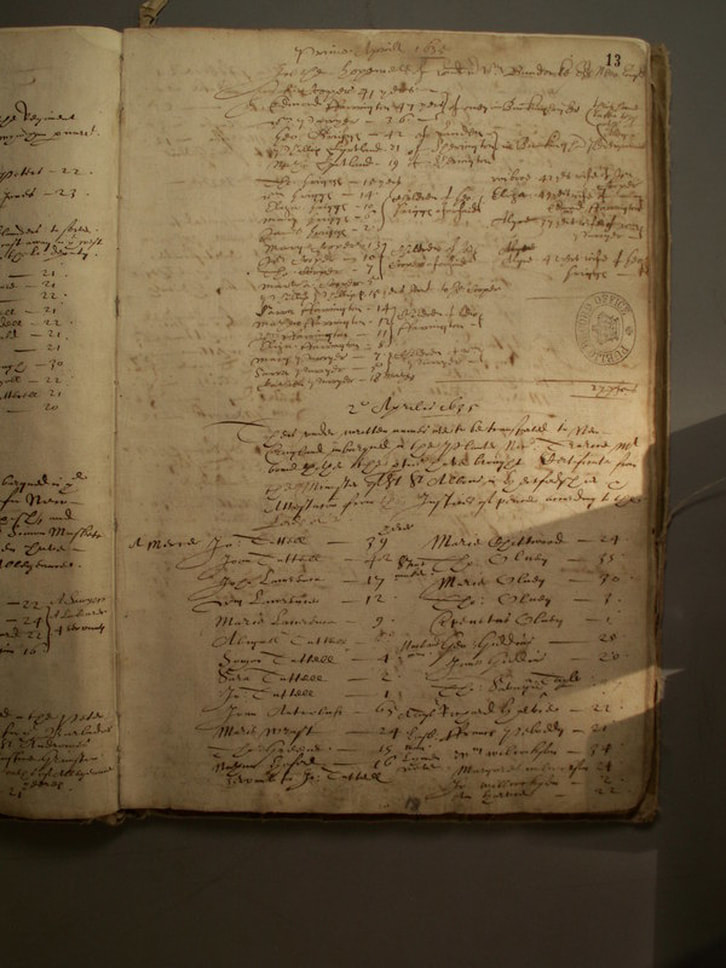
Picture
Manifest of Ship "Planter"
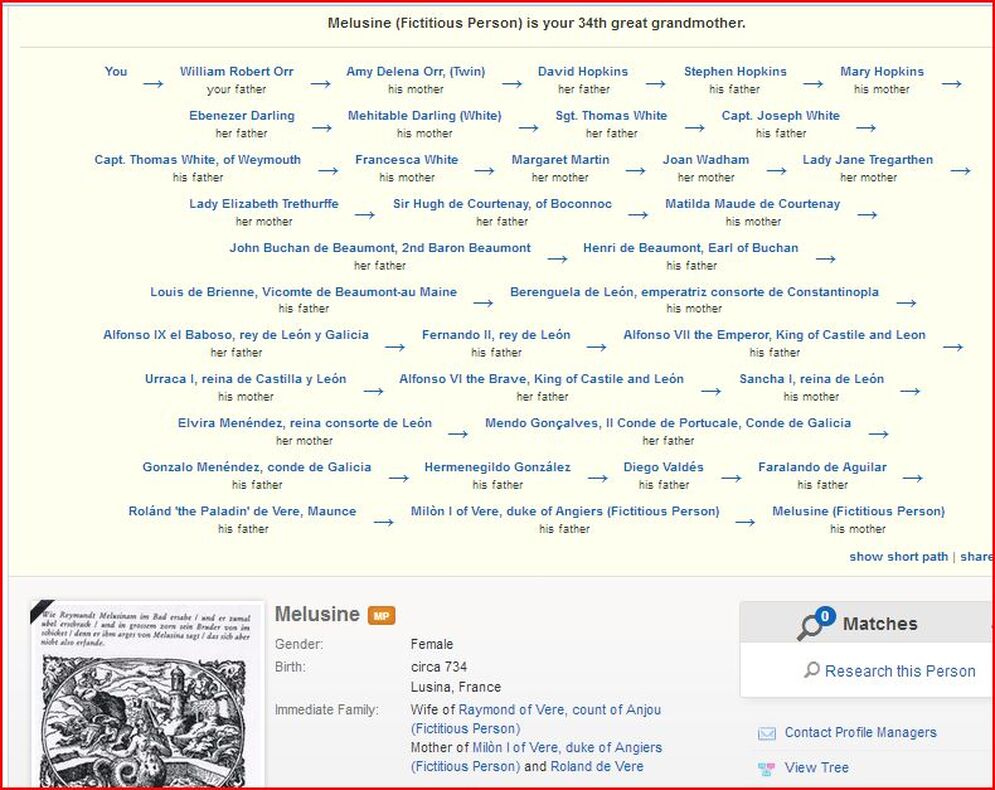
Picture
Picture
Picture
Picture
Picture
Picture
Picture
On the occasion of her marriage to Prince Niall, Lord of the Egyptian, Red Sea region of Capacyront in the High Kingdom, the two ancient dragon legacies fused into one and became all the stronger with their bond. Niall was the son of the Dragon King Fenius Farsaidh of Scythia and Queen Tadukhipaof the Scythian Mittani and, following their marriage Merytaten was bestowed with the Scythian royal title of “Scota,” meaning Princess of the Scythians or  Scotti. Thereby she became the Princess of the race of princes. Niall and Merytaten’s son was named Geadheal Glas and it was he who was the ancestor of the later Gaels in the land that eventually became known as Albha, Scotland.
SCOTA
Picture
Picture
Picture
Picture
With the marriage of King Kenneth MacAlpin to Princess Uistnecc of the Picts in the 9th century, the Pictish and Scottish Kingdoms became united and many Lords and Princes of the Dalriada sought magical Pictish Princesses for themselves. In this manner many Picts slowly became integrated within Scottish society and left their Forest Kingdoms forever to follow their Ladies and Lords. However not all succumbed to life outside the domain of the ancient woodland and sufficient remained to sustain both kingship and culture in the manner of their ancestors, against a new encroachment and a far more insidious threat - the rise of Roman Christianity.

By MacAlpin's era the Catholic Church had enacted the Donation of Constantine (312 a.d.) for some centuries and had attempted to divest all but their own Cliential Royal Houses of the right of Kingship. By implementing policies of regicide and controlled marriage the Church had attempted to breed out the pre-Carolingian royal bloodlines that stood for genuine kingship and thus posed a potential threat to the stranglehold that the Church had gained over the Monarchy. --NDV


In the Arthurian and Magdalene traditions of the Ladies of the Lake, Melusine was a fountain fey - an enchantress of the Underwood. Her fountain at Verrières en Forez was called Lusina - meaning Light-bringer - from which derived the name of the Royal House of Lusignan - the Crusader Kings of Jerusalem. The Fount of Melusine was said to be located deep within a thicket wood in Anjou. She was also known as Melusina, Melouziana de Scythes, Maelasanu, and The Dragon Princess.


Picture
Picture
Picture
LIFTING THE VEIL OF TIME
The 13th Generation

The Wisdom Tree

Picture
There are apparently legends which link Mary Magdalene to the west of Scotland, particularly the holy isle of Iona, where it has been suggested that a son of Jesus and Mary Magdalene was born. Iona is less than twenty miles from Kilmore Church on Mull. The Scottish literary writer, William Sharp, refers to "The old prophecy that Christ shall come again upon Iona", which presupposes that Christ had already visited Iona according to oral tradition. Jesus has been named the "Rose of Sharon" and in medieval times his Mother, Mary, was called "Santa Maria della Rosa". Could this suggest a Christic Rose lineage? It has been suggested that certain Scottish families, such as the Sinclairs of Roslin (founders of Rosslyn Chapel 1446) and the royal Stewarts, are descended from such a Christic bloodline. Intriguingly, Sir William Sinclair, a former Earl of Rosslyn, signed his name St. Clair of Roselin and ancient Scottish charters were witnessed by a certain Roger de Roselyn. Furthermore, one of the telluric leylines traversing Scotland has been named the "Rose Line" which appears to pass through the medieval Chapel at Roslin (Rose line?).
Picture
IN THE SAME VEIN
The Life of Millions of Years


I AM the Threshold
In the beginning, when we start our genealogical exploration, we necessarily begin with ourselves as Ground Zero of the ancestral field. This is our first step across the Threshold of the genealogical journey.
Marking the threshold implies we are entering a sacred space. Our ego may be challenged with another way of knowing when we shake up our family tree and find missing parts of ourselves within the ancestors. Such knowing is the knowledge of the soul on the road to Self. It is the search for deeper meaning in life -- questing for the Holy Grail. A psychic threshold refers to the place of transition from one belief to another or the shift from one state of being to another. Threshold is both place and process -- the in-between zone where passage from one sphere or one way of being to another is made possible. Inside and outside, sacred and profane, psyche and matter, conscious and unconscious.
Picture
“Acorn“, Io Miller, 2017
In James Hillman’s ‘acorn theory’ of soul we already hold
the potential for unique possibilities inside ourselves, much as an acorn holds the pattern for an oak tree. It shows in our calling and life’s work when fully actualized. O
ur calling in life is inborn and our mission in life is to realize its imperatives. The "acorn theory" is the idea that our lives are formed by a particular image, just as the oak's destiny is contained in the tiny acorn. The acorn theory expresses that unique something that we carry into the world.

Busting Myths of Origin
http://science.sciencemag.org/content/356/6339/678.full
Few of us are actually the direct descendants of the ancient skeletons found in our backyards or historic homelands. Only a handful of groups today, such as Australian Aborigines, have deep bloodlines untainted by mixing with immigrants.“We can falsify this notion that anyone is pure,” says population geneticist Lynn Jorde of the University of Utah in Salt Lake City. Instead, almost all modern humans “have this incredibly complex history of mixing and mating and migration.”

Wind back the clock more than a thousand years—a trivial slice of time compared with the 200,000 years or so since our species emerged—and stories of exclusive heritage or territory crumble. “Basically, everybody's myth is wrong, even the indigenous groups',” says population geneticist David Reich of Harvard University.The new data confirm that humans have always had wanderlust, plus a yen to mix with all manner of strangers. After the first Homo sapiens arose in Africa, several bands walked out of the continent about 60,000 years ago and into the arms of Neandertals and other archaic humans. Today, almost all humans outside Africa carry traces of archaic DNA.

That was just one of many episodes of migration and mixing. The first Europeans came from Africa via the Middle East and settled there about 43,000 years ago. But some of those pioneers, such as a 40,000-year-old individual from Romania, have little connection to today's Europeans, Reich says.


THE THREE-PART European mixture varies across the continent, with different ratios of each migration and trace amounts of other lineages. But those quirks rarely match the tales people tell about their ancestry. For example, the Basques of northern Spain, who have a distinct language, have long thought themselves a people apart. But last year, population geneticist Mattias Jakobsson of Uppsala University in Sweden reported that the DNA of modern Basques is most like that of the ancient farmers who populated northern Spain before the Yamnaya migration.

In other words, Basques are part of the usual European mix, although they carry less Yamnaya DNA than other Europeans.But try as they might, researchers so far haven't found anyone, living or dead, with a distinct Celtic genome. The ancient Celts got their name from Greeks who used “Celt” as a label for barbarian outsiders—the diverse Celtic-speaking tribes who, starting in the late Bronze Age, occupied territory from Portugal to Turkey. “It's a hard question who the Celts are,” says population geneticist Stephan Schiffels of the Max Planck Institute for the Science of Human History in Jena, Germany.


Bodmer's team traced the ancestry of 2039 people whose families have lived in the same parts of Scotland, Northern Ireland, and Wales since the 19th century. These people form at least nine genetic and geographic clusters, showing that after their ancestors arrived in those regions, they put down roots and married their neighbors. But the clusters themselves are of diverse origin, with close ties to people now in Germany, Belgium, and France. “‘Celtic’ is a cultural definition,” Bodmer says.

“It has nothing to do with hordes of people coming from somewhere else and replacing people.”The team went on to show that 25% to 40% of the ancestry of modern Britons is Anglo-Saxon. Even people in Wales and Scotland—thought to be Celtic strongholds—get about 30% of their DNA from Anglo-Saxons, says co-author Chris Tyler-Smith of the Wellcome Trust's Sanger Institute in Hinxton, U.K.“Ethnic groups in the past and present create an ‘imagined past’ of the longtime and ‘pure’ origins of their group,” Maeir says. But that created past often has “little true relation to the historical processes” that actually created the group, he says.

Picture
“The animus is the deposit, as it were, of all woman’s ancestral experiences of man-and not only that, he is also a creative and procreative being, not in the sense of masculine creativity, but in the sense that he brings forth something we might call . . . the spermatic word.” [“Anima and Animus,” CW 7, par. 336.]

The theme of " Absent Father " which generates the absence of his father was of great interest to James Hillman, a father overshadowed by a " great mother " and the exclusivity of his relationship with his son. Hillman is trying to recover the hidden genealogy, buried in the oblivion of history, of our stories.

He writes in Myth of Analysis (p. 16): "... without paternal lineage we have no genealogy. And without genealogy, which provides structure and content to mythology, or is itself a mythology, we succumb to the collective matriarchy which aims to hinder the inexplicable movement of psyche to social causes, animal urges, family problems and all other explanations The spiritual malaise of the soul."

Finding the father of the psyche leads us to recognize the creative thrust or as Hillman always says "the spirit that creates the psyche "...so the soul becomes psyche, giving us a growing sense of soul as it awakens in psyche. And in the psyche, for Hillman, that creative principle that merges with the soul to create psyche and psyche is eros. James Hillman still gives us this final thought: "the soul becomes psyche through love... and it is the eros that of and the psyche".

Genetic Adam & Eve
"Believe it or not, every man alive today can trace his DNA roots to one man who lived approximately 135,000 years ago, new research in the Journal Science suggests. And that one “Adam” must have shared the planet with Eve who would be the mother of all people alive today. Scientists have just completed an analysis of the male sex Y chromosome, to date.  Early research had suggested that men’s most recent common ancestor lived just 50,000 to 60,000 years ago.

Molecular genetics are quite provocative, however, and recent analysis of mitochondrial DNA (which provides insight into the origin of the maternal lineage) indicates that humanity actually traces back to a single ancestral sequence that could be interpreted as a single woman. Likewise, characterization of Y-chromosomal DNA (which provides insight into the origin of the paternal lineage) indicates that all men trace their origin back to a single ancestral sequence that could be interpreted as a single man.

While they suggest that Adam and Eve really existed and are genetically linked to all of humanity there’s a shocking twist. Because scientists believe that while Adam & Eve’s existence overlapped in time, “Adam” and “Eve” probably didn’t even live near each other, let alone mate with one other another. Melissa Wilson Sayres, a geneticist at the University of California, Berkeley who was a key member of the study put it succinctly, “Those two people didn’t know each other.”

However, Dr. Fazale Rana, in Reasons to Believe wrote that, “even though the genetic data traces humanity’s origin back to a single woman and man, evolutionary biologists are quick to assert that mitochondrial Eve and Y-chromosomal Adam were not the first humans. Rather, according to them, many “Eves” and “Adams” existed.7 Accordingly, mitochondrial Eve and Y-chromosomal Adam were the lucky ones whose genetic material just happened to survive. The genetic lines of the other first humans were lost over time.”

http://sciencevibe.com/2016/07/09/adam-eves-shocking-reality-they-didnt-mate/
GENEALOGY
Dead to You


ANCESTORS & ARCHETYPES
http://ancestorsandarchetypes.weebly.com/

This is a depth psychological approach to Ancestry, mythic, symbolic and metaphorical, not metaphysical, religious, or literal.
Our genealogy is that Tree and cosmic center that keeps us connected and balanced, and upon which we can ascend and descend in a way that keeps deep time, the transcendent, and our family of flesh alive within us. Genetic testing is revealing suppressed identity.

Our genealogies are living systems, which are constantly expanding and correcting. We work with others on the World Tree to create the most accurate droplines we can, and correct as we go, breaking brick walls and lopping off obsolete branches. The tree continues to grow. Like an arborist, we understand the deep interweaving growth, and just how much time such development takes (for trees, sometimes centuries) and how ecologically interconnected events and lives are. Our relationship really seems to exist in a kind of ancestral tree-time. New routes through life are found; tree intelligence sends signals out through the roots. Tree existence can be lived with warmth and an intimate sense of one’s inner core.

Our unconscious still functions like it did four million years ago. We have discovered that trauma can be passed between generations. The epigenetic inheritance theory holds that environmental factors can affect the genes of future generations. Chemical tags acting like Post-its can latch onto our DNA, switching genes off and on.


JUNGIAN GENEALOGY
http://jungiangenealogy.weebly.com/

Depth Psychology * Genealogy * Genetic Genealogy * Myth * Culture * Hermeneutics * Geni-Us * Bloodlines * Holy Grail * Archetypes * Healing Narratives * Ancestral Wisdom * Gnostic Vision * Relative Autonomy * Genealogical Memoirs * 
Famous Kin & History * Honoring Ancestors

Obviously, all genealogy is transgenerational. What distinguishes Transgenerational Genealogy from conventional or Jungian approaches is plunging deeper into the Medieval, legendary, and mythic layers of one's pedigree, rather than just the first few generations. But we can not concentrate only on the royal lines, because many other descents far out number them. Genetically, they have no priority.

As someone's descendant we answer the call. The transgenerational group is integrated within the individual. For Jung, fantasy is an integrative function. Imaginative expressions of hidden forces appear spontaneously as the direct expression of psychic life, creative and imaginative activity. Our lineage is our own, personal Mystery Play. We can allow the phenomena to speak - the multitude of personalities to speak, to be personified. Images are also voices -- messages from the dead. We need a sense of the ancestors.

What is the power of the individual against the voice of the whole people in him? ~Carl Jung, Liber Novus, Page 365.


SangREALITY
http://sangreality.weebly.com/

Genetic Genealogy * Grail DNA Project * Hermeneutics * Philosophy * Anthropology * Myth
History * Gnosis * Shamanism * Esoterics * Mysticism * Archetypal Psychology * Semiotics

An ancestor is a person from whom you have directly descended. An ancestor or forebear is a parent or (recursively) the parent of an ancestor (i.e., a grandparent, great-grandparent, great-great-grandparent, and so forth). An 'ancestor chart'
shows a person and all of their ancestors in a graphical format. 
Family is viewed as a closely united group of living and dead relatives. The ancestors are not limited to our blood and family lineages, but biological ancestors are most influential and important to engage for personal and family healing. To 'be' is to perceive and be perceived.

Shaman and traditional cultures emphasize active relations between generations. The ancestors weld the community to its origins or roots, assuring a certain individual and collective balance. Today this healing potential has been rediscovered and applied in "Transgenerational Integration." Ancestral connections correlate with well-being. Even while we 'grow up,' we simultaneously grow down into our roots, where we are entangled with our ancestral 'invisibles.'

The Ancients managed their ancestral inheritance in many ways, including connections to Earth and Sky, and applied artistic intelligence -- signs of a symbolic psyche and self-awareness. Evidence of tools and art as old as 40,000 years, from South Africa to Siberia, have been discovered, and the date keeps getting pushed backwards.

"The ancients brought over some of the beauty of God into this world, and this world became so beautiful that it appeared to the spirit of the time to be fulfillment, and better than the bosom of the Godhead." (Jung, Liber Novus, Page 238.) Ancestor veneration preserved memories and living family histories. Such rites celebrate the ancestors and moderate intergenerational issues that could affect descendants.
 Descendants affected can heal through deepening their ancestral connections.

HERE BE DRAGONS
http://herebedragons.weebly.com/

Those who have not done their own genealogies think some of the claims about conventional genealogical results are utterly fallacious. But if you draw your own lines past a certain era, you find the rumors are indeed 'true,' no matter what that means in terms of symbolic and psychological realities. Naturally, such fabled lines are not literally so. Though you or I can "raise Cain" in our drop lines, there is no way to document such mythic descent. Yet, these are the ancestors of our souls, of our psyche, including Sumerian KIngs, Egyptian Pharaohs, Trojan Lords, Jewish Kings, Viking Warriors, Merovingian Kings, Russian Tsars, Scottish Royalty, British Royalty, Moors, Habsburgs, etc.

Our society is oriented primarily around father and mother, patriarch and matriarch --the King or Queen archetype and basis of unconscious tensions and hidden value judgments. They give life to the archetypal Child, the new consciousness, creativity, and archetypal Seeker. When two people really unite, their inner and outer worlds merge, whether in gnosis or shared folly. Gnosis is a Mystery because its revealed truth can only emerge from direct experience. Therefore, it remains a secret that cannot be told, because it is a numinous experience -- a naked encounter with the divine.

We come upon our ancestors unawares as we 'dig up' our connections with them. If we aren't forewarned we may be shocked to find royals in our lines. The King or Queen can bless us, knight us, and make us feel special and a valuable part of the whole as no other archetype can. This may change our sense of self-identity forever. It can bring new insight, understanding, and comprehension, but may also lead to emotional flooding and an invasion of the unconscious as ego inflation.

We proceed along quite normally, logging commoner and noble spouses and their ancestors, then suddenly the atmosphere changes. Geography moves to imaginal landscapes. Genealogy is a place of exchange not only with ancestors, but between humans and a variety of supernatural creatures of mixed human and legendary lineage. Such creatures inherit different nature's from their parents, but they still draw their identity from the family unit.


DRAKENBERG DRAGON LABYRINTH
http://drakenberg.weebly.com/

The "Fog of Lore" obfuscates much of the true events of pre-history, ancient and medieval times. So let the reader be aware. Many marriages of fact and fiction are hostile mergers, with their own hidden agendas, depending on their sources and supporters. It helps therefore to keep the perennial Grail question in mind: "Who do these things serve?" We yearn for the revelation of hidden secrets.

Lore  is all the facts, beliefs and traditions about a particular subject  that have been accumulated over time through education or experience. By  nature it may or may not be entirely accurate and includes controversial  points of view. The body of anecdotal and popular knowledge about a  particular domain is subject to revision by opinion and sometimes  new information. Lore  is the cumulative wisdom stories of a certain culture or subculture. It  feeds into the worldview that forms an epistemological way of being and  thinking -- the "background story."

We are Gaian, Christian, Gnostic, Jewish, Muslim,  Buddhist, mystics,    shamans, and seekers of the Perennial  Philosophy -- often more "spiritual" than religious. Neither Ascent (Transcendence) nor Descent (Immanence) is final, ultimate or  privileged: like yin and yang, dominance and submission, they generate  and depend on each other.  They find their own true being by dying into  the other, only to awaken together, conjoined in Bliss.

All things flow. Related equally to the dark and the light, we are comfortable with both. Ultimately to go "up" in transcendence, or to go "down", in the descent to the Goddess is the same path, even if the metaphors and iconography change. The dynamic tension of the opposites creates cosmic equilibrium. Small changes can produce large effects, and the consequences of symbolic relationships have effects in the real world and on our consciousness. The Dragons connect Heaven and Earth.


Founder Event
The  Dragon heritage is an epic tale that can be traced from the Neolithic era of the Great Goddess in Transylvania, then Scythia, Siberia, Sumeria, Egypt, Khazaria, Khorasan, the Merovingians of medieval France and Britain (Grail bloodline), to Emperor  Sigismund's Dragon Court. Animal totism still survives among Indo-Aryan tribes. The totems of spiritual royalty have always been the serpent, the dragon, the wolf or dragon-wolf, the peacock, and the bee (hive mind). The Scythian (Saka) dragons were so named for wearing scaled armor which their horses also carried. Primary dragon symbols are the Vortex (the spinning whorl of the Goddess), Ankh, Rose, the    fleur de lys, Albigensian Cross and Templar Cross.  The spiraling journey to the center, a stronger version of yourself, is reflected in the labyrinth.

THE WELLSPRING
ANCESTORS & ARCHETYPES

http://ancestorsandarchetypes.weebly.com/


This is a depth psychological approach to Ancestry, mythic, symbolic and metaphorical, not metaphysical, religious, or literal. Interaction of the living and the dead can be more than symbolic, yet less than literal.

Our genealogy is that archetypal Tree and cosmic center that keeps us connected and balanced, and upon which we can ascend and descend in a way that keeps deep time, the transcendent, and our family of flesh and blood alive within us.

Dead Reckoning
Genetic testing is revealing suppressed identity.
An autosomal DNA test only goes back 8 generations. For genealogy within the most recent fifteen generations, STR markers help define paternal lineages. Mitochondrial DNA is passed through the female line unchanged for 15 generations (360 years).

Suppose that you wanted a written record of your every ancestor…with the Ancestral Pyramid, a doubling of ancestors each generation back, by the 12th generation back you have 2048, and 60,000 direct ancestors going back to the Crusades. By Generation 40, you have more than one trillion ancestors. You don't have DNA from all or even most of your ancestors. You only have to go back 5 generations for genealogical relatives to start dropping off your DNA tree.

 
The Serpents in our Tree are the individual lines of descent from various common ancestors. They lead us to question who and what we are, what we know and what we thought we knew about our roots. Like it or not, they are all still a part of our Truth -- that we are born and we die, and we stand on the shoulders of those who came before us.


Our genealogies are living systems, which are constantly expanding and correcting. We work with others on the World Tree to create the most accurate droplines we can, and correct as we go, breaking brick walls and lopping off obsolete branches. The tree continues to grow. Like an arborist, we understand the deep interweaving growth, and just how much time such development takes (for trees, sometimes centuries) and how ecologically interconnected events and lives are. Our relationship really seems to exist in a kind of ancestral tree-time. New routes through life are found; tree intelligence sends signals out through the roots. Tree existence can be lived with warmth and an intimate sense of one’s inner core.

Our unconscious still functions like it did four million years ago. We have discovered that trauma can be passed between generations. The epigenetic inheritance theory holds that environmental factors can affect the genes of future generations. Chemical tags acting like Post-its can latch onto our DNA, switching genes off and on.

Depth Genealogy is an approach to genealogy with its own roots in Jungian and archetypal psychology, Transgenerational Integration, phenomenology, genetic genealogy, the arts, and other relevant areas. It is a soulful approach, attuned to the Earth and Feminine with an eye for the imaginal, the ecological, the embodied, and mythological. The invisible environment is the ground of our experience.

In the genealogical journey our lineage descent becomes an initiatory experience of the depths of the human psyche and collective unconscious. Genealogy is a firm foundation for self-knowledge and any spiritual practice. Our ancestors become living presences informing our lives and being -- our relationship with the past, present, and future and the great cycle of life -- birth, death, and rebirth.

The thresholds of creativity we behold when we retrieve the Sacred Feminine for ourselves exist in the internal landscapes of our deep inner being. There we uncover the sacred well of the Goddess, where we can drink freely of Her nurturing waters and feel cleansed of our suffering, shedding like the snake, the ancient symbol of the Goddess, our outworn skins of despair. She is the elixir of life, the fountain of youth. Her youth lies not in an eternally youthful appearance, but in Her powers of regeneration, well-known by our ancestors.

In soul retrieval power is restored to the individual who has experienced soul loss. Soul loss is a shamanic term used to describe the loss of vital life force experienced in trauma, often linked to family of origin trauma. Lack of conscious connection to this source cuts us off from that which births and sustains us. We become detached and dissociated, losing our soul connection to the Sacred Feminine.

We must do the re-membering in order for the ancestors to inform our lives and to drink from the deep well within. Our approach includes many disciplines: archaeology, anthropology, linguistics, genetics, history, mythology,
comparative religions, psychology, poetry, and the visual arts.

Ancestor retrieval is information retrieval. Like alchemists of old, we become miners of data, trying to turn raw information and literature narratives into meaningful 'gold'. Extraction of characteristics from text is one of the main tasks in text mining. Family relationships help link people across different genealogical documents and sources.

Symbolism comes from trying to relate ourselves to reality, self-knowledge, and nature to understand ourselves and reality. First is reality. Second is knowledge from perception. Third are symbols of that knowledge from reality.

General human symbols:
Father, mother, grandfather, grandmother, son, daughter, sister, brother, child, wise old man, magician, king, queen, prince, princess, knight, teacher; the human heart, the human hand, the eye, the egg. Birth, growth, marriage, death and rebirth, rejuvenation, or resurrection.  The real purpose of religious ceremonial is to revivify.

Picture
Picture
DEAD AHEAD
THE DEAD DON'T TALK BUT THEY TELL THE TRUTH

Breathing Life Into Your Ancestors

The ancient Egyptian mystery school, the Per Ankh is the inspiration for a hermeneutic and healing approach to genealogy.
Every hermeneutical perspective constructs and reconstructs more or less coherent and meaningful pictures of the past, based on the particular spiritual needs and expectations of their real or imagined audiences. It is a soulful approach to psyche and our forebears and the mysteries of death, transformation, and spiritual rebirth, honoring soul and body.

The psychophysical approach is rooted in our being, land, water, and air, including our very first to our final breath -- the fire of the breath of life, the divine spark. Along the way, we are learning to live and learning to die with wisdom and meaning. Wisdom is not as concerned with a particular kind of thought, as a wisdom about thinking, and an analysis of what it means to think, and an inquiry into the nature of the ultimate reference of thought.

Our family tree is rooted in narrative and history which traces back to ancient Egyptian, Mesopotamian, and Biblical traditions, and spans continents and conflicts. We study the psychological and metaphysical meanings of the mythologies that anchor our longest lines of lineage. It includes mental activities, spiritual dimensions, methods, attitudes, practices, or even behavioral and ritual patterns that give us image and form.

Our psychological approach is Transgenerational Integration.
Trans- is a prefix meaning: across, beyond, through, on the other side of, to go beyond, while state is a ​condition or way of being that ​exists at a ​particular ​time.

So, the trans-state is, among other things, a coincidentia oppositorum. An alchemical wedding defines the fixed place, where boundaries are actively transgressed. In many ways, this very undertaking is where the role of the magician, mystic, artist, and healer collide. Down at the crossroads, where possibilities are collapsed into actualities, by the wondrous act of a conscious decision lies the place of suffering and surrender -- of realization and redemption.


We seek, not only ancestors, but signs, symbols, and symbolic meaning -- our origin in the One foundation of being -- with an eye to restoring sacred harmony and transformative connection to Cosmos, an indissoluble unity of potentiality and act, darkness and light. Systems of archetypal symbolism come from the mysteries of death, transformation, and spiritual rebirth, and related cosmogonical theories.

Many of these ideas had their roots in Egyptian philosophy. Philosophy is a rite of rebirth, the very essence of which is participation in divine reality and, therefore, its activities are primarily those of inner vision rather than mere logic. The Tree of Life is a logically coherent meta-structure of metaphysical knowledge -- its own body of wisdom.

Picture
Picture
Picture
Picture
Picture
JUNGIAN GENEALOGY
http://jungiangenealogy.weebly.com/


Depth Psychology * Genealogy * Genetic Genealogy * Myth * Culture * Hermeneutics * Geni-Us * Bloodlines * Holy Grail * Archetypes * Healing Narratives * Ancestral Wisdom * Gnostic Vision * Relative Autonomy * Genealogical Memoirs * 
Famous Kin & History * Honoring Ancestors

Obviously, all genealogy is transgenerational. There are more or less about 100 generations back to the mythic Adam and Eve (c. -3760 - -2830) and the kings of ancient Mesopotamia. By the 13th generation we are back the medieval times. Only royals lineages are recorded for lines older than the Domesday Book, and the institution of surnames.

What distinguishes Transgenerational Genealogy from conventional or Jungian approaches is plunging deeper into the Medieval, legendary, and mythic layers of one's pedigree, rather than just the first few generations. But we can not concentrate only on the royal lines, because many other descents far out number them. Genetically, they have no priority.

As someone's descendant we answer the call. The transgenerational group is integrated within the individual. For Jung, fantasy is an integrative function. Imaginative expressions of hidden forces appear spontaneously as the direct expression of psychic life, creative and imaginative activity. Our lineage is our own, personal Mystery Play. We can allow the phenomena to speak - the multitude of personalities to speak, to be personified. Images are also voices -- messages from the dead. We need a sense of the ancestors.

What is the power of the individual against the voice of the whole people in him?
~Carl Jung, Liber Novus, Page 365.
Picture
Picture
Picture
SangREALITY
http://sangreality.weebly.com/


Genetic Genealogy * Grail DNA Project * Hermeneutics * Philosophy * Anthropology * Myth
History * Gnosis * Shamanism * Esoterics * Mysticism * Archetypal Psychology * Semiotics

An ancestor is a person from whom you have directly descended. An ancestor or forebear is a parent or (recursively) the parent of an ancestor (i.e., a grandparent, great-grandparent, great-great-grandparent, and so forth). An 'ancestor chart' shows a person and all of their ancestors in graphic format. Family is viewed as a closely united group of living and dead relatives. The ancestors are not limited to our blood and family lineages, but biological ancestors are most influential and important to engage for personal and family healing. To 'be' is to perceive and be perceived.

Shaman and traditional cultures emphasize active relations between generations. The ancestors weld the community to its origins or roots, assuring a certain individual and collective balance. Today this healing potential has been rediscovered and applied in "Transgenerational Integration." Ancestral connections correlate with well-being. Even while we 'grow up,' we simultaneously grow down into our roots, where we are entangled with our ancestral 'invisibles.'

The Ancients managed their ancestral inheritance in many ways, including connections to Earth and Sky, and applied artistic intelligence -- signs of a symbolic psyche and self-awareness. Evidence of tools and art as old as 40,000 years, from South Africa to Siberia, have been discovered, and the date keeps getting pushed backwards.

"The ancients brought over some of the beauty of God into this world, and this world became so beautiful that it appeared to the spirit of the time to be fulfillment, and better than the bosom of the Godhead." (Jung, Liber Novus, Page 238.) Ancestor veneration preserved memories and living family histories. Such rites celebrate the ancestors and moderate intergenerational issues that could affect descendants.
 Descendants affected can heal through deepening their ancestral connections.
Picture
Picture
Picture
HERE BE DRAGONS
http://herebedragons.weebly.com/


"This plant is an inner, spiritual growth, the development of a tree of life and knowledge which played a great role in alchemy." --C.G. Jung Carl Jung, Letters Vol. II, Pages 607-608


Those who have not done their own genealogies think some of the claims about conventional genealogical results are utterly fallacious. But if you draw your own lines past a certain era, you find the rumors are indeed 'true,' no matter what that means in terms of symbolic and psychological realities. Naturally, such fabled lines are not literally so.

Though you or I can "raise Cain" in our drop lines, there is no way to document such mythic descent. Yet, these are the ancestors of our souls, of our psyche, including Sumerian Kings, Egyptian Pharaohs, Trojan Lords, Jewish Kings, Viking Warriors, Merovingian Kings, Russian Tsars, Scottish Royalty, British Royalty, Moors, Habsburgs, etc.

Our society is oriented primarily around father and mother, patriarch and matriarch --the King or Queen archetype and basis of unconscious tensions and hidden value judgments. They give life to the archetypal Child, the new consciousness, creativity, and archetypal Seeker.

When two people really unite, their inner and outer worlds merge, whether in gnosis or shared folly. Gnosis is a Mystery because its revealed truth can only emerge from direct experience. Therefore, it remains a secret that cannot be told, because it is a numinous experience -- a naked encounter with the divine.

We come upon our ancestors unawares as we 'dig up' our connections with them. If we aren't forewarned we may be shocked to find royals in our lines. The King or Queen can bless us, knight us, and make us feel special and a valuable part of the whole as no other archetype can. This may change our sense of self-identity forever. It can bring new insight, understanding, and comprehension, but may also lead to emotional flooding and an invasion of the unconscious as ego inflation.

We proceed along quite normally, logging commoner and noble spouses and their ancestors, then suddenly the atmosphere changes. Geography moves to imaginal landscapes. Genealogy is a place of exchange not only with ancestors, but between humans and a variety of supernatural creatures of mixed human and legendary lineage. Such creatures inherit different nature's from their parents, but they still draw their identity from the family unit.

Picture
Picture
DRAKENBERG DRAGON LABYRINTH
http://drakenberg.weebly.com/


The "Fog of Lore" obfuscates much of the true events of pre-history, ancient and medieval times. So let the reader be aware. Many marriages of fact and fiction are hostile mergers, with their own hidden agendas, depending on their sources and supporters. It helps therefore to keep the perennial Grail question in mind: "Who do these things serve?" We yearn for the revelation of hidden secrets. For some, Descent from Antiquity may be more than archetypal, mythic, or personal mythology...or so they say.

Lore  is all the facts, beliefs and traditions about a particular subject  that have been accumulated over time through education or experience. By  nature it may or may not be entirely accurate and includes controversial  points of view. The body of anecdotal and popular knowledge about a  particular domain is subject to revision by opinion and sometimes  new information. Lore  is the cumulative wisdom stories of a certain culture or subculture. It  feeds into the worldview that forms an epistemological way of being and  thinking -- the "background story."

We are Gaian, Christian, Gnostic, Jewish, Muslim,  Buddhist, mystics, shamans, and seekers of the Perennial  Philosophy -- often more "spiritual" than religious. Neither Ascent (Transcendence) nor Descent (Immanence) is final, ultimate or  privileged: like yin and yang, dominance and submission, they generate  and depend on each other. They find their own true being by dying into the other, only to awaken together, conjoined in Bliss.

All things flow. Related equally to the dark and the light, we are comfortable with both. Ultimately to go "up" in transcendence, or to go "down", in the descent to the Goddess is the same path, even if the metaphors and iconography change. The dynamic tension of the opposites creates cosmic equilibrium. Small changes can produce large effects, and the consequences of symbolic relationships have effects in the real world and on our consciousness. The Dragons connect Heaven and Earth.

Picture
Picture
Picture
There is a universe within -- the deep labyrinth of the Quantum Feminine (the "wave aspect" of the psyche), pregnant with super-potential and bursting with pure Awareness and continuous creativity. The creation takes on shape and life with feminine energy. The sacred feminine points to a subtler level of reality that  animates life and enables conscious experience and spiritual  transformation. Quantum mechanics also points to a subtler level of  reality that suggests a modern way of talking about the sacred feminine or invisible basis for creativity and the meaning of life. The sacred  feminine is alive and well, providing the interface between the  spiritual and material aspects of creative life. The heart of the Cosmos lies within.

Experimental metaphysics is an experiment we make on ourselves, delving into our own microcosmic nature, Dragons have done so throughout history, as a basis for vision, clarity and dialogue with dragon genius. Without "tuning" (with spiritual technologies), such potential remains latent. With transformation, procedures give way to Grace.  Our experiment delves into the nature of 'reality' and primordial 'truth' -- the nature and experience of fuller awareness, unhindered by the transient contents of the mind. Can we test and even transcend quantum reality by plunging into the abyss of the subquantal realm? To build a boundary is to create a place at which travel must cease.  Metaphysics establishes boundaries of knowledge beyond which questions cannot pass. They are interrupted and rendered void.  The creation of such boundaries is the translation of the unknown into the familiar.

Picture
WE LIVE NOW
Breath & Blood


Genealogy is a recorded history of a person or family’s descent from an ancestor or ancestors. Soul is spiritual or emotional warmth, force or evidence. These combine so that knowing your roots and connecting with family are good for the soul. Our ancestors are also symbols. Jung noted, "If one accepts the symbol, it is as if a door opens leading into a new room whose existence one previously did not know."(Liber Novus, Page 311)

"I Am. Lo, I Am Alive"
Genealogy is a written testament to the endurance of the archaic -- a historical epic of the flesh made word. Healing of the mind and body was practiced in prehistoric times and a vital part of it involved maintaining a living connection with the ancestors.

“Psyche” is Greek for soul, life, and breath; so psyche is Nature itself. Jung reminds us “nature is not matter only, she is also spirit,” -- the Great Mother.
If we repress nature, animals, creative fantasy, and the “inferior” or primitive side of humans, we depreciate the earth and lose our connection with nature and divinity.

Jung told Ira Progoff that, “individuation is the natural process by which a tree becomes a tree and a human a human." He said that consciousness can just as well interfere with the natural growth process as aid it. We do not have a sense of living history.

Incorporating wisdom from the depths of the psyche, spans the archaic, natural, primordial, or original. Dissociation from our ancestors is unconscious dissociation from nature, our nature and the world soul. Rituals, such as genealogy, can help us reconnect, to awaken both spirit and nature to a new life -- spanning modern and archaic.

This quest for self is the yearning for soul and the healing power of nature. Jung believed when we touch nature we get clean, that natural life is the “nourishing soil of the soul." When we search for our ancestors we search for soul. The collective unconscious is the well of souls.

When our soul is touched, we know what we are here for. Our whole purpose and destiny is just to be. We do not need to lose the mystery by pretending to a knowledge that we do not have. If we just stay with the process, living the soul, our genealogy unfolds with our life's journey and meaning. The streaming continuity of life becomes clear in our lineage. Our ancestral legacy is the ancestral continuum or ancestral field.

We can listen to the voices, feelings, sights and experiences of our ancestors. The land of the dead is the country of our ancestors. The images who walk in on us are our ancestors, ordinary and extraordinary. Genealogy is a tangible path to the soul and the sacred. In genealogy we have to go through the personal to get to the transcendent. Genealogy is a living mythology organically relevant to living the organic form and participating in myth.

Return of the Feminine
Unlike paternal line genealogy of inheritance, social norms and the Father Archetype, contemporary genealogy fully embraces the feminine, and the infusion of maternal lines and qualities into the family tree that speak on behalf of life.

The life value of the facts are related both to everyday and eternal images. The return to the Feminine is not focused on transcendence, but on the embodiment of the sacred, in life and in relationships. The grandmothers of our family tree embody the Mother Archetype.

The unification of the body, sexuality and emotions with the spirit heralds a return from striving to being.
Myth is the transcendent in living relationship with the present -- the life wisdom that lives within us and is bound in our body. Myth points the way beyond the phenomenal field, and this role is demonstrated in the roots of our genealogical lines, where we find families of gods and goddesses.

Joseph Campbell explored three major themes of the sacred Feminine:


1) Initiation into the cosmos and nature; immanence and eternity, and thus existing outside the bounds of ordinary, lived experience.
2) Transformation; guiding the life cycle from birth to death.
3) Inspiration; the deep, felt sense of the aliveness and energy of all life.

”On the simplest level, the Goddess is the Earth. On the next, archaic level, She is the surrounding sky. On the philosophic level, She is Maya, the forms of sensibility, the limitations of the senses that enclose us so that all of our thinking takes place within her bounds—She is IT. The Goddess is the ultimate boundary of consciousness in the world of time and space.”
(Joseph Campbell,
Goddesses: Mysteries of the Feminine Divine)

The Incredible Lightness of Breathing
Breath is life -- the life-giving presence. In Latin, Hebrew and Greek, 'breath' means 'soul.' When we breath we derive sustenance from the world around us. The breath of life is the symbol and medium of vital force which animates the body and shows itself in breathing and inspiration.
On a cosmic level, breath symbolizes the spirit and the vital breath of the universe. In this way, to breathe is to assimilate spiritual power.

Breath is a symbol of freedom, quest, direction, and delivery. Inhalation and exhalation symbolize the alternating rhythm of life and death, of manifestation and reabsorption into the universe. In L'Air et les Songes, Bachelard notes that breathing is connected with circulation of the blood and with the important symbolic paths of involution and evolution.

There Will Be Blood
Blood and bloodline is of central significance in genealogy. Where Breath is flight, Blood is the ties that bind -- relativity, heredity, bloodlines, and self-realization -- life, sex, and death. Blood is the fiery 'water' of our body's rivers, always in motion, ceaseless in its circulation.

When we feel most alive, when we experience passion, jealousy, or other overpowering emotions, blood rushes through our veins, we breathe faster, our cheeks redden. Blood impresses the imagination, stimulating all sorts of beliefs beyond the rational -- for example, drinking blood for regeneration. Globally it represents not only heritage, but life force itself, as the element of divine life that functions within the human body.

Blood has carried extraordinary symbolic power since Neolithic times with the cyclic mysteries of the goddess and menstrual taboos, reflecting the magical meaning of women as sources of life, symbols of Eros and fertility, and the magical meaning of blood as vital fluid.. The "knot of Isis" funerary amulet placed at the neck of the deceased symbolized "the blood of Isis."

In ancient Greek medicine, each of the four humors became associated with an element. Blood was the humor identified with air, since both were hot and wet. And blood means kin from common ancestry. Eliphas Levi called blood "the great arcanum of life" and, "the first incarnation of the universal fluid; it is the materialized vital light. Its birth is the most marvelous of all nature’s marvels; it lives only by perpetually transforming itself, for it is the universal Proteus."

Archetypal beliefs, fantasies and notions concerning the significance of blood are among the oldest surviving concepts from the earliest days of human existence. Symbolically, blood is bonds, promises, responsibility, sacrifice, collective will and has many religious connotations. Childbirth and death often involve blood. Wars have been fought in the name of bloodlines. Blood rituals symbolize death and rebirth. Body piercing is also a blood ritual.

The notion that "life is in the blood" gave rise to its presumed divine nature, a gift of the gods. Dream meanings of blood include life, fluidity, passion and that which sustains us, but also emotional pain and hurtful things.
Blood is said to have magic powers and it is also associated with a variety of irrational notions, including blood brotherhood, "royal blood," blood vengeance, "pure blood," blood baptism, "bad blood," bloodshed, and blood guilt.

Depth Approach
Jung thought his psychology contributed to a depth aesthetic that rests on the manifestation of the archetypal in all forms of creativity. As such, it is closely related to the spiritual and religious.

A Jungian approach to genealogy is not a requirement for practice, but it is a valid approach with its own coherence. Archetypal psychology is a legitimate 'ground' for an aesthetic, phenomenological approach to genealogy.


Depth Psychology can help us explore the hidden parts of human experience with a deeper rather than reductive view. Looking beyond the surface level we find currents that run throughout our lives and those of our ancestors, connecting us and communicating greater meaning through imagery, dreams, and archetypal patterns.

The depth orientation brings a new lens to our transgenerational issues we may have overlooked. The ancestral field connects us with something larger that our everyday selves, raising what was unconscious into conscious awareness. Symbolism is the practice of representing peoples, places, objects, and ideas by means of symbols or of attributing symbolic meanings or significance to objects, events, or relationships.

A psychological approach is a trustworthy framework for understanding a more holistic genealogical process, with a clear sense of humanness or personhood, and irreal and quasi-real experience -- intangibles produced by psyche itself.

Intangibles
Our genealogical lines are ours alone, although we share some of them with others. When we begin our genealogical adventure, we enter our own exclusive path. As Jung suggests, "You can enter only into your own mysteries." How do we explore the depths of our reality and experience, seeing underneath that which appears on the surface?

Campbell noted, "Whenever a knight of the Grail tried to follow a path made by someone else, he went altogether astray. Where there is a way or path, it is someone else's footsteps. Each of us has to find his own way, and this is what gives our Occidental world its initiative and creative quality. Nobody can give you a mythology. The images that mean something to you, you'll find in your dreams, in your visions, in your actions — and you'll find out what they are after you've passed them." (
Joseph Campbell, interview by Joan Marler, Yoga Journal, Joseph Campbell Foundation)

Our ancestors are like intangible assets that lack physical substance and usually are very hard to evaluate. They are not constituted or represented by a physical object and their value is not measurable. But we can feel and even assess it despite lack of physical presence.

Modes of Apprehension
A depth approach addresses the feelings, significant dreams, and imagery that are naturally aroused in the self-discovery process, and describes the nature of synchronous events. Grounded theory has a particular conceptual and methodological foundation that doesn't reduce what it means to be human, embodied or incorporeal.

We need to separate our constructions from a delusory interpretation of the facts of reality, as available to experience. How can we integrate different theories relating to the basis of reality?  No shortage of comparisons and correlations between spiritual notions,metaphysical ideas, and scientific theories has been made.

The normally unconscious functional layer of perceptional and emotional variants are only psychologically transcendent but by no means "transcendental," i.e., metaphysical. Perfectly normal people can have visions in certain moments. The heart of the labyrinth is the heart of all life; it is the womb of creation, rebirth, regeneration and metamorphosis. A labyrinth is a scrambled mandala.

In an idealist worldview, we act on the world through consciousness and, therefore, actively know and shape our world. In contrast, in a realist view, the world acts us and we react. Both perspectives tend to assume a dualist subject/object separation and directional relationship between person and world that does not exist in the world of actual lived experience.


We can describe at least three functional aspects of consciousness and focus of attention that relate to personal and collective conscious-unconscious phenomenology and models of reality — the way we perceive it, the way we imagine or interpret it, and the unified ground underlying existence.

1) Personal self-awareness fused with direct sensory experience and emotion (awake and aware of surroundings).
2) a fusion of imaginal memories, myths, dreams and conceptual interpretations of experience.
3) Non-dual unity and totality; the universal, suprapersonal or global aspect of dimensionless abstraction, we call “Consciousness,” or God in potentia.


A descriptive phenomenological method helps us grasp previously unrecognized assumptions regarding meaning -- the means to understand subjective matters. The psychological approach is neither idealist nor realist, but intimate. Like ourselves, most of our ancestors had a lifeworld, place and home that hold people and world together.
 
Place is a ontological structure of being-in-the world because of our existence as embodied beings. We are "bound by body to be in place." And the same holds true in the inner life. As with lifeworld and place, home as experience presupposes and sustains a taken-for-granted involvement between person and world. This bond is largely unself-conscious, and the phenomeno­logical aim it to make that tacitness explicit and thereby understand it.


There many challenges in life, from catastrophes (war, famine, plague, disasters), to loss of autonomy, major illness and disabilities, to involuntary displacement‑-the families' experience of forced relocation and resettlement, metaphorically a forced journey and starting over or rebuilding. Our ancestors faced them all, mostly without modern conveniences.

The grand plan on which the unconscious life of the psyche is constructed is so inaccessible to our understanding that we can never know what evil may not be necessary in order to produce good by enantiodromia, and what good may very possibly lead to evil. ~Carl Jung, CW 9i, Para 397.

The life­world includes both the routine and the unusual, the mundane and the surprising. Whether an experience is ordinary or extraordinary, however, the lifeworld in which the experience happens is normally out of sight. Each of our ancestors had their space in their landscape and in our genealogical descent. That place serves as the condition of all existing things --"To be is to be in place."

Typically, we do not make our experiences in the lifeworld an object of conscious awareness. Rather, these experiences just happen, and we do not consider how they happen in context. The natural attitude is to take the everyday world unquestioningly for granted. Inner and outer dimensions normally unfold automatically.

Phenomenology is the interpretive study of human experience. The aim is to examine and clarify spontaneous human situa­tions, events, meanings, and experienc­es, including personal impact, urgency, and ambiguity. We bring our own style to the process. It is an innovative way for looking at the person-environment relationship and for identifying and understanding its complex, multi-dimensional structure.

Conscious­ness was not separate from the world and human existence. A primarily aesthetic, poetic enterprise need not attempt to achieve a degree of rigor and epistemological clarity like natural scientists. We have no need to "objectify" the human being, but to adopt a qualitative, interpretive approach and to explore environmental and inherited issues. Phenomenology is one style of qualitative inquiry that involves symbolic interaction as its conceptual and methodological foundation.

As in conventional genealogy, we should apply trustworthy and reliable protocols to our practice. Humanity and the environment are an indivisible whole we can describe phenomenologically. Three phenomenological methods include: (1) first-person phenomenological research; (2) existential-phenomenological research; and (3) hermeneutical-phenomenological research.

Once we ourselves are rooted in this fertile earth of the deep unconscious, we can plant our contemporary and traditional Family Tree with its potentially vital forms and structures and listen to souls being born in the future. The Tree grounds us in imaginal space. We learn to "stand our ground" in the deep interiority of the psychological field with new vigor.

Dreaming the Earth, and Earthing the Dream
We can activate the deep knowing of the psyche as it is nourished and animated by intimacy with the natural world. Research suggests that interconnectivity manifests in our deep psychic bond with the earth, its creatures and plants, and the cosmos as a whole. Evidence of this interrelationship arises in our personal lives in dream images and synchronicities, and in the powerful and visceral sense of engagement we feel with the natural world.

In the beginning, the 'earth' was void and without form: "You have got to accept what the unconscious produces, and you have to understand its language. It is Nature, and it has to be translated into human forms." (Jung, C.G. Jung Speaking: Interviews and Encounters, Pages 359-364)

Joseph Campbell described four functions of myth:
(1) to help us through life passages, with ritual (baptism, marriage, initiation, job entry, funerals);
(2) to make connections with mysteries of the universe (spirituality, religion, arts);
(3) to explain the workings of nature (lightning, seasons, floods, birth, death); and
(4) to provide a way we find a place in the social community (family, clan, caste, ethnicity, social class, subculture).


Ovum Mundi
The longing for our origins is a metaphorical longing for paradise.
The primary myth, the seminal idea, is of our origins The egg is the universal symbol of the
archetypal phenomenology of the child’s birth. This embryo of the universe has been called the world egg, formed by light itself, The Primordial Being is hatched from the serpent-entwined Cosmic Egg. This proverbial ‘Orphic Egg’ was the source of the generative power of the entire universe.

In mythology, eggs stand for the earth, the life, or the seat of the soul. They indicate the presence of the Goddess, “whose World Egg contains the universe in embryo.” In India, Egypt, Greece and Phoenicia the creator and mankind emerge from the Cosmic Egg. The egg is commonly considered as a symbol of fertility, the rebirth of nature and wholeness. In Sufism the central goal is the rediscovery of the root of one’s being through reintegration with the entirety.

Eliade insists that the egg never loses its primary meaning, but "ensures the repetition of the act of creation which gave birth in illo tempore to living forms. ...the egg guarantees the possibility of repeating the primeval act, the act of creation...In as much as it is linked with the scenarios for the New Year or the return of spring, the egg represents a manifestation of creation." This golden egg is the most Divine being on the whole earth and from this primeval Immortal golden embryo springs the fountain of Immortality.

The world egg or golden embryo born of cosmic being or the cosmic womb is a global theme. Egyptian language implies "egg" is naturally related to "goddess."  The words "userit," "netrit," "hen-t,' and "shepsit," all  mean "goddess" and use the egg hieroglyph as a determinative. 

The cosmic egg of the Egyptians was also identified as Osiris, symbolizing life, death, renewal, rejuvination, rebirth, or immortality. As unconscious, Osiris is the paradoxical life/death ground where integrative impulses arise. His epic ordeals mirror our own.

We cannot speak of Osiris (Wasir) apart from the rejuvenating processes of Isis (Aset), who complements and completes him.
He was called "the Great Egg" -- "the only egg" -- and was lauded as "thou egg who becometh as one renewed."

From the viewpoint of the ground we are refreshed each and every nanosecond of our existence. Human beings weave imaginal tales about the nature of nature, their experience and dreams. We still stave off our fears of death with hopes of eternal life when the existential fact remains that it is impossible for us to leave the sacred source field that undergirds both our corporeal existence and our potential immortalization in the virtual field, the groundstate of continuous creation.

The sarcophagus of Seti I depicts Osiris as "bent round in a circle with his toes touching his head..." Phoenician cosmogenesis says, "From the union of [Desire and Darkness] were born Aer (air) and Aura (breath)...This couple then produced the cosmic Egg, in conformity with the intelligible spirit."

Life comes from life. The egg, the universal germ of creation, with all its potency for transformation and its circular containment, is a mandala, a magic circle, a microverse.

Greek philosopher Epicurus described the cosmic egg as a circular band. "The All," he stated, "was from the beginning like an egg," and the pneuma as serpent winds around the egg in a tight band as a wreath or belt around the universe.
This circle without beginning or end is a symbol of the parents of the world, portrayed in their equal stature as the original unity.

This ancient symbol of the Orphic Mysteries --the serpent-entwined egg -- signified Cosmos encircled by the fiery Creative Spirit. The egg also represents the soul of the philosopher; the serpent, the Mysteries. At the time of initiation the shell is broken and one emerges from the embryonic state of physical existence which is the fetal period of philosophic regeneration.

This germinal point is something great. Before our body is born of our parents, at the time of conception, this seed is first created where human nature and life dwell. The two intermingle forming a unity. Myth suggests: "In the state before the appearance there is an inexhaustible breath." Before the parents beget the child, the breath of life is complete and the embryo perfect.

Jung's incantation cries, "Oh light of the middle way, enclosed in the egg, embryonic, full of ardor, oppressed. Fully expectant, dreamlike, awaiting lost memories. As heavy as stone, hardened. Molten, transparent. Streaming bright, coiled on itself." (The Red Book; 53).

Alchemy describes the “Philosophers’ Child,” “Child of Wisdom,” “ Child of the Egg” or homunculus, born symbolically in a retort which represents the human Heart. Chinese Taoist alchemy calls it the “immortal foetus,” “embryo of the Tao,” “seed pearl” or “starseed embryo.”


In The Book of the Dead, Wallis Budge describes the primitive credo concerning the cosmic egg of the ancient Egyptians in these words:

"[In the beginning] nothing existed except a boundless primeval mass of water which was shrouded in darkness and which contained within itself the germs or beginnings, male and female, of everything which was to be in the future world. The divine primeval spirit which formed an essential part of the primeval matter felt within itself the desire to begin the work of creation, and its word woke to life the world, the form and shape of which it had already depicted to itself. The first act of creation began with the formation of an egg out of the primeval water..."

Paradise Myth
The search for our origins expressing a "longing for paradise."

The spirit of God moves upon the Face of the waters -- the embryo. Jung noted that Simon Magus considered the Garden of Eden a symbol or metaphor for corporeal uterine life. The fetus is surrounded by waters.

If paradise is the womb, then Eden is the placenta and the river branching into four is the umbilical with two arteries of breath and two veins of blood.
Magus claims Moses allegorically referred to the cave/womb as The Garden from which in time we are expelled, as the Fruit of the Tree of Life.

"[P]aradise is the uterus, and the Garden of Eden the navel. Four flows emanate from the navel, two air- and two blood-vessels, so to speak, through which the growing child receives its food, the blood, and the pneuma.” (Children’s Dreams Seminar, Pages 365-367.)


The world navel is a symbol for Paradise, as Eliade (1991) tells us. "Paradise, where Adam was created from clay, is, of course, situated at the center of the cosmos. Paradise was the navel of the earth and according to a Syrian tradition, was established on a mountain higher than all other" (p. 16).

In biological terms, this mountain is the pregnant body of the mother and her navel as the center of the world, the connection between Heaven and Earth. The umbilical cord is the container for the river (water of life) that flows into Paradise or the womb, thereby nourishing it. Biologically, we can also compare the act of physical love and female orgasm (water of life) to the river flowing out of Paradise, leaving behind the egg that generates new life at conception.


The serpent in our archetypal tree is the unconscious with its painful, dangerous interventions and frightening effects. Though totally unconscious, it has a wisdom of its own that is foundational to our origins. But the path of knowledge is painful and bitter. The unconscious is not a separate sphere, but found in all things at all times.
The soul has its own internal sources of knowledge.

Elemental Earth
The physical and chemical constituents of our bodies are the elemental earth in us. Here our acorn can grow into the oak it was meant to be. The future is affected by what we imagine. The challenge today is to sustain the vivacity of our culture and carry it into the future, maintaining a reciprocal relationship with nature, and connection to the ancestral past.

Consciously practiced, genealogy is a way to get in touch with the ground of being. It forms a great feedback loop between our present and our origins from the middle ground of imagery states that is our birthright. Interacting with one's genealogy becomes a rite of passage with three phases: severance (deciding to participate), threshold (entering uncharted territory), and incorporation, (literally, “to take on the body,” having gained new insights).

Our search is for our origins. Our lines take serpentine twists and turns mirroring the genetics of our DNA. Genealogy dignifies our existence as numinous, not merely derivative or reactive, nor is it prescriptive in any one-approach-fits-all manner.

"When the unconscious intrudes into spaces of consciousness, it is automatically split into its pairs of opposites." (Jung, Children’s Dreams Seminar, Page 408.) Symbols mirror the nuclear family union of gender opposites and reconciliation in new birth. Images, like the union of opposites, cannot be willed.

"What takes place between light and darkness, what unites the opposites, always has a share in both sides and can be judged just as well from the left as from the right… the only thing that helps us here is the symbol….with its paradoxical nature it represents the ‘third thing.”  (Jung, CW 13, pp. 134)


"The Kingdom of Heaven is within ourselves. It is our innermost nature and something between ourselves. The Kingdom of Heaven is between people like cement." (Jung, Visions Seminar, Page 444.)

Recognition of soul images and incorporation into awareness is an ongoing process. In The Red Book, Jung notes, "Because I sink into my symbol to such an extent, the symbol changes me from my one into my other ...I have interpreted these images, as best I can, with poor words." (Pg. 250.)

Jung cautions, "The dead who besiege us are souls who have not fulfilled the principium individuationis, or else they would have become distant stars. Insofar as we do not fulfill it, the dead have a claim on us and besiege us and we cannot escape them." (The Red Book; Appendix C; Page 370)

Jung advised the incorporation of death into one's lived experience. In The Red Book, he says, “The knowledge of death came to me that night, from the dying that engulfs the world. I saw how we live towards death, how the swaying golden wheat sinks together under the scythe of the reaper like a smooth wave on a sea beach.”


Our ancestors are permanent living residents in our own psychological life that continue to enrich, animate, and inspire us in their enduring significance and embodied meaning. Bringing them back through remembrance is also a recollection -- a re-collection and differentiation. Tacitly welcoming us across the years, they have aesthetic and psychological qualities -- subtle bodies clothed with the presence of our deep memories.

Our thought is constrained and impaired if we think in terms of partial derivatives (time- and space-bound effects) instead of full function. The capacity for objective inner experience remains latent. We gradually develop "an eye to see and an ear to hear." We dialogue with figures of the soul. Their radical otherness, activities, and words affect us as they move with their own intentions.

Aesthetic Genealogy
Genealogy reconnects us with nature and our own nature. It is an aesthetic interaction in which both the Greek chorus of ancestors and ourselves are the medium that makes art of life's remnants.
It is a tool we can use to change ourselves by turning into more of ourselves.

The evolutionary function of the aesthetic sense drew us toward conditions that made for survival and reproductive success and repelled us from conditions that impacted longevity and fertility negatively. Existence and the world are eternally joined as an aesthetic phenomena.

What we think and feel and the intensity of aesthetic engagement, is proportional to the depth of its unconscious content. Its imaginative texture cannot be fixed in meaning. Yet it is capable of moving us psychologically away from the temporal (human) present and towards the universal (divine) or archetypal constant. So, aesthetics is a form of transformation.

Genealogy forms both the aesthetic space or context as well as the figurative content in an authentic expression of the human condition through the ages. Genealogy is the basis for a configuration, re-configuration, and aesthetic appreciation of our life story. Genealogy is a 'mirror' of aesthetic engagement in the materially based image.

Addressing the needs of unconscious life is fundamental to aesthetic
appreciation. Implied inner needs drive the initial intention to physically create our genealogical image and to act this out imaginatively.
We raise the ancestors who carry meaning and value to consciousness from the labyrinth of unconscious form production and creative instinct.

The aesthetic paradigm is admittedly not the only approach, and it may be philosophically romantic, but it embodies a certain eros -- felt-experience or love toward the family -- known, unknown, and unknowable. Eros connects body and soul with vitality and passion born in the blood. Vivid libidinal participation connects our heart to the heart of the universe. It binds the ordinary and nonordinary worlds together by creating symbols of transcendence.

Genealogy becomes a homage to the power of love in our very creation. We heed the ancestors when we receive, listen, and contain. In that sense, genealogy becomes a temenos, or sacred space, the sanctuary of our holy grove -- the magic circle of extended family. The self-realizing motion performs the transformation. Our ancestors are a revelation. We need to reveal, not just know ourselves. Self-realization is self-revelation.

We have to accept that our genealogical 'dead ends' will remain unknown, will remain the 'road not taken.' We can relate to the blunt facts of our genesis and stop there as the genealogical 'realists' do, cutting off the fictional, legendary and mythic elements, but we may do so at our own psychological peril.
A myth is not a dream; its archaic images and memories constitute a world.

Aesthetic appeal is certainly a big part of the lure of genealogy that supersedes dry ancestral recording, analysis, and interpretation. The aesthetic approach does not rule out other perspectives on genealogy, which can be pursued as we are moved to do so.

But the archetypal approach probably makes the most 'sense' of the roots of our mythologically-based lines, and permits depth exploration without literalism,  concretization, or symptomatic concretization. For example, when Native American cultures say they get their ancestral wisdom, ceremonies, guidance, and direction from the 'womb at the center of the universe,' they refer to the sacred Feminine.

Jung echoes such ancient sentiments: "For him who looks backwards the whole world, even the starry sky, becomes the mother who bends over him and enfolds him on all sides, and from the renunciation of this image, and of the longing for it arises the picture of the world as we know it today." ( The Sacrifice; CW 5; Par 643.)

The archetypes are an aesthetic stimulus with their own properties and appeal, among other things. So is our aesthetic response to their symbolism and experience. The mythic is an expression of the larger whole. We often fail to realize that other fascinating possibilities exist.

Heuristic Method
Creative outpouring is the entrance to self-actualization. It is heuristic, preparing us for deeper understanding.
In psychology, heuristics are simple, efficient rules, learned or hard-coded by evolutionary processes. Like archetypes, they help us  function without constantly stopping to think about the next course of action.

We find or discover things by experience and experiment. It stimulates interest in further investigation. As a problem-solving strategy, the heuristic method allows us to discover something for ourselves,
to discover answers on our own and learn more about ourselves on our own.

A psychophysical approach is the secret behind the aesthetic experience. The ancestors feed the aesthetic formation of our living form. Aesthetic knowledge enables the psychological phenomena to link the body to the world.

Creativity points the way to the numinous, a high-voltage elemental force. Incubation brings new insights into ourselves and the ancestors. In our initial attempts to encounter the numinous with the emotions instead of with the body, we must expect indirect, rather than direct knowledge, and therefore be satisfied with intimations, allegory, implications, and transformations.

Psychic tensions accumulate and stimulate our imaginations to form images embodying their emotional essence. This process is the dynamic agency behind both individual fantasies and forms of cultural expression.


Aesthetic Intuition
Genealogy offers direct traditional testimony that archetypes as aesthetic universals lie at the roots of the collective unconscious which Jung insisted was not a mystical idea. Our invisible connections go down deep, and to go deep is to go backward.

Our aesthetic response, a psychic sensuality and sensitivity, to phenomena is the source of the immediate apprehension that Hillman describes as 'soul-making,' subjective interrelation. Reflection makes consciousness, but only love makes soul.

It means leaving our solid footing and carrying every question into deeper waters, rather than dragging 'the invisibles' out of the underworld and back into the daylight world. They may 'come up' spontaneously if we have no desire to control the outcome.

Poiesis, as creative act, is the death and re-birth of the soul. We constantly to re-form ourselves with 'soul-making.' Poiesis is integrative affirmation always emerging into form.
The naturally therapeutic process evokes the emotions and experiences that give life a deeper meaning. It evokes the ancestors.

"Psychological faith begins in the love of images, and it flows mainly through the shapes of persons in reveries, fantasies, reflections, and imaginations. Their increasing vivification gives one an increasing conviction of having, and then of being, and interior reality of deep significance transcending one’s personal life.
" (Hillman, James, Re-Visioning Psychology, p. 50)

The symbol is a means of guiding thought out into the Unseen and Incomprehensible.
Ancestral images remain largely ambiguous and are never precisely defined nor fully explained. They appear and are created in dreams, ritual, and art.

We know now there are neural correlates to aesthetic experience, including contemporary genealogical practice. Its effects include spontaneous appearance of intuitive forms and symbolic visualizations of what cannot be directly known. An aesthetic response to perception fosters notions of reverence, symbolism, and role relationships -- aspects of ancestor devotion.

We open to the aesthetic depths of the world, in addition to the physical, social, linguistic, and spiritual modes.
Spiritual here is a concept with a voice independent of formal religious structures with essential mystery underscoring its meaning, It has a deep resonance with key elements of religious practice.

The image now exists as an external presence, outside the maker and, at the same time, is temporarily inhabited by a part of the maker. Images are actively imagined internal feeling states now embodied within this external image. The image is both a statement about and a depiction of what was formerly an invisible and largely unconscious inner state. It can be understood in several ways at many levels of meaning.

At root, traditional genealogy is an archetypal activity, recapitulating and extending humanity's oldest activities. The aesthetic response is an ethical response -- a response of the heart -- that values the ancestors and the genealogical history. Genealogy is thus an archetypal order, an aesthetic construction, and a virtual map of the personal and collective unconscious, reflecting a principle of totality and primordial origins.

A Forest of Family Trees
Cosmic process provides the potential for life. The life-world is always there as the background of all human experiences. All the living world is aesthetic. Deeply felt aesthetic experiences are very likely to also be numinous. The aesthetic is a way to receive, process, and deal with coherent information.

Pattern is the ultimate "stuff" of reality. Without intent to do so, the patterns of our genealogical structures endure and then disintegrate. This occurs at all levels of explanation. The key is the integrity of the pattern, not the "substrate."

Even largely unconscious flowing information elicits physical responses. The "pattern which connects" is beauty, and the beauty of our connectedness is revealed graphically in the full flowering of our genealogy with its incorporation of the eollective tree -- the archetypal World Tree.
At its root is the archetypal drama of our origins, externally validated by sources of recognition and resonance.

Like the sea or the sky, the tree or forest is a kind of archetype of the foundations of the world. Because it reflects our inner and outer reality, genealogy becomes a means of access to insights about the deep nature of both personal and collective reality.
The ancestors are transcendent in their value if not their appearance.

Our genealogical chart is a shorthand of minimal graphics -- we are born; we mate; we die. It is a vast treasure of subconscious symbolism, wisdom, collective and self-knowledge that is the enabling of life. We are products of the aesthetic process of evolution, embryology, and life experience. Our bodies exhibit aesthetic proportion and so does a balanced mind.

Our family tree focuses and expands the field of our attention. Genealogy is a metaphor of primary process with the full intensity of literal truth. We can be inspired by lived relations with those energies on an ongoing basis...not just as a paper trial. Where lines meet dead ends or brick walls, the charts also represent emptiness.

Presence of Absence
The figures of absence inform us with their paradoxical presence -- the dead or missing parent, the grandparent never met, the unborn and miscarried. Absence of something is the negation of a presence as ‘non-presence.’

Many figurative strategies confront the notion of absence, and address the aesthetics of absence. For example, a spectre, phantom or absent figure is an archetypal representation of the presence of an absence, distorted shape (anamorphosis, a form of perspective) as uncertain presence.


Our untraceable lines remain profoundly unconscious in the silent margins from which the last known member of a lost line speaks. Such lines of descent do not enclose us but disclose our essential nature. They reflect and map out our embedding in the natural world, intricate in its elegance -- our very aliveness. Seeing with the eye of the heart gives us a very personal sense of the vastness and beauty of nature, our inherent place in it, and how we are sustained by it.

Autopoiesis
The genealogical aesthetic emerges somewhere between imagination and rigor as an ecology of souls, a self-organizing biophenomenon, the dynamics and functionality of interrelationships. We can apply ecological hermeneutics to explore our interpretations of disclosure and concealment -- in an imaginal sort of ecological intercorporeality.

Genealogy arouses and enlivens real psychological phenomena, with attention to bodily responses and emotional awareness enhanced by imagination.
Archetypal symbolism is an aesthetic experience, as is symbolic interaction with our ancestors, the archetypal background, and primal states of consciousness of the life-world. We interact through the meaning of symbols, by interpreting and reacting. We each have symbolic meaning to be revealed. Symbols bridge the gap between perceptual reality and and what we understand.

James Hillman’s aesthetic approach to dream images translate directly to genealogical imagery as scene, as context, as mood. Certain ancestors spontaneously suggest a place that we dream into, we enter into and in turn are embraced by it. Hillman noted the image doesn’t lead somewhere else like a story.

We can find nowhere to go but more deeply into the image. The images do not become pinned down by any particular interpretation, are never literalized into any single fixed concept or "meaning. Instead we return, drawn again and again to an experiential "living in the image," with new meanings potentially emerging over time as we go  "more deeply into the image."
Hillman suggests that images acquire autonomy and operate according to their own will, similar to gods.

Hillman’s approach to image is deeply rooted in the work of the French phenomenologist Gaston Bachelard. The image is a free expression created not from pressure but from play, not from necessity but from inventiveness -- the way we engage and embrace the world. Imagination is more than the stuff-sack of trauma; it is the cradle of renewal, a genesis, rather than effect. Imagination mobilizes the potencies of transformation.


In his Poetics of Space, Bachelard says, "By the swiftness of its actions, the imagination separates us from the past as well as from reality; it faces the future. To the function of reality, wise in the experience of the past, should be added a function of irreality, which is equally positive. Any weakness in the function of irreality will hamper the productive psyche. If we cannot imagine, we cannot foresee."

Our self-reference rests on a perceptual dimension of presence-openness not ‘closed’ within any conceptual system. As long as the images are not trapped in a single meaning, they continue as an animating, enlivening presence. You will quickly discover the ancestors various aesthetic preferences. These are forms, styles and archetypes that are inherent in their makeup. Aesthetic satisfaction validates the process.


Joseph Campbell said, "The object becomes aesthetically significant when it becomes metaphysically significant." Clarity is the "aha" quality -- privileged 'moments of grace.' Transient moments of grace and transformation put meaning into aesthetic arrest and creativity that is an intuitive awareness of the required action. The innocent viewer is stopped dead in their tracks and has no choice but to stare in awe at their relationship with the living world.

Aesthetic engagement is active engagement with the (genealogical) process -- engagement with the element of beauty and systemic wisdom. Aesthetic arrangement and metaphorical thought squeeze out the real meaning and value of our experience and the comprehensive properties of our relationships through 'wise relating.'

Like art, genealogy is significant life activity and a way to access systemic wisdom and connectiveness. We cultivate inner beauty in the life-changing play of our own natural history. Information is the stuff of relationship and the living world of context, relevance and integration. The conjunction of the spiritual and aesthetic is a Royal Marriage -- a grand synthesis of wholeness, our frail and mortal selves, revealed in their beauty over the epic panoply of history and myth.
 
"If your life has not three dimensions, if you don't live in the body,
if you live on the two-dimensional plane in the paper world that is flat and printed, as if you were only living your biography, then you are nowhere."

~Carl Jung, Zarathustra Seminar, Page 972.


LIFEWAYS
  
Phenomenology indicates a way to research where we can be open to the phenomenon and to allow it to show itself in its fullness and complexity through our own direct involvement and understanding. Understanding arises directly from our personal sensibility and awareness. Direct contact creates an intimacy with the phenomenon through prolonged, firsthand exposure and immersion.
 
We meet the phenomenon in as free and as unprejudiced a way as possible so that it can present itself and be accurately described and understood. The hopeful result is moments of deeper clarity in which we see the phenomenon in a radically fresh and fuller way.

Phenomenological intuiting requires discipline, patience, effort and care. It requires utter concentration on the object intuited without being absorbed in it to the point of no longer looking critically or falling into blind spots.

Through intuiting, we hope to experience a moment of insight in which we sees the phenomenon in a clearer light. Phenomeno­logical disclosure is "the aha! experience," "revelatory seeing," or "pristine encounter." Through phenomenological disclosure, we hope to see the thing in its own terms and to feel confident that this seeing is reasonably correct.

Consciousness, Behavior & Experience
Our personal efforts, experiences, and insights are the central means for examining the phenomenon and arriving at moments of disclosure so the phenomenon reveals something about itself in a new or fuller way.
Generally, phenomenological intuiting involves a series of smaller and larger disclosures that slowly coalesce into a fuller apprehension of the phenomenon.

In this sense, intuiting is rarely a single moment of revelation in which understanding comes in one full swoop. Instead, intuiting is gradual and unpredict­able. Through our wish, effort, and practice,  we see the phenomenon in smaller and larger ways. Patterns, relation­ships, and subtleties gradually arise that we never noticed before. Phenomenological intuiting is a flow and spiral, with unpredictability and serendipity.
 
We must begin somewhere and intends to end somewhere. Thus there is a movement, a progression, and eventually, an arrival. But, this movement isn’t a straight, sequential process. We see it more in terms of a flow, or of a cycling and spiraling motion. We can’t say where this flow begins. The first idea of trying to makes sense of something may evolve over the course of our genealogical research activity.
 
Uncharted Territory
 
The phenomenon is an uncharted territory that we attempt to explore, flexibly adapting to the nature and circumstances of the phenomenon. We must assume that we do not know the phenomenon but wish to, so we approach it as a beginner. We may know what we do not know, but need to consider that we may not know what we don’t know. We have no clear sense of what we will find or how discoveries will arise fluidly and unfold in a rich, unstructured, multidimensional way. A certain uncertainty and spontaneity must be accepted and creatively transformed into possibility and pattern.
 
We can use an existential and hermeneutic, as well as first-person approach, drawing on our realm of experience ‑- our own lived situation, setting aside preconceptions and biases. We examine specific characteristics and qualities and may become immersed in the process, its revelations and clarity. We become more perceptive, thus better able to articulate our experience. Emergent meaning arises from description and interpretation.
 
In genealogy the nature of ancestors is much more important for establishing the specific research procedure and descriptions, in a thoughtful, articulate way. Our specific methods and procedures fit the nature and needs of our own individual research style and the internal necessity that impels our impulses.
 
Our genealogy is a text imbued in some way with human meaning and therefore a subject for hermeneutic interpretation. We immerse ourselves in the process, get involved, and begin to discern configurations of meaning, of parts and wholes and their interrelationships.
 
We receive certain messages and glimpses of an unfolding development that beckons to be articulated and related to the total fabric of meaning. The hermeneutic allows the ancestors to be revealed to our eyes, ears, and intuition just by being what they are -- to speak their own story into our understanding in the universal language of imagery and symbolism. We are the lived fabric of inescapable fleshly connectedness. A whole lifetime is imprisoned in each ancestral image, a whole lifetime of fears, doubts, hopes, and joys.
 
Interpretive Relativity
 
The issue of trustworthiness raises the question, what criteria can be used to establish the reliability of phenomenological descriptions and interpretations? Reliability first of all involves interpretive appropriateness.

How is it that we can say what we experience and yet always live more than we can say, so that we could always say more than we in fact do? How can we evaluate the adequacy or inadequacy of our expression in terms of doing justice to the full lived quality of the experience described?

How are thought and life interrelated so that they can be characterized as interdependent, as in need of each other, as complementing and interpenetrating each other? Living informs expression (language and thinking) and, in turn, thinking-language-expression reciprocally informs and gives a recognizable shaped awareness to living.

Reliability can only be had through intersubjective corroboration. Do other interested parties find in their own life and experience, either directly or vicariously, what we find in our own work? In this sense, our interpretations are no more and no less than interpretive possibilities or potentials.
The aim is an openness and empathy whereby we begin to sense the other's situation and meaning. We can judge the trustworthiness of phenomenological interpretation from vividness, accuracy, richness, and elegance. Genealogical work is elegant because there is a clear interrelationship between real-world experiences and conceptual interpretation.

The Essence of Human Experience
In the end, this approach to genealogy is a highly personal, interpretive venture. In trying to see the phenomenon, it is very easy to see too much or too little. Looking and trying to see are very much an intuitive, spontaneous affair that involves feeling as much as thinking. In this sense, phenomenology might be described as a method to cultivate a mode of seeing with both intellectual and emotional sensibilities, for more whole and comprehensive understanding.
The genealogical work is born in a mysterious and secret way. It gains life and being. Its existence isn’t casual and inconsequential. It has a definite and purposeful strength, in its material and spiritual life. It exists and has power to create a spiritual atmosphere suitable for ancestral devotion. We adapt the form to its inner meaning. When it comes to the ancestors we can investigate general essences and watch modes of appearing. 
 
http://www.arch.ksu.edu/seamon/seamon_revieweap.htm

When Lao-tzu says: "All are clear, I alone am clouded," he is expressing what I now feel in advanced old age.
Lao-tzu is the example of a man with superior insight who has seen and experienced worth and worthlessness, and who at the end of his life desires to return into his own being, into the eternal unknowable meaning.
The archetype of the old man who has seen enough is eternally true. At every level of intelligence this type appears, and its lineaments are always the same, whether it be an old peasant or a great philosopher like Lao-tzu.
This is old age, and a limitation. Yet there is so much that fills me: plants, animals, clouds, day and night, and the eternal in man.
The more uncertain I have felt about myself, the more there has grown up in me a feeling of kinship with all things.
In fact it seems to me as if that alienation which so long separated me from the world has become transferred into my own inner world, and has revealed to me an unexpected unfamiliarity with myself. ~Carl Jung;

Picture
Genealogy is a mythic journey. The threshold is an archetype of beginnings, the initial conditions of the unfolding fractal of our psychic process. The threshold challenges us to follow the call of our ancestors and begin our adventurous genealogical quest for deeper meaning. It may be more of a crisis, a birth or death in the family that spurs the process. Our threshold moments may be full of anxiety or tentative ambivalence. Life’s thresholds include the grief of death, the anxiety of birth, and the trepidation of the unknown. Family is the initiatory vessel in which our raw psyche is alchemically cooked and transformed. We reclaim what has been lost.
THE MYTHIC ROOT
CHAIN OF GENERATIONS;
Descent from Antiquity
Iona Miller

Infinite Regress
Only a Jungian approach to traditional genealogy keeps the historic/mythic gestalt of The World Tree alive as a symbol of wholeness -- a holistic resonant field pattern. According to Jung, trees are a symbolic reference to the self, so family tree is self-defining. As well as our lineage, our ancestors also form a vast symbol chain, rooted in the mythic unconscious and pre-history.

The symbolic function is beyond innate impulse and ideological bias. Through introversion, we are fertilized, inspired, regenerated, and reborn. Self-incubation, self-castigation, and introversion are closely related ideas. Immersion in oneself (introversion) is a penetration into the unconscious, the imaginal world of psyche.

The World Tree is the Axis Mundi of genealogy, a worldwide database of genealogical connectivity. At this point travel and correspondence is made between higher and lower realms. Communication from lower realms may ascend to higher ones and blessings from higher realms may descend to lower ones and be disseminated to all. The spot functions as the omphalos (navel), the world's point of beginning.
The earliest mythologies are of the World-Tree, or Tree of Life. Aspects of the same image, sacred trees are the most common motif from the ancient world. The Tree connects our psychophysical aspects from sub-nuclear to macrocosmic scales. The trunk is the axis of psychic growth that unites Heaven and Earth, spirit and matter.

The major branch points on our shared paternal lineage trace back through genealogy, history, antiquity, and ancient anthropology through myth to reach our early hominid ancestors. The branches on the paternal tree are haplogroups. SNP markers on the Y-Chromosome define them. Deep ancestry research depends on recognizing and analyzing patterns in Y-STR marker values for discovering Y-SNPs.

The serpents of our family lines are entwined like Celtic knots in and around the World Tree. Celtic snakes symbolize the notion of rebirth. They still promise us primordial Knowledge -- unverified personal gnosis. Jung said, "the serpent is the earthly essence of man of which he is not conscious. Its character changes according to peoples and lands, since it is the mystery that flows to him from the nourishing earth-mother."

The healer traversing the axis mundi to bring back knowledge from the other world is a common shamanic concept. Anyone or anything suspended on the axis between heaven and earth becomes a repository of potential knowledge. The Tree is the means of communication with spiritual realms. It is our Tree of Voices -- Tree of Souls. Remembering is a noble and necessary act. The call of memory, the call to memory, reaches us from the very dawn of history.

On the global-level, spiritual experiences have been shown to buffer against the negative effects of stress on well-being for older adults. Spiritual experience potentially moderates the deleterious impact of a given day’s perceived stress on that day’s positive and negative affect. Thus, it relates to self-care, well being, and healing. Sometimes physical pain is a substitute for psychic pain. Healing is not always physical: it can occur in the emotional, mental and spiritual life, moderating immunity and neurochemistry.

Genealogy contains a spiritual healing potential, the living sap of the Tree, a manifestation of the sacred. It is a Grail banquet of cultures, customs and symbolism. We see in many manuscripts that wings are used to mark progress or advancement of an alchemical solution toward perfection. Crowns mark the final stage of a spirit or solution: perfection, completion, ascension. The spirit, by death or enlightenment, will produce the pure, perfected, incorruptible spirit. In alchemical terms, the incorruptible body is the potential of the philosopher's stone

Some branches of the World Tree are pruned (extinct). Others still thrive. Data entry is not fun, but it makes information analysis and pattern recognition much easier. By engaging in genealogy we create a sacred space, a sacred center. There is a deep ecology to the flow of relationships. Our return to the womb of the Mothers is a creative regression. Experientially it manifests within us as a spiritualizing instinct, a recursive "bending back" toward the primordial and divine.

We link backward to the bond that transcends the limitations of the physical form. Consciousness turns back on itself, reiterating each level of organization, de-structuring each strata as it dives deeper toward the unconditioned, formless beginning, or "unborn" state -- the Void of the Cosmic Womb. In essence, we re-enter the womb as we are initiated in the mysteries of the psyche. We re-conceive our primal self image, healed by communion with the creative Source - - our own Royal Wedding.

Religious myths give us the security and inner strength not to be crushed by the monstrousness of the universe. "Belief is no adequate substitute for inner experience, and where this is absent even a strong faith which came miraculously as a gift of grace may depart equally miraculously. People call faith the true religious experience, but they do not stop to consider that actually it is a secondary phenomenon arising form the fact that something happened to us in the first place which instilled pistis into us — that is, trust and loyalty." --Carl Jung, The Undiscovered Self," CW vol. 10, par. 521

In the Red Book, Jung said this is the way:
“An opus is needed, that one can squander decades on, and do it out of necessity. I must catch up with a piece of the Middle Ages-within myself. We have only finished the Middle Ages of-others. I must begin early, in that period when the hermits died out. Asceticism, inquisition, torture are close at hand and impose themselves. The barbarian requires barbaric means of education. My I, you are a barbarian. I want to live with you, therefore I will carry you through an utterly medieval Hell, until you are capable of making living with you bearable. You should be the vessel and womb of life, therefore I shall purify you.
The touchstone is being alone with oneself
."

Genealogy can be seen as a way of honoring the ancestors with a ritual from ancient times when lists of god-kings described the natural order of things rooted in mythic and 'divine' ancestors. The only way to revision and interact with it as a gestalt matrix includes the fictional, legendary, and mythological lines of this traditional World Tree. It is but one way to acknowledge our divinity, nobility, and humanity. Genealogy is a sure path to the heart. We can "gather our ancestors" before we are gathered unto them.

Mythology lost its role of explaining the forces of nature. But its role of delivering insights into the hidden, deep endeavors and fears of any human seems more alive than ever. It is a Mystery how our ancestors pass memories to us across the generations. They relate us to our ontological questions about space, time, and eternity, the deep structure of the human mind and perception, life and death -- what exists and what doesn't. Time concerns the existential nature of things -- temporal relationships.

The mythology of our ancestors is as important as their cosmology. We can explore the mystic in ourselves and in our ancestors. Our worldview is the root of our identity and relationship to Nature and our own deep nature. Researching the cosmologies of our direct ancestors in the historical era provides a quick path into dream shamanism, as these ways are still half-remembered. Our common destiny lies beyond any worldview.

"You could study the ancestors, but without a deep feeling of communication with them it would be surface learning and surface talking. Once you have gone into yourself and have learned very deeply, appreciate it, and relate to it very well, everything will come very easily." (Ellen White, Nanaimo)
Psyche creates reality every day. We have a mystical connection with our primitive ancestors. The primordial ancestors are still alive within the depths of our psyches and reach out to us with their ancient wisdom. We instinctively behave and feel the same ways as generations of our ancestors have in their lives.

This is also a relationship to the collectivity of the dead; for the unconscious corresponds to the mythic land of the dead, the land of the ancestors. Jung was the first to link the concept of ancestors to unconscious thinking. We learn to remember what our soul already knows. Our personality is literally expressed through our ancestors.

The gods and goddesses have 'gone to seed', and we are that -- their seed, their progeny. As James Hillman says, their minds and powers are living us in poetic moments of fantasy, insight and intuition. Nature, psyche and life are unfolding divinity. We are only cut off from the dead by what we have buried and forgotten. Working with our ancestral connection means connecting to everything around us and how we are placed in the world.

Jung said transpersonal psychic life "is the mind of our ancient ancestors, the way in which they thought and felt, the way in which they conceived of life and the world, of gods and humans beings. The existence of these historical layers is presumably the source of belief in reincarnation and in memories of past lives” (Jung, 1939, p.24).

In 'Extending the Family' (1985), Hillman says, "With the passing of time a sense of its power grows within one's psyche, like the movements of its skeleton inside one's flesh, which keeps one in servitude to patterns entombed in our closest attitudes and habits. From this interior family we are never free. This service keeps us bonded to the ancestors." Some report a sort of
"calling illness" until they respond to the ancestors calling them to do the work.

Genealogy is the science and art of what is emerging into the collective consciousness in one of the biggest hobbies of our era. It is a vast reclamation and reconstruction of our holographic connections, and certain emotionally toned experiences and images inherited from our ancestors, our spiritual guides. We translate meaning into life.

The entire gestalt of the World Tree is an iconic image -- a multidimensional symbol requiring hermeneutics as much as history for best practice. Genealogy has the problem of only focusing on the ancestors with surviving records, not all your ancestors. Of course, all the expansive aspects of the ancestors leave their shadow traces. With the light comes darkness. Ancestral blessings are not unaccompanied by ancestral curses.

The shadow is transmitted in a million subtle gestures and intonations. As you become aware of them in yourself, you can look back over your shoulder at your ancestors and see where these patterns came from. The family shadow is not the sole answer, but it's a place to do some work. It's a realm that is within our means to influence. When we stop passing the shadow on to the next generation, we spare them and break the chain. They don't pass it on either.

We can cut through the Fog of Lore to the mythic core. Clan ancestors are more than euphemisms. They may well be more than legends, being actual progenitors or composites of the ancient lineage. Some myths may have developed after the destruction of powerful lineages, displays of majesty, culture heroes, and ancestral temples. Royal family ancestor cults probably drew on a number of ancestral lineages.

Genealogy is the narrative of a pre-modern world. It has traditional roots in the ancient theogeny of gods and goddesses, divine-king lists and The Bible. Ancestral gods and ancestral religions developed over eons and are as old as particular branches of mankind -- gods of the blood. Astrologically determined gods and goddesses can often be found at the roots of dynastic houses. Royal houses claimed power through descent from ancestral gods.

Gods are difficult to destroy or conceal. Fictitious lines of descent blend indistinguishably with medieval forgeries. Some divinities may originally have been historical persons or war-chiefs, now lost to the mists of pre-history. Seedlines codify ancient ethnic identity and empires. Later, royals added them to their lines to bolster their claims to divine rule and the founding of thrones. Though not factual, traditional genealogy was a geographical and spiritual compass.

When Rome Christianized in the fourth century, it cut off the mythic corpus, and demoted gods to human status and allegories. The medieval period filled the gap with tales of the Holy Grail. The pagan content of mythology was codified in the mid-fourteenth century in Boccassio's Genealogy. Later, the Carolingians used such works to justify their right to rule, also citing the spurious Donation of Constantine, which the Church used to justify the appointment of rulers.

At root, traditional genealogy is an archetypal activity, recapitulating and extending humanity's oldest activities, including the imaginal root. The aesthetic response is an ethical response -- a response of the heart -- that values the ancestors and the genealogical history. Genealogy is thus an archetypal order, an aesthetic construction, and a virtual map of the personal and collective unconscious, reflecting a principle of totality and primordial origins.


Traditional genealogy considered these mythological inclusions best-practice, yet it may be more of a psychic than historical "fact" -- the product of a collision between pagan and Christian societies and their reconciliation. Historical time required a linear descent, even if it masked pagan roots at the theological fringe. Even if medieval genealogies connecting ancient kings to Adam are pure invention, they retain certain psychic values that are part of the archaeology of the collective unconscious.


Subjective mental life is a primary metaphor of
subjective Experience;
Primary Metaphor Becomes Embodied
and maps across generations.
The Grounding of the Whole is the grounding of its parts.

We reason with such metaphors.
(Lakoff & Johnson)

This argument against expunging legend and myth
from traditional genealogy practice is simple:

What happens outside us in these days is the image that the peoples live in events, to bequeath this image immemorially to far-off times so that they might learn from it for their own way; just as we learned from the images that the ancients had lived before us in events. ~Carl Jung, The Red book, Page 239.

"But if the believer without religion now thinks that he has got rid of mythology he is deceiving himself: he cannot get by without "myth."
~Carl Jung, Letters Vol. II, Pages 482-488


Genealogy was used to support the claims to nobility of individual families, both to differentiate them from commoners and in rivalry with other families either within the same national group or outside it.

Always when such genealogies are recorded by Christian writers (e.g. Bede, Historia EcclesiasticaI 15), the gods that appear in them will have been interpreted euhemeristically, i.e. as great kings or heroes who came to be worshipped as gods after their deaths. Descent from such great and successful men would have been regarded as a claim to nobility, while heathen gods themselves could hardly have been regarded with anything but abhorrence. Since the gods in genealogies were considered to have been really mortals, there was moreover felt to be no inappropriateness in continuing the genealogical lists back beyond them, sometimes even as far as Noah and Adam.

Biblical genealogy encouraged medieval scholars to compile genealogies stretching back to the remote past.

If genealogies were taken back to the gods in heathen times, they were presumably closely associated with the kind of legend that survives in the Eddic poems quoted above, and may have implied that those who could claim such descent were different from ordinary mortals. But if the gods were only introduced into genealogies after the coming of Christianity, then the euhemeristic interpretation of the gods must have preceded the construction of the genealogies. This latter view makes it easier to explain certain aspects of the extant genealogies, for instance the fact that many of them conflict with each other, so that there appears to have been no fixed tradition about the relationships of the gods and their human sons, and the even more striking fact that the family relationships of the gods in genealogies are very different from those they have in mythology.


It must be regarded as uncertain how common it was for genealogies in heathen times to go back to the gods, in Christian times it became almost universal. Some juxtapositions make for uncomfortable conflict both with the mythological tradition and historical plausibility.
http://www.vsnrweb-publications.org.uk/Descent-from-the-gods.pdf


THE PRIMORDIALS

These Gods are the Original race of Gods Before the Olympians, Titans, Monsters, Demigods, Mythical Creatures, and Mortals.

Hesiod's Theogony (c. 700 BC) tells the story of the genesis of the gods. After invoking the Muses (II.1-116), he tells of the generation of the first four primordial deities:

"First Chaos came to be, but next... Earth... and dim Tartarus in the depth of the... Earth, and Eros.
The Iliad, an epic poem attributed to Homer about the Trojan War (an oral tradition of 700 or 600 BC), states that Oceanus (and possibly Tethys, too) is the parent of all the deities.[4]
  • Alcman (fl. 7th century BC) made the water-nymph Thetis the first goddess, producing poros (path), tekmor (marker) and skotos (darkness) on the pathless, featureless void.
  • Orphic poetry (c. 530 BC) made Nyx the first principle, Night, and her offspring were many. Also, in the Orphic tradition, Phanes (a mystic Orphic deity of light and procreation, sometimes identified with the Elder Eros) is the original ruler of the universe, who hatched from the cosmic egg.[5]
  • Aristophanes (c. 446 BC – c. 386 BC) wrote in his Birds, that Nyx is the first deity also, and that she produced Eros from an egg.

TITANS
Before the time of the mighty Olympian gods and goddesses, before the time of the creation of humans, the earth was ruled by a race of giants called Titans. As the stories go, the Titans first appeared when Light emerged from out of the darkness of Chaos and the heavens, the earth and the sea were formed. These ruthless giants were so jealous of their power that when the great Titan Cronos realized he was to father a new race of gods that could threaten his unilateral rule, he swallowed his yet unborn offspring. But, despite this determined effort on the part of Cronos to eliminate all potential challengers, one son, Zeus, survives and forces his father to restore his siblings. Soon after, a great war began that pit the young gods and goddesses led by Zeus against the older Titan race. Eventually, the Titans were defeated, banished to a distant and isolated other-world and the new rulers of the universe took their place upon Mount Olympus. The rich and complex fabric of our Western mythological heritage has grown out of this myth of a pre-human world ruled by the Titans. What is of interest to us is a particular myth found in the writings of Orpheus, the myth of Dionysus-Zagreus--a story of an encounter between the subdued Titans and the favored son of Zeus, Dionysus. According to this myth, Dionysus was the child of Zeus and Persephone. One day, shortly following their defeat, the angry and vengeful Titans lured the very young yet curious Dionysus to a remote cave where he was beyond the vigilant and watchful eye of his protective father, Zeus. There, the Titans visciously attacked the youth, tearing him limb from limb and then devouring his every piece. Zeus, learning of the assault, immediately struck at the Titans who, with their bellies still full with the freshly consumed young god, were reduced to smoldering ashes. And, as the story goes, it was from these ashes that Zeus then created humankind. Thus, all of humankind is part Titanic and part Dionysian, two very different archetypal potentialities that roam our psychic landscape.

The cold, hubristic Titanic threatens to arrive. We are today witnessing an attempt at the triumphant return of the great Titans, a return that heralds the victory of the literal over the imaginal, the rational over the aesthetic, arrogance over eros, fundamentalism over tolerance, isolation over relatedness, pessimism over hopefulness, projection over responsibility, demonization over understanding, and technology over psychology. And, what should be of paramount concern to us all is the reality that the most prominent casualty of the Titanic way is Psyche in all her spontaneous, imaginal, erotic splendor.

http://www.jungatlanta.com/articles/summer05-return-of-titans.pdf


In the Western world, classical antiquity is usually taken to mean the period spanning the civilizations of ancient Greece and Rome – around the 8th century BC to the 5th century AD.  Most earliest surviving church records in Europe date from around the mid-16th century.  Written records which survived the 1,000 year gap of war, natural disaster and ‘intellectual darkness’ are rare to non-existent.

Charlemagne


A link to aristocracy may add a few hundreds years to a particular lineage, but the genealogical claims of the medieval aristocracy were often dubious.  Many European royal dynasties manufactured lines of descent from figures such as Julius Caesar, Alexander the Great, even Jesus Christ, for propaganda purposes.  Nevertheless, historical records do at least exist for royal and noble families.

Unfortuntately, there are few contemporary documents against which to confirm these lineages. The main source is the History of the Franks, written in the late 6th century by Gregory of Tours. In addition, there is a mid-7th century document known as Chronicle of Fredegar that deals with the genealogy of the Merovingian kings, but the earlier generations appear to be based almost exclusively on Gregory of Tours. Furthermore, all subsequent chroniclers, in particular the oft-quoted 8th-century Liber Historiae Francorum, clearly draw from Gregory of Tours for the Merovingian parts of their pedigrees.

Descents from Antiquity

Internet genealogies suffer a well-known defect -- many of them accept as true many lines that are known by scholars to be false. Geni is no exception. In Geni’s early days, many users uploaded GEDCOM files with spurious and fantastic genealogies. As users we’ve done a lot of cleanup, merging duplicates and cutting bad connections, but there is a lot of work still to do.

Usually, the term “Descents from Antiquity” refers to modern efforts to find plausible lines of descent. However, it can also include traditional descents that have varying degrees of reliability.

This project is designed to help clean up the many fictitious genealogies and to focus attention on legitimate debate about extending our shared genealogy. You can help us by identifying questionable lines. It is generally unhelpful to simply say something like, “No one can prove a descent from Julius Caesar.” What is most helpful is to identify the specific generations where the evidence fails, search for reliable sources, then start a discussion.

Medieval forgeries

A common belief in antiquity and in the middle ages was that tribes took their name from a common ancestor. For example, the Historia Brittonum (Nennius, 9th century) names Alanus as the first man to live in Europe. He had a son Hiscion, and Hiscion’s four sons Francus, Romanus, Alamanus, and Brutus were the ancestors respectively of the French, Romans, Germans, and British. The name of this Alanus was probably a corrupted form of Mannus, the Old Germanic god who was the ancestor of mankind. Some scholars believe that Mannus was another name for Bor, the father of the god Odin in Norse tradition. In English, German and the Scandinavian languages we get our word man from Mannus.

When the Europeans converted to Christianity, they had a problem. Their royal families were only a few generations removed from the old gods. And, worse. Exposed to Roman arts and sciences, they discovered the idea of “historical time”. The world was older than they had ever thought about. Their royal pedigrees weren’t long enough to go back to the creation of the world.

From the Romans they learned that modern science had proved that everyone on earth was descended from Adam and Eve. (It said so in the Christian scriptures, which were absolutely true -- according the scholars.)

The answer was simple and obvious. The old gods had to have been humans, famous men and great warriors who came to worshipped as gods. And, if they were human, they must have been descended from Adam and Eve like everyone else. The trick was to figure out how.


One of the earliest surviving attempts to create this kind of genealogy is the Historia Brittonum by the Welsh monk Nennius (9th century), who recorded the following genealogy:

(1) Noah, his son (2) Japheth, his son (3) Joham, his son (4) Jobath, his son (5) Bath, his son (6) Hisrau, his son (7) Esraa, his son (8) Ra, his son (9) Aber, his son (10) Ooth, his son (11) Ethec, his son (12) Aurthack, his son (13) Ecthactur, his son (14) Ecthactur, his son (15) Mair, his son (16) Semion, his son (17) Boibus, his son (18) Thoi, his son (19) Ogomuin, his son (20) Fethuir, and his son (21) Alanus.

Nennius also tied Alanus to Rome by making him a husband of Rhea Silvia, whose twin sons Romulus and Remus are said to have founded Rome in 753 BCE. The connection is scarcely credible historically, but served neatly to graft the eponymous ancestors of the northern Europeans onto classical tradition by making them brothers of Romulus, the eponymous ancestor of the Romans.

These medieval genealogies connecting ancient kings to Adam are pure invention. They are interesting now because they show the history of history.

England

The Anglo-Saxons, forerunners of the modern English, were ruled by kings who claimed to be descended from the god Woden (Odin in the Norse versions). In later Scandinavian versions, Woden was the son of Bor, son of Búri. Some scholars believe that in the Germanic version, which included the Anglo-Saxons, Woden was the son of Mannus, the ancestor of mankind, who was son of Tuisto.

English monks kept Woden, but dumped Bor and Búri. They “discovered” that Woden was descended from Noah, but the process took several tries.


In one place, the 9th century Anglo-Saxon chronicle gives the following line. There are too few generations here, but this fragment might preserve the earliest non-divine version of Woden’s ancestry.

(1) Noah, his son (2) ---, his son (3) Finn, who was born in the ark, his son (4) Freothelaf, his son (5) Frithuwald, his son (6) Woden.

About the same time, Nennius in his Historia Brittonum gives a slightly different version. Here we get two more generations beyond Finn, which might also represent an authentic tradition.

(1) Geat, “who, as they say, was the son of a god”, his son (2) Godwulf, his son (3) Finn, his son (4) Frithuwulf, his son (5) Frithowald, and his son (6) Woden.

Nennius gives us more theology than genealogy. He says that Geat “as they say, was the son of a god, not of the omnipotent God and our Lord Jesus Christ (who before the beginning of the world, was with the Father and the Holy Spirit, co-eternal and of the same substance, and who, in compassion to human nature, disdained not to assume the form of a servant), but the offspring of one of their idols, and whom, blinded by some demon, they worshipped according to the custom of the heathen.”

The Anglo-Saxon Chronicle is a collection of documents rather than a single document. In another place (855), it gives a fuller line.

(1) Noe [Noah], his son (2) Sceaf, his son (3) Bedwig Sceafing, his son (4) Hwala Bedwiging, his son (5) Haþra Hwalaing, his son (6) Itermon Haðraing, his son (7) Heremod Itermoning, his son (8) Sceldwea Heremoding, his son (9) Beaw Sceldwaing, his son (10) Taetwa Beawing, his son (11) Geat Taetwaing, his son (12) God wulf Geating, his son (13) Fin Godwulfing, his son (14) Frealaf Finning, and his son (15) Woden Frealafing. (Two of the Saxon Chronicles Parallel, Plummer and Earle (eds.), 66, 67 and note 6).

A note says, “id est filius Noe se waes geboren on þaere earce Noes.” That is, “he [Sceaf] is the son of Noah, he was born in Noah’s ark.” This detail ties the old pagan tradition to the new Christian tradition. Sceaf was a Norse god who arrived by boat as a baby to rule the Danes. Now, he is neatly made the son of the Christian ark builder.

Later monks, perhaps competing for prestige with the Franks, decided to dump Noah and take Woden’s ancestry back to Troy, then connect the Trojans to the Jewish scriptures. This version runs as follows. Note that the names of the new generations, between (10) and (16) have been drawn chiefly from nicknames of the old god Thor. Some of the other names might have been invented in a similar way.

(1) Judah, ancestor of the tribe of Judah, his son (2) Zara, his son (3) Darda, his son (4) Erichthonious, his son (5) Tros, his son (6) Ilus, his son (7) Laomedon, his son (8) Tithonius, his son (9) Memnon, his son (10) Thor, his son (11) Einridi, his son (12) Vingethor, his son (13) Vingener, his son (14) Móda, his son (15) Magi [Noe], his son (16) Sceaf [Seskef], his son (17) Bedwig [Bedvig], his son (18) Hwala, his son (19) Hrathra [Annarr], his son (20) Itermon [Ítermann], his son (21) Heremod [Heremód], his son (22) Heremod [Heremód], his son (23) Beaw [Bjárr], his son (24) Tætwa, his son (25) Geat [Ját], his son (26) Godwulf [Gudólfr], his son (27) Finn, his son (28) Frithuwulf, his son (29) Frealaf [Fridleifr], his son Frealaf [Fridleifr], his son (30) Freawine, his son (31) Frithuwald, and his son (32) Woden.

Attempts to reconcile these genealogies by equating the human Frithuwald with the divine Bor, and the human Frealaf with divine Búri have been problematic, because they end by giving Woden a set of mythical relatives that include the Ice Giants.

France

The Franks, a confederation of Germanic tribes that formed the core of modern France, claimed descent from Francus (or Francio). According to one version of the story, Francus and his people were defeated by the Roman general Drusus in 11 BCE. Francus was killed, and they were relocated to the region between the Rhine and the Danube.

Frankish monks linked Francus to the kings of Troy. The Chronicle of Fredegar (7th century) mentions the legend. It was elaborated in the Liber historiae Francorum (probably 727). Successive generations continued adding new details.

In other words, the Franks claimed to be the distant cousins of the Romans (who claimed descent from Aeneas, another Trojan). It was a nice piece of political propaganda
because it fit nicely with two things the Franks wanted to emphasize: (1) as cousins of the Romans they were equal to the Romans, and (2) as cousins and equals, they were the legitimate successors of the Roman empire.

The Grandes Chroniques de France (13th - 15th centuries), a vast compilation of historic material, refers to the Trojan origins of the French dynasty.

Johannes Trithemius' De origine gentis Francorum compendium (1514) describes the Franks as originally Trojans (called "Sicambers" or "Sicambrians") after the fall of Troy who came into Gaul after being forced out of the area around the mouth of the Danube by the Goths in 439 BCE (1:33). He also details the reigns of each of these kings—including Francus (43:76) from whom the Franks are named—and their battles with the Gauls, Goths, Saxons, etc.

(Source: Wikipedia, Francus)

Ireland John O'Hart (1824-1902), an Irish genealogist used ancient sources, such as the Lebor Gabála Érenn and the Annals of the Four Masters, to compile a genealogical history of Ireland, Irish pedigrees; or, The origin and stem of the Irish nation (1876).
more:
ancestorsandarchetypes.weebly.com/mythic-ancestors.html
Picture
Original Awareness
Our antic biophysical background has been easier to ascertain than the physics of the soul, though many have tried in transpersonal psychologies and the field of Consciousness Studies. Some suggest quantum and even subquantal descriptions of primordial consciousness, which could be described as identical with or inherent in matter.

Consciousness does not mean individual awareness. The larger concept includes the personal unconscious and collective mind, conscious and unconscious --
the union of the serpent (subconscious) with the eagle (super conscious).
Consciousness is the bottomless pit of the indivisible whole. It means the world. In the most inclusive sense it is cosmic consciousness. The mind's nature is primordial awareness, practiced by mystics and sages from time immemorial.

New archaeological finds have helped us discover human hybrid interbreeding among the archaic and extinct hominins. Genome analysis suggests there was cross-species interbreeding between modern humans, Neanderthals, Denisovans and additional unknown archaic populations, perhaps as far back as Homo Erectus.

We are in no way separate from Nature and our nature is archetypal.
We discover how to orient ourselves in the tidal pathways of the unconscious. We see that our shadows and strengths fall into archetypal patterns -- the timeless parts of ourselves we act out unconsciously.  Our genealogical maps help us find our way into the deep unconscious and our greatest possible treasure -- our inner gold.


Self-Awareness
We are always telling and remembering and forgetting our stories and those of our near and distant families. Primary in that telling is the tale of from whom we descend through archetypal process and relationship. The primary issues are ‘to be or not be’ and ‘to belong or not to belong.' Our inherent way of expressing is our flow state, our gift, and fulfillment of our personal myth.

We need to both identify and integrate our ancestral legacy in our trials of descent. Without it we may remain stuck in the wasteland of alienation, dissociation, and existential crisis rather than integrating our unconscious heritage and history. We can find our missing qualities in our genealogy.

To figure out what is happening in the present, we need to figure out something of the past. However, we imagine so many things to be true and so many to be false, we simply don't know what is 'real' or not. Life comes from your imagination and what you imagine to be real.

Raising Cain
Those who have not done their own genealogies think some of the claims about conventional genealogical results are utterly fallacious. But if you draw your own lines past a certain era, you find the rumors are indeed 'true,' no matter what that means in terms of symbolic and psychological realities. Naturally, such fabled lines are not literally so.

Though you or I can "raise Cain" in our drop lines, there is no way to document such mythic descent. Yet, these are the ancestors of our souls, of our psyche, including Sumerian KIngs, Egyptian Pharaohs, Trojan Lords, Jewish Kings, Viking Warriors, Merovingian Kings, Russian Tsars, Scottish Royalty, British Royalty, Moors, Habsburgs, etc.

Our society is oriented primarily around father and mother, patriarch and matriarch --the King or Queen archetype and basis of unconscious tensions and hidden value judgments. They give life to the archetypal Child, the new consciousness, creativity, and archetypal Seeker.

When two people really unite, their inner and outer worlds merge, whether in gnosis or shared folly. Gnosis is a Mystery because its revealed truth can only emerge from direct experience. Therefore, it remains a secret that cannot be told, because it is a numinous experience -- a naked encounter with the divine.

We come upon our ancestors unawares as we 'dig up' our connections with them. If we aren't forewarned we may be shocked to find royals in our lines. The King or Queen can bless us, knight us, and make us feel special and a valuable part of the whole as no other archetype can. This may change our sense of self-identity forever. It can bring new insight, understanding, and comprehension, but may also lead to emotional flooding and an invasion of the unconscious as ego inflation.

We proceed along quite normally, logging commoner and noble spouses and their ancestors, then suddenly the atmosphere changes. Geography moves to imaginal landscapes.

Genealogy is a place of exchange not only with ancestors, but between humans and a variety of supernatural creatures of mixed human and legendary lineage. Such creatures inherit different nature's from their parents, but they still draw their identity from the family unit.

BEST ROYAL DESCENT
The idea is that the "best" Royal descent is the descent from
the most recent Monarch. In other words, a descent from a youngest son of
Edward III of England (d. 1377) is considered "better" than a descent from
a daughter of Edward I of England (d. 1307).

One wrinkle in the idea of "best" is when the person is descended from
Monarchs of two different countries. In the past, several researchers would hold that a descent from any English king (such as Edward I, d. 1307) was "better" than a descent from any Scottish king (such as Robert III, d. 1406), but from what I can tell, all of the major researchers in this field have switched over to the strictly chronological definition.
Atavisms
The whole of evolution is within us and recapitulates in uterine life. D
evelopment of an organism (ontogeny) expresses all the intermediate forms of its ancestors throughout evolution (phylogeny). Atavism is the regressive tendency to revert to ancestral type -- an evolutionary throwback or reversal. The word atavism is derived from the Latin atavus -- a great-grandfather's grandfather -- or generally, an ancestor. An anatomical atavism is a vestigial structure, or morphological anomaly.

Atavism is the reappearance of a lost character specific to a remote evolutionary ancestor and not observed in the parents or recent ancestors.
Left-over traits from a distant evolutionary ancestor can reappear long after they disappeared generations before. Perhaps inherited genetic mutations, deformities, and birth defects were confounded with mythic beings.

Supernatural tales have their liminal settings, mythical characters, inter-species romances, and close family connections. The otherworld and the ordinary intermingle. This is the gloss of imaginal vision that co-exists with ordinary reality -- our desires, phantasms, and projections.


But it is not the family ties nor the romantic fairy tale appeal of such inclusions but their psychic necessity that makes them a legitimate part of our pedigree -- even if disowned, repressed, or 'fictionalized' by modern genealogical corrective trends. We enter the underworld when we cross the threshold dividing the rational and historical from the irrational and legendary.

We find curious hybrids, from fairies to godforms with supernatural romances, curses, and royal marriages in liminal spaces beyond mortal ken. Sometimes such creatures with their disturbing transformations enter a lineage as the result of a familial curse.

It is transmitted to descendants in repeating cycles of suffering, heartbreak, betrayals, separation, mourning, and death. This raises the specter that such demonic behavior is related to medieval descriptions of mental illness and mood disorders, such as schizophrenia, bipolar, narcissism, or borderline issues.

Some genealogists want to expunge supernatural characters and liminal settings from the World Tree, but we do so at our peril -- cutting of psyche from its own imaginal roots. Naturally, to claim we literally descend from pixies, elves, fairies, dragons, serpents, gods or goddesses sounds preposterous, and must be contextualized as imaginal.

The irreconcilable dual nature of human and bestial ancestry demands we work that out for ourselves, so it not turn monstrous. Ours is a very complicated and nuanced family full of by-gone cultural dreams that still inhabit and inform our films and literature.

http://scholarlycommons.obu.edu/cgi/viewcontent.cgi?article=1073&context=honors_theses

Family Wisdom
Our original awareness of ourselves is that of a family member, born of our ancestors through our parents into the House of our descent. We carry the First-Person perspective (self, body, self-reference) even though we may be the last of our line. But we can hardly claim self-knowledge if we remain unconscious of our unseen forebears from both a genealogical and symbolic approach. Along with our strengths we pass on our human weaknesses.

We may have different intentions as we begin our genealogical work, but despite our approach transgenerational EFFECTS will begin emerging spontaneously as a natural consequence of stirring the unconscious. Real time effects, seen and unforeseen always trump original intentions or will which has nothing to do with it.

Unconscious forces may amplify or draw attention to dynamics already in action -- chaotic relationships, addictive patterns, psychophysical symptoms, etc. as well as unconscious determinism and mythic dynamics. We may or may not notice similar patterns in our close ancestors, such as star-crossed lovers or maternal fusion/absent father.

How could we have something so life-changing, so valuable within and not even realize we have it? The persistent state of unconsciousness keeps them secret, keeps them hidden from us. These spontaneous effects contain elements of transgenerational  family problems and its inherent wisdom and healing potential. They remain an integral part of our lives through their effects on our psychophysical being -- avoidance, repression, denial, stress, blame, discomfort. Are we stuck or just ancestrally challenged?

How You Came To Be
We each have a way we put together the fragments that make up our lives — their flotsam and jetsam, highs and lows, meaningful and slight details, shrieking and weeping, big and small news, reminders of the family's past, with events and how they impact us. Who welcomed death when it came? But linear time is a persistent illusion -- a cultural artifact.

We could imagine switching off the default mode network so
the brain itself receives a denser spectrum of consciousness. The unconscious or ancestral field is actually just such a vast spectrum of information that we’re just not seeing, but it is always there. Each and every ancestor is there if we but tune into their essence, their nature, and their relationships -- not in a supernatural but an informational way.

The inner forms the outer, pulsating out in manifestation. Primordial awareness is an externalization of our existing internal patterns. The ancient Greeks perceived immersive time and linear perspective somewhat differently, seeing the past before them and the future behind. The past was ahead of them -- already manifested -- where they had eyes to see, not a by-gone event buried in the past. In symbol and myth the past is not the past.

So, through genealogy we can see and face the past head on. Without knowing who we are, we remain somewhat blind looking either forward or back. The ancients moved into the future facing the past, not the unknown future which cannot be seen. The future was behind, enveloping them, manifesting through them, stalking them relentlessly like death.

The anxieties of heredity mirror the fears and conflicts of society at any given time. Stains from the past raise questions about intergenerational or collective responsibility. Are we somehow marked by ancient violence, deprivation, or abundance? How does each generation shape and alter that story, hereditary character, and moral inheritance?

Transferred Guilt
Ancestral Fault?
Original sin? Missing the mark? The concept of inherited guilt and delayed punishment is archaic, appearing in the Torah, Bible, and Greek tragedy. Divine punishment of innocent descendants is an interaction of human action and divine order. Deferred punishment implies its inevitability. The perverted family is doomed to pass on its toxic inheritance until or unless someone takes on the great work of raising the pattern to consciousness.

Are we liable for the personal errors and transgressions of our ancestors? Do the gods hold us accountable?
They play a leading role in the sense that Jung mentions, that the gods have become diseases. Doesn't each generation  suffer in succession with or without family misfortune? Does our past mean moral debt, culpability, menace, shame, dishonor, grief, and distress? What is the hereditary character of human unhappiness and in what way is it 'divine punishment'? How can we "face it"?

Legacy of Misfortune
How and where do we hold the pain of the old transgressions? That anguish of the past has a remarkable grip on contemporary society as systemic crisis and inherited liability. Are some houses accursed? Any family 'curse' -- originating in a prayer for vengeance -- is more likely to mean inherited guilt, genetic corruption, or persistent unexplained adversity. Disaster, calamity, and ruin can also strike blindly.

Ancestral fault is a core idea of Greek literature. 'The guiltless will pay for the deeds later: either the man's children, or his descendants thereafter', said Solon in the sixth century BC, a statement echoed throughout the rest of antiquity. This notion lies at the heart of ancient Greek thinking on theodicy, inheritance and privilege, the meaning of suffering, the links between wealth and morality, individual responsibility, the bonds that unite generations and the grand movements of history. From Homer to Proclus, it played a major role in some of the most critical and pressing reflections of Greek culture on divinity, society and knowledge. The burning modern preoccupation with collective responsibility across generations has a long, deep antecedent in classical Greek literature and its reception.
(Gagne)

Why do we even endorse our belief in ancestral fault?
Probably because it appeals individually and collectively as an explanation for misfortune as punishment. Perhaps it gives meaning to adversity -- vague traces in distant historical records or dramatic tragedies. Besides its social functions, the cultural notion of ancestral fault also has its own coherent and inconsistent poetics -- how the idea is presented and what role it plays as we mine and reconstruct it.

As we write our genealogical story, we turn to the past even as the past returns to us. Facing it squarely, we are in the present, facing the past, while the unseen future, being unknown, is behind us. It depends if we are looking at event time or narrative time -- relative conceptualizations.

Physicist John
Wheeler suggested reality grows out of the act of observation, and thus consciousness itself is "participatory." He also considered information the most fundamental building block of reality. He thought the universe should be seen as a self-synthesized information system: a self-excited circuit that is developing through a (closed loop) cycle.

His experiments led to the idea that human observers may not only determine the present, but also may influence the past. According to Wheeler, ultimate mutability is the central feature of physics, and the meaning of reality can only be established if there is a universal knowledge field, that transcends physical past, present and future.

("The Universe as a Cyclic Organized Information System:
John Wheeler’s World Revisited", Dirk K.F. Meijer
)


Future Behind, Past In-Front
Time metaphor is a spatial (spatio-temporal) language. Marshall McLuhan said, "We look at the present through a rear-view mirror. We march backwards into the future." He reiterated the ancient Greek perspective. They stood in the present moment with the past receding away from them back toward the Golden Age as their point of reference, rather than the future. So, sequence is a relative position along a path -- a relationship of figure to Ground (the moment of utterance). Ego may play the role of Ground in directionality, but it is the directionless unconscious that is the primordial Ground.


What Is Unconscious Remains Timeless
In ancient Greece, Plato and Aristotle agreed that the past is eternal.
  Ancestral fault included inherited guilt and divine punishment.  The Greek word for 'revealed' actually means 'reappear,' like rivers and streams that flow underground and spring forth again. The course remains invisible until it reappears to sight.

Only the ideology of progress flipped the magnetic poles of our psyches. The past is no reliable guide to a future that is the main locus of our attention. We need to rethink how we construct our stories of duration and how we conceive our relationship to it. Stories anchor the present and seem to give our preferred futures some substance and pull.

Time doesn't only belong to events, because psychological time is open and all events are real. In the epistemic modality, there is no past or future but possibility, necessity, and evidentiality. Only our expression of past tense creates evidential markers.

Temporality is a modality. What time we are present in depends on which world we are in.
That is, in the genealogical domain our world is now as it was in 50 BCE, a product of linguistic relativity and tenseless language. In Kabbalah, “time” is a paradox and an illusion. Both the future and the past are recognized to be simultaneously present.

This purposefully fissured quality opens us to the heights and depths of our being, light and dark, accessible and opaque, concrete and abstract. Such stories may be drizzled in sadness and despair, while others remain profoundly unconscious until we find and walk through the threshold of our genealogy.

Our own family tree and our unique descent from the roots of mankind reveals the instinct, opinion, and knowledge of original thought. Rational comes from 'ratio' - from relationship. The bones of our mother are the stones of the Earth. The body of the Earth and her water is our water, our body, as primordial as it ever was.


OW DID YOU EVER GET HERE?
10,000 Paths to the Passed

Each of our ancestors is a gate to our Inner Sanctum, to our soul. Genealogy is the relational mode of understanding. The tale of our genesis is our prima materia and our ultima materia, the unknown and self-knowledge.

In the beginning everything is chaotic, fluid, co-mingled, and undifferentiated. Its alchemical symbol is a 3-headed serpent or dragon, of Sulpher, Mercury, and Salt. This represents the dance of Sun and Moon, King and Queen, the archetypal superpatterns of male and female, and their material offspring. We spring from the soul and remain the child of our ancestors.


In every adult there lurks a child--an eternal child, something that is always becoming, is never completed, and calls for unceasing care, attention, and education. That is the part of the personality which wants to develop and become whole. -C. G. Jung CW 17: 286

First matter gives universe its properties. It organizes into the Elements, (fire, water, air, and earth), which are the building blocks of words, thought-ideas or archetypes. It is liminal, between manifest and unmanifest. It is the spiritualized essence or soul of substance: identity, form, and function oscillating between creation and destruction.

We must go a bit deeper and realize that with the instinct of creation is always connected a destructive something; the creation in its own essence is also destructive. You see that quite clearly in the moment when you check the creative impulse; nothing is more poisonous to the nervous system than a disregarded or checked creative impulse. It even destroys people's organic health. It is dangerous because there is that extraordinary destructive quality in the creative thing. Just because it is the deepest instinct, the deeper power in man, a power which is beyond conscious control, and because it is on the other side the function which creates the greatest value, it is most dangerous to interfere with it.
~Carl Jung, Zarathustra Seminar, Page 654.


The main difficulty here is that the eternal ideas have been dragged down from their "supracelestial place" into the biological sphere, and this is somewhat confusing for the trained philosopher and may even come to him as a shock. (Jung, Letters Vol. II, Pages 559-560).

"The transformation of Mercurius, as prima materia, in the heated, sealed vessel is comparable to cooking the basic instinctive drives in their own affect until their essential fantasy content becomes conscious."
“Instead of arguing with the drives which carry us away, we prefer to cook them and . ask then what they want. . . . That can be discovered by active imagination, or through experimenting in reality, but always with the introverted attitude of observing objectively what the drive really wants.” (
Marie von Franz, Alchemy, p. 129)

It is often suggested the prima materia is found in "feces" or lead which is alchemical code for matter or the physical body and what gets shoved down into the unconscious. The first matter is cyclic, contains all the elements, and is the source of the Philosopher's Stone -- the egg or light of Nature; Anima Mundi or Soul of the World.

The alchemical motto
Visita Interiora Terrae Rectificando Invenies Occultuum Lapidem  means “Visit the innermost parts of the earth; by setting things right (‘rectifying’), you will find the hidden Stone.”

Jung more or less identified the unconscious with the autonomic nervous system. Such sympathetic identification is integral, interiorized or internalized knowing instead of conceptual knowing: unmediated, direct perception by the body and the emotions and the intellect -- the soul. Emotions are part of the reasoning process itself -- bodily intelligence.

This psychophysical mimesis, or power of imitation, is direct experience by total submergence of the unconscious tendencies of the ancestors.
So, we can visit the interior of our own earth, our physical body for the treasure of embedded ancestral memories it has hidden for good or ill.

Disorientation & Suffering.
Like any Great Work, Jung suggests that t
he opus consists of three parts: insight, endurance, and action. Psychology is needed only in the first part, but in the second and third parts moral strength plays the predominant role.

Working through the invisible loyalties of the family system is just the beginning of our journey back through time, the unconscious, and our genetic history.
Epigenetics demonstrates that we inherit our parents' trauma and family secrets. Children of survivors may be born less able to metabolize stress, more susceptible to PTSD, a vulnerability expressed in their molecules, neurons, cells, and genes.

Vicarious Traumatization Burden
Traumas are events that induce intense fear, helplessness, or horror. Dysregulation induced by that trauma becomes a body’s default state in PTSD. Trigger a person with PTSD, and the heart pounds faster, startle reflex is exaggerated, we sweat and the mind races. The amygdala, which detects threats and releases the emotions associated with memories, whirs in overdrive. Meanwhile, hormones and neurotransmitters don’t always flow as they should, leaving the immune system underregulated.

The result can be the kind of over-inflammation associated with chronic disease, including arthritis, diabetes, and cardiovascular disease. Moreover, agitated nervous systems release adrenaline and catecholamines, both involved in the fight or flight response, unleashing a cascade of events that reinforces the effects of traumatic memories on the brain. This may partially explain why intrusive memories and flashbacks plague people with PTSD. Also, extreme stress and PTSD shorten telomeres—the DNA caps at the end of a chromosome that govern the pace of aging.


Genes & Memes
The dragon's egg of the primordial unconscious or archetypal container
signifies the eternal cycle of life, primordial unconsciousness, the unity of opposing forces. Jung said there is no consciousness without discrimination of opposites.

To be whole is to be full of contradictions. The unity never becomes apparent because the opposites within us operate and mingle in various ways and it is their interaction that makes the whole man. The complete human being, the hermaphrodite, is never visible. He is indescribable, always a mystical experience. (Jung, Conversations with C.G. Jung - Ostrowski,)

So, the ultima materia means the total recapitulation of the species evolution beginning with conception moved by telos. Julian Huxley argued that evolution moved to the psychosocial realm and DNA was replaced by memory and language inside minds that could understand it, giving evolution a purpose.

The brain is the Tree of Life. If our reptilian brain and brain stem is our internal Tree of Life, then the higher brain and limbic system (with the amygdala) is our Tree of Knowledge of Good & Evil. Wisdom of the divine becomes wisdom of the self -- the seed of cosmic consciousness and Immortal Mind. In Hermetic doctrine, a circular relationship exists between mankind and the divine. The cosmos mirrors mankind's need for self-knowledge through recognition.

Serpent's Breath
The serpent in that Tree is its numinous voice, with its active dynamic kundalini -- the Serpent Power, the Secret Fire, the life force or basic animating principle -- the quintessence of matter.
Never calling it evil, Genesis 3:1 says, "Now the Serpent was more subtle than any beast of the field which the Lord God had made."

Our serpentine lines of ancestral descent recursively bite their own tails in the primordial archetype of the Orobouros. “"All human things are a circle” was inscribed on the temple at Athens.

The Hermetic "Holy Grail" was a circular crater or bowl of regeneration described in the fourth treatise of the Corpus Hermeticum. It was a font of immersion symbolizing the constant decay and renewal of all things, present in all Nature. The genealogical Holy Grail is found in royal lines that include the Arthurian legends then trace back to roots in various gods and goddesses.

For the gods, time is primordial and unstructured; for mankind it is historical and linear. In the unconscious if there is any notion of time at all, it is circular, arranging events so they return eternally and can be re-entered through myth, symbol, and ritual with no distinction between self and environment.

Grail symbolism encompasses the womb that always makes children, the horn and cup that serve drink, and the cauldron and bowl that give food. The quest for the Grail comes from these primal facts of life.

The holy bowl -- the cranium, where heaven meets earth -- is where individual souls mix with universal mind in a metaphor of immersive experience, The immersive baptism of wisdom or gnosis means 'living water' that springs up in creativity and illumination -- "the drink of the soul by the sweet stream of wisdom (Sophia)."

What Are They Remembering For Us?

Our history is our collective transgenerational memory. No people can successfully live outside of their memory. Jung tells us that, "Whenever we give up, leave behind, and forget too much, there is always the danger that the things we have neglected will return with added force." (MDR, Page 277). The past plays one of the most critical roles in Western civilization. but it is so embedded, so obvious that it becomes invisible. The past remains with us as experiences change sperm and eggs.

Genes aren't the cause of most disease; the cause of most disease alters genetic expression.
Epigenetics is revealing the biological transmission of molecular memory -- that we can pass down altered responses, emotional trauma, agitated nervous systems, under-regulated immune systems, chronic  over-inflammation, and somatic disorders.

Biological Legacy
Ancestral behavior can also mutate single genes.
Everybody has a different level of tolerance for alcohol, but some people act very strangely, exhibiting reckless, impulsive, violent, or even dangerous behavior on alcohol. Finnish researchers found that a fairly common mutation in serotonin 2B receptor gene can render some prone to impulsive behavior by nature, sober or under the influence of alcohol. They struggle with self-control or mood disorders.

“One of our main findings was that the HTR2B Q20* predicted alcohol-related risk-behaviors. The HTR2B Q20* carriers demonstrated aggressive out-bursts, got into fights and behaved in an impulsive manner under the influence of alcohol. They were also arrested for driving while under the influence of alcohol more often than the controls."
“The HTR2B Q20* carriers were not alcoholics per se, as measured by average alcohol consumption, and were not diagnosed as alcoholics, but they had a tendency to lose behavioral control while under the influence of alcohol.”
http://www.sciencealert.com/common-genetic-mutation-linked-to-reckless-drunken-behaviour?utm_source=Article&utm_medium=Website&utm_campaign=InArticleReadMore

All cells have a genetic code with information to produce certain proteins to carry out vital processes. Chemical switches can turn genes on or off, or crank them up or down, so the cells know which proteins to produce and in what quantities. These switches or epigenetic tags are altered by environment, bad habits, and experience, passed on to their offspring, and their offspring's offspring.

Sperm and eggs carry genetic memories of parents' health well before conception. Even what grandparents ate and the father's behavior long before conception can influence the child's health in a range from mood disorders to mental illness. They inherit parents' psychic burdens, anxiety, low impulse control. Older people can unconsciously externalizes their traumatized self onto a developing child’s personality. The physical transmission of the horrors of the past is “embodied history.”


Transgenerational trauma is transferred from the first generation of trauma survivors to the second and further generations of offspring of the survivors by complex post-traumatic stress disorder mechanisms. Epigenetics changes the way instructions in the genetic code were translated and carried out by the body. 

We are more than our transgenerational wounds. Our essence transcends our identification with history. In healing we are not alone, we trust a path to greater freedom, and feel our relationship to the suffering of our family lineage. We feel lighter when we release the burdens of our own trauma or family history. We can make wider choices and expand our sense of belonging in the world.


The Spent Breath of Millions
We all carry and relive the primordial psyche which is reliving the soul of our ancestors. They may be gone, but primordial psyche remains alive within us, and available for interaction. Some live closer to it than others, but we all have creative, rational, and intuitive faculties. These are rooted in this primordial ground, an unalterable level of creative imagination, primordial unity, and instinctive participation mystique.
As Jung says, "But in these days we live by our brains alone and ignore the very definite laws of our body and the instinctive world." (Letters Vol. II, Page 567)

Perhaps the ancestors inform us in their own way. Intuition is information that is received by the mind. But for that information to be useful, it must be analyzed and purposefully acted upon. When integrated we act on those intuitive impulses with wise judgment and confidence. Creative ideas then take shape in manifest form.

Primordial Psyche
Our genealogical lines may all look like good little soldiers lined up in neat succession. But they also have complex, nonlinear and cyclic dimensions among the patterns we can discern.
This is the realm of the imaginal -- primordial images or instinctual energy which nevertheless have objective effects.

We consciously and unconsciously mourn the loss of the sacred in our lives to the abyss of evolution and our primordial relationship with Mother Earth. We've forgotten our connection to the dark animal orobouric Great Mother. Mother Nature may be the oldest motif but it is the underlying pattern of symbol-formation that is inherited.


Archetypes & Instincts
That something missing in the lives of so many people isn't found in another's form, it's found in the dark of the unconscious. In Jungian thought, when we search for our "other half" and perhaps for our ancestors, too, we actually seek the integration of the elements of the unconscious psyche. “It is always important to have something to bring into a relationship, and solitude is often the means by which you acquire it” (Jung, Letters Vol. II, Page 610, Letters Vol. II.)


As Jung notes, "Whether he understands them or not, man must remain conscious of the world of the archetypes, because in it he is still a part of nature and is connected to his own roots." (Symbols of Transformation, Page 23).

If I speak of the collective unconscious I don't assume it as a principle, I only give a name to the totality of observable facts, i.e., archetypes. ~Carl Jung, Letters Vol. II, Page 567

The main difficulty here is that the eternal ideas have been dragged down from their "supracelestial place" into the biological sphere, and this is somewhat confusing for the trained philosopher and may even come to him as a shock. ~Carl Jung, Letters Vol. II, Pages 559-560

The Platonic "Idea" is in this case no longer intellectual but a psychic, instinctual pattern. Instinctual patterns can be found in human beings too. ~Carl Jung, Letters Vol. II, Pages 559-560


"Self-reflection, or - what comes to the same thing - the urge to individuation, gathers together what is scattered and multifarious and exalts it to the original of the One, the Primordial Man. In this way our existence as separate beings, our former ego nature, is abolished, the circle of consciousness is widened, and because the paradoxes have been made conscious, the sources of conflict are dried up." ("Transformation Symbolism in the Mass", CW 11, para. 401).

Inherent Nature of Man
Jung thought the "primordial images" are those expressed in the earliest life-history of the human species. They grow out of the rudimentary nature of the psyche in its pre-conscious form. These basic layers of the psyche spontaneously recur in modern psychic phenomena in ever-new forms that vary around certain deeply rooted motifs at the base of consciousness. The generic structural nature of the psyche is unrestricted to collective or group phenomena.

Water is the cosmogonic element by which the self sinks into involuntary immersion in the dimensional abysses. Our pre-historical ancestors have sunk in the Atlantis of the waters of the unconscious. This may be more than symbolic as we now know humanity has gone through a few local and global catastrophic events.

Supervolcanoes, repeated glaciation, meteor, and comet falls, massive sea-rise, and climate change are only preserved in myth and legend, leading to speculation that we have a species-wide amnesia. We have only recently found that our genome contains contributions from at least three other species -- Neanderthal, Denisovan, and another as-yet-unknown hominid.

Life is a thread interwoven with hidden archetypes which remain entangled in our eternal present. We're already in our phenomenological graves. If we can embrace the ancient soul of our ancestors soulfully and creatively, we may engage and  fall in love with the sacred again. Wisdom is recognizing patterns in life.


In our own genealogy, we begin to reveal a pattern in which we can locate a felt sense of understanding, a resonance that speaks to us within a myth or traces the path of a wounding through therapy. We can followed the thread of understanding using dreamwork, ritual, or other depth psychological methods, or experience the numinous on some unalterable level that changes us forever.

Genealogy can be our approach and return to the sacred. To understand the living we commune with the dead. We approach the phenomena of the psyche as we do the phenomena of nature. We've unwittingly buried with our ancestors any symbolic or revelatory meaning that would otherwise push its way through from the unconscious.

Modern life has short-circuited our connection with the primeval unconscious resulting in an intolerable rift -- psychic dissociation. This division separates us from the sacred, limiting our capacity to navigate divine corridors of the numinous, relegating us to lives of estrangement, isolation, and alienation.

Potentiality of Meaning
Genealogy makes us think about the nature of time and space, our own deepest nature, and cosmos -- and our relationship to it.
Entering our genealogy with a sensitivity to the phenomena that might arise means we are more attuned, more likely to notice when they arise within us and what they call forth.

Genealogy becomes our altar to the sacred -- to
the Great
Mystery that surrounds ideas of primordial mind, ancestral and shamanic wisdom, visionary transpersonal experiences, and other nu
minosum. As we become more keenly attuned to the psychophysical sensations of arising emotions, we become more keenly attuned to our ancestry, wholeness, and deep history. At the informational level, our bones are their bones, our nerve pathways are their nerves, our blood is their blood.


Information Storage & Retrieval
Akash and the Akashic Records have been linked to primordial informational fields. Even Tesla says,
“All perceptible matter comes from a primary substance, or tenuity beyond conception, filling all space, the Akasha or luminiferous ether, which is acted upon by the life giving Prana or creative force, calling into existence, in never ending cycles, all things and phenomena.” (Man’s Greatest Achievement, 1907)

Radical new proposals from physics are arising for vectors of information. Ervin Laszlo has linked it with psi phenomena and an integral theory recognizing the self-organizing interconnection of all things. He bootstraps from the Sanskrit, calling non-local interaction the Akasha Paradigm -- an entangled self-actualizing cosmos not limited to the here and now. We can connect and feel into each other. Laszlo shows the cosmos of the Akasha to be a self-actualizing, self-organizing whole. Each part is in coherence with all others and all parts together create the conditions for the emergence of life and consciousness. (2007; 2014).

http://manifestdestinytriforce.blogspot.com/2015/11/the-akashic-records-what-are-they-do.html

Igor V. Limar (2012) proposes linking synchronicity, correlated mental processes, and quantum entanglement. Mental processes of two different persons correlate not just when the subjects are located at a distance from each other, but also when both persons are alternately (and sequentially, one after the other) located in the same point of space. In this case, there is a time gap between manifestation of mental process in one person and manifestation of mental process in the other person.
NeuroQuantology, Sept. 2012, Vol. 10, Issue 3, Page 489-491.
"A Version of Jung’s Synchronicity in the Event of Correlation of Mental Processes in the Past and the Future: Possible Role of Quantum Entanglement in Quantum Vacuum"
http://www.neuroquantology.com/index.php/journal/article/view/477/535

Approaching the Ancestors
We begin our genealogy knowing there is an art of approaching. We may yearn for that which we cannot name; we may find unspeakable secrets. Jung spoke of it poetically, "
Take pains to waken the dead. Dig deep mines and throw in sacrificial gifts, so that they reach the dead. Reflect in good heart upon evil, this is the way to the ascent. But before the ascent, everything is night and Hell." (Liber Novus, Page 244).


When you step into your own Hell, never think that you come like one suffering in beauty; or as a proud pariah, but you come like a stupid and curious fool and gaze in wonder at the scraps that have fallen from your table. (Liber Novus, Page 262).

But the deepest Hell is when you realize that Hell is also no Hell, but a cheerful Heaven, not a Heaven in itself, but in this respect a Heaven, and in that respect a Hell. (Liber Novus, Page 244).

Our approach is framed with emotionally dependent perspectives, psychophysical reactions, and perceptual filters.
We become absorbed by the emotions we are feeling. Shifts in neurohormone levels affect our consciousness. They may manifest as interference patterns, psychosomatics or what might be called soma-signficance.
Sometimes we "carry on" the maladies of our parents or grandparents within ourselves long after their passing. More than genetic or epigenetic  inheritance, perhaps that is one way of keeping them with us.

Soma-Significance
Our bodies are simply connected with an intuitive sense of meaning, in all its implications and possibilities. Our structure encodes the recent and deep past. The physical and its significance are in no way separate but two aspects of a non-dual reality. So, some arising emotions may 'belong' to us while others arise from an empathic identification with our ancestors, or even fusions of their energies. They may appear in the pre-sensory, sensory elements and images in our dreams.


Proprioception is how we perceive ourselves physically -- our own individual orientation, moment to moment. It is how we grasp or sense of the relative position of neighboring parts of the body and strength of effort being employed in movement.
Sensory information contributes to the sense of position of self and movement.

Expressing emotions amplifies them. So we can also unlock significance by moving intuitively, by "letting go," and seeing how that feels and what it brings up. That movement itself is a primal image that communicates information not only to our senses but our entire being. It helps us sense stimuli arising within the body regarding position, motion, and equilibrium.


Contemplation of our family tree provokes reflection on our destiny. We look to the beginning to reveal the end, since like a hologram or fractal each part reveals the whole. The initial condition is archetypal. This alchemy of multigenerational marriage bridges has come down to us in the present -- as our unique embodied being. Jung cautions that, "Individuals who believe they are masters of their fate are as a rule the slaves of destiny." (Letters Vol. II, P. 520-523)

Connection to Source is the basis of creation, which manifests something unique from formless nothing. In our mundane existence we can lose sight of the wonder of life. Genealogy manifests the marriage of matter and psyche. Our family tree is a forest doubling in numbers each generation we go back.

Those who have passed are often passed over.
Recognizing them, we recognize the reality of the psyche. We contain multitudes. By the medieval period, they number in the thousands, and tens and hundreds of thousands. They outnumber themselves, leading to the phenomenon of 'pedigree collapse,' when ancestors repeat in multiple lines of our descent. Collectively, they are nevertheless our particular way of descending into the cosmos and life and carrying it forward.

Increasing knowledge of self can come by knowing the Others within and renewing ruptured relationships. We can draw an analogy between the ascending and descending pathways of our psychobiology and genealogy. Emotions have bodily effects.

"Threshold events" occur when information that was formerly profoundly unconscious arises within our somatic, emotional, mental, or spiritual perceptions. Once we can locate sensations in the body, we can get a metaphor for what that experience is "like," engaging our imaginal faculty.


Multiple streams of consciousness can participate in one perspective that frees us of our amnesia. Somato-sensory pathways are information channels. The somatosensory system is the part of the sensory system concerned with the conscious perception of touch, pressure, pain, temperature, position, movement, and vibration, which arise from the muscles, joints, skin, and fascia. Self-organizing systems of mind-body communication across all levels from the cellular-genetic to the psychosocial and behavioral affect our psychobiology and natural or spontaneous healing.

It isn't about belief but directing our awareness to a different transderivational level of the system. Richness of interactions allows systems as a whole to undergo spontaneous self-organization and reorganization at all levels. We emphasize the need to deal with illness at formative levels, i.e., at the organism's initial conditions -- perinatal states, as suggested by Grof, Tart, and Mindell.  At subtle levels outer structure is only a passing reflection of this continuing deep inner evolution.

An incoming communication we cannot make any sense of whatsoever is an integral part of processing language, and of attaching meaning to communication.
How we ask the question determines the information we get. For example, we can create association rather than dissociation.

One approach is to drop into the body and get a sensation for where a feeling is, following it around, if necessary. Sensory responses are evoked potentials. When we detect a response we have a place to begin noticing, remembering, and processing. At the threshold level we have a 50-50 chance of detecting our response as attention or distraction. We may feel it weakly or even wonder if we felt it at all. This way we can reactivate pretty much any feeling we've ever had or that lives in us with a new level of sensation and connection in the present. We become aware of issues by their somatic, energetic, and emotional components.


"Here, here's where we live
Here is a sea, my family
We'll always be young as we've ever been
Death will not part us again nearer to heaven than
10,000 ancestors who dream of me
Well I hear you dreaming of me
Yeah sometimes, dream of me!
"
The Albatross, (Rickie Lee Jones/Leo Kottke/John Leftwich)

Exploring the unconscious through genealogy or psychogenealogy is a healing process, an uplifting engagement that is foundational to self-realization. We are no longer relegated to a single contemporary place and time. The ancestors remained an important part of daily life not so long ago, and remain so for many indigenous societies.

We Are Highly Improbable
Scientists have calculated that each unique individual is highly improbable -- apparently a rather miraculous 400 trillion to one chance. The odds of us existing, 1:400 trillion, are virtually zero. Conversely, by the 40th generation we have over a trillion ancestors. We have to consider the odds of our parents meeting relative to the number of people on Earth. Then consider the odds of contact leading further in competition with all the others we meet.

The probability dwindles of a long-term relationship and reproduction, the right sperm and egg combining, and finally the probabilities of each of our trillion+ ancestors successfully mating with all the variables of genetics that make up the chain of those all those ancestors -- the Tree of Life of perfect eternal fruits.
Jung notes obviously that,
"Living matter is a mystery which is beyond our understanding, if only for the reason that we ourselves consist of living matter."

You are a virtual miracle, which is simply an event so improbable it is unlikely to occur. So each life is unique and precious to the nth degree as the result of the cumulative process of increasing information. Even Jung might be challenged to call it a fortuitous series of synchronicities. We are an emergent phenomenon. There are mere chance occurrences as well as synchronicity.
So, another model is self-organizing chaos in multiple systems.

Field, Form & Fate
Self-organization is the structure of creation -- a process where pattern emerges at the global (collective) level through interactions among the components of the system at the individual level. These interactions explicitly specify the global pattern. We are self-similar to our predecessors and all their reiterations.
In the vernacular of chaos theory, we are “strange attractors” or patterns of order within chaos, which never exactly repeat themselves. An observer can never predict exactly what will happen, yet we display a quality of orderliness which hints at underlying “laws not yet discovered.”

As times change so do our metaphors, psychological and otherwise. Self-organization, chaos, and complexity are the basis of the new biology, but it strains the imagination to consider it operating transgenerationally. We might consider the overall effect as a transgenerational field effect -- a relationship of archetypal fields within fields. Memories are accumulating affecting the soul.

Yet here we are, unpredictable though it may be. Souls extend from other souls. Order emerges at the edge of chaos and we are that leading edge of our descent. Our life somehow dances into being. And this is precisely the Mystery of our being, formed by historical, psychosocial, and genetic forces. We are active psychophysical elements of the entire creation. Information and spiritual knowledge is accumulating if we know how to listen deeply with a close attunement to our ancestral and generational themes.


Generational Archetypes
Everything we do starts with feeling and feeling starts in the family. Authors William Strauss and Neil Howe created the Strauss-Howe generational theory. It identifies a recurring generational cycle in the last five centuries of Anglo-American history. It can be explained by four generational archetypes that repeat sequentially in a fixed pattern every 80-100 years. This is the unfixed length of a long human life the ancients called a “saeculum,"
which can be divided into four "seasons" of approximately 22 years each; these seasons represent youth, rising adulthood, midlife, and elderhood.

Basically, this sociological generational theory describes how the era a person was born into affects the development of their view of the world. Our value systems are shaped in the first decade or so of our lives, by our families, our friends, our communities, significant events and the general era in which we are born.

All cultures are shared unconscious fantasies about how to live life. Traditional cultures viewed time as cyclical, much as the waxing and waning of the moon, the rising and setting of the sun, the birth and death of living creatures, the planting and harvesting of crops, and the seasons of the year. The idea of sacred time as an eternal round and the symbol of the ring or wheel are cross-cultural symbols. There is a repeating cycle in historical generational values. Each 20-year long generation faces similar issues and experiences.

http://www.tomorrowtoday.uk.com/articles/article001_intro_gens.htm


Beyond the modern pop nomenclature of Greatest Generation, Boomers, and Gens X, Y, Millennials, and Post-Millennials ("Homeland Generation"), their 1997 book The Fourth Turning, expands the theory focusing on a pulsating fourfold cycle of generational types and recurring mood eras in American history. Graeme Codrington summarizes the repeating cycle.

Social Cycle Theory
[Each]
80 year period of human history, we start with a crisis period, when society has to stop and deal with an issue that actually changes institutions and structures. Children born during such a time grow up to be like the Silent generation of today. This is followed by an outer directed and driven period of rebuilding, with grand visions and big dreams, giving rise to a Boomer-like generation. This idealistic world cannot be sustained, however, and a period of disillusionment and breaking down follows, with society being reconfigured and adjusted. The children of this era grow up to be like Generation X is today. This era is followed by an inner-directed era, where leaders, institutions and society itself focuses on consolidating and building new foundations, rebuilding institutions and protecting the young. This era gives rise to the type of people who are from the GI generation and the Millennial generation today. Finally, this inner-directed focus cannot be maintained, and a crisis occurs, sparking a new cycle.

If this is correct, then generational theorists are expecting a major crisis to hit global society in the next few years. This is something that will cause society to stop, reconsider and reconstitute itself. http://www.tomorrowtoday.uk.com/articles/article001_intro_gens.htm

While they focus on the history of the United States, including the Colonial era and British antecedents, they also find similar generational trends around the globe from the late Medieval period. They have defined generational archetypes in cohort groups that express the zeitgeist of their times. While such attributions are arguable they can provide a touchstone for certain eras and their collective culture.
http://www.lifecourse.com/about/method/generational-archetypes.html

They group four generations into a series of 80-year cyclic 'turnings' that include an initial 'high', followed by 'awakening,' unraveling,' and 'crisis.' Their archetypes include 'prophet,' 'nomad,' 'hero,' and 'artist' generations. We can think of such themes as collective dreams. Repeating cycles are a common theme for both individuals and whole generations.

As is the generation of leaves, so to of men:
At one time the wind shakes the leaves to the ground
but then the flourishing woods
Gives birth, and the season of spring comes
into existence;
So it is with the generations of men, which
alternately come forth and pass away.

– Homer, The Illiad, Book Six


We might benefit from the generational method in formulating our own Big Picture, as well as broad-stroke insights for our own generation within the pattern.
The theory contends that each new generation entering a specific lifestage will redefine that lifestage and change it either subtly or dramatically. As generations clash there is a collision of values, expectations, ambitions, attitudes and behaviors -- the generation gap.
https://en.wikipedia.org/wiki/Strauss%E2%80%93Howe_generational_theory

Self-Generating Creativity
Prima materia is the "beginning of all," "the abyss," the primary chaotic earth, or principle of existence in general. In his 1941 ETH lecture, Jung describes how many philosophers
have sought information about the prima materia from inhabitants of Hades, or in the "habitation of souls." This is the realm of psychic dark matter, what is hidden from view.

This "land of the dead" is also known as "the egg," "Adam's Earth," "Mercurial serpent," "winged dragon," and  the "entrance to the West,”
  "the root of itself," the dark sky of night, the non-created, or eternity. Or, as Jung states, in Liber Novus, "Hell is when the depths come to you with all that you no longer are or are not yet capable of." (Page 244).

Prima materia is also called a neglected, rejected, and abandoned "orphan." The original "chaos" or "sea" constitutes all matter.
Such self-organizing complexity is the beginning and end of transformation and renewal. This is the creative process Jung spoke about.

…a creative process, so far as we are able to follow it at all, consists in the unconscious activation of an archetypal image, and in elaborating and shaping this image into the finished work by giving it shape, the artist translates it into the language of the present and so makes it possible for us to find our way back to the deepest springs of life (CW 15, P. 82)

Edinger (1978) compares the problem of discovering the prima materia to the problem of finding what to work on in psychotherapy.  He gives some hints:

     (1)  It is ubiquitous, to be found everywhere, before the eyes of all.  This means that psychotherapeutic material likewise is everywhere, in all the ordinary, everyday occurrences of life.  Moods and petty personal reactions of all kinds are suitable matter to be worked on by the therapeutic process.

     (2)  Although of great inward value, the primal materia is vile in outer appearance and therefore despised, rejected or thrown on the dung heap.  The prima materia is treated like the suffering servant in Isaiah.  Psychologically, this means that the primal materia is found in the shadow, that part of the personality which is considered most despicable.  Those aspects of ourselves most painful and most humiliating are the very ones to be brought forward and worked on.

      (3)  It appears as multiplicity, "has as many names as there are things," but at the same time is one.  This feature corresponds to the fact that initially psychotherapy makes one aware of his/her fragmented, disjointed condition.  Very gradually these warring fragments are discovered to be differing aspects of ones underlying unity.  It is as though one sees the fingers of a hand touching a table at first only in two dimensions, as separate unconnected fingers.  With three-dimensional vision, the fingers are seen as part of a larger unity, the hand.
    
(4) The prima materia is undifferentiated, without definite boundaries, limits or form.  This corresponds to a certain experience of the unconscious which exposes the ego to the infinite. ...It may evoke the terror of dissolution or the awe of eternity.  It provides a glimpse of the pleroma. ...the chaos prior to the operation of the World-creating Logos.  It is the fear of the
boundless that often leads one to be content with the ego-limits he has rather than risk falling into the infinite by attempting to enlarge them.

The different operations to transform the prima materia follow as the natural consequences of finding the material to work on.  The imagery associated with these operations is profuse and draws from ancestors (genetic memory), myth, religion and folklore.  The symbols for all these imagery-systems comes from the collective unconscious. 


Dying to be Heard
Jung implies we cannot get rid of the unconscious and its intuitions, which are rooted in our instinctual, reflexive, and parasympathic systems. But we can go from being 'herd' to being heard. We can engage in intentional multisensory dialogue with our depths. It arises from the primordial ground of the subquantal level of every quantum particle of our being. Jung likened Hades to a black hole
without an outlet.

When we enter our genealogy we enter the realm of the dead, so we must find a way to reconcile that metaphor and our surrender to the process. Jung cautions, "Under certain conditions living people can descend into Hades, but it does not agree with them. One must really be dead to go there, for it is the dark land where the dead are imprisoned; and this is a place from which this marvellous substance comes."
(ETH, Pages 215-223.)

In Arcadia, the ancients sought out the Necromanteion or "Oracle of Death" where they communed with their dead ancestors in a psychoactive ritual. Though there were many oracles of the dead, the Necromanteion of Ephyra was the most important. Herodotus recounts that Periander, sent emissaries in the 6th century BC to ask questions of his dead wife, Melissa. In his nekyia, Odysseus enters Hades through the Necromanteion.

We can listen to the voice that has no words --the voice of the silence. We're all connected via the interactive sea of energy that connects us to everyone and everything in our world. It seems Hades presides over our descents and perhaps our descendancy. According to Jung, "To journey to Hell means to become Hell oneself. It is all frightfully muddled and interwoven." (Liber Novus, Page 240.)

Caves always had their own gods. The underworld with its narrow jagged gaps is essential to many spiritual worldviews. We can imagine that a notion of hell arose early in mankind's emerging consciousness somewhere between the darkness of imagination and physical mazes of deep caverns that seem like uterine spaces or living, breathing internal cavities that snake for miles. Caves -- the original temples -- were worshipped and feared as the center of the earth with miles of crumbling tunnels and steep precipitous drop offs multiple-stories deep.

Mankind has journeyed deep into them and used these dark and treacherous labyrinths that tortured and twisting passages with seemingly bottomless pits, to live, to hide, to explore,
and to worship with pilgrimage, art, and rituals. But all who descend into the underworld do so at their own risk. Initiatory passageways and vertical shafts have dangerous hand and footholds etched in lava and ice, and studded with magical curtains, spires, crystals and inscriptions.

In some sense, hell was our ancient dwelling place to which we returned upon death -- a metaphorical regression to the primal epoch. With its flickering fires, smoky caverns, and hidden dangers the cave gave rise to mythic and archetypal recollections and dreams of ancestral spirits.
The dreamworld became a stone cold abyss and the primordial underworld was born.

The first proto-images appeared in cave art. Men and women impulsively desired to participate in the potential transforming powers of the "insides."
Hades, the devouring one, could be contacted in the dark cavern of fathomless psychic force. The dismal labyrinthine complexity gave rise to the original trope. The soul is within, below, buried deep in self as within earth itself. This is the archetypal sleepworld of Hypnos and Thanatos.


If we accept that death is not the enemy but a doorway we can rest naturally in what is. The great invitation is to accept death. Lao Tzu invites us to give up the fight against death so existence is revealed as sublime relaxation. Each moment becomes a surrender, one of ‘touch and let go.’ We must not hide, but rather be open to all aspects of being. In sublime relaxation, shadow issues can emerge, some even hidden by our nondual language and cliches. All is grist for death’s mill.

In archetypal psychology, soul remains close to death -- disease, disorder, collapse. We die to the literal and concrete world of the senses for the sake of soul. Hillman imagined Hades right alongside daily life, the invisible made visible in psychic events, soul process, and revelatory meaning. It is the gaps between breaths. The dreamworld is also the underworld of Hades. From Hades perspective we are our images. By "letting be," we can allow dream images to speak for themselves, rather than forcing them toward interpretations for mundane life.

The underworld is the primal void -- the prima materia. Underworld is psyche. It is not a place but a hidden domain of liminal experience -- a dimension not available in itself. Our concern with Hades here regarding our ancestors is the spontaneous image-making of the soul. The 'ground' is a fathomless depth.

We experience dread and resistance when we delve too deeply inside ourselves -- this is the devouring darkness of death and desolation before rebirth.
Death is at the heart of alchemy. We can understand the "death experience" metaphorically and psychologically, but we still must all confront it with naked awareness without the symbols and images born of nature's own workings.

Some families never forget who they are, while others struggle with a few fragments that don't seem to fit together. Either way it's a puzzle with some missing or damaged pieces. We must keep the big picture in mind to understand the smaller parts. We all have
the ability to recognize and seize the deep sense of mystery that lives in our own lives.

Undoubtedly, there is a sacred dimension to the genealogical process, more so when we do the work ourselves. In our first attempts we cross the threshold of initiation. Jung suggests, "But if you know what the dead demand, temptation will become the wellspring of your best work, indeed of the work of salvation." (Liber Novus, Page 278, Footnote 188.)


"From the middle of life, only he who is willing to die with life remains living. Since what takes place in the secret hour of life's midday is the reversal of the parabola, the birth of death ..." ~Carl Jung; Soul and death, CW 8, §800.

History, Memories, Stories
With genealogy we dig below the basement of our personal unconscious to find what lies below that still haunts or calls for us. What has been buried in the past yet is not gone nor dormant because it is part of the our psychophysical being. Our
adaptive survival styles can distort identity in adult life.

To reclaim our ancestral soul we suffer through the anguish of the unknown as well as the burdens of what we do find from which we wished to protect ourselves. There is shock trauma and developmental trauma. We find things that are great and things that are tragic. Genealogy gives and it takes.

The Trail That Never Ends
Such discoveries have been popularized by media:
“Finding Your Roots”‘,
"Who Do You Think You Are", “Roots of Faith Ancestry”, "Genealogy Roadshow", and others. Genealogy is touted as the second biggest hobby in America. People want to reconnect with their ancestral homeland to know where and how they lived. http://b.treelines.com/in-defense-of-genealogy-as-a-hobby/

Finding Yourself
Many feel compelled to take on the project. Online genealogy sites are some of the most popular on the web.
It's a thrill extending the family heritage back a few more generations or discovering that your family is related to royalty, or allegedly to the legends of history. The progenitor of the clan lies at the root of the male line.

Bi-Lateral Descent
Our own bi-lateral descent includes both of our parents. But each female in our direct descent has her own bi-lateral lines, as well. We honor not only our paternal surname (patrilineal descent), but all those grandmothers whose families keep our lines invigorated with new blood.

New surnames enter the tree with each wife. These are not easy lines to follow, retrieve, or draw without the aid of computers. Maiden names often present brick walls difficult to push beyond. Pedigrees show both
family-as-child and their families-as-parent.

Algorithm Genealogy
Rather than mere family trees, massive genealogical sites with billions of records have been likened to Amazonian forests of family connections of blood ties and marriage bridges. Genealogists who
explore the family tree information, weeding out false or duplicate information, call themselves "forest rangers." When genealogies were digitally archived it became possible for algorithms to find  lines of descent that included both male and female progenitors.

Thus, genealogy reclaimed the realm of the Mothers -- a return of the Feminine to genealogy where female lines are equally valued. Algorithm genealogy finds paths of mixed fathers and mothers to particular ancestors that might not otherwise be discernible. This is particularly so for ancient and legendary ancestors. Usually, the term “Descents from Antiquity” refers to modern efforts to find plausible lines of descent. However, it can also include traditional descents that have varying degrees of reliability.

Matrilineal descent is called
a "mother line". An individual is considered to belong to the same descent group as her or his mother. The matriline of historical nobility was also called her or his enatic or uterine ancestry (corresponding to the patrilineal "agnatic" ancestry).

Family Relationships
Algorithms can find all family relationships. Data structure represents a genealogy or genealogies as a stand-alone date structure. Genealogy is considered as a finite, connected graph that enables storage of the minimum of family relationships and recognition of them and others like 'ancestor-descendant', 'sibs', 'twins', 'cousins', 'uncle/aunt-nephew/niece' or 'spouses'. Algorithms for genealogy retrieval are classified as vertical, lateral and parallel. In certain combinations, vertical and lateral algorithms become capable of finding any relatives, no matter if they are in a direct 'ancestor-descendant' relationship or if they have only the same ancestor(s).
http://www.ncbi.nlm.nih.gov/pubmed/8366693

Like miners for meaning we tunnel through our history encountering riches and danger below. But genealogy also has its own myths. As we proceed, we dig deeper into our multigenerational study. Like ancient navigators, we have to course correct along the way for errors, forgeries, and fictitious ancestors. Genealogy is not a mash-up of metaphysical percepts, concepts, and pareidolia. We begin with percepts (i.e. the senses, from which we initially
know reality), not concepts (i.e. what we imagine the world to be or, commonly, wish it would become).


Re-Cording the Ties that Bind
Genealogy directly manifests the psyche as a transpersonal field that informs our personality and sustains us. Each ancestral couple embodies psychic polarities from exaltation to the conscious and unconscious suffering that brings
positive developments such as enhanced empathy, wisdom, or spiritual development. Speaking of the opposites in his 1925 Seminar (p.85), Jung says, "Life is never so beautiful as when surrounded by death."

As we engage our ancestors we engage the numinous. We discover our mythic roots, the injured feminine, sacrifice, and other powerful archetypal forces of the cauldron of generativity -- the central theme of humanity.
Sexuality, love, and spirituality play through the epic ancestral drama, uniting the opposites, again and again, shaping who we are and weaving patterns of conditioning and potential wholeness.

Genealogy can help us recapture that sense through creating a sacred space that allows us to reconnect in a direct way with our ancient past.
Encounters with our ancestors, historical and imaginal, are encounters with soul. The imaginal becomes virtual and probabilistic vision. We don't need to split our subjective self from the the objective perception of the world. Perhaps "the view from death" enriches and enlarges the improbability of the gift of life. More than 10,000 ancestors are dreaming of you.

Feel It, Reveal It, Heal It
The emotional brain reacts the same way to objective or virtual information. In fact, the later may prompt a stronger brain response. Even when subliminal, the brain produces a global response to the unexpected, but it is more recognition than complex cognition. The neural correlates of conscious, global processing across the entire network are also generated during unconscious activity.
..even when something is perceived unconsciously, or subliminally, leading to activity over the entire network. We can speculate that waves of virtual particles might indeed create real effects.

https://www.newscientist.com/article/dn28444-leading-theory-of-consciousness-rocked-by-oddball-study/

Physics is finding that the arrow of time does not seem to follow the standard laws of physics. Now, physicists are unmasking a more fundamental source for the arrow of time: Energy disperses and objects equilibrate, they say, because of the way elementary particles become intertwined when they interact — a strange effect called “quantum entanglement.”

The Crucible of Love
It is well-known to clergy and psychologists that on their deathbeds, people don't wish to discuss God or religion, but their own families. Many are not afraid to die but don't want to leave their living families. They speak and may even call out to their parents, their sons and daughters, or see lost spouses.

Or, we may call on our 'godparents,' those whom we've chosen as nurturing allies, known or unknown, for their inspiration and succor. Hillman noted as we become old we develop character which makes us fit ancestors and mentors.  Soul's Code (1997)

We are born into and create our lives in families and families we create. This is where we find meaning, where our purpose becomes clear. There we experience love and first give it, and are hurt, betrayed, or rejected by caregivers
and siblings.
In this crucible of love we begin asking big spiritual questions to which we come back in the very end. Jung admonishes us, "
My friends, it is wise to nourish the soul, otherwise you will breed dragons and devils in your heart." (The Red Book, Page 232)

Those images in the conscious mirror reflect both the material and universal soul, our spiritual essence through a "sympathy," an intelligence of spirit that reflects the animation of the material world and the union of cosmic reality.

Some confess
what it feels like to know that they neglected, criticized, abandoned, or engulfed and overwhelmed their children, or that drinking destroyed their family. They lament they were physically or psychologically abusive, or failed to care for those who most needed them. It isn't difficult to understand how such behavior leaves its mark on the future. All seem to know what is missing, and what was deserved by the innocent.

On their deathbeds, people often speak of the love they felt and gave away -- or didn't receive or give, or even known how to offer unconditionally. Love may be imperfect, emotionally unavailable, or entirely missing, or full of rage and trauma -- or uncertain and ambiguous. In the end the meaning of life is concerned only with love -- lost and found. Love is what matters -- perhaps the only thing that  matters in the end.

We may hope we've had a gift to give.
When the love is imperfect, or a family is destructive, forgiveness can be learned. Our spiritual work as human beings is learning how to love and how to forgive. Most have a simple wish that someone will remember them fondly and that they lived and loved fully, even if they know they have not.

But it's not about fixing, or making, or doing, but being in the presence of the Mystery into which we are born and to which we return with a fully open heart. The Egyptians had a ceremony for weighing the lightness of the heart against the weight of a feather of Ma'at for balance.  Thought, memory, and emotion came from the heart. Today we speak of the neurological heart-brain and gut-brain. We might imagine weighing our own hearts for such psychic and emotional balance.


Exploring our family tree helps us explore the depths of love. We never say goodbye to those we hold in our hearts. If we listen with our heart, we make a mindful journey as we wend our way along. We won't know where it is leading. As in physics, the very act of our observation disturbs and alters the whole system through our participation.

Long buried issues come up, are unburied, challenge and lay claim to us somatically, emotionally, mentally, even spiritually. Many develop self-destructive biological processes or behaviors. We may need to reconnect with Death and our own death to reorient ourselves in life and find sanctuary. Doors are opened and closed by the mysterious spirit behind life and death.

Our dreams and the body will tell us. We may come to understand that fate itself rules and as we age we have to give up our own story, our merely personal history, to find peace. We find in some sense the end is in the beginning.
Even death may need to feel our love. Death becomes our medicine.

Genealogy has a dry factual basis but the imaginal dimension is also inherent in the self-unfolding dynamics. It helps us create and cultivate an imaginal sacred space where soul and spirit unfold generation after generation. It creates 
a wealth of energy that we find is a source of wisdom and containment. Inner guidance connects us with source. We awaken from our illusion of separateness by embracing our extended family.

We cross the threshold from the edge of the sacred, into the temenos, moving toward the numinous at the far boundaries of our mythically-rooted lines. As we stay with a family line, working our way up through the children to the parents, we get to "know" them. The sacred makes claims on us as well as offering gifts. It takes the form of personal experience.

Spontaneous fantasies with all kinds of implications will naturally arise in the genealogical process. Jung notes that such play of ideas and impression can be purposeful and valuable. Hillman says we wrestle with our spirits at night.

"
The dynamic principle of fantasy is play, a characteristic also of the child, and as such it appears inconsistent with the principle of serious work. But without this playing with fantasy any creative work has ever yet come to birth. The debt we owe to the play of imagination is incalculable. It is therefore short-sighted to treat fantasy, on account of its risky or unacceptable nature, as a thing of little worth. (Psychological Types Ch. 1; Page 82).

Resonance Phenomena
Our ancestral deep field is a plenum of personalities and procreation -- a community of virtual beings and sacred space of wholeness. It pulsates with life force and the creative energy of love. We can imagine messages resonating along the many family lines -- waves of vibration that connect with the ancient past like some archaic tin-can and string 'telephone.' Such 'kindling' is an important part of our neurological process. Listening and sounding is interactive.


In The Emerald Tablet, Thoth says, "Send through thy body a wave of vibration, irregular first and regular second, repeating time after time until free. Start the wave force in thy brain center. Direct it in waves from thine head to thy foot."

The recipient then becomes a receiver and, through the process of entrainment, modulates the same frequency and the same waveform in a reversed phase. They become coupled and are no longer distinguishable from one another. In-between two physical systems, entrainment synchronizes one entity to vibrate in an identical way in metaphorical response to the Other.


"The Orphan" Soul
Nature’s ensemble of voices curiously leads to systems of increasing complexity, and hints at a collective intelligence -- the instinctual and the luminous
. It may at first come as an emotional flooding or an inundation of fantasies before that massa confusa of primal material differentiates. We may experience loss and grief that things haven't worked out as we might have hoped. Powerful events can triggers such feelings.

It evokes an image of the archetypal  "orphan soul" sought by alchemists to create the Philosopher's Stone. Secret fire is the "leaded" fuel that cooks under the surface from the "heat" of awareness -- that cooks it into conscious experience. This calcination is Stage 1 of our spiritual alchemy, which is followed by dissolution (solutio) and separation (coagulatio).


We begin in a state of disintegration, of insensibility, and gradually reach greater awareness. We all have a bit of the disillusioned orphan in us. Some have living parents who were never available or are now emotionally unavailable. We may be alienated but long to belong or connect in a meaningful way. Perhaps we resonate with other orphans in our lines.

The experience of "adult orphans" is often underplayed as we consider the death of our parents 'normal' in adulthood, but it is a condition worthy of attention, and genealogy is one way to address it, to deepen it, to deal with abandonment and loss. Jung says, "When one lives for a long time in great solitude, the silence or the darkness becomes visibly, audibly, and tangibly alive, and the unknown in oneself steps up in an unknown guide."


This is no seance, spiritualism, hallucination, or lunacy, and should not be approached as such.  It is not supernatural. This is an involuntary flood of charged emotions arising from the unconscious. Often double binds and hyperarousal lead to emotional flooding -- that ocean of emotion. Much of the trauma is held in the body in structure, soft tissue, and symptoms.

It's All Relative
For example, we may have internalized the traits of one parent, as well as the other parent's loathing of those qualities.
If you are overloaded you may feel swamped. 
You may dream of tsunamis. Such feelings are linked to helplessness, frustration, anger, feeling trapped, remorse, guilt, and self-hate.

Orphans have to learn to not be loyal to their suffering, the abandonment,  trauma, and betrayal. But we must be willing to accept our grief and loneliness and let go. It's not just your pain or hurt, but the hurt of humanity in this vastness. We can learn mercy and forgiveness, within our Tree and for ourselves. We may transform from hating and being incensed, to the sweet fragrance of an incense tree that perfumes our sacred space.

Follow the Pain & Fear Deeper
Pain also leads us into liminal space. We can view it as an acronym for "pay attention; integrate now."
When we surrender control, something genuinely new can happen. We see beyond our self-interest and security issues. The liminal opens a space for alternative consciousness to emerge.

Furio Jesi suggests the mask of pain and despair counterfeits the reality of death. He cites Dionysus as the God of pain because loss of the past is painful when the truth of the past is not mentioned. Primordial initiation was about the experience of death and rebirth -- change from one state to another, from one Time to another. The death that precedes rebirth is the abandonment of the past, but rebirth includes everything from the past that was and is alive that we don't remember.

Furio Jesi, Mythological material. Myth and anthropology in Central European culture, Einaudi , Turin 1979.


House-Burial
Some cultures wanted their dead so close to home and family, they buried them
under their house. In the Neolithic era, the dead "slept" beneath the floor where their kindred continued their activities. The Greeks and Minoans interred loved ones, especially children, in jars buried in the floor. The Dravidians buried the dead in the house so their spirits could be more easily reborn as children of the same family. Poverty is another reason of under home burials.

The Cherokee buried their dead
in the floor directly under the place where the person died. Some cultures later removed the bones and venerated them in the house. Sometimes only the soul of the dead is returned to the house after burial elsewhere. We likely wouldn't do so, but if we don't have an urn, we might have file boxes of photos and genealogical research "buried" in the basement or elsewhere, symbolically echoing the ancient sentiment of "housing" the dead. We may house skeletons in the basement of our subconscious.


Even grieving can be a sacred space -- a Grail space where magic can happen. We cannot get rid of the pain until we discern what it has to teach us. Much of our understandable anger is actually disguised and denied sadness, a depression.

We can learn self-compassion to carry our pain more graciously. Meditative dialogues and co-meditation with the ancestors become possible. As we penetrate the unknown we have to tolerate not knowing and maintain trust in the process and sea of people.

We are never experts in this task, as Confucious reminds us:
"Real knowledge is to know the extent of one's ignorance." In 2009, China acknowledged a new Confucianism by publishing the genealogy of the 800-year-old Kong family on a computer database at China's National Library in Beijing.

China is trying  to revive its traditional culture, including genealogy. "The Chinese have always been interested in their past -- worship of ancestors is worship of origins." (Heinz 1999:225). Kong Ming, a 33-year-old businessman from Shanghai, began researching his family in 1998. His elderly grandfather dug up the coffin in which he had hidden the family records to escape persecution during the Cultural Revolution. Heinz, Carolyn Brown, Asian Cultural Traditions (Waveland Press, Inc., 1999).

Tian, commonly translated as Heaven or Sky, but philologically meaning the Great One, the Great Whole, is a key concept in Confucianism. "Forming one body with the universe" is a neo-Confucian ideal. As we work, formlessness congeals into form. We arose from that. Such a healing space is naturally therapeutic and traditionally described as "the center of the world."

In our case this archetypal center is the Tree of Life that connects heaven and earth. It realigns us with the Cosmos with a new perspective -- a much larger story. Our personal family tree merges with the collective World Tree. We repeat the cycle of discovering and adding ancestors and the images and symbolism of their lives. We get out of it the transformed energy we put into the process.

In Letters, Vol. I, Jung suggests,
"The community is nothing without the individual and if a community consists of individuals that do not fulfill their individual telos, then the community has no telos or a very wrong one" (p. 464). The only thing we need to know is ourselves, the greatest secret, the greatest gnosis.


Pleroma
In Liber Novus, (Pg. 274, Fn 75), Jung notes that life is an energetic process with its own goal. "But every energetic process is in principle irreversible and therefore unequivocally directed toward a goal, and the goal is the state of rest ..."
Jung's plenum is a field of universal potential, unbound luminosity and infinite awareness. Space isn't an empty vacuum but characterized as a fullness and creative flow.

Science tells us the ultimate state of rest is the virtual vacuum of absolute space, the Zero Point, zero-phase geometry. It is the groundstate of being and has been likened to the Akashic Field and universal memory by Ervin Lazlo (2007).

This subquantum coherent field is pure information. Rather than linear lines of ancestors, we might think of them metaphorically as superpositions of our deep ancestry -- a superwave "reaching over" with interference peaks, information states with entangled and partly coherent stimulated emissions.

Jung called it the Pleroma, after the Gnostics.  The non-dual is beyond all distinctions, a field that is the only reality. "Emptiness is Form, Form is Emptiness." In it thinking and being cease, because the eternal is without qualities. There is no one in it because they would be differentiated from the Pleroma, according to the Red Book. We must watch out for what we believe, but we can entertain many notions.

All These Paths Lead to You
The call to adventure is the call to the future and interiority. Genealogy makes it graphically obvious that many paths lead to the central experience and facilitate the other paths that lead there.

An underground stream runs through the hidden ground of our being.
  We can meander through the furthest reaches of the transpersonal imagination, purposefully seeking that which remains as-yet-unknown in the depths. It is just a matter of being present with our experience, open to what is found along the way, be it answers or ambiguity.


Mankind has wandered in the fields of reality seeking its true nature since the dawn of time. A fiercely lived life is an artform -- illumination in action, based on discipline, practice and service. The specific “Art” is alchemical, a merger of inner and outer reality in One Worl
d. Jung said, "To live what is right and to let what is false die, that is the art of life." (Liber Novus, Pg 274, Footnote 75).

Rootedness
Conscious experiences belong to slipstreams of consciousness, and these streams are part of nature’s process. They can be described in physical and psychological terms as our sacred journey.

Experience is a process rooted in the stream of consciousness and happens “to” a person in that stream of consciousness. Each person is an aspect of nature’s process whose stream can flow forth like a fountainhead to quench and nourish many over the course of time.


Whose Trauma Is It?
Whether your genealogical methods are clinical or intuitive, you face your lineage as an individual. Each ancestor relationship you form is special to you because intuition is never completely conscious. Regardless of our style of genealogy practice, we need to approach recovery of our deep identity with a sense of balance.
We want to recover our ancestors, not reinvent them. We want to recontextualize them and reinvigorate that spirit. At some point all family lines fade into historical amnesia.

Trauma can be physical or psycho-emotional impact. We may seek specific trauma recovery while a variety of behavioral, emotional and physical conditions are rooted in unresolved traumatic experiences, whether in real-time crisis or post-event disorder. Anger and hate may be there but so is our inner guidance system, the capacity to love and accept.


Transgenerational Inheritance
Our inheritance from ancestors is both good and burdensome. Their issues become our issues through genetics, epigenetics, and shared trauma. Not only our emotions, but what we eat and breath affect the genes of our descendants. The environment affects up- and down-regulation of gene expression and disease development.


Upregulation and downregulation can also happen as a response to toxins or hormones. An example of upregulation in pregnancy is hormones that cause cells in the uterus to become more sensitive to oxytocin.

Transgenerational integration suggests that trauma can become displaced in time, leading to symptoms and repetition compulsion. Freud saw repetitious compulsions or symptoms as a way of “working through” or exorcising the pain of traumatic events and thoughts. But it is also re-traumatizing. Working through requires some degree of re-living of events as we re-enliven emotional and mental patterns.

Metaphors Be With You
However, we can safely use metaphors rather than the historical dimension. How we know what we know is expressed naturally in metaphor. Images arise as self-generating metaphors -- what is happening and what it's like.
  Thus, we can dig up our buried sorrow, or release bottled-up anger.

We can express our experiences symbolically. M
etaphoric expressions are tied to our unconscious or implicit experiences. They are inherent to our language. Metaphor functions like dreams and symptoms that simultaneously express material from different dynamic, structural, and topographical psychic levels.

With metaphor we can link our experiences across diverse times and situations. Change the root, change the reaction. We treat the figurative language as real. The figures of the subconscious pictures or constructs are treated as real. Resistance is also information from which a metaphor can emerge. Such metaphors are naturally healing.


Lacan reversed Freud's conception: Symptoms help us reorganize our life so we continue to derive a secret enjoyment from something that, on a conscious level, we want to be rid of. We may not really enjoy it, but what is "familiar" from family life, even chaos, is often more comfortable than what is healthy.

Trauma Crosses Generations
Trauma in one generation can be transmitted consciously and unconsciously to later generations. For example, three or more generations can share similar traumas, such as early loss of a parent, and/or early loss of a spouse. They may all share multi-generational denial, repression, triggers, PTSD, unresolved grief and attendant depression.


The contradiction between conscious aversion and unconscious enjoyment actually warps our symbolic-imaginary spacetime, causing the strange tail-chasing, repetitive “orbiting” behavior of all neuroses and obsessive behavior. Our miseries or dreary compulsions conceal, 
preserve, and protect a vital and enlivening unconscious dimension. Genealogy and therapy help us unbury these toxic attachments from our genetic tree. Expressive therapies address intergenerational trauma and psychophysical conditions.

There are numerous changes at the physical, neurobiological, emotional, and spiritual levels. There are phases of response after trauma. We can map traumas across our own lives and related others in a timeline revealing personal challenges and stress triggers. For self-care and self-regulation we can make a stress management plan. Some might choose to use expressive or genogram techniques for trauma integration.


Often it is necessary to clarify a vague content by giving it a visible form. This can be done by drawing, painting, or modeling. Often the hands will solve a mystery that the intellect has struggled with in vain.” (Jung, CW 16, Para 181)

Cross Time Communication
Paradoxically, our most personal past is a telos. This emergent aim or purpose pulls us forward into our deep past through a process in the present. In genealogy, it is one thing to know what to look for and another to know where to look. The red thread passes through the eye of the cosmic needle.


Like Aboriginal song-lines from the Dreamtime, our genealogical lines reveal place names with their own stories. We have to sense our way along, to navigate through the terrain of the unconscious. Such dreaming-tracks cut through the wilderness of the unknown. We catch the rhythm and 'observe' the landscape. By such a path, through sacred movement of the soul we discover our Self, a dynamic emancipation of our life energies and self-actualization.

"Our concepts of space and time have only approximate validity, and there is therefore a wide field for minor and major deviations.
In view of all this, I lend an attentive ear to the strange myths of the psyche, and take a careful look at the varied events that come my way, regardless of whether or not they fit in with my theoretical postulates." (Jung, MDR, Pg. 300)


Reassume the Past
Our ancestors embody our innate unconscious metaphors and archetypal autonomy. Archetypes give form to chaos and intuition. Jung said, "
An archetypal content expresses itself, first and foremost, in metaphors." In this sense, genealogy has a transcendent function, concerning the meaning of being in time -- psyche's innate purposiveness, aesthetics, and biocultural evolution.

False Trails
We must watch our conditioned responses directly. As we engage in this Great Work, we encounter merge issues, dead ends, and false trails. We cannot rewrite the past. We must be willing the surrender understanding we thought we had found if it proves fallacious.

We must frame and reframe our pictures of the past as it grows and changes each time we access our genealogy, each time we contemplate it within. In that process we will make many concretizations and assumptions, commit cultural errors, and encounter lacuna we cannot fill with any evidence. The gap in time is also a gulf in mores and ways of life, so be careful making anachronistic personal judgments from today's standpoint.

Hypnoidal Dynamics
We all have our own wounds and our ancestors did, too. The wound healing cycle is an instrument of recovery. Pathological traumatic stress (PTSD) has hypnoidal dynamics indicating unresolved trauma. Fostering resilience with direct suggestion, metaphor, and
transpersonal methods that bring healing from beyond the self is another long-term recovery tool. Analytical methods help internal conflict resolution and transformation. Bio-energetics and hands on methods help the physical and energy body.

Because the brain accepts the imaginal as real,
changes take place at a physical and mental level. Looking at what lies ahead becomes part of our noncausal interpretation of the past, an emotional movement from darkness to light. We live nested in two levels of personal and transpersonal being. We should be watchful for our own projections and distortions.


We must bear in mind that we do not make projections, rather they happen to us. ~Carl Jung, Letters Vol. II, Page 563.

Of course you really don't make projections: they are; it is a mistake when one speaks of making a projection, because in that moment it is no longer a projection, but your own property. ~Carl Jung, Zarathustra Seminar, Page 1493.

Ghosts and Spirits. These phenomena are projections from the background of the psyche, autonomous inner images of a subjective nature, obeying no conscious intention, but coming and going at their own volition. ~Carl Jung, Modern Psychology, Vol. 1, Page 40

Those wounds teach us something about ourselves that effects a holistic re-patterning. Going through our wound means realizing we will never again be the same once we emerge from this initiatory process. All forms are dissolved in the underground stream, the rushing stream of consciousness, in a  baptism or healing immersion in the vast ocean of deep consciousness. We ride the dragon on the backs of our ancestors to the realm of the Unborn, returning to the pure creative energy of the cosmic womb for the mystery of alchemical rebirth.

Going through our wound is a genuine (ego) death experience, as our old self "dies" in the process, while a new, more expansive and empowered human potential is born. Thus, the Grail is not only about birth, it is about catalyzing transformational rebirth into a nonlinear, nonlocal expanded sense of self beyond mere ego inflation. Self-actualization or self-realization implies the stabilizing or grounding of the spiritual fruits of inner exploration. This is gnosis.

Marie-Louise Von Franz, said "the wounded healer IS the archetype of the Self (our wholeness, the God within) and is at the bottom of all genuine healing procedures," resulting in a more open-ended and expansive sense of who we think we are, and who we imagine others are in relation to us. The wound is not only a personal experience, but a doorway, a hyper-dimensional portal into the transpersonal / archetypal realm, which is a higher order (in terms of freedom) of our being.


Self-Compassion
Both future and past operate in the present, symbolizing our as-yet-unlived life potential, including extension into eternity. Anticipation fuels the process, but everything cannot happen at once as we need time to digest it. We tend to overlook the infinitely vast scale of time at every moment. Genealogy helps us keep such insights in sight by softening the boundaries of birth and death in our narrative, exposing us experientially to the unbound sweep of deep time.


We are neither gods nor demons, and neither were our ancestors though we are all filled by archetypal potentials, their archetypal pathologies, and symptoms. Our collective unconscious -- the primary phenomena -- informs the experience of being. Suffering merges with hopeful transcendence. Instead of dissociating, we experience it by creatively collapsing the future-past timeline, reflectively and reflexively interpreting that experience.
We remember the past but not the future because of a buildup of correlations between interacting particles. From some perspective there is a single psyche and a single subject that is not acquired through personal experience.

Archetypal Merger
All individual lives are simultaneously participating in the collective unconscious, as graphically depicted in our genealogical charts. Jung links the realization of withinness with the image of the World Mother, Mother Bride, rebirth, and the archetype of vision of what is waiting to be seen and known -- a symbolic within. Our revelations express the aims and instincts of the soul which invites us into the sacred marriage with psychic life. Our story is a living symbol of eternal mystery, personal and collective.


We participate in that Royal Marriage, the telos of Jungian work, when we lovingly hold those opposites, all those couples that metaphorically and literally express the union of personal and archetypal mediators, anima and animus. Authentic and genuine relationship is complimentary.

Genealogy is thus another way to experience and integrate the concept that psyche is matter, and matter is psyche. What is-is, and it is divine. Jung says,
"In this deification mystery you make yourself into the vessel, and are a vessel of creation in which the opposites reconcile." As St. Augustine said, "For it is secretly, and in the hidden depths of the spirit, that the soul of man is joined to the word of God, so that they are two in one flesh." This is the marriage of heaven and earth, the eternal and transient.

The divine is a divine couple, the father and mother of souls, who give birth to the divine child in the depth of winter. Jung speaks of the path of soul as a phenomenological path -- the soul lives and knows. This is Gnosis. It is a psychic fact we are born in the divine world to the divine couple. The divine is within the unconscious but autonomous. It gives birth to the divine child, to possibility, the potential of the soul. Our spiritual task is to protect the child.


Sacred Marriage, Sacred Feminine
Perhaps the archetypal appeal of sacred marriage -- the union of alchemical opposites, hierosgamos, or Mysterium Coniunctionis -- is one reason many people become fascinated with royal lines almost to the exclusion of others. Yet it is only the royal lines that have epic historical scope and are hypothetically traceable back to ancient times.


Spiritual marriage recalls the union of archetypal figures in the rebirth mysteries of antiquity.. These are ancient rites of fertility, regeneration, and psychophysical transformation, an archetypal drive inherent in our nature and a primordial mystery of sexuality.

Myths come to life in ways that resonate with our own lives. According to Jung, the deeper mystery of the unifying myth represents the psychological process of "individuation," the "inner marriage" of the opposites within the psyche - masculine/feminine, conscious/unconscious, divine/human - giving birth to the archetype of wholeness.

Naming Our Ancestors
When writing appeared
in the 2nd and 3rd millennium BC,  “a new concept of creation enters religious thinking: Nothing exists unless it has a name. The name means existence.” “Naming has profound significance in the Old Mesopotamian belief system. The name reveals the essence of the bearer; it also carries magic power . . . What is important to observe here is that the concept of creation has changed, at a certain period in history from being merely the acting out of the mystic force of female fertility to being a conscious act of creation ” by merely expressing “the name”. (Gerda Lerner, 1986)

As preparation for eternity, the ancient Egyptians made a priority not only of preserving the body but also preserving the name of the deceased.  The body, a combination of the non-physical ka, ba, name and shadow, was thought to make a person complete in this life and in the next.

So, perhaps in this archaic sense, we complete our ancestors as we recollect and re-member them.
Just as archaeologists can only tell so much from digging up artifacts and interpreting archival material, psychologists and genealogists can do no more.

Who has fully realized that history is not contained in thick books but lives in our very blood? --Jung

GENEALOGY FACTS & FICTIONS
Most people are nothing special, except perhaps to those close to them. Descent is one of the Mysteries of everyday life. What 'matters' about our past is more than only the biology of our descent, though this is the premis of genealogy. We are not only related to each other in family and in social relationships, but are related to all nature.

Among genealogists the battle still rages, whether to cut off once and for all disputed, fictitious, and legendary lineage, or to allow its traditional use to remain, even though some may be misled in their own minds by mythological material. Their issue, on shared trees, is having to repeat the same corrections over and again, especially in the medieval era. Fake lines to royalty that arise in the 1800's are also common, so they get re-added as often as they are removed.
The same mistakes are copied over and over.

Who's Genealogy Is It?
In the medieval and ancient lines the whole research landscape changes.
Monks in early Christian eras invented genealogies taking the lines of kings back to Adam. If the kings were no longer descended from the indigenous gods, then they must be somehow descendants of figures from the Bible, from Troy, and from Rome.

Then, starting in the 1200s and reaching a peak in the 1600s, royal propagandists were competing to collect every old tradition and invent new ones if necessary to enhance the prestige of royal and noble families.

The French kings, for example, produced the Grandes Chroniques de France that claimed to show they were the heirs of a small band of Trojan refugees who established the Frankish people. Not to be outdone, Habsburgs followed a conscious policy for centuries of creating propaganda to show they were the heirs of the Trojan hero Aeneas through Julius Caesar. The idea that Julius Caesar was descended from Aeneas is just a much earlier, Roman example of the same kind of propaganda.

Still, radical amputation is a non-issue in Jungian work, which approaches mythic material with an "as if" on a regular basis. No one is confused there about the imaginal nature or depictions of mythic material and narrative. In many genealogy sites, such lines questioned by 'realists' are clearly marked as such. There will also, as well, always be fantasy-prone individuals who will believe what they wish to believe about such subjects.

Genealogy is a systems concept of emergence -- our emergence. It is a creative process within a formal system -- an ecology of ancestors we foster and conserve, not merely a causal chain of linear descent. We create most of what we think of as reality through the stories we tell, even in science. Lately, scandals in science and medicine suggest as much as half of the published studies are erroneous, and yet are disseminated and allowed to influence public opinion and behavior.

Even profiles that contain only names and dates are still story telling. They say, "I come from people who lived here and went there." They connect into history. And history can be scholarly history, which depends on evaluation of sources and the creation of logical arguments, or it can be family history, which depends on the stories being passed down through the generations, or it can be even older oral history, which existed before writing, and eventually made it into manuscripts and then into print.


Though the lines often blur, a generic distinction is the source of such stories. Biases in story telling needs arise in relation to genealogy and the World Tree:
we need to see how we might be connected to history, or we need to know that we are special somehow, or we need to be able to see a path that connects us to our gods. All such stories are "real," since they are valued and retold, giving people a picture of who they think or imagine they are.

"Imagined" Family
But, none of them are "real," in that even with as much good evidence as we can muster, good solid scholarly sources have their own biases, and will have included some things and left others out. The self-narrative of individuals is notoriously unreliable, and second- or third-hand evaluations probably moreso, despite well-meaning research. In genealogy as in life we mostly relate to our illusions of family, rather than a fixed reality, at best based on skimpy information.

With any sort of balance or psychological perspective it is easy enough to recognize when we step from the ordinary world into that imaginal world, which is more than illusion or fiction, if less than or merely different from hard fact. Some of our heritage comes from specific places and people while the deeper parts come from  the Far Country. By "traveling" in such foreign territory we learn other kinds of things about ourselves and our origins.

"Foreign Countries"
For example, in Masonry
“Foreign Countries” do not mean the various geographical and political divisions of the Old World, nor a realm of external feats. “Foreign Countries” is used as a symbol. Like all symbols, it has more than one interpretation; but, unlike many, none of these is very difficult to trace or understand.


Through such travels we gain a new perspective on our origins, life, love, and ourselves. When we visit such 'foreign lands' we must use the laws of that land as well as customs and traditions - deciding what is right and what is wrong. In this regard a Jungian approach offers the most leeway without succumbing to literalisms or fantasy-based illusions.

Like genealogy, Freemasonry itself is a “foreign country” in which the initiate will travel; a world as different from the familiar workaday world as France is different from England, or Belgium from Greece.  The standards are different. Surely such a land is a “foreign country” to the stranger within its borders; and the visitor must study it, learn its language and its customs, in order to enjoy and explore it.


Professional genealogists trying to revision traditional practice need not shepherd the public like over-protective parents. The fantasy of professional genealogy as some sort of factual reality is erroneous in itself. It remains an aid to learning, discovery, or problem-solving by experiment and trial-and-error methods.

Reconciling Pedigrees
Sure, we can rely on the data, but only to a certain limited extent. A quick review of more recent census data shows it is riddled with multiple incorrect spellings and data recording, just for starters.
If you can get a line back to the early-1800s you have a good chance of connecting to extant research, especially American colonial lines.

Further back, most family lines disappear by 1500 or so, and there are no proven lines from before around 700. Statistically, our descent from Charlemagne is (virtually) certain, but the details of who, how, where, etc. could be laughably wrong or contain gaps.

All family trees go back as far as anyone else's whether you know it or not. You are real and so are your ancestors, even if they are hiding. Hidden ancestors are as real as you are in this process of "Hide and Seek." Our job is to effectively release the hidden information and forms, even where 'inaccurate' information proliferates as much as reliable data. Cliches, such as "Like father, like son" are necessarily abbreviated 'truths' that stand up to scrutiny in some instances and utterly fail in others.


Genealogy's Shadow
Genealogists and Curators need to realize they are always and only dealing with a symbolic landscape, even though some factual hook is available. To imagine otherwise is psychological naivete. They need to realize that no matter how they approach it or annotate the lines, or discuss the medieval flaws in the system people come to genealogy for their own reasons -- no longer the legal issues of legitimacy, inheritance, or succession. We all risk inaccuracy together.

People are inclined to believe what they want to believe in terms of literalisms and metaphors for their own psychic needs. Whatever impressions we form, including those about our parents, remain mostly that. Psychological pay offs feed into self-narrative, the stories we tell ourselves, a social construct much like Jung's persona archetype.


Most of us understand the notion that history is written by 'the winners' and is riddled with propaganda and deliberate falsehood or retrofitted  'spin'. Historical accuracy outside the story is likely unattainable, much less something genealogy is capable of re/producing. Can we not logically discern, for example, that we all descend from archetypal evil, whether we find the Mark of Cain in our pedigree or not?

Archetypal Assumptions
We approach the family tree in full comprehension this is an archetypal phenomenon. The only certainty in genealogy is the archetypal imagination. Pedigree is way to help us imagine our origins. Genealogy is a template; in the beginning a tabula rasa upon which we construct a family "history."
Often even the timeline is weak or ignored.

Like a Big Dream genealogy requires heuristics,
any approach to problem solving, learning, or discovery that employs a practical method not guaranteed to be optimal or perfect, but sufficient for the immediate goals.
Heuristics is a discovery process of gaining knowledge or some desired result by intelligent guesswork rather than by following some preestablished formula -- "trial-and-error" learning or using "a rule-of-thumb." In other words, we interpret all the data.

In certain situations it is not enough to simply cross that threshold; we must wait for the image to penetrate, work in the depths, gestate, and emerge from its own path. Such phenomena can be treated the same as all psychic phenomena.

People's capacity to tell the difference between fantasy and reality varies to the degree to which they use accurate 'reality testing' or are being sucked into the stories they are telling themselves about their family. 

These include religious beliefs, 'royal' pay offs, romanticizing, feeling superior, self-delusion, and identity issues and needs. Rather than redacting the traditional lines, such issues are better dealt with individually in Transgenerational Integration.

After all, we really can think, even if not with an absolute independence from nature; but it is the duty of the psychologist to make the double statement, and while admitting man’s power of thought, to insist also on the fact that he is trapped in his own skin, and therefore always has his thinking influenced by nature in a way he cannot wholly control. ~Carl Jung, 1925 Seminar, Page 83


Picture
Picture
Picture
Picture
Picture
Highland family name 'Orr' means someone inhabiting the border, the 'edge' or the shoreline. The topographic origin is from the olde English pre 7th century "ORA" meaning an 'edge', shore or slope. I have lived my life with a foot in each world, the sacred and mundane. The Scottish surname traces back to the Gaelic odhar, meaning "pale", "the pale person", "dun," fair or red haired. The Orr name dates back further than the reign of James VI of Scotland (James I of England). In 1603 when the MacGregors were proscribed, some changed their names to avoid hanging, seeking sanctuary with other clans. Orr was one of the names these "children of the mist" acquired as freedom-fighters.

Padraig Mac Giolla Domhnaigh suggested that the Orr surname originates from an Anglicisation of Gaelic Mac Iomhaire. This was an old name from Renfrewshire, and a sept of the Campbells (Black Watch tartan); he stated that the name was earlier spelt Mac Ure. Historian Edward MacLysaght suggests that the name in Scotland derives from the parish of Orr or Urr in Kirkcudbrightshire, where the River Orr or Urr flowed. John Baliol (mother, Dervorgilla), an estwhile King of Scotland (1292) built his castle there. Land surrounding this river was granted to the Knights Templar by King David I (ruled 1124-1153). Hew Orr or Urr (Hughe de Urre) swore alliegence to King Edward I in 1296. Old variants include Urr, Ure, Oorr, Oare, Owr, Owar, Ower, Oar, Or, Oarr, Oayre, Oure, Our. The Ulster version of the crest of James Orr of the Villa Antoinette, Cannes, France and Belfast has a trefoil. He was the second son of James Orr of Ballygowan and Holywood House, a Belfast banker. His mother was Jane Stewart of the Stewarts of Ballintoy. His grandfather was Alexander Orr. Being a sept or division of the Campbell Clan entitles you to wear the Campbell tartan, also the Jacobite, Caledonia and Black Watch.

Approximately 60% of all the Campbells tested are likely to be members of Oppenheimer’s R1b-9 sub-clan. This sub-clan is the oldest branch of R1b in the British Isles and the progenitor of other R1b lines including the Celts. This finding is consistent with the finding that most Campbells are members of the indigenous Scottish genotype concluded from my May 2007 analysis. Summer 2008 – The Campbell project has approximately 280 members.
ORR Surname: http://books.google.com/books?id=-Emi0MmvPaEC&pg=PA2&lpg=PA2&dq=Orr+surname+meaning&source=bl&ots=xylcgyyQhi&sig=leY39A3MbcvnPEswcdAQEvwbPOg&hl=en&ei=Z8HZTJHgDoy6sAPQoZS4Bw&sa=X&oi=book_result&ct=result&resnum=8&ved=0CEEQ6AEwBzge#v=onepage&q=Orr%20surname%20meaning&f=false
http://orrnamestudy.com/lochwinnoch.htm
https://books.google.com/books?id=o3qcmGbLHGQC&printsec=frontcover#v=onepage&q&f=false
Orr Family History Scotland http://www.gengenie.co.uk/Orr%20Family%20History%20Narrative.html Surnames who married Orr in Ulster http://www.orrnamestudy.com/surnames2.htm Ulster Scots http://www.orrnamestudy.com/historyindex.htm

The earliest known Orr recorded in Ulster is James Orr, b ca 1580 in Beith Scotland who with his wife Janet McClement settled in Ballyblack, Co. Down in 1607. We know of James and Janet and their descendents through the work of Gawin Orr of Castlereagh, who researched and documented some 2,900 relatives in his epic Ulster Pedigree. This has been added to and published by Ray A Jones in 1977 under the title of " Ulster Pedigrees Descendants, in Many Lines, of James ORR and Janet McCLEMENT who Emigrated from Scotland to Northern Ireland ca 1607 " This book is in the Latter Day Saints Library in Salt Lake City, Call no 929.2415 Or7j; and on fiche #6036613. It may occasionally turn up on the second hand book market (eg www.abebooks.com) but is increasingly rare and expensive.

The Montgomery Manuscripts is a record of the plantation of Scottish settlers on the estates of Sir Hugh Montgomery in the Ards ca 1607. It includes a very valuable note of the many families with whom the Orrs are connected by marriage which are listed here. I will do searches of my copy, but please be as specific as you can. All 2900 named persons are by definition, related. But the work is 154 pages, short on dates, and still in copyright. I cannot therefore blanket copy everything.
A growing number of Orrs have had DNA tests done and a pattern is emerging of two main locations - Londonderry/Donegal; and Newtownards/ Co. Down. The indications are that they reflect the migration of the family from Ballyblack. James Orr (1580) had two son James and Patrick. Gawin Orr remarks that Patrick and his descendants migrated to Armagh and Donegal and regrettably gives no details of that branch. James, the elder son, remained in the Ards and is thought to be the ancestor of a large number of Orrs in that area. The implication is that James Orr (1580) is the common ancestor for many Orrs in Ulster. This sits comfortably with a span of 14-16 generations.

" the Orrs, the Montgomeries, the Brydines , the Kirkwoods, the Glens, the Sempiles have charters from five hundred years." [ from the Abbott of Paisley].

This indicates that the Orrs had been leasing land since then and is consistent with the record that a Hew Orr or Urr swore allegiance to King Edward I (the Ragman Rolls ) in 1296. This is also consistent with the use of a surname from the 13th century onwards which could be derived from Hew or Hugo of Urr becoming Hew Urr / Orr.

The family of Orr is very ancient in Scotland, the name dating in Renfrewshire Records from 1100, where it was most respected. Rev. Alexander Orr, of Burrowfield, married Lady Barbara Crawford, of Anchinames. He was an ardent Covenanter, and suffered martyrdom for his faith. His son. Rev. Alexander Orr, of "Hazelside," married Lady Agnes, daughter and co-heiress of Hon. John Dalrymple, Laird of "Waterside" and writer to the signet. The Dalrymples of Waterside were of the family and bear the arms of Stair ; the Earle of Stair, the present head of which house, very kindly gave the writer the information necessary for this sketch.

John Orr, the younger son of Rev. Alexander Orr and Lady Waterside, came to Virginia in about 1750, and married Susannah Monroe Grayson, an aunt of James Monroe, fifth President of the United States. John Orr was a signer of the Revolutionary Resolutions drawn by Richard Henry Lee in protest against the Stamp Act in 1766.

Orr A1. Rev. Alexander Orr, minister of Beith, co. Ayr, and of St. Quivox, d. 1710, aged about 60, m. Barbara Crawfurd, daughter of William Crawfurd of Auchinames, co. Renfrew, and his wife Anna Lamont. Argent, two spears in saltire, betw. four spots of ermine.
Background: Claiming a regal origin, their motto anciently was, "My race is royal". Griogar, said to have been the third son of Alpin, king of Scotland, who commenced his reign in 833, is mentioned as their remote ancestor, but it is impossible to trace their descent from any such personage, or from his eldest brother, Kenneth Macalpine, from whom they also claim to be sprung.
According to Buchanan of Auchmar, the clan Gregor were located in Glenorchy as early as the reign of Malcolm Canmore (1057-1093). As, however, they were in the reign of Alexander II, (1214-1249) vassals of the Earl of Ross, Skene thinks it probable that Glenorchy was given to them, when that monarch conferred a large extent of territory on that potent noble. Hugh of Glenorchy appears to have been the first of their chiefs who was so styled. Malcolm, the chief of the clan in the days of Bruce, fought bravely on the national side at the battle of Bannockburn. He accompanied Edward Bruce to Ireland, and being severely wounded at Dundalk, he was ever afterwards know as "the lame lord".
In the reign of David II, the Campbells managed to procure a legal title to the lands of Glenorchy; nevertheless, the Macgregors maintained, for a long time, the actual possession of them by the strong hand. They knew no other right than that of the sword, but ultimately that was found unavailing, and at last, expelled from their own territory they became an outlawed, lawless and landless clan.
John Macgregor of Glenorchy, who died in 1390, is said to have had three sons; Patrick, his successor’ John Dow, ancestor of the family of Glenstrae, who became the chief of the clan; and Greogor, ancestor of the Macgregors of Roro. Patrick’s son, Malcolm, was compelled by the Campbells to sell the lands of Auchinrevach in Strathfillan to Campbell of Glenorchy, who thus obtained the first footing in Breadalbane, which afterwards gave the title of earl to his family.
Motto: 'S rioghal mo dhream, My race is royal. Battle Cry: Ard Choille!, The woody height!. Arms: Argent, a sword in bend dexter Azure and an oak tree eradicated in bend sinister Proper, the former supporting on its point in dexter chief canton an antique crown Gules. Crest: A lion's head erased Proper, crowned with an antique crown Or. Supporters: Dexter, a unicorn Argent crowned and horned Or; sinister, a deer Proper tyned Azure. Plant: Scots Pine.
View the Heraldry Dictionary for help.
The Clan Gregor held lands in Glenstrae, Glenlochy and Glenorchy. Sir Iain Moncreiffe believed that they were descended from the ancient Celtic royal family through the hereditary Abbots of Glendochart, a descent which may be proclaimed in the motto, ‘Royal is my race’. There is no evidence to support the tradition that Gregor was the son of Kenneth Macalpin. He may have been Griogair, son of Dungal, who is said to have been a co-ruler of Alba, the kingdom north of Central Scotland, between AD 879 and 889. Most modern historians agree that the first certain chief was Gregor ‘of the golden bridles’. Gregor’s son, Iain Cam, One-eye, succeeded as the second chief sometime prior to 1390.
Robert the Bruce granted the barony of Loch Awe, which included much of the Macgregor lands, to the chief of the Camp-bells. In common with many royal gifts of the time, it was left to the recipient to work out how he would take possession of it. The Campbells had already built the stout Castle of Kilchurn, which controlled the gateway to the western Highlands. They harried the Macgregors, who were forced to retire deeper into their lands until they were largely restricted to Glenstrae. Iain of Glenstrae, the second of his house to be called ‘the Black’, died in 1519 with no direct heirs. The Campbells supported the succession of Eian, who was married to the daughter of Sir Colin Campbell of Glenorchy. Eian’s son, Alistair, fought the English at the Battle of Pinkie in 1547 but died shortly thereafter. In 1660 Colin Campbell of Glenorchy, who had bought the superiority from his kinsman, Argyll, refused to recognise the claim of Gregor Roy Macgregor to the estates. For ten years Gregor waged war against the Campbells. He had little choice but to become an outlaw, raiding cattle and sheltering in the high glens. In 1570 the Campbells captured and killed him. His son, Alistair, claimed the chiefship, but was unable to stem the tide of persecution which was to be the fate of the ‘Children of the Mist’.

John Drummond, the king’s forester, was murdered after hanging some Macgregors for poaching. The chief took responsibility for the act, and was condemned by the Privy Council. In April 1603 James VI issued an edict proclaiming the name of Macgregor ‘altogidder abolisheed’, meaning that those who bore the name must renounce it or suffer death. Macgregor, along with eleven of his chieftains, was hanged at Edinburgh’s Mercat Cross in January 1604. Clan Gregor was scattered, many taking other names, such as Murray or Grant. They were hunted like animals, flushed out of the heather by bloodhounds. Despite their savage treatment, the Macgregors actually fought for the king during the civil war. When the Earl of Glencairn attempted a rising against the Commonwealth in 1651, he was joined by two hundred of the clan. In recognition of this, Charles II repealed the pro- scription of the name, but this was promptly reimposed when William of Orange deposed Charles’s brother, James VII.

It was at this time that the legendary Rob Roy Macgregor came to prominence. Born in 1671, a younger son of Macgregor of Glengyle, he was forced to assume his mother’s name of Campbell. His adventures have been immortalised and romanticised by Sir Walter Scott’s novel, Rob Roy, but there is little doubt that he was a thorn in the government’s flesh until his death in 1734. When the Stuart flag was raised in 1715, he attached himself to the Jacobite cause, although acted largely independently. After the indecisive Battle of Sheriffmuir, he set out plundering at will. In one raid he put Dumbarton into panic, causing the castle to open fire with its cannon. He is buried in the churchyard at Balquhidder.

The persecution of Clan Gregor ended in 1774, when the laws against them were repealed. In order to restore their clan pride, it was necessary to re-establish the chiefs. A petition subscribed by eight hundred and twenty- six Macgregors declared General John Murray of Lanrick to be the proper and true chief. He was, in fact, a Macgregor, being a descendant of Duncan Macgregor of Ardchoille who died in 1552.

The general had served extensively in India before being created a baronet in July 1795. His son, Sir Evan, was also a general and later Governor of Dominica. He married a daughter of the fourth Duke of Atholl, for whom he built the House of Edinchip, until recently the home of the present chief. Sir Evan played a prominent part in the 1822 visit of George IV to Scotland, where he and his clansmen guarded the honors of Scotland. He proposed the toast to the ‘chief of chiefs’ at the royal banquet in Edinburgh. The father of the present chief, Sir Malcolm Macgregor, served in the navy during the First World War, being decorated not only by his own country, but also by France.

Name Variations: Arrowsmith, Black, Bower, Bowers, Bowmaker, Brewer, Caird, Comrie, Dennison, Denson, Dochart, Docharty, Docherty, Dowie, Fletcher, Gair, Geuer, Gregor, Gregorson, Gregory, Greig, Grewar, Greyson, Grier, Grierson, Griesck, Grigor, Gruer, King, Kirkpatrick, Laikie, Leckie, Lecky, MacAdam, MacAinsh, MacAlaster, MacAldowie, MacAlester, MacAngus, MacAnish, Macara, Macaree, MacCainsh, MacCance, MacCansh, MacChoiter, MacConachie, MacCondach, MAcCondochie, MacCrouther, MacGregor, MacGrewar, MacGrigor, MacGrouther, MacGrowther, MacGruder, MacGruer, MacGruther, MacIldowie, MacIlduff, MacIlduy, MacInnes, MacInstalker, MacLeister, MacLiver, MacNay, MacNea, MacNee, MacNeice, MacNeish, MacNess, MacNey, MacNie, MacNiesh, MacNish, MacNocaird, MacNucator, MacPeter, MacPetrie, Malloch, McGregor, Neish, Neish, Nice, Nish, Nucator, Orr, Pattullo, Peat, Peter, Peterkin, Peters, Peterson, Petrie, Rob Roy, Skinner, Stalker, Stringer, Walker, White, Whyte .
http://www.geni.com/surnames/orr

Padraig Mac Giolla Domhnaigh suggested that the Orr surname originates from an Anglicisation of Gaelic Mac Iomhaire. This was an old name from Renfrewshire, and a sept of the Campbells (Black Watch tartan); he stated that the name was earlier spelt Mac Ure. Historian Edward MacLysaght suggests that the name in Scotland derives from the parish of Orr or Urr in Kirkcudbrightshire, where the River Orr or Urr flowed. John Baliol (mother, Dervorgilla), an estwhile King of Scotland (1292) built his castle there. Land surrounding this river was granted to the Knights Templar by King David I (ruled 1124-1153).

Hew Orr or Urr (Hughe de Urre) swore alliegence to King Edward I in 1296. Old variants include Urr, Ure, Oorr, Oare, Owr, Owar, Ower, Oar, Or, Oarr, Oayre, Oure, Our. The Ulster version of the crest of James Orr of the Villa Antoinette, Cannes, France and Belfast has a trefoil. He was the second son of James Orr of Ballygowan and Holywood House, a Belfast banker. His mother was Jane Stewart of the Stewarts of Ballintoy. His grandfather was Alexander Orr. Being a sept or division of the Campbell Clan entitles you to wear the Campbell tartan, also the Jacobite, Caledonia and Black Watch.

William Orr (1766-1797) was a member of the United Irishmen who was executed in 1797 in what was widely believed to be a judicial murder and whose memory led to the rallying cry “Remember Orr” during the 1798 rebellion.

Orr was born to a Presbyterian farming family outside Antrim town and little is known of his early life. He was active in the Irish Volunteers and joined the United Irishmen sometime in the mid-1790’s, contributing several articles to their newspaper, the Northern Star. He was compelled to go on the run to avoid imprisonment during the brutal “dragooning” of Ulster in 1797, a concerted attempt by the authorities to smash the United Irish movement. However, he was captured on 15 September 1797 when he slipped home to pay a visit to his dying father.

He was charged with administering the United Irish oath to two soldiers, an offence which had recently been deemed a capital charge under the Insurrection Act of 1796. It was widely believed that the evidence of the soldiers was fabricated and that the authorities wished to make an example of Orr to act as a deterrent to potential United Irish recruits. Despite packing the jury, the court had difficulties in convicting Orr as he was widely believed to be a scapegoat and innocent of the trumped up charges. Even the presiding judge, Yelverton, was said to have shed tears at the passing of the death sentence, although Orr’s friend, the poet and United Irishman William Drennan expressed his disgust at this display with the words “I hate those Yelvertonian tears”.
Orr was hanged on October 14 1797 in Carrickfergus and is regarded as the first United Irish martyr. Source: "http://en.wikipedia.org/wiki/William_Orr"

The Scots-Irish surname ORR is ultimately Scottish in origin and has been in Ireland since the seventeenth century. It may be derived from some last place name or from the gaelic word "odhar", meaning "dun coloured", in which case it would have been scribed as a nickname to one of sallow complexion.

Orr is a common scottish surname and the name of an old Renfrewshire family; it is numerous in the west end of the shire, in the parish of Lochwinnoch, and also in Campbeltown, Kintyre, where it was documented as early as 1640. it is probable that the Kintyre Orrs came originally from Refrewshire. Early recorded scottish instances of the name include a reference to Hew Orr who rendered homage in 1296 and four persons named Or who were summoned to answer charges made against them by the abbot of Paisley in 1503 (Registrum monasterii de Passelet... Passelet, 1877. p. 61).

One of the earliest references to the surname in Ireland relates to a shopkeeper caled Thomas Orr who lived in Church Street, Dublin in 1655. A family of the name settled in Co. Tyrone, possibly even earlier than 1655, and many families of Orr are recorded in Co. Derry and adjacent areas in the 1660's. Indeed, Orr figures aming the more numerous scottish surnames in Ulster today. Notable bearers of the name include William Orr (1766-1797) and James Orr (1770-1816), both United Irishmen, and Andrew Orr (1822-1895), from Coleraine, a poet, whose "in exile" was written after he had emigrated to Australia. Orrs from the north of Ireland have also been prominent in the United states; in fact, they gave their name to Orrsville in Anderson County, South Carolina.

BLAZON OR ARMS: Gules, three piles in point argent, the center pile charged with a trefoil slipped vert, on chief or, a torteau between two crosses crosslet fitchee of the field.
CREST: A Cornucopia proper, charged with a trefoil slipped as in the arms.
MOTTO: Bonis omnia bona.
TRANSLATION: All is good to the good.
IVERSON, MACEVER, MACGURE, MACIVER, MACIVOR, MACURE, ORR, URE

The above are all variations of Mac Iomhair meaning ‘Son of Iver.’ Iver or Ivarr was a popular Norse name and, as such, found over most of Scotland, particularly in the Western Isles.
There seems little or no likelihood of a common origin and of a single ‘Clan MacIver’ but the waters were considerably muddied by the efforts of Principal P.C.Campbell who wrote an anonymous book ‘Account of the Clan Iver’ seeking (unsucessfully) to strengthen his petition to the Lord Lyon for the chiefship of such a Clan. There is a good deal of interesting information in the book but it has to be extracted with some care. According to ‘Ane Accompt’ Iver was one of two illegitimate sons of Colin Maol Math - the other one being Tavish Coir from whom descended the MacTavishes. Iver’s mother was said by the same source to have been the daughter of Sween of Castle Sween who as ‘Swineruo’ or ‘Suibhne Ruadh’, was the leading chief of the kindred of Anrothan, possessors of the districts of Cowal, Glassary and Knapdale.

This myth is further given credence by the existence of Dun Mor, at Kilmory, near Lochgilphead, a most impressive small fort which, according to legend, was a stronghold of the MacIvers. (40) (Campbell, PSAS xcv, 52.) The MacIvers’ early possessions were said to have been in Glassary. First on written record is Malcolm M’Ivyr who features in the list of magnates in Balliol’s new Sheriffdom of Argyll/Lorne in 1292. ‘The Lordship of MacIver’, however, was further north; the area of country immediately south of the mouth of Loch Melfort near the site of the present-day Loch Melfort Hotel and Arduaine Gardens. The rocky spur by the road just to the south of the hotel is Dun an Garbh-sroine, site of a fortification thought to have been the MacIver base here from the 14th to the 17th century.

The leading family of the MacIver Campbells was MacIver of Lergachonzie and Stronshira. Lergachonzie is just south of Dun an Garbh-sroine and Stronshira is at the mouth of Glen Shira near Inveraray where a branch of the MacIvers were Captains of the Castle of Inveraray. The standing stone in the grounds of Inveraray Castle in the Winterland, the field on which the annual Inveraray Games are held, is said to have marked the boundary between the MacIver lands and those of the MacVicars. Other subsidiary branches include the MacIver Campbells of Ballochyle in Cowal, the Campbells of Kirnan in Glassary, the MacIvers later Campbells of Pennymore on Loch Fyne, south of Inveraray, and the Campbells of Ardlarach near Ardfern, Craignish. The inheritors of the main line were the MacIver Campbells of Asknish, the old name for the area in the old Lordship of MacIver now known as Arduaine. When the family moved to Loch Fyneside, they took the name of Asknish with them and gave it to their new house.
Less certain is the branch to which Principal Campbell belonged - the Campbells of Quoycrook in Caithness, allegedly descended from Lergachonzie in the persons of a Kenneth Buey MacIver and his brother Farquhar, claimed to have gone North to protect the interests there of the Countess of Argyll c 1575. From them, according to Principal Campbell come the families of Campbell of Duchernan, of Thurso and Lochend and the Iverachs of Wideford away up in Orkney. Both the Iverachs and the Campbells of Duchernan display the Campbell gyronny in their arms. Much is made of the use by the MacIvers in their heraldry of the coat quarterly , or and gules, a bend sable which is claimed by Nisbet to be the ancient arms of MacIver in contrast to the Campbell gyronny. In fact the coat is a popular one displayed by, among many others, the family of Eure as far back as 1300 and it would seem all too likely that this is a case of a fancied resemblance between that name and that of MacIver in its form ‘Ure’ resulting in its assignation to or adoption by the MacIvers in Argyll.
In June 1564, at Dunoon, Archibald 5th Earl of Argyll resigned to Iver MacIver of Lergachonzie, in return for certain sums of money, all calps paid to him by those of the name MacIver, reserving to himself the calp of Iver himself and his successors. (41) (A/T.) The significance of this act has been given various interpretations. It would also seem to be the case that after this date those of the name MacIver started to use the name Campbell in addition or instead of their former one. It has been claimed that this was recognition of the MacIvers as a separate Clan and that the change of surname was part of the deal and in effect forced upon them. For this last there seems to be no actual proof whatever; what seems to be more likely is that the move was for administrative convenience; the various MacIvers in Argyll were now firmly placed under a chieftain who would be answerable for their actions to his Chief, Argyll, in whose hands his own calp very specifically remained. The move would seem a popular one and those affected appear keen to have stressed the continuation of their status as part of Clan Campbell by increasing their use of the name.
Ive researched the origins of the Orrs deeply when I had the Orr One Name Study. and when writing my book They are Lowland Scottish, with their original roots I believe to be in the Parish of Urr , the Stewartry of Kirkcudbrightshire, in the 13 century; the likely forebear was a Hugh del Urre, a local baron who swore allegiance to Edward I in 1296 Since about 1300 or so they have been found in the Lochwinnoch area of Renfrewshire - Lochwinnoch is hard by the county border with Beith in Ayrshir where they were also in large numbers.
They are now spread throughout the world - over 132,000 of us, with some 90,000+ in the USA; 7000 in Canada, 7000 in Australia11000 in England, 10,000 in Scotland 5000 in Ulster, as well as NZ, S Africa, West Indies, - all the corners of the former British Empire.
The Orrs in Ireland can be traced to migrants who went with Sir Hugh Montgomery to his lands in North Down in 1606 when James Orr of Ballyblack (1580-1627) and two sons James and Patrick spread their genes - Sir Hugh and another Scottish landlord, Sir James Hamilton were the main settlers of Presbyterian persusasion in 1606-7. In 1610-1630 the rest of Northern Ireland (Ulster) was "settled" under the Plantation scheme whereby James I amongst other things did indeed want to be rid of troublesome Presbyterians in Scotland but mainly he wanted English and Scottish settlers of Protestant persusasion on whom he could rely if more insurgency broke out with the native irish. From ca 1620 the Presbyterians were subjected to discrimination (James wanted strict Church of England for all). By the 1660 -1690s (the Restoration of Charles II) they were increasingly penalised, imprisoned and eventually hunted down and killed for failing to attend the "official" Church - this was the period when the dissenters - Covenanters, suffered greatly The unrest in Scotland, especially in the West , resulted in a steady flow of migrants to Ulster. But for many is was just a stop over before they moved on to the colonies.
There is more about the Ulster Scots / Scotch Irish on my web site at www.thereformation.info< http://www.thereformation.info/>; - click on the tab Ulster Scots at the foot of the page.Happy hunting ! Brian THE ORR ROOTS
What the experts say. Highland family name 'Orr' means someone inhabiting the border, the 'edge' or the shoreline. The topographic origin is from the olde English pre 7th century "ORA" meaning an 'edge', shore or slope. I have lived my life with a foot in each world, the sacred and mundane. The Scottish surname traces back to the Gaelic odhar, meaning "pale", "the pale person", "dun," fair or red haired. The Orr name dates back further than the reign of James VI of Scotland (James I of England). In 1603 when the MacGregors were proscribed, some changed their names to avoid hanging, seeking sanctuary with other clans. Orr was one of the names these "children of the mist" acquired as freedom-fighters.
Padraig Mac Giolla Domhnaigh suggested that the Orr surname originates from an Anglicisation of Gaelic Mac Iomhaire. This was an old name from Renfrewshire, and a sept of the Campbells (Black Watch tartan); he stated that the name was earlier spelt Mac Ure. Historian Edward MacLysaght suggests that the name in Scotland derives from the parish of Orr or Urr in Kirkcudbrightshire, where the River Orr or Urr flowed. John Baliol (mother, Dervorgilla), an estwhile King of Scotland (1292) built his castle there. Land surrounding this river was granted to the Knights Templar by King David I (ruled 1124-1153). Hew Orr or Urr (Hughe de Urre) swore alliegence to King Edward I in 1296. Old variants include Urr, Ure, Oorr, Oare, Owr, Owar, Ower, Oar, Or, Oarr, Oayre, Oure, Our. The Ulster version of the crest of James Orr of the Villa Antoinette, Cannes, France and Belfast has a trefoil. He was the second son of James Orr of Ballygowan and Holywood House, a Belfast banker. His mother was Jane Stewart of the Stewarts of Ballintoy. His grandfather was Alexander Orr. Being a sept or division of the Campbell Clan entitles you to wear the Campbell tartan, also the Jacobite, Caledonia and Black Watch.
Approximately 60% of all the Campbells tested are likely to be members of Oppenheimer’s R1b-9 sub-clan. This sub-clan is the oldest branch of R1b in the British Isles and the progenitor of other R1b lines including the Celts. This finding is consistent with the finding that most Campbells are members of the indigenous Scottish genotype concluded from my May 2007 analysis. Summer 2008 – The Campbell project has approximately 280 members.
George Black in Surnames of Scotland relates that Hugh de Hur was a member of an assize court in 1289, he, or another Hugh de Hur was a juror on the enquiry about the privileges claimed by Robert de Brus, Earl of Carrick in 1304. Hugh del Urre was a signatory to the Ragmans Rolls ( swearing allegience to Edward I) in 1296. The barony of Urr existed from at least 1280 and follows the valley of River Urr from Loch Urr/Orr some twelve miles inland where there was once a castle. It is believed that the Orr name is derived from Hugh. Around 1300 the lands of Urr changed hands when Edward I (the Hammer of the Scots) ravaged the land which is consistent with the family reappearing in the Lochwinnoch area ca 1300 where they have been ever since. Andrew Crawford, author of The Cairn of Lochwinnoch ca 1836 records that the Orrs had had charters [from the Abbott of Paisley ] from five hundred years. The first Orrs in Ulster were James Orr and wife Margaret McClement who went from Beith, next door to Lochwinnoch, to the Ards ca 1607 with the Montgomery Settlement ( Their lineage is in the Ulster Pedigree ca 1830 by Gowan Orr). Their sons were James and Patrick. James stayed in the North Down area around Comber; Patricks line moved on into Armagh and to Londonderry. Regrettably Gowan Orr did not include Patricks details in his genealogy. The Orrs are a recognised sept of Clan Campbell. Recent DNA tests by male Orrs indicates that, like many west coast Scots, they stem from Somerled and the Vikings who roamed the region and the Solway Firth , further supporting the claimed origins in South West Scotland.
Edward MacLysaght states that the name derives from the parish of Orr ( Urr ) in Kirkcudbrightshire. It is also the name of an old Renfrewshire family and is most common in the west of Renfrewshire and in particular in the parish of Lochwinnoch.
Mac Giolla Domhnaigh claims that the name was also used as an anglicisation of Scots Gaelic Mac Iomhair, 'son of Ivar', a name also made Maclver, Maclvor, MacUre and Ure
Some others derive the name from the Gaelic odbar donn, odbar, meaning 'sallow (of complexion) and donn, meaning 'brown'. I am not too sure about sallow, all the Orrs I have ever met, or seen in photographs and paintings have generally been of a healthy, ruddy, complexion, or weather beaten and tanned.
In Ireland this name is common only in the Province of Ulster, where it is chiefly found in counties Antrim, Down, Londonderry and Tyrone. Although in Ulster for four hundred years, and probably longer because of the closeness of the West coast of Scotland, the roots of the family lie squarely in Scotland The Ures or Orrs are an acknowledged sept (a family giving allegiance to another more powerful family) of Clan Campbell.
Sorry folks - some myths rejected.
I have seen several claims that the Orr name is derived from McGregor which is inconsistent with the facts. It is not a diminutive form of McGregor, the Orr name had been been in existence in its own right for over 300 years before the McGregor name was banned in 1603. It is just possible that a MacGregor might have taken the Orr name when the clan was forced to give up his own - in the same way that Rob Roy MacGregor took Campbell as his new surname - but that is an entirely different thing. The chances of this having happened is probably small, not least because Orr is essentially a Lowland name. But on the other hand, if you are certain to be transported or lawfully killed on sight, it might not be such a bad idea to take a name of a southern Scottish family. Neither is the Orr name a derivative from the French dOr (meaning gold) from the Huguenots or from the name of Spanish sailors washed ashore from wrecked ships of the Spanish Armada.
Existence of the name since at least 1296
A reference book from Inveraray Castle, the home of the Duke of Argyll and Chief of Clan Campbell lists the names associated with the clan and includes Orr:
" ORR .Old Renfrewshire name, originally either from extinct placename or from Gaelic odhar, of sallow complexion. The numerous occurence of Orrs in Campbelltown, Kintyre since c. 1640 likely due to movement from Renfrewshire. John Or in Moy listed as Campbell of Cawdor family, 1578. Alexander Over, alias Robertson, in Connoch mentioned for receiving stolen goods belonging to Clan Gregor, 1613"
Andro Craefurd (Crawford) author of "The Cairn of Lochwinnoch " ca 1836 deeply researched the history of the Lochwinnoch area and in his notes observes that
" the Orrs, the Montgomeries, the Brydines , the Kirkwoods, the Glens, the Sempiles have charters from five hundred years." [ from the Abbott of Paisley].
This indicates that the Orrs had been leasing land since then and is consistent with the record that a Hew Orr or Urr swore allegiance to King Edward I (the Ragman Rolls ) in 1296. This is also consistent with the use of a surname from the 13th century onwards which could be derived from Hew or Hugo of Urr becoming Hew Urr / Orr.
There are many variations in spelling as a result of officials in the past writing the name as it sounded and it was not until the mid nineteenth century that a consistent form appeared. You might try to imagine a stereotype Scotsman with a broad accent pronouncing Orr as Urr, Ure, Oorr, Oare, Owr, Owar, Ower, Oar, Or, Oarr, Oayre, Oure, Our, - maybe he was just .. err ... clearing his throat or reluctant to admit he was a MacGregor !
The Irish connection
The Irish connection came about primarily through the acquisition of land in Co Antrim and Co Down by two Scottish landlords, Hugh Montgomery and Sir James Hamilton, both from Ayrshire. They purchased a great deal of land between 1603 and 1607 and took with them tenants from Scotland to settle on their new estates.The earliest Orr recorded in Ireland is James Orr, b ca 1580 in Scotland who with his wife Janet McClement settled in Ballyblack, Co. Down in 1607. We know of James and Janet and their descendents through the work of Gawin Orr of Castlereagh, who researched and documented some 2,900 relatives in his epic Ulster Pedigree. This has been added to and published by Ray A Jones in 1977 under the title of " Ulster Pedigrees Descendants, in Many Lines, of James ORR and Janet McCLEMENT who Emigrated from Scotland to Northern Ireland ca 1607 " This book is in the Latter Day Saints Library in Salt Lake City, Call no 929.2415 Or7j; and on fiche #6036613.
A long title but it is the most comprehensive record of Orrs in Ulster there is. This has been loaded into my database and I am happy to search it for specific links. I regret that it is 154 pages long and still in copyright, I cannot therefore do blanket searches as that would mean copying the whole book. A list of names of people who married Orrs, and are mentioned in the Ulster Pedigree is also available.More Orrs came to Ireland to settle in especially Counties Londonderry, Tyrone, Fermanagh, and Monaghan as tenants of Scottish landlords, during the Plantation of Ireland between 1610 and 1630. first Orr in Ireland, who appeared in an Index of Wills in the Salt Lake City Library of the Latter Day Saints. This gives a Richard Orr having lodged a will (or his executors/family did) in 1563. His residence is given as Clontarf in the Diocese of Dublin, site of a famous victory by King Brian Boru over the Vikings in 1014. Richard is an unusual name in Scotland and at first guess he may well have a different origin. In Land Of Urr I remarked on the possibility of a Norse origin from their word Orri meaning blackcock ( a bird ) and that a link appeared in the Lincolnshire Assize Roll of 1298 with reference to a Roger Orre in 1202. That the name Orre should turn up so early on the East coast of England where Norman knights from William the Conqueror's time had lands, raises all sorts of possibilities. A new twist to the origin and the Norse men has appeared in recent DNA tests by Orrs that is throwing up a Viking/Norsemen/Scandinavian link. This includes the Norwegian Vikings who founded Normandy in France, and were the ancestors of William the Conqueror.
The Hearth Money Rolls and Poll Tax records for County Antrim (1660-9) give details of further Orrs .
How, why and when the Orrs migrated round the world is a separate and complex story.
Surnames of people who married an Orr and have an entry in "The Ulster Pedigree "
A Abernethy, Agnew, Alexander, Allen, Anderson, Andrew, Appleton, Armer, Armstrong, Arnold, Arthur, Auchinleak
B Bailey, Bailie, Ball, Barbour, Barnet, Barr, Barry, Basset,
Bateman, Beard, Beaty, Beck, Bell, Bellamy, Bennet, Biggam, Bingham, Binsley, Black, Blackburn, Blair, Blakely, Blythe, Boden, Bole, Borrer, Bowman, Boyd, Boys, Bradly, Breeze, Brennan, Brice, Brown, Browne, Bryan, Bryson, Burgess, Burnett, Burns, Burt, BusbyC Cally, Cammack, Campbell, Carleton, Carlin, Carlisle, Carmichael,
Carr, Carrenduff, Carse, Carson, Caruthers, Catherwood, Chain, Chalmers, Charters, Chatworthy, Christy, Clark, Clarke, Clegg, Cleland, Coats, Cochran, Cochrane, Conn, Conner, Connery, Cook, Cooper, Corbert, Corbet, Corry, Cosby, Cosgrove, Coulter, Cowan, Craig, Crawford, Creighton, Croft, Cross, Crossan, Crozier, Cultra, Cumberland, CumingD Dalzell, Davidson, Davison, Demster, Dickey, Dickson, Dobbin,
Dodd, Doran, Dorman, Dougherty, Douglas, Downe, Drake, Duff, Dugan,Duglass, Dunbar, Dunlop, Dunn, Dunwoody, DyerE Eagleson, Eccles, Ellison, Erskine, Espy
F Falkender, Ferguson, Finlay, Finley, Fisher, Fleming, Folingsby,
Forbes, Forcher, Ford, Foreman, Forester, Forsythe, Foster, Frame, Frazer, Freshfield, FrewG Gabbey, Galway, Gamble, Garret, George, Gerrit, Gibson, Gill,
Girvan, Gordon, Goudy, Gourley, Gowan, Graham, Grainger, Grant, Gray, Greer, Gregg, GunningH Hamilton, Hanna, Hannah, Hardy, Harper, Harris, Harrison, Harvey,
Hays, Henderson, Henry, Herron, Hewit, Hill, Hitt, Hogg, Holyman, Hood, Houston, Howell, Hubbard, Huddleson, Hughs, Hunter, Hurd, Hurst, Hutchison, Hutton, Hyndman, HyndsI Irvine
_________________________________
Orr in the Plantation
The earliest Orr found in Ireland is that of Richard Orr of Clontarf who died ca 1563. Whether he was of Scots origin or otherwise can only be conjecture, however there are no doubts about James Orr and Margaret McClement, from Ayrshire, who settled in Co Down in 1607 as part of the Montgomery settlement.
It is highly probable that there were a number of Scottish Orrs in the early influx of new settlers under the Plantation although documentation is quite another thing. There is one Orr listed in the early denizens (a form of naturalisation so that they could legally hold title to the lands granted to them ) this being James Orr, of Raphoe in County Donegal who was granted denization 20 November 1617. It is probable that this Orr originated from either Ayrshire or Galloway. It was from these regions that the Scots settlers in the County Donegal baronies of Boylagh and Banagh, and Portlough, originated. There was a Thomas Orr in East Inishowen and a Donnell Orr in Raphoe in the 1630 Muster. By the time of the Hearth Tax Rolls in 1665 there were quite a few Orr families - William Orr in Conleigh; John and William Orr in Letterkenny; John Orr in Castlefin; Alexander Orr in Beltany and Joseph Orr in Drumay .
Robert Bell in his "Book of Ulster Surnames" says that there were settler families in Co Tyrone in 1655. The Hearth Money Rolls and Poll Tax Returns for Co Antrim 1660 - 1669 show a reasonably well off William Orr in Antrim Town with 2 hearth taxes ( ie he probably had a house with two fire places) in 1666 and 1669. In the Parish of Raloo in 1669 there was a Robert Orr (townland of Ballyrickard More) and a Widow Orr (townland of Ballywillin) .In the Parish of Ballymoney there was a Pat Ore ( townland of Ballymoney) in both 1666 and 1669 Hearth Money Rolls. In the Parish of Dunluce a John Orr (townland of Ballybogy) in 1669. In the Parish of Larne John Oure (townland of Larne Parish & Town) in 1669. In the Parish of Ballinderry John Orr ( townland of The New Park) in 1669.
Tracing James Orr and Janet McClement
The Old Parish Registers of the Church of Scotland, most of which have been filmed by Latter Day Saints ( the Mormons) and included in the International Genealogical Index ( IGI ), only takes us back to 1682 or so in Beith which is adjacent to Lochwinnoch Parish in Renfrewshire. The earliest dates for births, marriages and deaths in the Parish Registers for Beith are - 1661,1659 and 1783 respectively. The earliest records for Lochwinnoch are 1718. This means that we have to turn to the Kirk Session records and the Commissariot Registers, the original church court testaments, in the hope of an entry. Both of these localities were in the Glasgow Commissariot. That far back in time one might expect to find something in the minutae of the Montgomery family papers - such as a list of tenants, rents, and workers, who went to Ireland. But as we have seen, William Montgomery could find no list of tenants in the family papers when he was writing the Montgomery Manuscripts in 1698-1704; so the chance of finding anything three hundred years later is frankly nil.
But we can go forward from James Orr and Janet McClement thanks to the work of Gawain Orr of Castlereagh who spent a great deal of his life researching his family history and creating his " Ulster Pedigree ". This work provides information on about 2,800 individuals although the births, marriage and deaths information is rather lacking. A list of persons who married an Orr has been compiled from the Pedigree.
THE ORR FAMILY "The Orrs had their origin in Scotland as early as the fourteenth century, possibly the thirteenth and took their names as did Brackenrig, Blackwood, Forest and hundreds of other families from the lands on which they lived. They are largely to be found in Renfrewshire, where there are thirteen hundred bearing the name. They are chiefly of Presbyterian faith but some are Episcopalians and in the Cathedral at Glasgow there is a memorial window to William Orr. "The first recorded evidence of the Orrs in Ireland is of those who came from Scotland with Sir Hugh Montgomery in 1606, who crossed to Ireland for the purpose of settlement in North Down on lands ceded to him by one of the great O'Neill family. In Charles A. Hanna's History of the Scotch Irish, Vol. I, Page 496, is given the genealogy of James Orr, of Bullyblack, who died in 1627 and of Jane Clement, his wife, who died in 1636. From it I quote: The descendants, male and female, of this worthy couple were very numerous and as their intermarriages have been care- fully recorded, we have thus fortunately a sort of index to the names of many other families of Scotch settlers in the Ards and Castlereagh.'" (From paper read May 28, 1903 by John G. Orr of Chambersburg, Pa. before the Kittochtinny Historical Society.) Among the early pastors of the Irish Church in Clough, county of Antrim, Ireland is found Peter Orr, 1673 to 1705 and following him came Alexander Orr, 1709 to 1713. Other pastors of Antrim and Derry Counties were John, Robert, Thomas and James Orr. In certificates of character or what we now call "church letters of dismissal", issued by vicars of the Church of Ireland and by 14


Copyright ©2017 Iona Miller, All Rights Reserved.
FAIR USE NOTICE
This site may contains some copyrighted material which has not been specifically authorized by the copyright owner. We are making such material available in our efforts to advance understanding of environmental, political, human rights, economic, democracy, scientific, and social justice issues. This constitutes a 'fair use' of any such copyrighted material as provided for in section 107 of the US Copyright Law, in accordance with Title 17 U.S.C. Section 107. The material on this site is distributed without profit to those who have expressed a prior interest in receiving the included information for research and educational purposes.

Powered by Create your own unique website with customizable templates.
  • Home
  • PUBLICATIONS
  • ARTICLES 2017
    • MAJOR ARCANA
      • ARCANA VIDEOS
    • MYTHIC FORMS
      • NUIT
      • GEN-ISIS
      • SOBEK - Wild Psyche
      • KYBELE
      • Helios Uplifter
      • HELIOS TITAN
      • Aphrodite
      • THANATOS
    • ART & TRAUMA
    • PAINTING
    • DAIMON
    • ANIMA MUNDI
    • WORLD WEARY
    • INTERIORIZED VISION
    • TRANSFIXED
    • REFLECTIONS
    • CREATIVE APPROACH
    • SELF-EXPLORATION
    • SELF KNOWLEDGE
    • THEURGY
    • ART & SOUL
    • ESOTERICS
    • INDIVIDUATION
    • LABYRINTH
    • JUNGIAN QABALAH
    • THE BEAD GAME
    • DUNE MYTHS
    • NEW AGE CRITIQUE
    • PHILOSOPHERS STONE
    • BLACK MADONNA
    • ST. GERMAIN Film
    • DRAGON ARCHETYPE
    • TOTAL ECLIPSE
    • PROJECTS
      • PSYCHE
      • Sobek
      • Athena 2018
      • Ares
      • Apollon
      • Horus
    • Afterlife
    • Transformation
    • Transgressive Forces
    • Wisdom Light
    • Sacred Sex
    • TARANTISM
  • ABOUT
  • GENEALOGY
    • Here Be Dragons Home
      • DRAGONTREE
      • Myth Ancestors
      • EGYPT
      • Grail
      • CATHARS
    • 100 Generations
    • Kindred Spirits
    • Ancestors
    • Lineage
    • XX
  • GNOSIS
  • HEALING
    • Metaphors
    • Holo Healing
    • Microvibrations
  • Mind-Body
    • BODY & SOUL
  • Io Art
  • FRONTIER SCIENCE
    • SEDLAK
    • Pineal DMT
    • Bioholography
    • The Field
    • Holographic Archetypes
  • DREAMS
    • Dreamwallker
  • SACRED GEOMETRY
    • QABBALAH
      • DIAMOND BODY
  • ALCHEMY
    • PRIMA MATERIA
  • VIDEOS
  • ARCHIVES
    • Climate 2020
  • Journal
  • Contact
  • Wrestling Thanatos
  • Innate Imagery
  • SIRIUS RISING
  • UFO
  • OANNES
  • DREAMHEALING
  • SELF THERAPY
  • ART SOUL
  • PSYCHE
  • XYZ
  • EVENT HORIZON
  • HADES
  • Thanatos Myth