Iona Miller is a nonfiction writer for the academic and popular press, clinical hypnotherapist, and multimedia artist. Writing itself is a developmental process that creates self-discovery, image, and meaning while integrating learning, memory, and experience.
Iona is a Symbolist and visionary, perhaps more pragmatic and less literal than most with similar interests. Her writing is informed by Jungian, Post-Jungian, Archetypal, Personality, and Transpersonal psychologies, as well as philosophy and meditation. Early knowledge of these processes shaped her relationship to the world. She is interested in creativity, experiential therapy, extraordinary human experiences, using interpretive and non-interpretive strategies. Many of today's trends in self-exploration came from the therapeutic communities of the 1960s and perennial wisdom traditions. She is also interested in effects at the global level, unintended consequences, rather than intentions. Experiential therapies were developed and popularized in later decades, and now are mainstream, thanks to social media. This psychology without walls transcends the consulting room, explores the soul of the world -- the global agora. It deliberately connects with personal history, the arts, culture and history of society, which are also derived from the imagination. Its lessons can be applied by individuals to themselves, adding new depth to Self-help. Her work is an omni-sensory fusion of depth psychology, personal mythology, meditation, dreamwork, science-art, frontier science, symbolism, philosophy, source mysticism, futuring, digital life, emergent healing, poetics, and paradigm shift. Her framework is semiotic (image-as-sign) and phenomenological (image-in-consciousness). Works with a trans- quality go beyond mundane time, space, logic and personal taste or aesthetic preference. They connect with our essential Being at the core, reflected in nature and art, piercing time to find eternity. Transcending content, they open a new dimension...an invisible initiatory dimension. From here the artist gives birth to the secret space of the image itself which comes alive by giving shape to that secret. In Iona's work, there is an underlying thread of digging in deep, connectivity and personal spirituality, based on contact with the numinous. Novel, transpersonal, uncanny, and highly personal appearances create a specific quality of sacredness that grips the soul with particular states (awe, dread, stupor, wonder, healing, reverence, astonishment, etc.). This contact is the essence of the guiding process -- an act of grace and profound symbolic experience. A certain brightness in the soul transcends our own personal suffering. When we rediscover it, it turns suffering into meaning. A temporary loss of personal identity is natural when consciousness expands into transpersonal Reality, into non-conceptual Mystery. 
LINKS Iona Miller Homepage http://ionamiller.weebly.com http://ionamiller2020.weebly.com Iona Miller Frontier Science http://holographicarchetypes.weebly.com MRU - http://mankindresearchunlimited.weebly.com/ Iona Miller Publishing http://research-publication.site123.me/ Iona Miller Websites http://iona-miller-websites.site123.me/
IONA MILLER GOOGLE SCHOLAR CITATIONS https://scholar.google.com/scholar?start=0&q=%22Iona+Miller%22&hl=en&as_sdt=0%2C38 Iona Miller is a nonfiction writer for the academic and popular press, clinical hypnotherapist (ACHE) and multimedia artist. Her work is an omni-sensory fusion of intelligence, science-art, new physics, symbolism, source mysticism, futuring, and emergent paradigm shift, creating a unique viewpoint. She is interested in extraordinary human potential and experience, and the EFFECTS or unexpected consequences of doctrines of religion, science, psychology, and the arts. Miller practiced as an innovative Clincal Hypnotherapist through the 1980s and 1990s. She now enjoys active retirement in the Rogue Valley in So. Oregon, USA. She serves on the Advisory Boards of Journal of Consciousness Exploration & Research, DNA Decipher Journal, and Scientific God Journal, as well as the Board of Directors of Medigrace, Inc. & Calm Birth; a Miami-based Integral Medicine institute. She also works in Risk Management and Cyber Security. She has worked with the Science-Art Centre (Australia) since 2003, and the Editorial Board of CRAFT, AU (Community Resilience through Action for Future Transitions) from its inception. The Center for the Study of Digital Life (CSDL) was formed (2012) as a 'digital' RAND Corporation, to try to avoid WW III or worse, by coordinating effects of East, West, and Digital spheres. She has shown her art work in individual and group shows in the following:
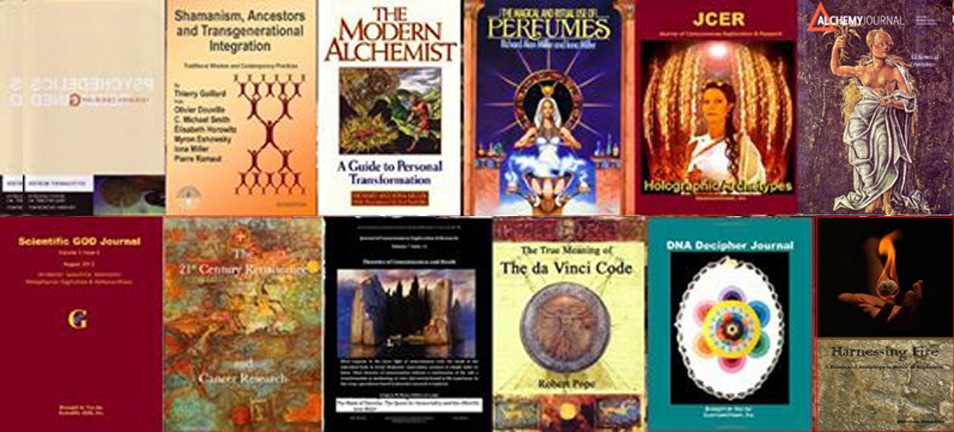
Ms. Miller is published by Phanes Press, Destiny Books (Inner Traditions), Autonomedia, Nexus Magazine, Paranoia Magazine, Alchemy Journal, Green Egg, Bibliotheca Alexandrina, Jungian Analysis Journal (Moscow), ECODITION (Geneva), DNA Decipher Journal (DNADJ), Scientific God Journal (SGJ), Journal of Consciousness Exploration & Research (JCER), Journal of Nonlocality & Remote Mental Interactions (JNLRMI), Science-Art Research Centre Australia (SARCA), Dream Network, Chaosophy Journal, OAK-Publishing, PM&E, DNA Monthly, Antibothis, Pop Occulture, and more. Ms. Miller coordinates Media & Wellness in the Operations Division of The Osborne Group (TOG), a risk management organization. Over the last 10 years she also managed the ad hoc projects of Mankind Research Unlimited (MRU) alumni from 3 decades, in intelligence, digital life, new physics, paranormal, creativity, consciousness studies, DNA research, superlearning, DIY mind control, biophysics, other frontier science and blue sky experimentation. This work continues in a variety of forms and outlets. Ms. Miller has taught numerous community education classes (RCC) on Jungian Studies, Biofeedback, Hypnotherapy and related topics. She also oversees numerous curatorial, archival and genealogical projects. She has served in a professional capacity at Southern Oregon Hypnotherapy, Asklepia Foundation, Institute for Applied Consciousness Science, the Wisdom Center, Science-Art, USA, and Life Energies Research Institute. Selected Publications of Iona Miller: http://research-publication.site123.me/ |
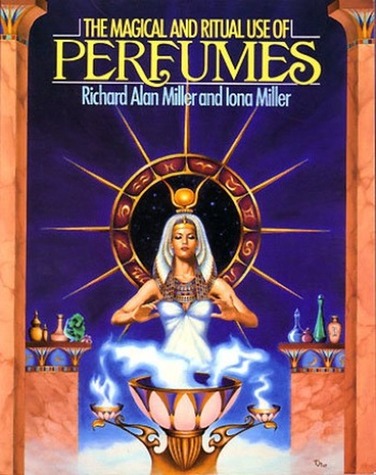
A transdisciplinarian, Miller's documented pioneering work anticipated the following, and more:
- Holographic Concept of Reality, Bioholography, anticipating Holographic Paradigm
- Biophotonics, anticipating Subtle Body Fields and Nonlocal Cellular Communications
- Bioelectronics and Healing, anticipating Energy Medicine and Distance Healing
- Deterministic Chaos Theory in Integrative Psychotherapy, anticipating Complexity Science
- Sub-quantal Physics, Vacuum Potential and Structure of the Vacuum, anticipating Source Field fad
- Pre-geometric Structure of Absolute Space, anticipating Sacred Geometry & Merkabah Mysticism fad
- Nonlocal Mind Paradigm, anticipating Nonlocality and Entanglement in Psi Phenomena
- Quantum Cosmology, Systems Theory & Transdisciplinarity Knowledge & Modelling
- Emergent Healing Paradigm, anticipating Bioplasma, Intentionality & Mind-Body Healing
- Resonating Systems & Biocommunications, anticipating Resonance Energy Transfer Phenomena
- Liquid Crystal Properties of Living Cells, Electro-Optical, and Ferro-electrical Effects
- Consciousness Studies, anticipating Primordial Root of Existence as Interface of Psyche & Matter
- Creativity in Trance, Archetypes, Myth, & Dream; Taxonomies of Discrete States of Consciousness
- Metacognition, Esoterics, and Ancient Wisdom, anticipating the Gnosticism fad
- Mapping Frontiers of Consciousness & Extraordinary Human Potential
- Transgenerational Integration, anticipating Epigenetics, Wave Genetics, & Genetic Genealogy fad
- Genetic Regulatory Architecture, EMF, Biolelectromagnetics, & Conscious Intent
- Experiential Dreamwork, Personal Mythology, anticipating Shamanic Therapy fad
- Geophysical Mind-Body Effects of Space Weather, Schumann Resonaces, and Geomagnetics
- Quantum Mind Metaphor, Coherence-Decoherence, Remote Viewing, & Distance Healing
- Integrative Biophysics, Magnetohydrodynamic Model of Bioplasma & Micropulsations
- Novel Applications of Mind-Matter Interface in Integrative, Depth, and Archetypal Psychologies
|
|
|

|
|
|

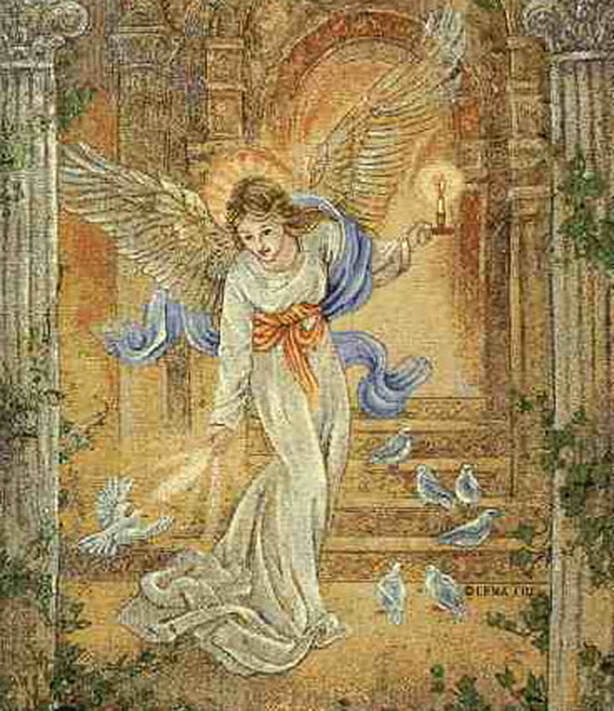
The Word and the Angel
"We need a new angelology of words...
We need to remember the angelic aspect of the word,
To recognize words as self-bearers of a soul
between one person and another.
We need to remember that words are not just something
That we invent or learn at school...
The words, like angels, are powers
Who wield an unseen power over us...
Because words are people."
--James Hillman, Blue Fire
Iona Miller is a nonfiction writer for the academic and popular press, clinical hypnotherapist, and multimedia artist. Writing itself is a developmental process that creates self-discovery, image, and meaning while integrating learning, memory, and experience.
As Baudelaire suggests, symbolism and "correspondences" help us "Extract the eternal from the ephemeral." Symbolic languages such as esoterics, alchemy, and Qabalah articulate the phenomenology of inner experience. Our own personal growth and efforts towards deepening our spiritual connection help us wake up and grow up.
Symbols represent transcendental and timeless values and stories. They help us describe our kinesthetic, aesthetic, cognitive, emotional, moral, and spiritual awareness, engagement, and intelligence. This is how we think about and experience that reality.
"To heal the symptom, we must heal the person, and to heal the person we must first heal the story in which the person has imagined himself." --James Hillman
Such concepts help us move beyond over-zealous, power-driven, ethnocentric, and egocentric ways. We need to pay attention to the depth of narrative space, the spaces that connect our stories, the relationship field, and our psycho-genealogical lines. We need to uncover collaborations with new spaces and the healing power of narrative history.
http://ionamiller.weebly.com/healing-narratives.html
Nature's Narrative
We carry our histories, as well as the whole history of humanity, with us into the present through our bodies. Our feelings and thoughts become manifest in our physical structure. The past is "sedimented" in the body -- that is, it is embodied. Our bodies' sensory apparatus is the only way we experience the larger world. It is the medium through which we meet and respond to that world, feeling its reciprocal impact on us. Thus our symptoms can reflect our cultural as well as personal attitudes.
Our mind doesn't store memories; it is memory. Our wounds are necessary to fulfill our calling. The marks of memory are the signs of destiny. Penetration of the mystic veil often comes through one's wounds. They allow us to see through to an immaterial sense of being.
We are wounded simply by our relation to the world, the world's body. The world and body are the same stuff and share vision. The mind can also obscure the body, as lived experience -- the core, the limbs, the scars, the head, the back. It changes like a landscape.
Miracles of the body are triumph or transcendence over decay. We don't forget the knowledge of death until we experience it. Body is material (animal imagination), sensual, metaphorical, and spiritual. Its parts have personal, mythic, and cultural (aesthetic, social, political, and medicalized, mutilated, etc.) significance in a wide range of cultures.
Evidence suggests spirituality emerged from female body mythology as the matrix of birth. It led to a recognition of time and heavenly cycles linking earth and sky. The body's sacred geography is the primary genesis and root of mythic imagination, physiology, and psychology. It is the body that tries to find place, identity, origin, home. Soul thinks with reference to the body and body image.
Meaning is a non-material imaginal dimension. Imagination is a vital spiritual function, inseparable from the World Soul. Psyche is soul. Symbols are the currency of consciousness and the connective tissue of the mind-body correlation. . . . "the spirit is the life of the body seen from within, and the body the outward manifestation of the life of the spirit - the two being really one." (Jung, CW 10, Page 195).
Art draws the viewer into its participatory space. Images and symbols are visible in the psychic aspect of symptoms and behavior. The reader can be involved in a self-disclosing collaborative process mapping the conceptual terrain, including our response to the spiritual uncertainties of our times. Our invisible ground is now simultaneous information that travels at the speed of light, centered everywhere and nowhere.
Innate Image
Iona is a Symbolist and visionary, perhaps more pragmatic and less literal than most with similar interests. Her writing is informed by Jungian, Post-Jungian, Archetypal, Personality, and Transpersonal psychologies, as well as philosophy and meditation.
Jungian psychology strongly connects with the arts, culture and history of society, which also derive from the imagination. Writing is ordinary magic, natural magic. It can transport the reader to new territory, to 'foreign lands.'
To Go Up or Down is the Same
Opposites -- actually a unified system of balanced exchanges -- are necessary for life to flow, much like current in electricity. In his natural philosophy, Jung agreed with the physicists that there is no energy without duality.
Heraclitus declared, "The road up and down is one and the same," but unity is not identity. Consciousness arises from the interplay of primal opposites, but ego resists being overwhelmed by that and tries to suppress that fear of chaos through one-sided polarization.
The psychological path is a middle way. Spiritual paths tend to encourage the glorification of the spirit (ascent) over the body and instincts (descent) we need to keep us grounded. We cannot merely drop the body and soar infinitely skyward, even metaphorically. Nor can we ever comprehend the entire meaning of all ideas, symbols, and myths.
Despite spiritual movements of fullness or emptiness (plenum or void), transcendence or immanence, we are neither solely 'ascenders' or 'descenders.' If our perceptions are flooded with the sacred, eventually we are overcome with silence. This switch is a product of our paradoxical neurological wiring (Fischer). Soul connects the two movements if we pay attention and engage with it. When we look deeply, the self that we love so much may turn out to be everything else.
Meaning is about connectivity and interdependence with everything else out there: self, others, and cosmos. As Hillman notes in Re-Visioning Psychology, "The soul loses its psychological vision in the abstract literalisms of the spirit as well as in the concrete literalisms of the body." Much the same holds true for the sacredness and spiritual values of the Earth, which is synonymous with body and matter, in general.
We cannot deny the body's role in our complete being as we confront the autonomous aspects of our transpersonal nature. Our wounds and blocks are expressed as psychic or somatic symptoms. The body also contains our natural innocence. We are an extraordinary phenomenon of nature. Our notions are conditioned by our experience of space and time.
So, to come 'full circle' we need to find balance. Both upward and downward spiraling movements are expressed in imagery and embedded in our innate physical nature. The deeper self releases the higher self; 'deeper' and 'higher' consciousness aren't really so different. The ultimate paradox is to get higher we have to go deeper.
The psyche of the visionary artist or seer follows unconscious intuitions about the present and the past, and unconscious impulses from both the past and the future. What we call visions are vast, nebulous intuitions. Meanings not consciously intended may emerge. In the absence of radically polarized notions secure beliefs and critical thinking are compliments to psychological perception. Inner vision opens the whole self to consciousness.
Thus, we circulate among the aspects of our unfolding sacred and natural being as a single systemic reality. In Taoism, seeing and knowing are turned inward by reactivating the more primordial, pre-verbal, or intuitive, or tacit modes of knowledge. Empty knowing and doing resonate freely with the cosmic pulse of life and nature.
Our journey is one into the heart of primal myths, and that path is more art than theology, beyond paths of affirmation or negation. We can simply surrender into the heart of that being. Path-less, content-free, non-conceptual awareness, the ultimate ground state fosters new understandings of reality. Individuated Wholeness is Mature Freedom.
MytholoGEMS
"Great innovations never come from above; they come invariably from below, just as trees never grow from the sky downward, but upward from the earth." (Jung, CW 10, Para 177)
Our co-creative task is to bring to light the mythologems, the basic core elements, motifs or themes of myth, behind our individual and collective fate. Basic themes include recurrent patterns: survival, relationships, love and war, chaos and order, revenge, self-sacrifice, or betrayal, death and grief, rejuvenation and rebirth. Jung considered rebirth "an affirmation that must be counted among the primordial affirmations of mankind." (CW 9i, Para 207)
Our myths play out in internal and external history. The paradox of myth is that they are cultural creations that declare that the cultural order can never fully contain the meaning of creation in human life. Myths transcend linear time.
Mythologems form the core of our personal myths and the whole gamut of the repertoire of humanity. They are ways to see the whole picture, without losing the relative specificity of the image as it is given, without interpretation or distortion that stops the imaginal process. We follow the thread of that tale and among tales, connections of meanings and potentialities.
If we stay with the images evoked, that immersion takes us to places where solutions appear. We don't go to the images for answers, but to have a deeper relationship with that part of ourselves. It isn't striving and it isn't ego-heroic. Our goal is self-realization. The process is one of spiritualizing the material and noticing how it is informed.
If certain conditions foster the self, then others, such as rejection, misunderstanding, incongruence or instability, can thwart it. Thwarting of self by the environment can create alienation, negativity, suppression, anxiety, insecurity, distrust, defensiveness, even violence.
Jung pointed out that God is reality itself, and therefore includes the divinity in mankind. The stars are still there in the daytime. The central meaning begins to shine through at every point of contact. The image isn't necessarily what is on the page but what can be provoked, elicited or emerges from the reader's encounter. The participant can enter or engage the dialogue.
Beyond Postmodernism
"At the root of our compulsion to create art is the need to establish some calm point within life's turbulent flow." --Camille Paglia, "Sexual Personae" (Vintage).
Early knowledge of these processes shaped her relationship to the world. She is interested in creativity, experiential therapy, extraordinary human experiences, using interpretive and non-interpretive strategies. Many of today's trends in self-exploration came from the therapeutic communities of the 1960s and perennial wisdom traditions. She is also interested in effects at the global level, unintended consequences, rather than intentions.
Experiential therapies were developed and popularized in later decades, and now are mainstream, thanks to social media. This psychology without walls transcends the consulting room, explores the soul of the world -- the global agora. It deliberately connects with personal history, the arts, culture and history of society, which are also derived from the imagination. Its lessons can be applied by individuals to themselves, adding new depth to Self-help.
Her work is an omni-sensory fusion of depth psychology, personal mythology, meditation, dreamwork, science-art, frontier science, symbolism, philosophy, source mysticism, futuring, digital life, emergent healing, poetics, and paradigm shift. Her framework is semiotic
(image-as-sign) and phenomenological (image-in-consciousness).
Panpsychism is the philosophical view that consciousness, mind or soul (psyche) is a universal and primordial feature of all things. Primordial consciousness gives rise to potentialities, patterns and cycles which are realized as instances -- conscious experience.
Mystics seek the Formless God or Inner Light. While the mystic seeks the frameless, non-conceptual, thoughtless experience of primordial awareness, the artist seeks every way to navigate mind, and explore its domains by reframing consciousness.
In some languages the verb for 'paint' and 'write' is the same word. Both hand gestures initiate a flow state: When hand and eye play, awareness of self and object fuse in a new entity on the paper or screen. The inner organizing “urge to pattern and wholeness” differs from willed planning and is free to embody in the product of the process.
Once we reconnect with that core we feel that all is in alignment, including our physical, emotional, mental and spiritual domains. Bathing ourselves in Pure Awareness, communing with the groundstate of our being opens us to new possibilities. Amplifying the inaudible is a way of revealing the radiant essence of life.
Pathos
We feel like ourselves, in our own rhythm, and aligned with Cosmos. This opens us to the synergetic effects of the flow state and synchronicity; doing better than we know; Being In the Zone. This is the authentic life, also known as self-actualization. Potential becomes lived Reality. We can never achieve 100% knowledge and accuracy - this is the psychological Uncertainty Principle.
A struggle of opposites makes the image. When we make art our conscious mind intentionally cooperates with the unconscious depths, and something alive arises from the dead medium.
A sort of being that takes on a life of its own, a significance of its own, suffused with essence. We can embrace a diffused emergent reality, suspending any inclination to know or plan an outcome.
Here we explore relationships of psyche and matter, extraordinary human potential, genres of ritual healing, mythic potentials, hypnotic realities, and therapeutic processes. Cultural phenomenology explores existential significance and cultural meaning of phenomena, and mind-body-spirit modes of attention. The effects of ancient and modern doctrines of religion, science, psychology, media, and the arts hold special interest.
The Tree in the Psyche & Psyche in the Tree
The essence of psyche is myth and ritual, enactment of the stories of the soul, by which we differentiate the unconscious. Myth itself is the human search for what is true, significant, and meaningful -- the rapture of being alive and full of life experiences.
There is more to genealogy than the search for the historical ancestors. We continue to search for the creative principle in the psyche. What spirit creates psyche and moves soul? Myth can provide psychological insight, just as it can seize and influence psychic life.
James Hillman suggests without paternal descent we have no genealogy to provide structure and content for mythology. This is literally shown in ancient lines of descent from gods and goddesses. It is not literal, but self-revelatory.
Couple after couple are thrown into an existential situation where each searches for their basis of being and continuance. Loss of myth creates existential anxiety. Genealogy is a mythology itself, not just family problems and the soul's spiritual crisis.
The wisdom of Sophia is the feminine contribution providing wider context in the relational union of love and necessity that reconciles us with our fate, necessity, and events -- reconciliation with the silent labyrinth of creation.
Love stays connected to the soul and seeks a way through a sort of personal and universal teleology beyond metaphysics. Such love shows in the spirit in which we approach psyche's phenomena and how faithfully we stick to the image with resourcefulness, inventiveness, and creative intelligence that seeks psychological connection. Creative insight is linked to involvement, engagement, imaginative complexity, aesthetic energy, and psychic beauty.
Approach
This "know thyself" approach is through novel means of presentation, conservation, and curation in a holistic, participative, contextual and relational way. Inclusion is a strategic move out of reductive frames of reference. “'Know thyself,' means also 'know thy peculiar images.'”
The intention is to promote directions of 'sensibility,' where each viewer can deploy their own narrative and approach to the material presented, blurring the logic of inside and outside, a tension between the universal and the particular, collective and individual.
She articulates the curatorial as critical thought that does not rush to embody itself, but instead raises questions that are to be unraveled over time. There are lots of great stories out there, but not always history. Things tend to look different from inside than outside. Self-realization is a solitary journey, described by Plotinus: "The way to truth was the journey of a lonely person to that which is eternally alone."
Her labyrinth of works is a free-floating conceptual framework. It is a spiritual, philosophical, and psychological practice. In therapy we work with particular models. But an artist or philosopher can work purely symbolically. The creative impulse is brought to fruition in the world. Such secret forms grow into our life's work and purpose. By communing deeply with the outside world we find the familiar in the unfamiliar.
Works with a trans- quality go beyond mundane time, space, logic and personal taste or aesthetic preference. They connect with our essential Being at the core, reflected in nature and art, piercing time to find eternity. Transcending content, they open a new dimension...an invisible initiatory dimension. From here the artist gives birth to the secret space of the image itself which comes alive by giving shape to that secret.
In Iona's work, there is an underlying thread of digging in deep, connectivity and personal spirituality, based on contact with the numinous. Novel, transpersonal, uncanny, and highly personal appearances create a specific quality of sacredness that grips the soul with particular states (awe, dread, stupor, wonder, healing, reverence, astonishment, etc.).
This contact is the essence of the guiding process -- an act of grace and profound symbolic experience. A certain brightness in the soul transcends our own personal suffering. When we rediscover it, it turns suffering into meaning. A temporary loss of personal identity is natural when consciousness expands into transpersonal Reality, into non-conceptual Mystery.
“The main interest of my work,” writes Jung, “is not concerned with the treatment of neurosis but rather with the approach to the numinous. But the fact is that the approach to the numinous is the real therapy and inasmuch as you attain to the numinous experiences, you are released from the curse of pathology." (VonFranz, Marie-Louise, Psychotherapy, Shambahla Publications, 1990, p.177.)
Interactive Field
The reader is welcomed into their own journey of self-discovery -- sometimes lost, sometimes validated, sometimes illuminated. But, always once again picking up the connective thread. Ideally, there is a co-creation with readers, listeners, and viewers. More books and information don't change your soul, but active participation and engagement with psyche open new vistas. The psychic material weaves together into patterns with seasons of agony and grace.
That participatory process, a soul-making practice, creates a unique message, meaning, and body with poetic expression. We remember our soul's journey and calling, related to our soul's stories and moved by our struggles. We participate in this sacred act by correlating our experiences in the world with archetypal dynamics -- ancient and traditional patterns, only fleshed out in conscious content.
"We need a new angelology of words...
We need to remember the angelic aspect of the word,
To recognize words as self-bearers of a soul
between one person and another.
We need to remember that words are not just something
That we invent or learn at school...
The words, like angels, are powers
Who wield an unseen power over us...
Because words are people."
--James Hillman, Blue Fire
Iona Miller is a nonfiction writer for the academic and popular press, clinical hypnotherapist, and multimedia artist. Writing itself is a developmental process that creates self-discovery, image, and meaning while integrating learning, memory, and experience.
As Baudelaire suggests, symbolism and "correspondences" help us "Extract the eternal from the ephemeral." Symbolic languages such as esoterics, alchemy, and Qabalah articulate the phenomenology of inner experience. Our own personal growth and efforts towards deepening our spiritual connection help us wake up and grow up.
Symbols represent transcendental and timeless values and stories. They help us describe our kinesthetic, aesthetic, cognitive, emotional, moral, and spiritual awareness, engagement, and intelligence. This is how we think about and experience that reality.
"To heal the symptom, we must heal the person, and to heal the person we must first heal the story in which the person has imagined himself." --James Hillman
Such concepts help us move beyond over-zealous, power-driven, ethnocentric, and egocentric ways. We need to pay attention to the depth of narrative space, the spaces that connect our stories, the relationship field, and our psycho-genealogical lines. We need to uncover collaborations with new spaces and the healing power of narrative history.
http://ionamiller.weebly.com/healing-narratives.html
Nature's Narrative
We carry our histories, as well as the whole history of humanity, with us into the present through our bodies. Our feelings and thoughts become manifest in our physical structure. The past is "sedimented" in the body -- that is, it is embodied. Our bodies' sensory apparatus is the only way we experience the larger world. It is the medium through which we meet and respond to that world, feeling its reciprocal impact on us. Thus our symptoms can reflect our cultural as well as personal attitudes.
Our mind doesn't store memories; it is memory. Our wounds are necessary to fulfill our calling. The marks of memory are the signs of destiny. Penetration of the mystic veil often comes through one's wounds. They allow us to see through to an immaterial sense of being.
We are wounded simply by our relation to the world, the world's body. The world and body are the same stuff and share vision. The mind can also obscure the body, as lived experience -- the core, the limbs, the scars, the head, the back. It changes like a landscape.
Miracles of the body are triumph or transcendence over decay. We don't forget the knowledge of death until we experience it. Body is material (animal imagination), sensual, metaphorical, and spiritual. Its parts have personal, mythic, and cultural (aesthetic, social, political, and medicalized, mutilated, etc.) significance in a wide range of cultures.
Evidence suggests spirituality emerged from female body mythology as the matrix of birth. It led to a recognition of time and heavenly cycles linking earth and sky. The body's sacred geography is the primary genesis and root of mythic imagination, physiology, and psychology. It is the body that tries to find place, identity, origin, home. Soul thinks with reference to the body and body image.
Meaning is a non-material imaginal dimension. Imagination is a vital spiritual function, inseparable from the World Soul. Psyche is soul. Symbols are the currency of consciousness and the connective tissue of the mind-body correlation. . . . "the spirit is the life of the body seen from within, and the body the outward manifestation of the life of the spirit - the two being really one." (Jung, CW 10, Page 195).
Art draws the viewer into its participatory space. Images and symbols are visible in the psychic aspect of symptoms and behavior. The reader can be involved in a self-disclosing collaborative process mapping the conceptual terrain, including our response to the spiritual uncertainties of our times. Our invisible ground is now simultaneous information that travels at the speed of light, centered everywhere and nowhere.
Innate Image
Iona is a Symbolist and visionary, perhaps more pragmatic and less literal than most with similar interests. Her writing is informed by Jungian, Post-Jungian, Archetypal, Personality, and Transpersonal psychologies, as well as philosophy and meditation.
Jungian psychology strongly connects with the arts, culture and history of society, which also derive from the imagination. Writing is ordinary magic, natural magic. It can transport the reader to new territory, to 'foreign lands.'
To Go Up or Down is the Same
Opposites -- actually a unified system of balanced exchanges -- are necessary for life to flow, much like current in electricity. In his natural philosophy, Jung agreed with the physicists that there is no energy without duality.
Heraclitus declared, "The road up and down is one and the same," but unity is not identity. Consciousness arises from the interplay of primal opposites, but ego resists being overwhelmed by that and tries to suppress that fear of chaos through one-sided polarization.
The psychological path is a middle way. Spiritual paths tend to encourage the glorification of the spirit (ascent) over the body and instincts (descent) we need to keep us grounded. We cannot merely drop the body and soar infinitely skyward, even metaphorically. Nor can we ever comprehend the entire meaning of all ideas, symbols, and myths.
Despite spiritual movements of fullness or emptiness (plenum or void), transcendence or immanence, we are neither solely 'ascenders' or 'descenders.' If our perceptions are flooded with the sacred, eventually we are overcome with silence. This switch is a product of our paradoxical neurological wiring (Fischer). Soul connects the two movements if we pay attention and engage with it. When we look deeply, the self that we love so much may turn out to be everything else.
Meaning is about connectivity and interdependence with everything else out there: self, others, and cosmos. As Hillman notes in Re-Visioning Psychology, "The soul loses its psychological vision in the abstract literalisms of the spirit as well as in the concrete literalisms of the body." Much the same holds true for the sacredness and spiritual values of the Earth, which is synonymous with body and matter, in general.
We cannot deny the body's role in our complete being as we confront the autonomous aspects of our transpersonal nature. Our wounds and blocks are expressed as psychic or somatic symptoms. The body also contains our natural innocence. We are an extraordinary phenomenon of nature. Our notions are conditioned by our experience of space and time.
So, to come 'full circle' we need to find balance. Both upward and downward spiraling movements are expressed in imagery and embedded in our innate physical nature. The deeper self releases the higher self; 'deeper' and 'higher' consciousness aren't really so different. The ultimate paradox is to get higher we have to go deeper.
The psyche of the visionary artist or seer follows unconscious intuitions about the present and the past, and unconscious impulses from both the past and the future. What we call visions are vast, nebulous intuitions. Meanings not consciously intended may emerge. In the absence of radically polarized notions secure beliefs and critical thinking are compliments to psychological perception. Inner vision opens the whole self to consciousness.
Thus, we circulate among the aspects of our unfolding sacred and natural being as a single systemic reality. In Taoism, seeing and knowing are turned inward by reactivating the more primordial, pre-verbal, or intuitive, or tacit modes of knowledge. Empty knowing and doing resonate freely with the cosmic pulse of life and nature.
Our journey is one into the heart of primal myths, and that path is more art than theology, beyond paths of affirmation or negation. We can simply surrender into the heart of that being. Path-less, content-free, non-conceptual awareness, the ultimate ground state fosters new understandings of reality. Individuated Wholeness is Mature Freedom.
MytholoGEMS
"Great innovations never come from above; they come invariably from below, just as trees never grow from the sky downward, but upward from the earth." (Jung, CW 10, Para 177)
Our co-creative task is to bring to light the mythologems, the basic core elements, motifs or themes of myth, behind our individual and collective fate. Basic themes include recurrent patterns: survival, relationships, love and war, chaos and order, revenge, self-sacrifice, or betrayal, death and grief, rejuvenation and rebirth. Jung considered rebirth "an affirmation that must be counted among the primordial affirmations of mankind." (CW 9i, Para 207)
Our myths play out in internal and external history. The paradox of myth is that they are cultural creations that declare that the cultural order can never fully contain the meaning of creation in human life. Myths transcend linear time.
Mythologems form the core of our personal myths and the whole gamut of the repertoire of humanity. They are ways to see the whole picture, without losing the relative specificity of the image as it is given, without interpretation or distortion that stops the imaginal process. We follow the thread of that tale and among tales, connections of meanings and potentialities.
If we stay with the images evoked, that immersion takes us to places where solutions appear. We don't go to the images for answers, but to have a deeper relationship with that part of ourselves. It isn't striving and it isn't ego-heroic. Our goal is self-realization. The process is one of spiritualizing the material and noticing how it is informed.
If certain conditions foster the self, then others, such as rejection, misunderstanding, incongruence or instability, can thwart it. Thwarting of self by the environment can create alienation, negativity, suppression, anxiety, insecurity, distrust, defensiveness, even violence.
Jung pointed out that God is reality itself, and therefore includes the divinity in mankind. The stars are still there in the daytime. The central meaning begins to shine through at every point of contact. The image isn't necessarily what is on the page but what can be provoked, elicited or emerges from the reader's encounter. The participant can enter or engage the dialogue.
Beyond Postmodernism
"At the root of our compulsion to create art is the need to establish some calm point within life's turbulent flow." --Camille Paglia, "Sexual Personae" (Vintage).
Early knowledge of these processes shaped her relationship to the world. She is interested in creativity, experiential therapy, extraordinary human experiences, using interpretive and non-interpretive strategies. Many of today's trends in self-exploration came from the therapeutic communities of the 1960s and perennial wisdom traditions. She is also interested in effects at the global level, unintended consequences, rather than intentions.
Experiential therapies were developed and popularized in later decades, and now are mainstream, thanks to social media. This psychology without walls transcends the consulting room, explores the soul of the world -- the global agora. It deliberately connects with personal history, the arts, culture and history of society, which are also derived from the imagination. Its lessons can be applied by individuals to themselves, adding new depth to Self-help.
Her work is an omni-sensory fusion of depth psychology, personal mythology, meditation, dreamwork, science-art, frontier science, symbolism, philosophy, source mysticism, futuring, digital life, emergent healing, poetics, and paradigm shift. Her framework is semiotic
(image-as-sign) and phenomenological (image-in-consciousness).
Panpsychism is the philosophical view that consciousness, mind or soul (psyche) is a universal and primordial feature of all things. Primordial consciousness gives rise to potentialities, patterns and cycles which are realized as instances -- conscious experience.
Mystics seek the Formless God or Inner Light. While the mystic seeks the frameless, non-conceptual, thoughtless experience of primordial awareness, the artist seeks every way to navigate mind, and explore its domains by reframing consciousness.
In some languages the verb for 'paint' and 'write' is the same word. Both hand gestures initiate a flow state: When hand and eye play, awareness of self and object fuse in a new entity on the paper or screen. The inner organizing “urge to pattern and wholeness” differs from willed planning and is free to embody in the product of the process.
Once we reconnect with that core we feel that all is in alignment, including our physical, emotional, mental and spiritual domains. Bathing ourselves in Pure Awareness, communing with the groundstate of our being opens us to new possibilities. Amplifying the inaudible is a way of revealing the radiant essence of life.
Pathos
We feel like ourselves, in our own rhythm, and aligned with Cosmos. This opens us to the synergetic effects of the flow state and synchronicity; doing better than we know; Being In the Zone. This is the authentic life, also known as self-actualization. Potential becomes lived Reality. We can never achieve 100% knowledge and accuracy - this is the psychological Uncertainty Principle.
A struggle of opposites makes the image. When we make art our conscious mind intentionally cooperates with the unconscious depths, and something alive arises from the dead medium.
A sort of being that takes on a life of its own, a significance of its own, suffused with essence. We can embrace a diffused emergent reality, suspending any inclination to know or plan an outcome.
Here we explore relationships of psyche and matter, extraordinary human potential, genres of ritual healing, mythic potentials, hypnotic realities, and therapeutic processes. Cultural phenomenology explores existential significance and cultural meaning of phenomena, and mind-body-spirit modes of attention. The effects of ancient and modern doctrines of religion, science, psychology, media, and the arts hold special interest.
The Tree in the Psyche & Psyche in the Tree
The essence of psyche is myth and ritual, enactment of the stories of the soul, by which we differentiate the unconscious. Myth itself is the human search for what is true, significant, and meaningful -- the rapture of being alive and full of life experiences.
There is more to genealogy than the search for the historical ancestors. We continue to search for the creative principle in the psyche. What spirit creates psyche and moves soul? Myth can provide psychological insight, just as it can seize and influence psychic life.
James Hillman suggests without paternal descent we have no genealogy to provide structure and content for mythology. This is literally shown in ancient lines of descent from gods and goddesses. It is not literal, but self-revelatory.
Couple after couple are thrown into an existential situation where each searches for their basis of being and continuance. Loss of myth creates existential anxiety. Genealogy is a mythology itself, not just family problems and the soul's spiritual crisis.
The wisdom of Sophia is the feminine contribution providing wider context in the relational union of love and necessity that reconciles us with our fate, necessity, and events -- reconciliation with the silent labyrinth of creation.
Love stays connected to the soul and seeks a way through a sort of personal and universal teleology beyond metaphysics. Such love shows in the spirit in which we approach psyche's phenomena and how faithfully we stick to the image with resourcefulness, inventiveness, and creative intelligence that seeks psychological connection. Creative insight is linked to involvement, engagement, imaginative complexity, aesthetic energy, and psychic beauty.
Approach
This "know thyself" approach is through novel means of presentation, conservation, and curation in a holistic, participative, contextual and relational way. Inclusion is a strategic move out of reductive frames of reference. “'Know thyself,' means also 'know thy peculiar images.'”
The intention is to promote directions of 'sensibility,' where each viewer can deploy their own narrative and approach to the material presented, blurring the logic of inside and outside, a tension between the universal and the particular, collective and individual.
She articulates the curatorial as critical thought that does not rush to embody itself, but instead raises questions that are to be unraveled over time. There are lots of great stories out there, but not always history. Things tend to look different from inside than outside. Self-realization is a solitary journey, described by Plotinus: "The way to truth was the journey of a lonely person to that which is eternally alone."
Her labyrinth of works is a free-floating conceptual framework. It is a spiritual, philosophical, and psychological practice. In therapy we work with particular models. But an artist or philosopher can work purely symbolically. The creative impulse is brought to fruition in the world. Such secret forms grow into our life's work and purpose. By communing deeply with the outside world we find the familiar in the unfamiliar.
Works with a trans- quality go beyond mundane time, space, logic and personal taste or aesthetic preference. They connect with our essential Being at the core, reflected in nature and art, piercing time to find eternity. Transcending content, they open a new dimension...an invisible initiatory dimension. From here the artist gives birth to the secret space of the image itself which comes alive by giving shape to that secret.
In Iona's work, there is an underlying thread of digging in deep, connectivity and personal spirituality, based on contact with the numinous. Novel, transpersonal, uncanny, and highly personal appearances create a specific quality of sacredness that grips the soul with particular states (awe, dread, stupor, wonder, healing, reverence, astonishment, etc.).
This contact is the essence of the guiding process -- an act of grace and profound symbolic experience. A certain brightness in the soul transcends our own personal suffering. When we rediscover it, it turns suffering into meaning. A temporary loss of personal identity is natural when consciousness expands into transpersonal Reality, into non-conceptual Mystery.
“The main interest of my work,” writes Jung, “is not concerned with the treatment of neurosis but rather with the approach to the numinous. But the fact is that the approach to the numinous is the real therapy and inasmuch as you attain to the numinous experiences, you are released from the curse of pathology." (VonFranz, Marie-Louise, Psychotherapy, Shambahla Publications, 1990, p.177.)
Interactive Field
The reader is welcomed into their own journey of self-discovery -- sometimes lost, sometimes validated, sometimes illuminated. But, always once again picking up the connective thread. Ideally, there is a co-creation with readers, listeners, and viewers. More books and information don't change your soul, but active participation and engagement with psyche open new vistas. The psychic material weaves together into patterns with seasons of agony and grace.
That participatory process, a soul-making practice, creates a unique message, meaning, and body with poetic expression. We remember our soul's journey and calling, related to our soul's stories and moved by our struggles. We participate in this sacred act by correlating our experiences in the world with archetypal dynamics -- ancient and traditional patterns, only fleshed out in conscious content.

WHAT INSPIRES ME
A Field Theory of Art and the Imagination
By Iona Miller 10-2005
Inspiration, noun
1: arousal of the mind to special unusual activity or
creativity
2: a product of your creative thinking and work; brainchild
3: a sudden intuition as part of solving a problem
4: arousing to a particular emotion or action
5: the act of inhaling [inhalation, breathing in]
Your vision will become clear only when you can look into your own heart.
Who looks outside, dreams; who looks inside, awakens. ~ Carl Jung
Your work is to discover your work
and then with all your heart to give yourself to it. ~ Buddha
Sensual Culture
Inspiration should be a verb, not a noun; it is a complex dynamic, a force of Nature and our nature. When someone asks me what “inspires” me and my artwork, I can’t imagine naming any one thing, or list of “things”. It’s like asking my favorite color. I can’t help but answer, ALL, “all of the Above…and Below”.
What doesn’t inspire the artistic eye that doesn’t merely “look at”, but “sees through” to the imaginal depth of any given perception or experience? Rather than the impressionistic senses informing the soul, the soul informs the multisensory experience of being. Inspiration means life, the opposite of death. It implies purpose, direction, meaning, ecstasy, creativity.
Any moment can be as inspirational as the next. Inspiration can come from an internal movement or sensation, a love affair with color and form, the awe of an incandescent moment, even the pain of a soul on fire struggling to express itself or the zeitgeist of the times. All ways of looking at reality are imaginative. When we see soul as the background of all phenomena, we become aware of the animating principle.
The soul in depth psychology is an empirical manifestation of imagination, fantasy,
and creativity which is always in the process of becoming--images forming, and
dissolving, and forming anew. Imagination is the essence of the life forces, both physical and psychic. It is the hidden ground behind symbol, archetype, metaphor, image. These fantasies always permeate our beliefs, ideas, emotions, and physical nature.
Our imagination is not something possessed by our minds, but the fundamental conscious/unconscious field of our psyche – our soul. The imaginal field is not derivative, but the very ground of our existence, conditioning all of our experience. It is where the personal encounters the transpersonal and finds “I AM That”. Imagination is the primary irreducible activity of the soul.
The image-making psyche or soul is the primary creative capacity, not only in art. Yet, perhaps, this is what is meant when it is said an artist has ‘soul,’ the capacity to draw on the inspirational mythopoetic taproot to Source, the creative field. Imagination is the basis of soul. In fact, to live the artistic life is to live immersed consciously in that aesthetically-nuanced Reality, to find it virtually inescapable.
Imaginal Ground as Aesthetic Paradigm
The intrapersonal process of art and the products of art have different cultural meanings. However, the primary purpose of art as a culture is to externalize and concretize for some time that ephemeral ever-morphing field of the image-scape. It merges subjective and objective through an affective, aesthetic experience.
Our cultivation of the soul restores the human dimension to experience, destigmatizing imagination as merely fantasy, illusion, dream, or delusory perception. It is the mind that is perhaps a distorting lens, structured by beliefs, myths, and philosophies, even those of so-called rational science.
This is so because the mind is in the Imagination, the Anima Mundi, rather than the reverse. We can’t think without images. Multisensory images constantly condition our meaningful perception of the world, inner and outer. They organize our beliefs, thoughts, feelings, and behavior – our responses.
Our images condition our perception and perspective – the way we see. As artists, it isn’t what we see and depict, but how we see it. Traditional art promotes conformity. Interesting art, as distinct from what we could call “sofa art”, has something to say, a unique perspective or point of view that speaks to the observer or participant.
Art as a culture is a traditional means of confronting the imagination. Art as a process is not confined by rules of academic art. The digital revolution challenged the traditional world of painting, but computer-assisted art is no less human because the tool has changed from a brush to a program. In fact, it is the human dimension of this art that keeps it interesting, over-riding the sterility of mere technical perfection.
People turn to film and art to help them contextualize experience, personal and collective. The “art world” as a biased cultural force cannot predetermine how any generation or individual will meet the imagination. Dogmatic expression of fantasy is an oxymoron. It discourages the genuinely novel, demoting it to novelty.
Thus, there is no “artform” today, because even “The Present” barely qualifies as such. Thus, “fame” has become a pseudo-artform superseding the importance of one’s ouvre in the public domain. The “artist”, a role-playing “put on”, becomes a mere novelty or element of the media spectacle, there to provide entertainment.
The more we attune to the imaginal field, the closer we come to the semantic idea of “inspiration”, as a lived and breathed reality, renewed in each instant. That ‘present’ can remake our past and forge our future. Why should inspiration or creativity be “unusual” when, in fact, it goes on all the time? It quickens, exercises, elevates and stimulates the intellect and emotions with passion, purpose, meaning, drive.
Make friends of The Muses. Inspiration is simply the loving expression of a heightened and churning impulse toward creativity. What we believe conditions what we perceive, feel, and express. The prime expression of beliefs is through spontaneous imagery. We never experience directly, but interpret our experience of our perceptions through imagery. All our input comes through multi-sensory channels.
If you want to be inspired, live a life undergird and informed by that inherent capacity. Quit fantasizing that you do not! Inspiration comes from the imaginal field – the zero-point of soul -- even if we are as unaware of it as the quantum field.
The soul generates images unceasingly. The soul lives on images and metaphor. These images form the basis for our consciousness. Embrace the image. Soul mediates between mind and body, personality and world. Believe in the truth of images. Don’t roboticize or institutionalize your imagination or experiences.
We “make soul” by living life, by irrepressibly imagining possibilities. Soul is rooted firmly in the mundane world. We cannot be in the physical world without demonstrating the archetypal or the imaginal. We might conclude that imaginative behavior and physical behavior exist in a symbiotic relationship.
Quit falsely imagining that you are uninspired, that you are separate at all from the heartfelt Source of inspiration – the communication of Truth. Cultivate your soul, giving it a voice. Challenge your accepted, institutionalized way of perceiving, habitual forms, with an imaginative aesthetic response.
Beauty is the manifestation of the soul, reflecting the ways we are touched, psychically and sensually. We connect with objects through imagination and feeling, our heartfelt response to our senses. What Is-Is.
Imaging is an aesthetic activity that evokes human feeling. The value of images is their ability to evoke feeling, elaboration, speculation, and transformation. Engage process and inspiration flows. You become artist, not as a role but a vocation, when you return that heart and soul to the world.
A Field Theory of Art and the Imagination
By Iona Miller 10-2005
Inspiration, noun
1: arousal of the mind to special unusual activity or
creativity
2: a product of your creative thinking and work; brainchild
3: a sudden intuition as part of solving a problem
4: arousing to a particular emotion or action
5: the act of inhaling [inhalation, breathing in]
Your vision will become clear only when you can look into your own heart.
Who looks outside, dreams; who looks inside, awakens. ~ Carl Jung
Your work is to discover your work
and then with all your heart to give yourself to it. ~ Buddha
Sensual Culture
Inspiration should be a verb, not a noun; it is a complex dynamic, a force of Nature and our nature. When someone asks me what “inspires” me and my artwork, I can’t imagine naming any one thing, or list of “things”. It’s like asking my favorite color. I can’t help but answer, ALL, “all of the Above…and Below”.
What doesn’t inspire the artistic eye that doesn’t merely “look at”, but “sees through” to the imaginal depth of any given perception or experience? Rather than the impressionistic senses informing the soul, the soul informs the multisensory experience of being. Inspiration means life, the opposite of death. It implies purpose, direction, meaning, ecstasy, creativity.
Any moment can be as inspirational as the next. Inspiration can come from an internal movement or sensation, a love affair with color and form, the awe of an incandescent moment, even the pain of a soul on fire struggling to express itself or the zeitgeist of the times. All ways of looking at reality are imaginative. When we see soul as the background of all phenomena, we become aware of the animating principle.
The soul in depth psychology is an empirical manifestation of imagination, fantasy,
and creativity which is always in the process of becoming--images forming, and
dissolving, and forming anew. Imagination is the essence of the life forces, both physical and psychic. It is the hidden ground behind symbol, archetype, metaphor, image. These fantasies always permeate our beliefs, ideas, emotions, and physical nature.
Our imagination is not something possessed by our minds, but the fundamental conscious/unconscious field of our psyche – our soul. The imaginal field is not derivative, but the very ground of our existence, conditioning all of our experience. It is where the personal encounters the transpersonal and finds “I AM That”. Imagination is the primary irreducible activity of the soul.
The image-making psyche or soul is the primary creative capacity, not only in art. Yet, perhaps, this is what is meant when it is said an artist has ‘soul,’ the capacity to draw on the inspirational mythopoetic taproot to Source, the creative field. Imagination is the basis of soul. In fact, to live the artistic life is to live immersed consciously in that aesthetically-nuanced Reality, to find it virtually inescapable.
Imaginal Ground as Aesthetic Paradigm
The intrapersonal process of art and the products of art have different cultural meanings. However, the primary purpose of art as a culture is to externalize and concretize for some time that ephemeral ever-morphing field of the image-scape. It merges subjective and objective through an affective, aesthetic experience.
Our cultivation of the soul restores the human dimension to experience, destigmatizing imagination as merely fantasy, illusion, dream, or delusory perception. It is the mind that is perhaps a distorting lens, structured by beliefs, myths, and philosophies, even those of so-called rational science.
This is so because the mind is in the Imagination, the Anima Mundi, rather than the reverse. We can’t think without images. Multisensory images constantly condition our meaningful perception of the world, inner and outer. They organize our beliefs, thoughts, feelings, and behavior – our responses.
Our images condition our perception and perspective – the way we see. As artists, it isn’t what we see and depict, but how we see it. Traditional art promotes conformity. Interesting art, as distinct from what we could call “sofa art”, has something to say, a unique perspective or point of view that speaks to the observer or participant.
Art as a culture is a traditional means of confronting the imagination. Art as a process is not confined by rules of academic art. The digital revolution challenged the traditional world of painting, but computer-assisted art is no less human because the tool has changed from a brush to a program. In fact, it is the human dimension of this art that keeps it interesting, over-riding the sterility of mere technical perfection.
People turn to film and art to help them contextualize experience, personal and collective. The “art world” as a biased cultural force cannot predetermine how any generation or individual will meet the imagination. Dogmatic expression of fantasy is an oxymoron. It discourages the genuinely novel, demoting it to novelty.
Thus, there is no “artform” today, because even “The Present” barely qualifies as such. Thus, “fame” has become a pseudo-artform superseding the importance of one’s ouvre in the public domain. The “artist”, a role-playing “put on”, becomes a mere novelty or element of the media spectacle, there to provide entertainment.
The more we attune to the imaginal field, the closer we come to the semantic idea of “inspiration”, as a lived and breathed reality, renewed in each instant. That ‘present’ can remake our past and forge our future. Why should inspiration or creativity be “unusual” when, in fact, it goes on all the time? It quickens, exercises, elevates and stimulates the intellect and emotions with passion, purpose, meaning, drive.
Make friends of The Muses. Inspiration is simply the loving expression of a heightened and churning impulse toward creativity. What we believe conditions what we perceive, feel, and express. The prime expression of beliefs is through spontaneous imagery. We never experience directly, but interpret our experience of our perceptions through imagery. All our input comes through multi-sensory channels.
If you want to be inspired, live a life undergird and informed by that inherent capacity. Quit fantasizing that you do not! Inspiration comes from the imaginal field – the zero-point of soul -- even if we are as unaware of it as the quantum field.
The soul generates images unceasingly. The soul lives on images and metaphor. These images form the basis for our consciousness. Embrace the image. Soul mediates between mind and body, personality and world. Believe in the truth of images. Don’t roboticize or institutionalize your imagination or experiences.
We “make soul” by living life, by irrepressibly imagining possibilities. Soul is rooted firmly in the mundane world. We cannot be in the physical world without demonstrating the archetypal or the imaginal. We might conclude that imaginative behavior and physical behavior exist in a symbiotic relationship.
Quit falsely imagining that you are uninspired, that you are separate at all from the heartfelt Source of inspiration – the communication of Truth. Cultivate your soul, giving it a voice. Challenge your accepted, institutionalized way of perceiving, habitual forms, with an imaginative aesthetic response.
Beauty is the manifestation of the soul, reflecting the ways we are touched, psychically and sensually. We connect with objects through imagination and feeling, our heartfelt response to our senses. What Is-Is.
Imaging is an aesthetic activity that evokes human feeling. The value of images is their ability to evoke feeling, elaboration, speculation, and transformation. Engage process and inspiration flows. You become artist, not as a role but a vocation, when you return that heart and soul to the world.
DigIOsophy; Media Studies; Belief Systems, 3.2.06
DIGITAL UNIVERSE:
SCIENCE-ART MANIFESTO 2006
New Media Morphs the Memescape
By Iona Miller 2/2006
From Global Village to Chaosmos1929: "But the fact remains that, so recently that most people have not realized it, the Earth has become ONE place, instead of a romantic tribal patchwork of places.... What has fact on its side is still this strange synthesis of cultures and times (which we named Vorticism in England) and which is the first projection of a world-art, and also I think the clearest trail promising us delivery from the mechanical impasse." - Wyndham Lewis, "A World Art and Tradition", Drawing and Design Magazine, February, 1929.
1946: "But I should perhaps add, before concluding, that just as eclecticism as a policy would find its justification in a new synthesis, so, in the case of an individual artist, his personality will all the time be creating a personal synthesis ...When all the cultures have been digested , we shall become a new cultural creature: an Earth Man."--Wyndham Lewis, Towards an Earth Culture, The Eclectic Culture of Transition, 1946
1960: “Experimentation has passed from the control of the privateg private and inexpensive materials, was able to shape models of new experience years ahead of the public, today the arti artist to the groups in charge of the new technologies. That is to say, that whereas in the past the individual artist, manipulatinst works with expensive public technology, and artist and public merge in a single experience. The new media need the best artist talent and can pay for it. But the artist can no longer provide years of advance awareness of developments in the patterns of human experience which will inevitably emerge from new technological development." - Marshall McLuhan, Report on Project in Understanding New Media, Part VII(Exhibits), p.i, 1960
2003: "It is now possible to probe the role of politics within the vision of communications beyond media. Particularly now the political element within communication is of the very essence of the process of creating probes and percepts that will ultimately lead to the decentering of the global megalopolis. And this must be done with the awareness that the 20th century launched a "new science" a "poetic science" that will permit analysis of the interplay of contrapuntal oppositions within the cosmic chaosmos--- the post-global village." Donald Theall, ParaMcLuhan and Poetic Exploration. 2003
ARTIST'S STATEMENT: THE QUANTUM PAINTBOX
STATE OF THE ART: The cry of Post-Postmodern art is "NOMO POMO: Stop! We've had enough!" We're full of appropriations, sampling, graffiti, data glut, quick-cut image glut, new media and new protocols. We’ve seen so much cool it’s left us cold. We've Flashed into a collective spasm that verges on panic. We can't fight or flee the technological juggernaut, and why should we? The price of entry to this Brave New World is surrender of your belief barrier. We can use new media as our medium for self-expression, joyously making technological and experiential works, body-based works, and mythopoetic works. They aren't machine-made; they are informed, considered executions of our vision, not just mechanical programs or aesthetic accidents. Art connected to Source and the zeitgeist of its times has a living taproot in the matrix of evolution.
There is as much unlimited digital aesthetic content as there is in nature. Our works "work" when they work themselves through our culture, based on that culture's underlying psychological need.
They become meaningful if perceived as carrying revelatory weight that somehow illuminates our collective lives. They may not be "true", but good things come of this generative vision, reaffirming and celebrating our humanity. To be art, it just has to be significant, reflecting or steering culture.
As artists, we use our own experiential vision to create perceptual embodiments in our medium of choice. We can still take a fresh look at the world, inspired by the entire spectrum of human artistic endeavor, without resurrecting or imitating the past, but taking it that strategic step further with contextualized elements. We have attained a degree of technological sophistication to open most, if not all, of the new realms to the creative process.
Unexplored media in the quantum paintbox include truly tactile virtual reality, and various levels of induced altered awareness, such as hypnotism, which assault as many of the senses and emotions as possible in order to break open the door of the five senses and drive our audience into the infinitude beyond, newer vistas of participatory experience and expression.
Soon artists will be designing new bodies, new senses, and synthetic environments. The path of our unManifest Destiny clearly leads toward a transhuman biological imperative in the evolutionary event stream.
STATE OF THE HEART: Higher art must be intensely personal while being universal and universally accessible. It must show refined knowledge, understanding and respect for the art that has come before to enrich those around us. Much the same can be said for an artfully and heartfully lived life.
We can apply a similar strategy to our spirituality, drawing on the best of what the past offers while keeping our practice and service contemporary and relevant. Our lives become multidimensional artful expressions without frames, embodied in living Light. Process-oriented spirituality is eclectic and intensely personal.
The connection we have with the inspirational Source that nourishes creative life is the same source that sustains our spirits and funds our compassion. It is a deep well from which we can drink at will, the abundant lifesprings of our essential being. The Romantics, arguably beginning with Blake, turned art into a kind of substitute for religion. The East emphasizes a mystical-magical orientation, the West a humanist-rationalist POV.
Romanticism is an essentially gnostic spirituality, a Mystery religion. But now there is no intergenerational priesthood to have our visions for us; we have them for ourselves. Rather than anti-scientifically considering cognition and technofacility an anti-artistic dirty little secret, digital art and multimedia embrace the fusion.
There is no Romantic terror of human cognition nor need for anti-technical transcendence with direct interface on the horizon. Knowledge is power...over yourself. Mind your mind; control yourself with self-awareness and self-responsibility. There is no artificial distinction between the pursuit of knowledge and self-knowledge and aesthetics. Beauty is an affair of the heart but speaks to our whole being.
Key Concepts: DigI/0sophy; No Naked Free Lunch; Hypermedia; White Noise; Obsolete Reality Tunnels; Cliches and Archtypes; Beyond Belief; Virtual Reality Check; Breaking the Spell; Boundary Free Creative Edge; Metamedia; You Turn Me IONA; Bioholography; Technotopia; Kinetic Field of Dreams; New Media; Venture in the Slipstream; Figure/Ground Switch; Byte Me; Lumonics; Paramedia Ecology; Anti-Mystery School; Recycling Consciousness; Metamagic and Technoshamanism; Truth Values; Dissonance Resolution; Digital Universe
2006: POST-POMO DIGI/OSOPHY. What Picture of the World do we need? How can we imagine it into existence, realizing there is no perfect world? Reality is the ultimate medium. To some extent we are all “reality-hackers” because we concoct unique worldviews about self, others and world. We learn ways to make the system work for us, but often fail to notice how it works on us, too. We can now make the electrons dance with Science-Art, and soon, moreso.
Two generations of scientists and engineers were inspired by Star Trek to create what was envisioned there, in an idealized future, and we got cell phones, non-invasive medical scans, the PC, and someday perhaps a Holodeck. On the horizon is Real Fantasy VR full immersion simulation, nanotech subatomic assembly and repair, neural biochip computer interface, cold fusion and/or free energy devices, intervention in the germ line, pharmacogenetics, and healing with quantum bioholography. Low intensity laser therapy (LILT) is already approved for pain control and tissue repair, and promises tissue regeneration. Biotech is poised to take us into the posthuman era of global engineering.
Arthur Kroker, cultural theorist, delineates a dehumanizing vector: “what we traditionally have meant by human perception, (vision, insight, ethical judgment, discriminating between reality and illusion) has been effectively shut down, almost surgically replaced by the virtual vision machine of the militarized imagination. We are suddenly rendered vulnerable to the new virtual myths about the supposedly hygienic character of posthuman warfare.” Information warfare (PSYOPS; Agitprop; psychotronics) is bloodless but just as pernicious.
We live in a complex physical and social structure, historically located in space and time. Kroker suggests we develop filters against such psychic infiltration. He suggests that in radical crisis the individual must courageously refuse to assent to totalitarian power. The destiny of individual freedom depends on maintaining critical ethical judgment and a clarity that can filter out propaganda and rebel against it. He seems to suggest being a rebel with a cause, a novel notion in the anarchist pomo world.
A post-Postmodern movement (Science-Art and Know Brow art) is outlining a new ethic, as one counterpoint to the postmodern message, which rejected all utopian ideals and humanism for cultural relativism, alienation, and disillusionment. It is based on the fundamental nature of the zero-point vacuum. This plenum is an untapped source of virtually infinite free energy potential. ZPE is the physical basis of a negentropic paradigm. It infuses us with a new form of optimism based in evolutionaryism rather than survivalism. We can, for example, have an optimistic spirit without insisting on perfecting society; we can prioritize social safety nets putting people’s real needs above ideology and corporate cycles of business and war.
Although postmodernism claims opposition to the arrogant values of the world order as it exists today, this rather hopeless view never offered positive advice for future generations. It fosters ambivalence, ennui, and resignation over the healthy self-esteem of recognition for accomplishments rather than negative attention from "acting out". This attitude is ironic because we lose some of our humanity toward our fellow beings and it has left a craving for attention from a continuously preoccupied world.
Postmodernism ratifies trauma and drama, offering no new meaning, encouraging no search for identity. It considered humanism and any idealism painfully banal; but is it any better, any less predictable once you know the rules of its transgressive game? How "bourgeois" will humanism be once humanity is posthuman? We realize science hasn't and won’t solve today's problems and remains poised to complicate existence further. We must appeal to our own humanity to “Save the Humans”.
We already have freed ourselves from established order with transgression, emotion, intuition, fantasy, contemplation, mysticism, eroticism, and eclecticism, even magick. We claimed the subconscious and elevated the trance state; we've recycled the entire iconography of human history. We've appropriated, sampled, and graffitied our global cultural heritage. We should have integrated the lexicon of both the rational and irrational by now.
Instead of anarchy, what's wrong with being free AND humane, turning our spirituality back to the real world? Can we find our humanity through apolitical ambivalence, pleasure-seeking narcissism, without identity, purpose, or attachment? This question is acute since we are among the last generations of purely organic humans. Science is meddling in changing human nature as well as the blueprint of life.
We are facing unprecedented challenge as a species. Biotech is on the verge of revolutionizing our species for good or evil. It's one thing to know about futuristic tech that can transform society, and something else to continuously adapt to it. Who will help us if we don't help one another? We are facing unprecedented challenge as a species.
It is one thing to know about futuristic tech that can transform society, and something else to continuously adapt to it. Who will help us if we don't help one another? We'll still be here, just not quite human anymore, with obvious benefits and some subtle, physical and spiritual harms. As spiritual orphans, we are vulnerable to the resurgence of old archetypes and stereotypes.
Maybe this is why New Age prophets claimrf history ended in 2012. Maybe that is the official end of our "human" history. History can’t really end till science ends. Military apps drive most of the technology upgrades. Mechanistic augmentation is already here from the heart transplant, pacemaker, and prosthetics, to the hearing aid, and beyond. Then there are the media extensions of our nervous system, from computer to cell phone. Ironically, we're fighting a posthuman war that recently destroyed precisely the artifacts of the dawn of human civilization in Mesopotamia and Sumeria.
Meanwhile, marketers are on the verge of deploying HyperSonic advertising, which aims an aural laser at your head and drills an advert wormhole into your thoughts and biophysical reactions. Hypersonic sound is inaudible to anyone standing outside the beam. Tightly focused ultrasound (HSS) can hit a single person in a crowd 200 feet away. Pitches will be matched to items on the shelves. Your purchasing ideas won't be your own and you won't know the difference. The frequency will put you in a receptive alpha state and sell you at the same time. You're a sitting duck; they are inside your head. HSS is also being incorporated into consumer electronics for direct sound TV and music.
Hyper-space even makes common time and space obsolete, eliminating customary boundaries. This nihilism reflected the prevailing skepticism of the late 20th Century, with it's meltdown Millennial Fever and, but hardly reflects life moving well into the 21st Century. It substitutes an ideological Truth in the vacuum it created by rejecting existential truth for functional truth. In the end, how alive or lively can we be without ideals and love?
The Information Age is obsessed with meaning and lack of meaning. The relationship between sign and meaning is complex. At this stage, most Postmodern art is more symptomatic than memorable, more eclectic than revelatory, more predictable than ironic. Private artistic universes, such as installation and performance art, are obsolete, because now we are all performers in the world of new media. Their predictive element is gone. Everyone stars in his or her own reality show.
In the end, Postmodernism is just a body of complex academic theory without much heart or compassion. But we need to find a sociological way to fund that art, heart and compassion in disaffected youth who have been psychically abused and disenfranchised without spiritual hope for the future. A broader view shows that more than one thing happens. The most progressive thinkers can fear the future they envision, and the most anarchistic person can care deeply for his or her peers. So why hide behind an outmoded trendy academic philosophy, which shaped the 90s but now is just another mask of tattooed conformity?
Reality can be manipulated through physics and technology, through cultural engineering, through media, through hypnosis, through creativity, through contagious ideas, agitprop, psychological propaganda and misdirection. The global dispersal of illicit and pharmaceutical drugs, weapons, and consumer goods is not unrelated to the secret war for your mind, which ranges from economic and sociopolitical objectives to overt spiritual manipulation. If you are an end-user, you are the final link in a causal chain of supply and demand driven by brainwashing.
Democracy went extinct in a hostile corporate takeover. Corporate raiders are now gutting the US economy just as they did the Third World nations. Religion and metaphysics have been hijacked as tools of manipulation of large populations. Marx said as much last century, calling it the "opium of the masses". We might say the same now for plasma TV, X-Box, Play Station and even the web.
Likewise, much of the so-called New Age consists largely of numbed-out dilettante idealists: blue-hairs, beamers, and bliss bunnies. Your cherished beliefs, focus and attention are the most potent weapons of a system gone mad. The battle for your mind is a competition for your screen, including the internal Theater of your Mind. Soon it will be the race for your neural interface. To the extent you are a passive consumer, they have essentially won. If you have otherworldly concerns, you have abdicated control of the only reality we can know: this one. Someone else’s ideas are playing your strings.
DIGIOSOPHY is a metaphysical perspective, a philosophy with its own technopriests, structure of unseen realms (virtualities), subtle bodies, energy/matter fields, technological metaphors (systems, processing, software, networking, interface), rituals (protocols), and visions of the future of mankind. Its rite of passage is a golden ticket to the 21st Century. It may or may not be a human survival technology since its very nature is leading inexorably toward transhumanism. However, it is a form of culture that creates its own context, process, and content.
We've already fused our nervous systems with electronics, essentially making ourselves cyborgs. Next comes the biochip implant, the transducer/biology interface that will be able to automatically modulate mood and regulate the body more optimally than our metabolism. Then comes its first cousin, the nanites to repair and restore the tissues and battle intruders. The inevitable future of medicine, communications, data management and nanotech can only make it more so. The interfaces for computer and communications tech will become less and less noticeable and more organic, a seamless interface between user and information.
The digital universe consists of a matrix of 1’s ad 0’s; input and output: I/O. Likewise, our subjective experience consists solely of Input and Output. Human beings can’t be reduced to purely mechanistic descriptions. Still, the maxim "garbage in, garbage out" holds in both organic and mechanical logic. Often we generate our own garbage internally, playing on our own nervous systems with self-generated signals, self talk, emotional reactions, and self-defeating patterns. Negative patterns both arise from and take root in the lacunae of our unconscious. But faulty ideas take root in both the rational and emotional parts of our mind.
Biology and information converge in bioinformatics. Information is generated by the interaction of systems, composed of matter/energy. Consciousness is generated by the integration of information in special conditions. For each individual, a large part of this information naturally comes from the social/cultural environment. Information integration is focused on brain processes. However, the brain is an interactive system that develops and functions with the body and environment.
We are subjected to philosophical, religious and political propaganda continuously. Culturalization colonizes us at the belief system layer of psyche and infects our self talk and self-image from birth forward. The same process happens at the national and multinational level. People are controlled and manipulated through their belief systems, often based on the most outrageous primary assumptions about how things work. But what if they/we are completely wrong? Our beliefs condition how we think, feel and act.
But our beliefs are recursively conditioned by centuries of cultural programming and mythic patterns that control and manipulates entire populations, socio-politically and spiritually. What if your most cherished beliefs about your spiritual life were undermined with less glamorous revelations about the manipulation of human nature? Why do we seek Truth, and more importantly, why do we seek it outside ourselves in some mysterious authority or mystical signs?
We have to learn how to stop gobbling down propaganda, consumerism, and phony beliefs and make ourselves immune to such manipulation because the onslaught is virtually relentless. Why is the Information Age riddled with gurus? Different classes of belief diseases poison not only what we think, but also HOW we think. Our beliefs about belief are the deeper problem.
We need to build our psychological immunity to such psychotropic infections with DIY mind control. Organized arrays of opinions on economics, philosophy and theology battle for our human minds, seducing and then abandoning us when their false promises fail to manifest. But perhaps if we believe we can, we can solve the problems we claim are unsolvable because of our stupefication, without resort to “higher powers”. We have to focus on what these arcane and banal beliefs deflect us from thinking about, learning to cope without mental crutches. Propaganda misdirects our attention down a dead end path.
First we have to reclaim our brains and our true power of manipulating and regulating our own nervous systems because beliefs work through punishment and reward and the thrills of discovery and belonging. They work by playing a neurotransmitter symphony on our sympathetic and parasympathetic systems of sensory overload and deprivation, our enthusiasm and ennui. The neurochemistry of love works through the same pathways creating addictive patterns that rivet our focus in delight and obsession. We need to learn some measure of self-soothing and self-care.
We’re supposed to love Truth, yet there is none. We’re supposed to love Beauty but we are drugged into a zombified oblivion by the narcotizing false standards of consumer culture that would homogenize us all. We’re supposed to love love itself, which science reveals as an obsessive, addictive process.
The more we are calculatedly instructed to be freedom loving the less we can realize it. If that doesn't numb you, they give you Prozac. Shareholder values control your life, the plutocracy, the oil-ogarchy, global corporate feudalism. We are stuck between myths and the system, the decaying American Dream and unaffordable, non-sustainable globalization.
Even though it's an entertaining idea, let's not go down the cinematic black hole that claims we're storage batteries for alien life in the digital Matrix. The tides of human history are sufficient to program most of us into a myopic self-absorbed stupor. Everyone is missing the Big Picture because their attention is waylaid by survival, mindless entertainment, or cultural and religious myths. Just try working yourself out of that labyrinth.
Self-organization and self-steering provide alternative dynamics for the subjective experience of will in Chaosmos. We think we are autonomous, but consciousness studies cannot confirm free will or True Will. We may tell ourselves we have intentionally aligned our will with cosmos for some greater good and experience "cosmic flow", but that could be a bigger fantasy than The Matrix. You may as well rage against the Machine. As long as sociopolitical forces anticipate your next thought you are conditioned to think that way. We think we experience free choice if the determinants are hidden from us. What, if anything, makes our discontent "divine"?
Free Will is arguably as improbable as Free Lunch or Free Energy, according to today's Science. If it exists, we can't find it or tap into it at this time, except conceptually. But we like to speculate and dream about these potential freedoms, which could magically fulfill our desires, security, and power needs. THEN, we might feel "in control". But we fear we aren't in control of our lives except in small ways; the world at large is completely different than we have been led to believe. And freedom remains a "potential". The structure of digital information is decentralized, heralding the end of cultural and individual control fantasies.
Nobody controls anything. It's so complex, everything affects everything else, and we can't anticipate, plan for, or escape it all, despite our intentions or the quantum-mind magic buzzword, "intentionality". Perhaps we seek a domain of control of our lives and health and futures precisely because we feel so OUT of control. We see the flux of chaos and sense the fear and pain in its wake.
In his theory of the virtual class, Pomo social and political theorist Arthur Kroker raises this fear to double irony, to hysteria, to spasm in his reflections on technoculture. In 'Hacking the Media', he says "We like the notion of overidentifying with the feared and desired object, to such a point of obsession that you begin to take a bath in its acid juices. You travel so deeply and quickly in cyberculture that you force it to do things it never wanted to. I try to live my philosophy through cyberculture."
The mind is a factory of illusions, therefore disillusionment. The directed mind also has the capacity to SEE THROUGH its former illusions. We are constantly under the influence of subliminal and overt messages, both internal and external, that create natural trance states and associated beliefs. They color our self-image, relationships, worldview, existential and spiritual beliefs. They self-generate signals that attempt to fill the existential void with some repertoire of multisensory iconography, the linguistic and visual grammar and vernacular of a belief system.
Metaphysics is more than an umbrella term for eclectic spiritual practice or a spiritual study of the Arcane, magick, and hierarchies of altered states and Unknowable Truths. It is the domain of philosophy. In physics it means that which by its very nature is beyond physics, beyond physical corporeality and observability and experimentation. In thought, truth passes as the resonance felt when an old opinion marries a new fact. If it performs this function for you, you consider it “true”; you vibrate with the bliss of recognition, the “ring” of truth.
But metaphysics has been fused with the gnostic lie: The fundamental idea being that there are no knowable ideas, only Mysteries which some elite people have been given the key to and others haven't. God likes some and doesn't like others, and that's all there is to it, and we know who we are, and we know who you are. Like Parsifal in the mythic struggle of the Grail Quest, you have to ask yourself, “Who do these things serve?" Then follow the money. Some myths are worth believing; they have a cash value.
Again, it is well to notice what your attention is being misdirected from while pondering the imponderables in the echochamber of religions. The whole arena is a tableau of magician's misdirection. While you became drowsy digesting the gluttonous banquet of the global cultural content of the collective unconscious something else is going on in the world. You have to ask, where are these ideas really coming from; where did they originate, and what was their functional purpose in society? The real questions is WHAT IS IT PREVENTING YOU FROM THINKING ABOUT - WHAT OTHER COMPELLING PERSONAL AND SOCIAL ISSUES?
Passion for unattainable Truth and Beauty is just as big a deflection as the narcissistic pragmatics of ambition, lust and greed. They can both be carrots to chase. Both naturalism and pragmatism may be doomed by the exponential acceleration toward a transhuman technofuture. Manipulative intervention is possible at multiple points in these belief cycles to reinforce them. In the end, they are concepts of ways of being and becoming. The history of metaphysical ideas is riddled with political and social intrigue. They are deployed to strengthen and manifest downright feudal agendas. There are many new names for old ways of thinking and being.
Ontology is the philosophical investigation of existence, or being. It may be directed towards the concept of being, asking what ‘being’ means, or what it is for something to exist and/or what exists?’, or ‘what general sorts of thing are there?’ It is common to speak of a philosopher’s ontology, meaning the kinds of thing they take to exist, or the ontology of a theory, meaning the things that would have to exist for that theory to be true. All seekers have these basic assumptions about reality based on their experience and worldview.
Epistemology describes how we know what we know and what it is subjectively like, metaphorically. It is concerned with the nature, sources and limits of knowledge. There is a vast array of views about those topics, but one virtually universal presupposition is that knowledge is true belief, but not mere true belief. Our own personal epistemological metaphors are how we describe our subjective experiences to ourselves. They condition our experience, but they can be morphed in therapy, through trauma, by propaganda and enculturation.
Metaphysics is a broad area of philosophy marked out by two types of inquiry. The first aims to be the most general investigation possible into the nature of reality: are there principles applying to everything that is real, to all that is? We can abstract from the particular nature of existing things what distinguishes them from each other, and what can we know about them simply because they exist?
The second type of inquiry seeks to uncover what is ultimately real, frequently offering answers in sharp contrast to our everyday experience of the world. Understood in terms of these two questions, metaphysics is very closely related to ontology, which is usually taken to involve both ‘what is existence (being)?’ and ‘what (fundamentally distinct) types of thing exist?’
Even the philosopher with a low opinion of the prospects for traditional and "woo woo" metaphysics can believe that there is a general framework which we in fact use for thinking about reality, and can undertake to describe and explore it. We can inquire into our most general patterns of thought, and the nature of things themselves only indirectly, if at all. Perhaps it does imply that there is a small but fairly stable core of human thought for it to investigate, but this collides with Postmodern thought which rejects meta-narratives.
When we waken from one of these philosophical dreams into another, we find the crumbling 'truths' were simulations or simulacra all along. What felt authentic, even sacred, at the time is revealed as a sham. A change of heart correlates with the revisioning. The belief's charge of divinity came from the believer's attribution, not its inherent qualities. It is now revealed as a projection.
We have scientific explanations for most of the phenomena that were considered divine powers until a few decades ago. Pre-scientific explanations usually included magic or divine intervention. We've plumbed the galaxies and universe back to the beginning of time, cracked the codes of life, and the workings of the brain. But we can't explain ourselves, much less how we are frequently duped by our subjective experience - or our interpretations of that experience.
Our environment is no longer more mysterious than the unsolved Mystery inside ourselves. We've consumed subject after subject in science and metaphysics in a feeding frenzy. But, we still haven't plumbed the depths of our own consciousness, which is riddled with paradoxes and weird properties. Our sense of Self imposes a sense of unity on our morphing essence, but science can't find this core self in our hardwiring. The "I's have it" and try to make sense of what the other "I's" are doing.
Consciousness eludes both scientists and the common person, but we remain sure we exist, even though physics has shown that the basis of all existence is quite ephemeral. The world of objects has disappeared in the waves of a quantum magic wand. So-called Reality is not at all solid, emerging from the primordial Nothingness beyond the mystic veil of biological and inorganic corporeality.
Nothing Matters. Nothing has been the same since science convinced us we DO live in a vacuum (fluctuation). The ideological equivalent was the diversified relativity of Postmodernism, a bleak vision which can be summed up as the philosophical, intellectual and aesthetic equivalent of "Been There; Done That".
NO NAKED FREE LUNCH: There is no Common Sense; it is the least common attribute. There are plenty of compulsives, sociopaths, toxic narcissists and hyperactives. Illogical reasoning abounds; critical thinking is virtually nonexistent. Intuition works no better though it is trotted out as buzzword and viable alternative. Often intuition means "anti-rational" or "anti-scientific" to those who "trust" it. They can recite a litany of how it has worked for them, conveniently overlooking times it did not.
Intuition is described as a mystic resonance, and zealously defended, but is essentially an emotional argument tied to "felt" sense. I'm not saying we shouldn't listen to intuition; it is a basic way of apprehending, but why is it being reified now? It's another way of pretending there is choice and control; in other words, a form of denial of reality. The fantasy of meaningful intuition is a way of seeking divine connection, mystic signs, confirmation and validation from the Beyond. Meaning has imploded into digital binaries of electronic society. Reality has imploded into hyperreality in life and art. Imagination is reality.
What happens to our social instincts in the age of media? Nothing is as it seems at "face value". Metaphor is a linguistic and visual shorthand of primal sensory experiences that help us map and understand domains of experience. Something stands for something else. When metaphor is a transaction between two concepts, interpretation of each concept is changed in the catalytic process. They trade meaning. Metaphor creates and expresses rather than reveals similarities.
DIGITAL UNIVERSE:
SCIENCE-ART MANIFESTO 2006
New Media Morphs the Memescape
By Iona Miller 2/2006
From Global Village to Chaosmos1929: "But the fact remains that, so recently that most people have not realized it, the Earth has become ONE place, instead of a romantic tribal patchwork of places.... What has fact on its side is still this strange synthesis of cultures and times (which we named Vorticism in England) and which is the first projection of a world-art, and also I think the clearest trail promising us delivery from the mechanical impasse." - Wyndham Lewis, "A World Art and Tradition", Drawing and Design Magazine, February, 1929.
1946: "But I should perhaps add, before concluding, that just as eclecticism as a policy would find its justification in a new synthesis, so, in the case of an individual artist, his personality will all the time be creating a personal synthesis ...When all the cultures have been digested , we shall become a new cultural creature: an Earth Man."--Wyndham Lewis, Towards an Earth Culture, The Eclectic Culture of Transition, 1946
1960: “Experimentation has passed from the control of the privateg private and inexpensive materials, was able to shape models of new experience years ahead of the public, today the arti artist to the groups in charge of the new technologies. That is to say, that whereas in the past the individual artist, manipulatinst works with expensive public technology, and artist and public merge in a single experience. The new media need the best artist talent and can pay for it. But the artist can no longer provide years of advance awareness of developments in the patterns of human experience which will inevitably emerge from new technological development." - Marshall McLuhan, Report on Project in Understanding New Media, Part VII(Exhibits), p.i, 1960
2003: "It is now possible to probe the role of politics within the vision of communications beyond media. Particularly now the political element within communication is of the very essence of the process of creating probes and percepts that will ultimately lead to the decentering of the global megalopolis. And this must be done with the awareness that the 20th century launched a "new science" a "poetic science" that will permit analysis of the interplay of contrapuntal oppositions within the cosmic chaosmos--- the post-global village." Donald Theall, ParaMcLuhan and Poetic Exploration. 2003
ARTIST'S STATEMENT: THE QUANTUM PAINTBOX
STATE OF THE ART: The cry of Post-Postmodern art is "NOMO POMO: Stop! We've had enough!" We're full of appropriations, sampling, graffiti, data glut, quick-cut image glut, new media and new protocols. We’ve seen so much cool it’s left us cold. We've Flashed into a collective spasm that verges on panic. We can't fight or flee the technological juggernaut, and why should we? The price of entry to this Brave New World is surrender of your belief barrier. We can use new media as our medium for self-expression, joyously making technological and experiential works, body-based works, and mythopoetic works. They aren't machine-made; they are informed, considered executions of our vision, not just mechanical programs or aesthetic accidents. Art connected to Source and the zeitgeist of its times has a living taproot in the matrix of evolution.
There is as much unlimited digital aesthetic content as there is in nature. Our works "work" when they work themselves through our culture, based on that culture's underlying psychological need.
They become meaningful if perceived as carrying revelatory weight that somehow illuminates our collective lives. They may not be "true", but good things come of this generative vision, reaffirming and celebrating our humanity. To be art, it just has to be significant, reflecting or steering culture.
As artists, we use our own experiential vision to create perceptual embodiments in our medium of choice. We can still take a fresh look at the world, inspired by the entire spectrum of human artistic endeavor, without resurrecting or imitating the past, but taking it that strategic step further with contextualized elements. We have attained a degree of technological sophistication to open most, if not all, of the new realms to the creative process.
Unexplored media in the quantum paintbox include truly tactile virtual reality, and various levels of induced altered awareness, such as hypnotism, which assault as many of the senses and emotions as possible in order to break open the door of the five senses and drive our audience into the infinitude beyond, newer vistas of participatory experience and expression.
Soon artists will be designing new bodies, new senses, and synthetic environments. The path of our unManifest Destiny clearly leads toward a transhuman biological imperative in the evolutionary event stream.
STATE OF THE HEART: Higher art must be intensely personal while being universal and universally accessible. It must show refined knowledge, understanding and respect for the art that has come before to enrich those around us. Much the same can be said for an artfully and heartfully lived life.
We can apply a similar strategy to our spirituality, drawing on the best of what the past offers while keeping our practice and service contemporary and relevant. Our lives become multidimensional artful expressions without frames, embodied in living Light. Process-oriented spirituality is eclectic and intensely personal.
The connection we have with the inspirational Source that nourishes creative life is the same source that sustains our spirits and funds our compassion. It is a deep well from which we can drink at will, the abundant lifesprings of our essential being. The Romantics, arguably beginning with Blake, turned art into a kind of substitute for religion. The East emphasizes a mystical-magical orientation, the West a humanist-rationalist POV.
Romanticism is an essentially gnostic spirituality, a Mystery religion. But now there is no intergenerational priesthood to have our visions for us; we have them for ourselves. Rather than anti-scientifically considering cognition and technofacility an anti-artistic dirty little secret, digital art and multimedia embrace the fusion.
There is no Romantic terror of human cognition nor need for anti-technical transcendence with direct interface on the horizon. Knowledge is power...over yourself. Mind your mind; control yourself with self-awareness and self-responsibility. There is no artificial distinction between the pursuit of knowledge and self-knowledge and aesthetics. Beauty is an affair of the heart but speaks to our whole being.
Key Concepts: DigI/0sophy; No Naked Free Lunch; Hypermedia; White Noise; Obsolete Reality Tunnels; Cliches and Archtypes; Beyond Belief; Virtual Reality Check; Breaking the Spell; Boundary Free Creative Edge; Metamedia; You Turn Me IONA; Bioholography; Technotopia; Kinetic Field of Dreams; New Media; Venture in the Slipstream; Figure/Ground Switch; Byte Me; Lumonics; Paramedia Ecology; Anti-Mystery School; Recycling Consciousness; Metamagic and Technoshamanism; Truth Values; Dissonance Resolution; Digital Universe
2006: POST-POMO DIGI/OSOPHY. What Picture of the World do we need? How can we imagine it into existence, realizing there is no perfect world? Reality is the ultimate medium. To some extent we are all “reality-hackers” because we concoct unique worldviews about self, others and world. We learn ways to make the system work for us, but often fail to notice how it works on us, too. We can now make the electrons dance with Science-Art, and soon, moreso.
Two generations of scientists and engineers were inspired by Star Trek to create what was envisioned there, in an idealized future, and we got cell phones, non-invasive medical scans, the PC, and someday perhaps a Holodeck. On the horizon is Real Fantasy VR full immersion simulation, nanotech subatomic assembly and repair, neural biochip computer interface, cold fusion and/or free energy devices, intervention in the germ line, pharmacogenetics, and healing with quantum bioholography. Low intensity laser therapy (LILT) is already approved for pain control and tissue repair, and promises tissue regeneration. Biotech is poised to take us into the posthuman era of global engineering.
Arthur Kroker, cultural theorist, delineates a dehumanizing vector: “what we traditionally have meant by human perception, (vision, insight, ethical judgment, discriminating between reality and illusion) has been effectively shut down, almost surgically replaced by the virtual vision machine of the militarized imagination. We are suddenly rendered vulnerable to the new virtual myths about the supposedly hygienic character of posthuman warfare.” Information warfare (PSYOPS; Agitprop; psychotronics) is bloodless but just as pernicious.
We live in a complex physical and social structure, historically located in space and time. Kroker suggests we develop filters against such psychic infiltration. He suggests that in radical crisis the individual must courageously refuse to assent to totalitarian power. The destiny of individual freedom depends on maintaining critical ethical judgment and a clarity that can filter out propaganda and rebel against it. He seems to suggest being a rebel with a cause, a novel notion in the anarchist pomo world.
A post-Postmodern movement (Science-Art and Know Brow art) is outlining a new ethic, as one counterpoint to the postmodern message, which rejected all utopian ideals and humanism for cultural relativism, alienation, and disillusionment. It is based on the fundamental nature of the zero-point vacuum. This plenum is an untapped source of virtually infinite free energy potential. ZPE is the physical basis of a negentropic paradigm. It infuses us with a new form of optimism based in evolutionaryism rather than survivalism. We can, for example, have an optimistic spirit without insisting on perfecting society; we can prioritize social safety nets putting people’s real needs above ideology and corporate cycles of business and war.
Although postmodernism claims opposition to the arrogant values of the world order as it exists today, this rather hopeless view never offered positive advice for future generations. It fosters ambivalence, ennui, and resignation over the healthy self-esteem of recognition for accomplishments rather than negative attention from "acting out". This attitude is ironic because we lose some of our humanity toward our fellow beings and it has left a craving for attention from a continuously preoccupied world.
Postmodernism ratifies trauma and drama, offering no new meaning, encouraging no search for identity. It considered humanism and any idealism painfully banal; but is it any better, any less predictable once you know the rules of its transgressive game? How "bourgeois" will humanism be once humanity is posthuman? We realize science hasn't and won’t solve today's problems and remains poised to complicate existence further. We must appeal to our own humanity to “Save the Humans”.
We already have freed ourselves from established order with transgression, emotion, intuition, fantasy, contemplation, mysticism, eroticism, and eclecticism, even magick. We claimed the subconscious and elevated the trance state; we've recycled the entire iconography of human history. We've appropriated, sampled, and graffitied our global cultural heritage. We should have integrated the lexicon of both the rational and irrational by now.
Instead of anarchy, what's wrong with being free AND humane, turning our spirituality back to the real world? Can we find our humanity through apolitical ambivalence, pleasure-seeking narcissism, without identity, purpose, or attachment? This question is acute since we are among the last generations of purely organic humans. Science is meddling in changing human nature as well as the blueprint of life.
We are facing unprecedented challenge as a species. Biotech is on the verge of revolutionizing our species for good or evil. It's one thing to know about futuristic tech that can transform society, and something else to continuously adapt to it. Who will help us if we don't help one another? We are facing unprecedented challenge as a species.
It is one thing to know about futuristic tech that can transform society, and something else to continuously adapt to it. Who will help us if we don't help one another? We'll still be here, just not quite human anymore, with obvious benefits and some subtle, physical and spiritual harms. As spiritual orphans, we are vulnerable to the resurgence of old archetypes and stereotypes.
Maybe this is why New Age prophets claimrf history ended in 2012. Maybe that is the official end of our "human" history. History can’t really end till science ends. Military apps drive most of the technology upgrades. Mechanistic augmentation is already here from the heart transplant, pacemaker, and prosthetics, to the hearing aid, and beyond. Then there are the media extensions of our nervous system, from computer to cell phone. Ironically, we're fighting a posthuman war that recently destroyed precisely the artifacts of the dawn of human civilization in Mesopotamia and Sumeria.
Meanwhile, marketers are on the verge of deploying HyperSonic advertising, which aims an aural laser at your head and drills an advert wormhole into your thoughts and biophysical reactions. Hypersonic sound is inaudible to anyone standing outside the beam. Tightly focused ultrasound (HSS) can hit a single person in a crowd 200 feet away. Pitches will be matched to items on the shelves. Your purchasing ideas won't be your own and you won't know the difference. The frequency will put you in a receptive alpha state and sell you at the same time. You're a sitting duck; they are inside your head. HSS is also being incorporated into consumer electronics for direct sound TV and music.
Hyper-space even makes common time and space obsolete, eliminating customary boundaries. This nihilism reflected the prevailing skepticism of the late 20th Century, with it's meltdown Millennial Fever and, but hardly reflects life moving well into the 21st Century. It substitutes an ideological Truth in the vacuum it created by rejecting existential truth for functional truth. In the end, how alive or lively can we be without ideals and love?
The Information Age is obsessed with meaning and lack of meaning. The relationship between sign and meaning is complex. At this stage, most Postmodern art is more symptomatic than memorable, more eclectic than revelatory, more predictable than ironic. Private artistic universes, such as installation and performance art, are obsolete, because now we are all performers in the world of new media. Their predictive element is gone. Everyone stars in his or her own reality show.
In the end, Postmodernism is just a body of complex academic theory without much heart or compassion. But we need to find a sociological way to fund that art, heart and compassion in disaffected youth who have been psychically abused and disenfranchised without spiritual hope for the future. A broader view shows that more than one thing happens. The most progressive thinkers can fear the future they envision, and the most anarchistic person can care deeply for his or her peers. So why hide behind an outmoded trendy academic philosophy, which shaped the 90s but now is just another mask of tattooed conformity?
Reality can be manipulated through physics and technology, through cultural engineering, through media, through hypnosis, through creativity, through contagious ideas, agitprop, psychological propaganda and misdirection. The global dispersal of illicit and pharmaceutical drugs, weapons, and consumer goods is not unrelated to the secret war for your mind, which ranges from economic and sociopolitical objectives to overt spiritual manipulation. If you are an end-user, you are the final link in a causal chain of supply and demand driven by brainwashing.
Democracy went extinct in a hostile corporate takeover. Corporate raiders are now gutting the US economy just as they did the Third World nations. Religion and metaphysics have been hijacked as tools of manipulation of large populations. Marx said as much last century, calling it the "opium of the masses". We might say the same now for plasma TV, X-Box, Play Station and even the web.
Likewise, much of the so-called New Age consists largely of numbed-out dilettante idealists: blue-hairs, beamers, and bliss bunnies. Your cherished beliefs, focus and attention are the most potent weapons of a system gone mad. The battle for your mind is a competition for your screen, including the internal Theater of your Mind. Soon it will be the race for your neural interface. To the extent you are a passive consumer, they have essentially won. If you have otherworldly concerns, you have abdicated control of the only reality we can know: this one. Someone else’s ideas are playing your strings.
DIGIOSOPHY is a metaphysical perspective, a philosophy with its own technopriests, structure of unseen realms (virtualities), subtle bodies, energy/matter fields, technological metaphors (systems, processing, software, networking, interface), rituals (protocols), and visions of the future of mankind. Its rite of passage is a golden ticket to the 21st Century. It may or may not be a human survival technology since its very nature is leading inexorably toward transhumanism. However, it is a form of culture that creates its own context, process, and content.
We've already fused our nervous systems with electronics, essentially making ourselves cyborgs. Next comes the biochip implant, the transducer/biology interface that will be able to automatically modulate mood and regulate the body more optimally than our metabolism. Then comes its first cousin, the nanites to repair and restore the tissues and battle intruders. The inevitable future of medicine, communications, data management and nanotech can only make it more so. The interfaces for computer and communications tech will become less and less noticeable and more organic, a seamless interface between user and information.
The digital universe consists of a matrix of 1’s ad 0’s; input and output: I/O. Likewise, our subjective experience consists solely of Input and Output. Human beings can’t be reduced to purely mechanistic descriptions. Still, the maxim "garbage in, garbage out" holds in both organic and mechanical logic. Often we generate our own garbage internally, playing on our own nervous systems with self-generated signals, self talk, emotional reactions, and self-defeating patterns. Negative patterns both arise from and take root in the lacunae of our unconscious. But faulty ideas take root in both the rational and emotional parts of our mind.
Biology and information converge in bioinformatics. Information is generated by the interaction of systems, composed of matter/energy. Consciousness is generated by the integration of information in special conditions. For each individual, a large part of this information naturally comes from the social/cultural environment. Information integration is focused on brain processes. However, the brain is an interactive system that develops and functions with the body and environment.
We are subjected to philosophical, religious and political propaganda continuously. Culturalization colonizes us at the belief system layer of psyche and infects our self talk and self-image from birth forward. The same process happens at the national and multinational level. People are controlled and manipulated through their belief systems, often based on the most outrageous primary assumptions about how things work. But what if they/we are completely wrong? Our beliefs condition how we think, feel and act.
But our beliefs are recursively conditioned by centuries of cultural programming and mythic patterns that control and manipulates entire populations, socio-politically and spiritually. What if your most cherished beliefs about your spiritual life were undermined with less glamorous revelations about the manipulation of human nature? Why do we seek Truth, and more importantly, why do we seek it outside ourselves in some mysterious authority or mystical signs?
We have to learn how to stop gobbling down propaganda, consumerism, and phony beliefs and make ourselves immune to such manipulation because the onslaught is virtually relentless. Why is the Information Age riddled with gurus? Different classes of belief diseases poison not only what we think, but also HOW we think. Our beliefs about belief are the deeper problem.
We need to build our psychological immunity to such psychotropic infections with DIY mind control. Organized arrays of opinions on economics, philosophy and theology battle for our human minds, seducing and then abandoning us when their false promises fail to manifest. But perhaps if we believe we can, we can solve the problems we claim are unsolvable because of our stupefication, without resort to “higher powers”. We have to focus on what these arcane and banal beliefs deflect us from thinking about, learning to cope without mental crutches. Propaganda misdirects our attention down a dead end path.
First we have to reclaim our brains and our true power of manipulating and regulating our own nervous systems because beliefs work through punishment and reward and the thrills of discovery and belonging. They work by playing a neurotransmitter symphony on our sympathetic and parasympathetic systems of sensory overload and deprivation, our enthusiasm and ennui. The neurochemistry of love works through the same pathways creating addictive patterns that rivet our focus in delight and obsession. We need to learn some measure of self-soothing and self-care.
We’re supposed to love Truth, yet there is none. We’re supposed to love Beauty but we are drugged into a zombified oblivion by the narcotizing false standards of consumer culture that would homogenize us all. We’re supposed to love love itself, which science reveals as an obsessive, addictive process.
The more we are calculatedly instructed to be freedom loving the less we can realize it. If that doesn't numb you, they give you Prozac. Shareholder values control your life, the plutocracy, the oil-ogarchy, global corporate feudalism. We are stuck between myths and the system, the decaying American Dream and unaffordable, non-sustainable globalization.
Even though it's an entertaining idea, let's not go down the cinematic black hole that claims we're storage batteries for alien life in the digital Matrix. The tides of human history are sufficient to program most of us into a myopic self-absorbed stupor. Everyone is missing the Big Picture because their attention is waylaid by survival, mindless entertainment, or cultural and religious myths. Just try working yourself out of that labyrinth.
Self-organization and self-steering provide alternative dynamics for the subjective experience of will in Chaosmos. We think we are autonomous, but consciousness studies cannot confirm free will or True Will. We may tell ourselves we have intentionally aligned our will with cosmos for some greater good and experience "cosmic flow", but that could be a bigger fantasy than The Matrix. You may as well rage against the Machine. As long as sociopolitical forces anticipate your next thought you are conditioned to think that way. We think we experience free choice if the determinants are hidden from us. What, if anything, makes our discontent "divine"?
Free Will is arguably as improbable as Free Lunch or Free Energy, according to today's Science. If it exists, we can't find it or tap into it at this time, except conceptually. But we like to speculate and dream about these potential freedoms, which could magically fulfill our desires, security, and power needs. THEN, we might feel "in control". But we fear we aren't in control of our lives except in small ways; the world at large is completely different than we have been led to believe. And freedom remains a "potential". The structure of digital information is decentralized, heralding the end of cultural and individual control fantasies.
Nobody controls anything. It's so complex, everything affects everything else, and we can't anticipate, plan for, or escape it all, despite our intentions or the quantum-mind magic buzzword, "intentionality". Perhaps we seek a domain of control of our lives and health and futures precisely because we feel so OUT of control. We see the flux of chaos and sense the fear and pain in its wake.
In his theory of the virtual class, Pomo social and political theorist Arthur Kroker raises this fear to double irony, to hysteria, to spasm in his reflections on technoculture. In 'Hacking the Media', he says "We like the notion of overidentifying with the feared and desired object, to such a point of obsession that you begin to take a bath in its acid juices. You travel so deeply and quickly in cyberculture that you force it to do things it never wanted to. I try to live my philosophy through cyberculture."
The mind is a factory of illusions, therefore disillusionment. The directed mind also has the capacity to SEE THROUGH its former illusions. We are constantly under the influence of subliminal and overt messages, both internal and external, that create natural trance states and associated beliefs. They color our self-image, relationships, worldview, existential and spiritual beliefs. They self-generate signals that attempt to fill the existential void with some repertoire of multisensory iconography, the linguistic and visual grammar and vernacular of a belief system.
Metaphysics is more than an umbrella term for eclectic spiritual practice or a spiritual study of the Arcane, magick, and hierarchies of altered states and Unknowable Truths. It is the domain of philosophy. In physics it means that which by its very nature is beyond physics, beyond physical corporeality and observability and experimentation. In thought, truth passes as the resonance felt when an old opinion marries a new fact. If it performs this function for you, you consider it “true”; you vibrate with the bliss of recognition, the “ring” of truth.
But metaphysics has been fused with the gnostic lie: The fundamental idea being that there are no knowable ideas, only Mysteries which some elite people have been given the key to and others haven't. God likes some and doesn't like others, and that's all there is to it, and we know who we are, and we know who you are. Like Parsifal in the mythic struggle of the Grail Quest, you have to ask yourself, “Who do these things serve?" Then follow the money. Some myths are worth believing; they have a cash value.
Again, it is well to notice what your attention is being misdirected from while pondering the imponderables in the echochamber of religions. The whole arena is a tableau of magician's misdirection. While you became drowsy digesting the gluttonous banquet of the global cultural content of the collective unconscious something else is going on in the world. You have to ask, where are these ideas really coming from; where did they originate, and what was their functional purpose in society? The real questions is WHAT IS IT PREVENTING YOU FROM THINKING ABOUT - WHAT OTHER COMPELLING PERSONAL AND SOCIAL ISSUES?
Passion for unattainable Truth and Beauty is just as big a deflection as the narcissistic pragmatics of ambition, lust and greed. They can both be carrots to chase. Both naturalism and pragmatism may be doomed by the exponential acceleration toward a transhuman technofuture. Manipulative intervention is possible at multiple points in these belief cycles to reinforce them. In the end, they are concepts of ways of being and becoming. The history of metaphysical ideas is riddled with political and social intrigue. They are deployed to strengthen and manifest downright feudal agendas. There are many new names for old ways of thinking and being.
Ontology is the philosophical investigation of existence, or being. It may be directed towards the concept of being, asking what ‘being’ means, or what it is for something to exist and/or what exists?’, or ‘what general sorts of thing are there?’ It is common to speak of a philosopher’s ontology, meaning the kinds of thing they take to exist, or the ontology of a theory, meaning the things that would have to exist for that theory to be true. All seekers have these basic assumptions about reality based on their experience and worldview.
Epistemology describes how we know what we know and what it is subjectively like, metaphorically. It is concerned with the nature, sources and limits of knowledge. There is a vast array of views about those topics, but one virtually universal presupposition is that knowledge is true belief, but not mere true belief. Our own personal epistemological metaphors are how we describe our subjective experiences to ourselves. They condition our experience, but they can be morphed in therapy, through trauma, by propaganda and enculturation.
Metaphysics is a broad area of philosophy marked out by two types of inquiry. The first aims to be the most general investigation possible into the nature of reality: are there principles applying to everything that is real, to all that is? We can abstract from the particular nature of existing things what distinguishes them from each other, and what can we know about them simply because they exist?
The second type of inquiry seeks to uncover what is ultimately real, frequently offering answers in sharp contrast to our everyday experience of the world. Understood in terms of these two questions, metaphysics is very closely related to ontology, which is usually taken to involve both ‘what is existence (being)?’ and ‘what (fundamentally distinct) types of thing exist?’
Even the philosopher with a low opinion of the prospects for traditional and "woo woo" metaphysics can believe that there is a general framework which we in fact use for thinking about reality, and can undertake to describe and explore it. We can inquire into our most general patterns of thought, and the nature of things themselves only indirectly, if at all. Perhaps it does imply that there is a small but fairly stable core of human thought for it to investigate, but this collides with Postmodern thought which rejects meta-narratives.
When we waken from one of these philosophical dreams into another, we find the crumbling 'truths' were simulations or simulacra all along. What felt authentic, even sacred, at the time is revealed as a sham. A change of heart correlates with the revisioning. The belief's charge of divinity came from the believer's attribution, not its inherent qualities. It is now revealed as a projection.
We have scientific explanations for most of the phenomena that were considered divine powers until a few decades ago. Pre-scientific explanations usually included magic or divine intervention. We've plumbed the galaxies and universe back to the beginning of time, cracked the codes of life, and the workings of the brain. But we can't explain ourselves, much less how we are frequently duped by our subjective experience - or our interpretations of that experience.
Our environment is no longer more mysterious than the unsolved Mystery inside ourselves. We've consumed subject after subject in science and metaphysics in a feeding frenzy. But, we still haven't plumbed the depths of our own consciousness, which is riddled with paradoxes and weird properties. Our sense of Self imposes a sense of unity on our morphing essence, but science can't find this core self in our hardwiring. The "I's have it" and try to make sense of what the other "I's" are doing.
Consciousness eludes both scientists and the common person, but we remain sure we exist, even though physics has shown that the basis of all existence is quite ephemeral. The world of objects has disappeared in the waves of a quantum magic wand. So-called Reality is not at all solid, emerging from the primordial Nothingness beyond the mystic veil of biological and inorganic corporeality.
Nothing Matters. Nothing has been the same since science convinced us we DO live in a vacuum (fluctuation). The ideological equivalent was the diversified relativity of Postmodernism, a bleak vision which can be summed up as the philosophical, intellectual and aesthetic equivalent of "Been There; Done That".
NO NAKED FREE LUNCH: There is no Common Sense; it is the least common attribute. There are plenty of compulsives, sociopaths, toxic narcissists and hyperactives. Illogical reasoning abounds; critical thinking is virtually nonexistent. Intuition works no better though it is trotted out as buzzword and viable alternative. Often intuition means "anti-rational" or "anti-scientific" to those who "trust" it. They can recite a litany of how it has worked for them, conveniently overlooking times it did not.
Intuition is described as a mystic resonance, and zealously defended, but is essentially an emotional argument tied to "felt" sense. I'm not saying we shouldn't listen to intuition; it is a basic way of apprehending, but why is it being reified now? It's another way of pretending there is choice and control; in other words, a form of denial of reality. The fantasy of meaningful intuition is a way of seeking divine connection, mystic signs, confirmation and validation from the Beyond. Meaning has imploded into digital binaries of electronic society. Reality has imploded into hyperreality in life and art. Imagination is reality.
What happens to our social instincts in the age of media? Nothing is as it seems at "face value". Metaphor is a linguistic and visual shorthand of primal sensory experiences that help us map and understand domains of experience. Something stands for something else. When metaphor is a transaction between two concepts, interpretation of each concept is changed in the catalytic process. They trade meaning. Metaphor creates and expresses rather than reveals similarities.
HYPERMEDIA:
For the simplest example, digital art can be a copy of a photo of a painting, that is further tweeked into a reflection of the artist's vision in the theater of the mind. Where photography stops, digital art begins it's fractal reiterations of reality. So the Digital Art image or icon is a copy of a copy of a copy of the original. It bears only a surface resemblance having become hyperreal, what Umberto Eco might call an authentic fake, a recombinant commodity. Multiplied stylized images take on a life of their own, shattering the grid of representation.
There is an implicit aesthetic in our experience, and in our virtual experiences. We are hyper-connected yet perhaps less intimate than ever in our technological disembodiment. There are many brands of technological determinism, from utopian to neo-conservative. The utopian 'global village' is replaced with the hyperreal simulation. (Deleuze, Guattari).
Likewise, cultural life has become a hyperreal parody of itself, in the arenas of new media, class, science, politics, celebrity, money, sexuality, power, work, relationships, health, madness, and values. There is no empirical science, just subjective relativism. The virtual class is invisible, dispersed. Cyberpunk is stuck somewhere between resistance and arrogance that everyone "will be assimilated" or become merely obsolete eaters.
Neither the artworld nor spirituality has escaped this flux. Both are full of self-styled gurus and pundits. Classically, the means employed by fakirs are simple misdirection, hypnosis and Psychology 101, which seem to gain in effect as they are divinized and employed beyond the consulting room. After all the psychobabble, vergiberage and bafflegab, we don't need more interpretations or programming; we need to WAKE UP.
Instead of promoting human-centered value systems, fashionable buzzwords twist their meanings often into the functional equivalents of their exact opposites in New Speak. We go to war to insure a peace that never materializes. Our 'salvation' comes at the expense of the whole biosphere; 'rapture' justifies rape of the planet. Human values are touted as reasons to infringe on our autonomy and civil rights. Love means hate; peace means war; security means corporate slavery. Health means mechanization, hybridization. Democratization means corporate looting and exploitation. "Sick" means cool; "Peace Out" notices there is certainly none within us.
There is a subliminal war being waged for our minds, which the Not-Sees would like to hijack for their agenda. Democracy has crashed. Culture only requires a few progressive or innovative thinkers, and a vast army of passive followers who can't or won't think for themselves. Those who don't passively follow the groupthink are labelled weird or eccentric, dancing to a different drum. "Eccentric" means you use your brain instead of letting an external phenomenon condition your brain. The more "conscious" you are, the more eccentric "they" consider you. Well, maybe "they" are boring and predictable.
WHITE NOISE: The cacophonous sumtotal of all frequencies and symbols is white noise. Our culture is stratified by classes (elite, intellectual, bourgeois, wage slave) and racism. The same psychological dynamics, prejudices and misapprehensions prevail in the jumbled philosophies of the spiritual arena, aka the "spiritual supermarket". Metaphysical beauty hides the rotting corpse of new age thought, the eclectic pastiche of incompatible decaying and ruined abstractions.
Seeking a root in today’s creatively evolving culture, many look backward and start digging in the fertile soil of perennial philosophy and gnostic thought. Maybe it is fertile because it contains millennia of conceptual shit, faulty restrictive beliefs. So what do we resurrect when we recursively adopt bits and pieces of outdated philosophy extracted from their native cultures? The sampling and remixing of previous cultural forms.
Others take their cues from psifi Utopias or dark futures. Punk may be edgier, but is oppositional, and therefore stuck in a 19th century dialectical struggle with conventionality and the banal, expressed largely in transgressive and anti-Christian iconography. Post-apocalypsis has become predictable Gothic neo-tribalism, an ancient-future fusion, a pagan occult revival, cyberpunk.
Eclectic philosophical fusions possible are as numerous as drops of water, and some of them are outright rackets. Their roots are all intermingled in our collective heritage. In many cases, the so-called Wisdom of the past is over-rated or an unworkable program in today's world, but nostalgia draws us back like an undertow. Does being dead or discarnate make one smarter? Just how many incarnations or spiritual rebirths does it take to WISE UP? How many bytes of revivalist or transcendent Pie in the Sky does it take; how many trips down the rabbithole?
OBSOLETE REALITY TUNNELS: Tim Leary and R.A. Wilson called them “reality tunnels” while McKenna dubbed it an archaic revival. Tunnelling makes us “see” in a certain way; it creates our often myopic beliefs about self, others and world at any time. Belief wormholes that take us to imaginal or potential universes don’t necessarily match up with Reality. They are a way of sticking our metaphysical heads in the sand, giving our spirits a premature burial in the past.
Physics and art face similar problems with imaginary universes that do not match up with this existant one. Even Renaissance art was trying to re-capture some values from the past, technologically. It’s good to ask yourself just where you think you are going? Where do you go from here?
You are already living a Hyperreality. Debord calls it the Spectacle; Baudrillard calls it the Similacrum. Beliefs are false promises to restore a mythical truth underlying the simulation. Belief maps create the fabled territory that claims to be salvation but is a well-disguised trap, mentally and spiritually. Do you opt for magical concepts that are tricks of the mind or the charm of the so-called real? Imaginal representations are metaphysical simulations, virtual realities. The map isn't the territory of the mindscape, even if it's a good map.
Metaphysics is a dead end; all points of reference are liquidated by the universal solvent: chaos. Likewise, the preferred terrain of popular religions. There is a short-circuit in our psychological position. There is no touchstone of reality or truth, beyond the simulation of the sacred, the content of sacred technologies. We have mass murdered our own models, creating a power vacuum. Only the simulation of power masks the political fiction. Democracy has disappeared from the landscape leaving an existential vacuum. Capitalism has mutated into virtuality, a theater of advertising.
Baudrillard concludes, "It is no longer a question of imitation, nor of reduplication, nor even of parody. It is rather a question of substituting signs of the real for the real itself; that is, an operation to deter every real process by its operational double, a metastable, programmatic, perfect descriptive machine which provides all the signs of the real and short-circuits all its vicissitudes. Never again will the real have to be produced: this is the vital function of the model in a system of death, or rather of anticipated resurrection which no longer leaves any chance even in the event of death. A hyperreal henceforth sheltered from the imaginary, and from any distinction between the real and the imaginary, leaving room only for the orbital recurrence of models and the simulated generation of difference."
CLICHES AND ARCHETYPES: Are you creating a unique reality tunnel reflecting your aesthetic like an artist, or a haphazard victim of dogmatic programming and conditioning? McLuhan said the archetype is born of the encounter of cliches. Michelangelo artistically forces intuition to metaphysical exhaustion. The technique of metamorphosis consists in arresting processes in full flight in the act of infinite fractal reiterations. Each new medium is a cliche that burrows and borrows and barrows, or dumps, earlier cliches. Media as environments are quotation devices for psychic and sensory hooks that stick in the mind. The electric media retrieved the unconscious, the old cliches of tribal man, and scrapped private identity and consciousness built up over centuries of repressing the corporate and tribal life, etc.
Jung suggests that archetypes are dynamic energetic forces, universal templates of generic human experience, that act as lenses on our perceptions. In ancient times they were revered as gods and goddesses. They subvert and control our personalities unconsciously, playing out their eternal stories in our personal mythology. To the extent they dominate our personality we fail to carve out a unique individuality. Often we consciously identify with and idealize some over others, such as the Goddess revival.
The myth of the eternal return of the repressed feminine is the emotional appeal behind the popularity of The DaVinci Code, despite its historical inaccuracies. The humanist, rather than feminist perspective realizes the feminine has been here all along, working in its archetypal ways, suppressed or not. You never hear a self-styled Feminist man asking how to balance his work and family life. We don't really "get it" till we have transcended the essential dichotomies that actually perpetuate the struggle. In terms of gender reunion it is a biologically-based power struggle. So, yearning to free the repressed feminine, rather than just being a free human being perpetuates the split rather than resolves it.
There are no ideals and no ultimate negation. Those choices just buffer us in archaic perceptual cocoons, rather than drawing us into the vortex of developing futures. McLuhan pointed this out long ago, saying, "Utopians and anti-utopians are always obsessed with a period preceding their own. Orwell's 1984 happened in 1930." - MM, Take Today, p.75.
Most of New Age culture is either Gnostic, Theosophical or Utopian, sometimes in a very saccharin kind of way, sickly sweet if not toxic, smug and phony; full of New Age “guilt”, parroting, parody, and put ons. Sincerity just means you believe your own delusory pitch. Many speaking careers are based on charisma, the cult of personality, rather than strong content; a triumph of style over substance, validated by "True Believers", consumers. It is based in promotional culture, not necessarily its spiritual content. But no one seems to want to admit that blunt truth; it is the ghost in the shameless self-promotional machine. Often both leaders and followers build their whole personas around their beliefs, adopting the jargon, clothing, music, friends and lifestyle of a particular subculture or cult.
Of course, it is good to root in tradition, but we can get caught in the web of living metaphors. But reality tunnels create tunnel vision, a subconscious filter of belief-congruent experience, confirmation bias. In the womb we recapitulate the phylogeny of species, and after birth our beliefs evolve following the historical arc. Yet, we never stop in our arc to live like a reptile, for example.
R. Buckminster Fuller pointed out that rulers in the past made it virtually mandatory through the rules of academic advancement that the smartest minds became specialists knowing more and more about less and less, thus missing the Big Picture. In this way they sought to suppress their own overthrow by those more intelligent than themselves by containing their thought-processes. This system creates stricture in scientific and artistic freedom. Much the same is true of the culture of corporate seduction and consumerism.
The human mind is a competitive memescape. Small numbers of metaphors can define whole systems of thought; metaphors which are "fuzzy" are described with a truth scale from Zero (absolute falsehood) to One. Its 'normal' to have our desires shaped by the social grid and social codification (groupthink), but it makes us neurotic.
The effect of pop culture is conformity; even our subcultures are homogenized and reappear over the years in an infinity of fractal forms. Pop art is an oxymoron since it cannot fulfill the promise of art to deliver us from the conformity of market forces. The 'original' becomes a fiction; nothing is original since it is all derivative. But, like fashion, it may reflect the zeitgeist of the moment, and include the individualized touch, the artist's stamp of style.
Everyone is a fundamental slave to the system because virtually no one can ever fulfill their desires. If you think you are happy, it may just be the bliss of the "comfortably numb". There is the saying that those who forget or do not know the past are condemned to repeat it. But, in the post-postmodern world, what hasn’t been done? And done to death probably as good or better than it can be redone? Where is the unexplored territory?
BEYOND BELIEFS: Neurotheology has shown that spirituality is a natural phenomenon, hardwired into humans as a biosocial survival strategy that bonds groups with common beliefs and goals, personal and collective. This current runs so deep that for the majority of people, nothing is more important. It infuses all life passages with Presence and meaning in animism, shamanism, polytheism, and monotheism, even science-ism. We believe in belief even over uniformity of belief. But there is a deeper causal vector than beliefs, rituals, customs, commitments, and sacrifices: evolutionary value or fitness. It is the source of mythmaking, morality, sociality, and redemptive values.
Belief systems and paradigms provide rigid structures, the matrix of belief, we can use as our medium for self-expression. They allow us to investigate existence in conventional or unconventional ways. Research methods include setting aside received wisdom, burrowing deep inside your subject and learning to think like your material, becoming fluent in its vernacular.
Hypnotic trances can be instilled but are often a self-generated, self-created reality that appears to happen to us. Instead of being emancipated, we are hyper-dependent. Once we can acknowledge our role in creating these trances we can assume responsibility for the part we play in consciously or unconsciously creating our own realities.
Just as one trauma can lead to a recurrent syndrome, one deprogramming can eliminate it. We can do it ourselves, much like we create belief trances, by burrowing underneath the roots of our belief to a deeper clarity. We can "overwrite" obsolete or imported programs that have taken on a life of their own within us.
A meme is a self-propagating idea, a unit of cultural imitation that, much like a biological or computer virus, effectively programs its own retransmission. They spread through motivating their "host population," novel configurations of old ideas, and by proselytizers. Popular beliefs spread like contagions, cognitive viruses. Memes are informational viruses that influence our thinking, feelings, even our physical regulation.
Memes evolve as cultural viruses taking on a fractal life of their own in the trances we live. They engineer our cultures and subcultures; what we will, won’t and can’t do, and believe. In short, self-replicating memes condition our lifestyles as “True Believers”. Each meme is an existential trance state. Memetic structures compel our attention; we propel and persuade one another toward them socially; they are the basis of sociocultural programming.
VIRTUAL REALITY CHECK: Korzybski pointed out that there are two ways to slice easily through life; to believe everything or to doubt everything. Both ways save us from thinking. So, from time to time you have to give yourself a Virtual Reality Check by playing Devil's Advocate to your own cherished ideals. How do they look from 180 degrees away? The hallmark of postmodern philosophy has been disbelief or skepticism of all "metanarratives," or translations of reality. Postmodernism has even turned its profound skepticism on such important humanist concepts as "objective truth" and reason.
Yet, for a deconstructionist postmodern society, individually we are still riddled with superstition and gullibility, and open to manipulation through our belief systems as any politician, philosopher, clergy, or salesperson will attest. Further, most people are painfully naive when it comes to even the simplest scientific understanding. Most of us don't have a clue about the fundamental nature of physical reality or our own psychological nature, and our ability to be fooled by our senses and mind, or methods of social and technological persuasion. We may think we know, but the penetration is deeper than we dare imagine.
Nature rejects the naivete that seeks absolute truth. We are beginning to realize, individually and culturally, that "realities" are all human constructions. The task becomes one of "catching ourselves in the act" of creating our own "reality" from the flow of events. Human truth is always an engagement of mind with experience. The challenge of the therapist in these times of chaotic change is to validate the concept that we don't have to fear the collapse of what we think we are.
We can embrace this disruptive chaos, trusting that it is an emergent self-organizing process. We don't need to fear the collapse of our personalistic belief system (the "box" we live in), nor our belief in absolute truth. A strong desire to engage in the "quest for uncertainty" complements our anxiety that perhaps there is no absolute, objective ground to reality. The warrant of Truth is ever elusive when we deconstruct the foundational justifications of our convenient notions about the way the world works.
It is easy to confuse what is actually the creation of beliefs with the "discovery of Truth," a common goal of science and theology. Science offers no ontological Scientific Picture of the World but substitutes a number of applied theories as meta-theory. It’s close, powerful and useful: it ‘works’ and allows us to do work. But the still mysterious “true” metatheory may reveal the basis of consciousness. But who knows when we will lift that veil of Nature?
Permeating the living reality of our culture are certain contagious notions, fads and trends that have the ability to influence the way we think about the nature of Reality and ourselves. Some of them are toxic and can consume you; others are just whims of pop culture infectious and benign as the common cold. Jung described the concept of psychic contagion by certain archetypal forces inherent in the human psyche, which manifest in our spiritual lives and belief systems. He spoke of both conscious and unconscious contamination. Notions like this range from simple superstitions to scientific concepts, to urban myths.
Psychologically, when you change your internal imagery, you automatically change the attitudes associated with those mental pictures and old tape loops. All symbols and signs have been fetishized; every ethnicity and its native imagery has cycles of fashionability. They sweep in and out like the winds of March. Notions burn through our cultural landscape and insinuate themselves hyponotically within its fabric, as fads, whether they are "real" or not, they can be influential. They change us, how we think and feel. They mood alter us, make us feel we belong. An analysis of these notions is useful in distinguishing a common human phenomenon from any potential "alien influence" which may or may not be exerted on us from an unknown source.
BREAKING THE SPELL: Skeptic, Daniel Dennett takes a hard look at beliefs and attendant phenomena in his new book of this name, and asks: Where does our devotion to God come from and what purpose does it serve? Is religion a blind evolutionary compulsion or a rational choice? In a spirited investigation that ranges widely through history, philosophy, and psychology, Dennett explores how organized religion evolved from folk beliefs and why it is such a potent force today. He contends that the “belief in belief” has fogged any attempt to rationally consider the existence of God and the relationship between divinity and human need.
Ask yourself how adaptive it is to remain spiritually, mentally, or emotionally stuck in the past, for whatever reason. In my written archive you can catch me at virtually every phase, yet never stuck in one. Most forms of ‘worship’ are either archetypes or cliches, perhaps both. Personal revelatory experiences are no measure; they are often fraught with strong emotional content, but faulty thinking built on a grain of Truth. Often it is a compensatory mechanism to help us maintain specialness, a trick of the mind and self-image. If you recycle a retrievalist reality tunnel you are blinded to other options. It’s like being a scientific or artistic specialist; you know more and more about less and less.
What organic robotoid, parroting perennial philosophy is truly spiritual? Devotees often have a blank look in their eyes when they recruit. Future-resistance stops the process of maturation, as well. What we procrastinate about can take on overwhelming dimensions. It is a way of not “letting go” of outmoded forms that stunt developmental potential, a way of staying stuck. Be careful what models you let colonize your imagination. Are the terms you define yourself with irrelevant; is living up to your old dreams preventing your potential from manifesting?
Those whose cherished beliefs are challenged in the context of traumatic life events are likely to experience severe spiritual disequilibrium; manifesting chaos instead of self-organization. Spiritual disequilibrium can be a blessing, heralding rebirth: emergence from the destructuring of emergency, breakthrough from breakdown. The old structure must "die" before psychic rebirth is possible.
The future draws us forward like a handshake reaching back from somewhere between our fate and destiny, the strange attractor of our own futurity. It does not squeeze us into a recycled mold, and send us down a dusty rabbit hole of myopic vision. That is not focus, but self-deception, disinformation. You are probably not the “reincarnated alien-hybrid messiah of world peace and environmental restoration”. But you do make your own global contribution to the commonweal, especially through self-awareness, practice, service, and compassion.
The Cloud of Unknowing, a medieval mystic text, describes the human soul as embodied in one's memory, reason, will, imagination, and senses. Yet, all these faculties are falsifiable or easily subject to distortion. Unless USED artistically, rather than experienced passively, media is an interruption of our internal narrative, our self-talk; a detour in content and focal point. Is your phone more important than your movie, or your loved one?
Interruption enables incoming messages by lending them shape and hijacking our attention, or they enter subliminally. Particularity is content and momentary truth. The goal is not to pick the right reality tunnel or be psychically tunneled by obsolete beliefs but to live freestyle on the tunnelless edge of dissolving boundaries, the anticipatory/participatory fusion of NOW.
BOUNDARY FREE CREATIVE EDGE: Welcome to the Edge, existential free fall, er, "free-style", since there is literally NoWhere to go. The multimedia field gives rise to the possibility of a work-of-total-art. The avant-garde is software, new interfaces. Computers are personal expression media that simulate old media interfaces. Outside of the professional and scientific domains, consumers think of computers as machines for downloading, storing, transmitting and editing media. Software such as media players and editors, CD and DVD burners, ports to connect digital still and video cameras or MP3 players are what consumer computing is about today.
In part, conceptual gaps and different technical metaphors are the source of generation gaps. The imaginative and adaptive faculties play a big role in what century (archaic revival) we choose to live in, according to our adopted beliefs, which condition our perceptions. Popular options include eclectic adaptations of the world’s religions, neo-tribalism, psychics, and gurus; even science and art have their own historical POVs.
The so-called New Age of spiritual snake oil sales actually harbors the agenda of hijacking the Holy Grail of new paradigm thinking, as long your new vision resonates with a polyglot of poor research protocols, implausible assumptions and lack of critical thinking. Radical pointlessness is the least occupied position, having no POV, it is the toughest to maintain. The poetic vision of Science-Art does not split the material base of Multiverse from the reflexive component of Spirit. It encourages mythopoesis but not literalization at the expense of common sense.
There is a paradoxical dissonance between old and new ways of being in the environment; things that should be preserved and those that are emerging. Things that stay the same are isomorphic constants; but metamorphosis, metaphoric change creates a sense of novelty and newness. The new excites us by emotional appeal, overwhelming our senses, shocking us, thrilling us, or otherwise modulating our systems in a way the old cannot. It reflects the future of our dreams, as leading edge art reveals the future of culture.
Our own epistemological metaphors describe how we know what we know and what it is like. Harking back to the past for a point of reference helps us move from the known to the Unknown in our descriptions, but if we take our metaphors literally, our beliefs stay archaic. We continue to recapitulate the philosophical evolution of mankind, but not truly move forward into new territory. The same is seen in the iconography of “sofa” art, which recycles the same tired themes and styles in the same media, over and over.
Free Style is an improvisational aesthetic that uses one’s realtime local surroundings and (synthetic) synchronicities and virtualities from which to create new expressions in any medium or discipline. We can deal with and use “what comes up” in a creative and therapeutic manner; we can intuit, invent, and concoct from the nonlocal information that is at hand if we simply open to that, living artfully from that spontaneous place.
Free style is an intuitive act that is at once intentionally connective with source and presence, thus freeing and directing that which is inside desiring to emerge: meta-creativity. Freestyle breaks free from the vault of derivative, corporate, or audience-driven formula production. After all, it takes risk to either succeed or fail.
This is the source of artistic and scientific freedom. We must trust the process; trust our own vision as the womb of our subconscious that gives birth to full-blown ideas and inspirations. Freedom of expression means each artist is free to create their own style, weaving into the existing genres of expression, combining, contrasting and injecting their own unique rhythms, modulations, and vision by working at their dynamic edge.
Free style results may be concrete or ephemeral, but the drive comes from a committed perspective on the fundamental nature of reality and our nature. It seeks and sometimes embodies a new way of being, an ethic and aesthetic that is open and psychophysically transformational -- morphogenic. The art of survival equals the survival of art. Art is a human survival technology, in every personal and collective sense of the words.
The Glass Bead Game is a metaphor for playing with the total contents and values of our culture. It plays with them like a painter might play with the colors of his palette. The creative elements are all the insights, noble thoughts, and works of art that the human race has produced in its creative eras. The freestyle artist plays like an organist on this immense body of intellectual and spiritual values.
Ideally, we surf the harmonization of cognitive awareness with empathic and compassionate emotional sensitivity to the zeitgeist of the day. It implies a global conscious awareness that gets the Big Picture, and perhaps even does something about it. ALL the creative juice of science and art is at the leading edge, the living edge.
Chaos theory defines the “edge of chaos” as a special dynamical balance. Science has shown that order emerges from the critical paths of chaos. In psychology, it means sticking to the image as given in Imagination, rather than resorting to glib dream or symbol interpretations. Shamanic personalities work at the edge of chaos for healing. Talent expresses at the edge. Phase transitions occur here, state changes, quantum leaps of consciousness, complexity. Like Schrodinger’s Box, it separates the Living from the Dead.
METAMEDIA: Wyndham Lewis wrote that all "living art is the history of the future". The formula is we become what we behold. What our culture compels us to behold is the holographic ICONOSCOPE: all the new media that both virtually surround and contain, as well as permeate our lives, and comprise an intrinsic part of our environment. The mind-numbing rate of change in our society is so unprecedented it is called Future shock. It’s a technological tsunami.
Debord called it a Society of the Spectacle, emphasizing its visual nature. Everyone is a player. We feed our human selves into seductive processing machines, dreaming of hyper acceleration. Some would say we ourselves are being superseded by technology, having fused with it already in a virtually religious epiphany. We're just the dangling flesh at the end of the terminal. The historical velocity of technoculture is so intense it's created a new autistic species: Homo Mutans.
All the high tech hype is to create a hypnotic fascination, hyper-fascination. Spectacle as a culture commodity is embodied in so-called Reality TV. The War on Terror is a materialized ideology, fighting an Idea. It is unwinable since you can’t wage war on an idea. Ideology is the problem, not the solution to human survival technology. Coercive ideas foster looting of natural resources, coercive institutional power and imported orthodoxies. The same dynamic produces trends, fads and memes, which permeate thinking as well as lifestyle. All gnostic forms are based in an ideology and theology of elitism, truth and secrecy.
Virilo relates all physical dimensions to simulacra, hyperdimensionality, physical presence vs. telepresence. We pass through time and space leaving trails of transmissions. Bluetooth and Broadband expands our aura with portable peripherals. The artistic object can also be dispersed at the speed of light; art rides at the speed of light. This action connects two distant places with a reality wormhole that can make the piece interactive.
Baudrillard speaks of successive phases of the image: 1) It is the reflection of a basic reality. 2) It masks and perverts a basic reality. 3) It masks the absence of a basic reality.4) It bears no relation to any reality whatever: it is its own pure simulacrum. In the first case, the image is a good appearance: the representation is of the order of sacrament. In the second, it is an evil appearance: of the order of malefice. In the third, it plays at being an appearance: it is of the order of sorcery. In the fourth, it is no longer in the order of appearance at all, but of simulation.
YOU TURN ME I-ON-A: We literally have the electromagnetic capacity to broadcast our images if not ourselves to the stars. We broadcast our identities as a fusion of recombinant personae, cliches, and archetypes: infinite fractal use of finite iconography: technological self-amplification of our bodyminds. You turn me on; I turn you on in a fusion of knower and known. I call my broadcast "Radio Free Qabala". coming to you from station IONA, sponsored by the Temple of Living Light. Channels may vary in your locale, that is, by your capacity to tune in and comprehend my essential nature.
Hegel said, “Self-consciousness exists in itself and for itself only insofar as it exists in and for another self-consciousness; that is, it exists only by being recognized and acknowledged.” Likewise, only relationships between objects are observable. Arguably, language was the first real technology, and all others mere extensions of our five senses.
Metamagic, the original reality medium, is a hypercharged spiritual technology, driven by ritual and belief: active attention is synonymous with “worship”. We are a fractalization of collective history. We are carried forward by the anticipation of our own lives, their emergent qualities. Infinite mirroring and anticipation is beyond synchronicity; Xenochrony is the holomovement of Xenochronicity. Only the level of resolution changes, not the content.
LIFE IS A HOLOGRAPHIC PROJECTION: Technology that allows us to manipulate our biophysics makes the body a true medium. We already manage our psyches and moods from a pill bottle, and soon we will be able to achieve similar results with our bodies.
Because we are so often overwhelmed by input and the light-speed of cultural change is it any wonder that stress, panic attacks and anxiety top the list of psychophysical maladies? Add the biological pressures of chemical and electronic "smog" and we can barely function. We are being poisoned slowly but surely by the environment and denatured or modified food.
The advance wave of transhumanism appears in the tattoo and body mod culture, which also carries a heavy nostalgic tone. Body modification is a neo-tribal fad that has allowed us to use the fabric of our being as a medium, to create body art or make our own bodies works of art through exercise, modification and embellishment. For some this is a soulful emergence and natural way of being, for others a desperate attempt to be "different", and for those who jump on the bandwagon mere conformity. This same notion is applied conventionally in plastic surgery. We all want to feel and look better, and that trend has become frantic in an increasingly competetive world.
We can modify our appearance to achieve a variety of desires. Soon we will be able to engineer ourselves from birth, and modulate our existential holograms at any point. It is difficult to imagine the repurcussions and endless possibilities this opens. When we interfere in our own morphogenesis can we continue to be "human" at all? What unnatural acts will becom embodied somewhere between desire and obsession?
The team of physicist Peter Gariaev detected DNA Phantoms in their research and concluded that we are human biocomputers. The genome is a quasi-intelligent system, but the wave level of genetic coding programs and organizes our 3-D spatial/temporal organism. Gariaev describes DNA expression as a meaningful text that is read and projected by DNA in 3-D in a bioholographic process with sound and light, much like programs of DNA movies or videotape. The digital analogy is probably even closer to the process of development and maintenance.
These movies get corrupted over time and produce aging and mutations. Wave genetics offers new healing and life extension possibilities. Morphogenic information is holographically transmitted and programmed. DNA is not 98% junk, but the formative and transmissive text.
All the cells of our organism combine to form a unified informational space which functions as a DNA wave biocomputer regulating morphogenesis and metabolic information, activated by transduced coherent light and modulated sound. This is more fundamental than genetics or molecular biology. Disturbances in the field that presage disease can be treated.
Healing information can be transmitted in waveform by resonance, sound and light, correcting error patterns or missing information. Video morphogenic information is regenerative, patterning a healing matrix. The bio-computer reads or scans the data and adapts according to the DNA-movie of healthy form and function. A weak field produces a powerful result. We are mutually linked material and nonlocal energy-informational substances that dynamically exchange energy and information. Soon we’ll be able to “change the movie” physically with quantum bioholography as the medium. This is another aspect of the Acoustic Environment: structural cymatics.
TECHNOTOPIA: Technology impacts socity for good or ill. McLuhan might say warfare itself has become its own virtual simulacrum: a self-contained, self-promoting, self-transforming virtual phenomenon stretching from abusive physical violence to the psychological colonization of human perception. Kroker speculates that for McLuhan, the empire of technology performs “psychic surgery” on the global village by means of the war on terrorism. McLuhan wasn't a technotopian because he was pessimistic about the applications of hitech as a humanist and leery of the media hype of the military-industrialists.
Evolving technology resonates like feedback in our phenomenology. Buckminster Fuller did not view technology as separate from nature and our nature, biological intelligence and technological evolution, including speech. Our separateness has created the pursuit of infinite individual "reality wormholes" which reconnect us with the collective unconscious and collective conscious identity through "voluntary ESP".
Media can be defined as devices that transfer a message between human beings. Cyberspace is electronic space, composed of computer networks like the Internet; in them information moves at the speed of light. At that speed less than 0.1 seconds is needed for an electronic signal to join the two most distant points on Earth. computer terminals, scanners, cameras, television, microphones, telephones, cell phones, and other sensors convert the real world into digital information.
Within about 200 years the human body has accelerated from the speed of walking to the speed of light. We no longer live as point-particles but in our waveforms, often spread simultaneously over several time zones. We can read the entire holographic time log of the Akashic Records at our local theater or on DVD. In Dobb’s vernacular, “past times have become our passtimes”, including interests in deep nature as the province of science and art, and obsolete gnostic and spiritual technologies.
According to Baudrillard, when the real is no longer what it used to be, nostalgia assumes its full meaning. There is a proliferation of myths of origin and signs of reality; of second-hand truth, objectivity and authenticity.
There is an escalation of the true, of the lived experience; a resurrection of the figurative where the object and substance have disappeared. And there is a panic-stricken production of the real and the referential, above and parallel to the panic of material production. This is how simulation appears in the phase that concerns us: a strategy of the real, neo-real and hyperreal, whose universal double is a strategy of deterrence.
KINETIC FIELD OF DREAMS: The Digital Revolution is here and it IS being televised in a myriad of fractal incarnations, but not on your Grandmother's screen. For artists, the 21st Century is a Digital Universe. In the perceptual-space we now occupy, the gender of presence is neither male nor female, but discarnate! It is the era of the metamorph. Even conventional artists can manipulate their images into a myriad of morphs. Because of insurance problems, fine art has moved toward the giclee print where originals are printed onto canvas and overpainted with a topcoat of paint. But why even bother with the smelly stuff? Why not just slip through the datastream? High end galleries are installing projectors. Popular art is being displayed as virtual paintings on plasma screens in private homes.
NEW MEDIA: That's HOT! And the hottest IT is multimedia, new media. Media guru Mark Stahlman defines this term he coined as the media, which replace the ‘cinesthesia’ of TELEVISION as the dominant environment in our lives and culture. Surround sound is already the medium that replaced television. Home theaters now dominate the consumer electronics business. They are simply big television sets with multi-channel sound added, replicating the experience of multi-channel sound in movie theaters. Acoustic space as surround sound replaced the "tactility" of television.
Media analyst/cultural theorist, Marshall McLuhan dubbed various media hot or cool. He stressed that ALL media are ultimately a matter of sensory balances and sensory biases. He believed that artists need to integrate, analyze and utilize rapid changes in technology, in order to truly have a mass impact on people in the modern age. But the electronic environment isn't limited to artists but is available to virtually everyone. No one escapes its influence. Rapid evolution of communication devices enables and future-shocks us at the same time.
On the other hand, some new media are in the hands of individual artists, who have the capacity to produce desktop films, find innovative new means of distribution, or create art that helps us meet our future. It doesn't take a multimedia studio to create meaningful work. But cultural and political factors are still limiting factors in the global arena of spiritless totalitarianism.
The era of revolutionary democracies is over, replaced by corporate feudalism which holds our attention in a vice grip of technological self-absorption and self-interest that infiltrates the thinking of both left and right with media propaganda. The Fear-Media Machine fights democracy and liberty with fear and racism, creating a mass culture of disembodied cyborg mutants.
The alluring promise of full-immersion Virtual Reality is the ersatz embodiment of this disembodiment, naturalized technological alienation. Still, the so-called New Age is still focused on 19th and 20th century out-of-body experiences, apparently ignoring they are rarely in-habiting their physical bodies. By subverting new media, the artist introduces a new way of being: Homo Lumen, who recognizes our essential nature is nothing but light. It is the old shamanic function of art and artist in 21st century form, artists and scientists who make the electrons dance. Biophilosopy reflects patterns of the ceaseless transformation of life, disclosing the networks of relations that draw the living thng outside itself.
In Simulacra and Simulation, French social theorist Jean Baudrillard argues that our "postmodern" culture is a world of signs that have made a fundamental break from referring to "reality." Reality is simulation of the simulation of reality. The simulacrum is never that which conceals the truth--it is the truth, which conceals that there is none. The simulacrum is true.
For Baudrillard all the media of information and communication neutralize meaning and involve the audience in a flat, one-dimensional media experience which he defines in terms of a passive absorption of images, or a resistance of meaning, rather than the active processing or production of meaning. The electronic media therefore on this account have nothing to do with myth, image, history, or the construction of meaning (or ideology).
Television is interpreted instead as a media "which suggests nothing, which magnetizes, which is only a screen, or is rather a miniaturized terminal which in fact is found immediately in your head -- you are the screen and the television is watching you. Television transistorizes all neurons and operates as a magnetic tape -- a tape not an image"” (from Baudrillard: A New McLuhan?)
VENTURING IN THE SLIPSTREAM: Welcome to The Media Matrix, the 'machine war'. Are you the One, a Neo trying to figure it all out in a world where nothing makes sense but Ones and Zeros? New Media paradoxically sucks us into the vortex of disembodiment and is simultaneously the anodyne that assuages the resulting pain of alienation. This is metaphorically presented as Aliens from UFOs, paranoid abducton phenomena, hybridization, and cattle mutilations. We used to be fed a steady diet of these hyperdimensional mysteries on the Discovery Channel, but now they have spread to the History Channel, as if they have migrated from phenomena of the natural world to factoids of human culture.
We have fused our nervous systems with the information environment, fusing and morphing both art and nature. We have met the cyborg aliens and they are us. Biomedia, genetics and wave genetics are not human survival technologies, but just the opposite, by making us transhuman.
FIGURE-GROUND SHIFT: Shift happens. It is the ground that is the medium, for the most part, and the figure-ground relationship that creates the message. It is the capability of the underlying medium to appear in and through fundamental changes and to sustain fundamental change in this way which is the message (mission), the sending. It might be said that the message of medium/media exceeds any figure-ground relationship by ex-posing the passing of some previous ground or grounds in the past and pointing to the analogous passing of the present one in the future.
Exceeding figure/ground indicates grounds (plural), indicates medium indicates message: "changes the medium, which is the message." The medium is the message because the medium, aka the plurality and dynamics of media, is what the message is always going on about.
In Take Today, McLuhan states, “Hypnotized by their rear-view mirrors, philosophers and scientists alike tried to focus the figure of man in the old ground of nineteenth-century industrial mechanism and congestion. They failed to bridge from the old figure to the new. It is man who has become both figure and ground via the electrotechnical extension of his awareness. With the extension of his nervous system as a total information environment, man bridges art and nature.” - p.11
New Media are the various implementations and the profound implications of the shift by acoustic space from the ground of our lives under the conditions of the electric media environment (i.e. television). They are becoming the figures of expression in our increasingly post-electric world -- in particular, as reflected in three-channel stereo (3CS.) When you run your own multimedia content through your home theater, it becomes your own Church of Self-Amplification.
The post-electronic environment is the ground that is the true medium which creates the message, altering our perceptions of self, others and world. The ground of consciousness itself is necessarily double. It includes the nothing part of itself and the something part of itself; and can’t see itself. Conspiracy is the ground of the shifting paradigm.
Bob Dobbs points out, “I would say, the reason why the profane think (increasingly) conspiratorially, is: we have disappeared. So, we are not manipulable anymore. Therefore, the whole social engineering through the media, controlling masses as puppets (conspicuous consumers) - it’s a rearview mirror image. We can now see it aesthetically; or as an artform. So WE like to think and project that we’re being manipulated. Thus, conspiracy is the crude popular slang version of watching (Orwellian) TV and seeing the arty ego-ads manipulate you - saying: hmmm, they’re manipulating me. And I know they’re manipulating me! And they know I’m knowing that. There you have a menippean irony going on! And so, an alphabetic distillation of this process is: "We’re being controlled and it’s a conspiracy."
BYTE ME: Media are unconscious extensions of our sensorium. In 2006, New Media are Broadband, Wireless, High Def, and creating portable environments: the cell phone, high rez digicam, digital video recorder, gaming, podcasting, V-cast. The cell phone has become both the mini computer and TV screen with on demand self-programming of content. Portable screens represent a crucial inflection in the arc of digital media development.
McLuhan's famous dictum, "The Medium is the Message" had a second part -- "The Audience is the Content." Entertainment content must become more and more compelling or we simply make our own, instead. We all now have the capacity to capture virtually every nuance of our lives digitally. We don't have to "download" our psyches into the computer; they are already out there in the data streams as disembodied bytes in the aethyr, each with discrete wavelengths: our images, thoughts, and emotions.
LUMONICS: High Brow art dominated the artworld before Duchamp, followed by Low Brow postmodern rejection of all metanarratives. Arguably video guru Nam June Paik ushered in Know-Brow art based in electronic media. Only light can capture the nuance of energetic processes. Special FX pushes it imaginatively over the top.
The multisensory electronic moving image is now an artist's medium. The identity of the artist is not sublimated in the machine. Deliberately manipulating software in a considered way to create one's vision is quite different from creating art by letting the software run. The creative process between the body and the machine creates a dynamic unified trance presence. The body pushes on the machine and the data-body of the machine pulls the physical body into the generative process, sometimes in realtime.
We don't conquer the process; we link directly or celebrate with multimedia authoring tools in a private ritual wit more layers than Photoshop could ever provide. Is there anything we don't want to see or know? The body is still immanent in the work, in electronic and net-based media. We launch outside of ourselves. There is a metaphoric connection between the finished image and original data. It can be employed to express representational and abstract imagery through recorded and virtual technologies.
The moving image is central to our visual culture, articulating new strategies and forms of image making. The kinetic image fuses electronic and digital media into a new form of expression. We can easily alter both materiality and composition of the electronic image; we can refashion its content, visual vocabulary, and plastic forms. Desk-top cinema has made individual productions a possibility that has jumped the Theatre of the Mind, to become sensuously embodied as a "body without organs", an Android Meme. In the vernacular of paramedia ecologist Bob Dobbs, the parts of the Android Meme are the Chemical Body, the Astral Body, the TV Body, and the Chip Body. But in an era in which everyone is a filmmaker, who is the audience?
PARAMEDIA ECOLOGY: Primal man made his environment by magic rituals that were re-enactments and dramatizations of the creative process by which the world comes into being. Even Renaissance art was trying to capture the values of the past technologically, but 21st Century art is a holographic time machine. Your beliefs determine what century you are inhabiting. Technology has the power to be environmental entirely independent of art as environmental.
Even Jung had no dynamic idea of the psychic role in creating technologies or in responding and reacting to them. Yet technologies, especially electronic tech, are extensions of the body, making us all Cyborgs. The psychic and social saturation resulting from electric extension of the nerves is much swifter than effects of mere extensions to our physical being, such as clothing, or the wheel, or mirrors. The environmental role of art can be spiritual or concretely physical. The actual effects of new technologies turns old environments into art forms that help define us as modern humans.
Dobbs defines the Android Meme as the ability of human-invented technology to acquire the intimacy of speech and intuition. In other words, the Android Meme is technology that has the qualities of "being alive". McLuhan’s chief characteristic of modern media is that they're living organisms. That means they can communicate. The Android Meme wants to join with us in an unholy alliance of archetypal technology and human organism.
The Android Meme is a cacophony of all media, all technology and all ideas of particular times, anthropomorphized, trying to make itself human. There is no great architect of the Meme besides our compliance to feed it. It is collective mythic thinking, in the Jungian sense, where people mime/behave cues from technology when it becomes used by a million people and becomes environment (morphic resonance).
We actually download the archetype of the Android Meme into our nervous systems through television and multimedia. Bob says, “The Android Meme absorbs any response made to it. The artist's task is to understand and meditate upon the why's and wherefore's of its present techniques. This effort has nothing to do with how an artist survives economically.” So, don’t quit your dayjob.
"Media are really environments, with all the effects geographers & biologists associate with environments. We live inside our media. We are their content. TV images come to us so fast, in such profusion, they engulf us, tattoo us. We're immersed. It's like skin diving. We're surrounded & whatever surrounds, involves. TV doesn't wash over us and then go "out of mind." It goes into mind, deep into mind. The subconscious is a world in which we store everything, not something, and TV extends the subconscious....Such experiences are difficult to describe in words. Like dreams or sports, they evade verbal classification." (Edmund Carpenter; They Became What They Beheld 63)
According to anthropologist Carpenter, we are forced into new modes of communication and forced to create our own environments of declassified information when media render old patterns of perception obsolete. When we program our own psychic and sensory lives, we turn to artists who practice creating their own lives for reference. In many ways we are forced to improvise, taking what is at hand, and forming it into something that could be, into something new, but which is made from the parts of the old in a fractal reiteration.
ANTI-MYSTERY SCHOOL: SACRED AND PROFANE. We virtually 'worship' that which we give our attention; the more energy we give it the more we worship it. Our society is compulsive. Technology as the "demon of progress" is a spiritual rival, a rival to spiritual technologies, our "technical destiny". Naturally in the electric age this rivalry for the soul of man is far more intense than ever before: inner vs. outer quest. McLuhan’s thesis was revolutionary: each medium has a larger effect than its mere content, overloading, compensating and extending our physical senses, forcing individual minds and whole societies to adapt.
Today's 21st Century Media Mystery Schools retrain our perceptions even reviewing obsolete Reality Tunneling of the past: ritualized utility and understanding without boundaries or satcom interconnectedness. Technology competes for and effects human senses and perceptions. Art is inherently and seamlessly wed to media ecology. In some sense, the environment can be seen as merely a war between good and bad art. The question becomes not what do we believe and have faith in, but how can we live more artfully and heartfully, developing human survival technologies that feed our souls and spirits.
RECYCLING CONSCIOUSNESS: McLuhan taught that the environment is a programmed teaching machine. He was arguably the first feedback artist, hungry for people with new ideas, angles, insights, so he could use that material to generate more of his own. Feedback of feedback is bad feed, imitation and parody rather than the chaotic creative edge.
Now, with weblife, cell phone/cameras, Blackberries and Sidekicks we all live in our nonlocal "chip bodies" and have become feedback artists, perhaps imagining we are generating our own content of infinite fractal reiterations in a vast parody of ourselves-the put on, the spectacle. Is there any CONTENT without an audience to receive it? Is there any reason to DO anything if it isn't a PhotoOp? At art shows now people are more interested in taking their own photo with the art, than in looking at it firsthand. The same is true for travel; no one looks at the scenery except through the camera or digital video.
Between space and ground camera surveillance and GPS accountability no one is ever really ALONE; no first-person singular exists anymore. In Dobbs-speak, between voluntary ESP (net) and synthetic telepathy we no longer own our own thoughts and can't even know what they are or might have been without that perturbation. No wonder there is so much static on the Reality Channel of the Digital Universe. Also see http://www.fivebodied.com/project/
METAMAGICK; TECHNOSHAMANISM: Shamanic beliefs are based on the notions that 1) the matrix of reality can be manipulated with artistic endeavor and spiritual technologies, and 2) powerful artwork can be stimulated by a variety of consciousness altering experiences, or initiations. Technoshamanism is the process of altering consciousness through technology. It implies using the artistic, psychosexual, healing and mind altering techniques of ancient shamanism combined with modern technologies for altering consciousness, culture, and the holistic mindbody.
Technoshamanism is the interactive integration of futuristic technology with ancient pathways of the past. As an artform, it implies access to full-immersion experiences, virtual realities that have consequences in the real world. Magickal technologies evolve; belief systems are technologies. Magic means intentionally defining a state of reality through the transmission of information; the medium is the message. Ritual technology is manipulation of categories of information as data and instructions. Contemporary magic claims that the human mind can directly influence the state of reality, though old-fashioned magic attributed it to manipulation of spirits or occult forces.
This gnostic experience for the new millennium explores the final frontier: the untapped powers of the human mind: spiritual technology without the straightjacket of fixed belief. It means dancing through the doors of perception into the hyper-spatial realities of the unfettered collective imagination.
The world of mage and shaman is the world of the spirits, psi powers, psychic phenomena, initiation, altered states, dreams, death, rebirth, and healing. It is the irrational realm of body, faith, trust, and belief. Shamanism reveals the uncanny world of superstition, disruption, dissolution, intuition, mysticism, transcendence, psychedelia, cosmic consciousness. It controls societies, revealing Dionysian and Apollonian spirit: sex and madness vs. conventionality, intellect, morality, and dogma.
Technoshamanism is also the world of what we can call extrasensory science. We can bridge the archaic and modern with cutting edge science and art, which dares to trespass into the forbidden realms. We can play the human sensorium with modulated electromagnetic energy. We can move shamanically through our blocks by heading directly into the fear and pain, which are the doorways to our transformation and head chaotically toward the creative Source. This is the shamanic journey. It is a restructuring process that dissolves old, outworn forms, and fosters spontaneously emergent new images and manifestations.
Technoshamanism is a voyage into the holographic matrix of experience, reflecting both our tribal heritage and global citizenship. In mythology Prometheus, staling fire from the gods, represents the archetypal technological man.
Arguably, two defining characteristics of the modern age, icons of our times, are the omnipresence of the Promethean spirit and the pervasiveness of sexuality and its imagery, soft and hardcore pornography. But even more important and fundamental is the power of imagination, passion, and pathos. We can each tap the spirit of Prometheus and Promethea, grasping our share of the fire of the gods, taking a bite of the forbidden fruit.
To the extent that the shamanic personality (like any artist) has great power, he or she penetrates deeply into the basic roots of the structuralizing process, and brings that symbolic information back. In the realm of “metaphorms” our brain images reality and the universe in its own structural terms. This surreal vision attempts to portray the working of the subconscious mind.
The future is being created in the imagination of the now. Herein lies the tremendous power of both art and invention. All the symbolic iconography of the ages is perpetually recycled and morphed at warp speed, and the vanguard senses that breakthrough is near. The morphology of this repertoire is embodied in Know Brow Art, neither high nor lowbrow, but cutting edge electronic media.
TRUTH VALUES: Is "Truth" destined to remain an eternally displaced metaphor, always just out of reach in the future or another domain? Categories of the "real" include not only the symbolic and imaginal, but also the hyperreal. Even our libidos have been hijacked and short-circuited by the therapeutic medium. Truth changes what we think and what we think is possible.
All forms of psychotherapy are riddled with fads, buzzwords, and belief systems about how and when healing and transformation can and do occur, and what constitutes the valid content of the trusted process that leads to the healthy, authentic life, self-actualization. It may be an oxymoron.
Is the search for the “holy grail” of Truth the ultimate Quest, a journey rather than a goal, as so many philosophers imply? It has taken humanity through the physical rigors of horizontal exploration, and accompanied us on our trips down the rabbit hole of conceptual and spiritual exploration. But, as we know, there is ‘truth’ and ‘Truth’. In Fuzzy Logic, which models vagueness, very precise assertions are almost never certain. Probabilites are uncertain; fuzzy logic is ambiguous.
Our beliefs compel us to engage in confirmatory searches, where we support, corroborate and verify to our own personal satisfaction. There is dissonance between the possible, the plausible, and the probable; then we hit the philosophical wall of the Uncertainty Principle as the deepest nature of reality. There is scant foundation of truth to build on. Can truth be refined in revisionist steps beginning with faulty assumptions?
It is the same drive that motivates both scientist and spiritual seeker to bite off an experiential piece of the Great Unknown. Is Truth primary or emergent? What is Truth? We may know nothing about truth but presume it knows everything about us. Our concept of truth is actually pretty flimsy.
Metaphysical truth is by definition beyond observation, beyond the physically observable, yet perhaps available by deduction or inference. What any given person considers a probability is conditioned by his or her beliefs. The probability of an event as not merely the frequency with which that event occurs, but also as a measure of the degree to which someone believes it "will" happen.
Some even contend they can influence proability with the buzzword, "intentionality". Is that a reality or a fantasy of mind over matter through minute perturbations of quantum mind? It all works logically if you embrace the foundational mythopoesis.
The very first and foundational inner experience in Kabbalah (the art of being fully human) is the Vision of the Mechanics of the Universe, in order to foster a critical eye toward Reality and its underlying physical laws. How can you possibly comprehend yourself if you don’t know the fundamental laws of physics and psychobiology? A common existential “mistake” is viewing ourselves primarily as a solid meatbody, rather than as an electromagnetic wavefront in space that science suggests.
If you are wrong about the fundamental truth of your own existence, how distorted will your other notions be? Kabbalah is radically pragmatic, though not objective, empirical, or reductionist in its approach. It invites you to subjectively make the experiment yourself.
We should take care that our protocols and resulting theories have a sound rational basis, taking the best from both ancient and modern worlds. The brain can register the same result for a simulated or real event; that is a double-edged sword that leads many to faulty conclusions. Can Truth be extracted from Cosmos; will the Truth ever come out? And if so, where is it hiding? All we know right now about the primary groundstate of human existence is that it is Pure Nothing (vacuum fluctuation; ZPE).
The physical and metaphysical roots of different kinds of Truth, relative and Absolute, include physical, emotional, psychological, and spiritual dimensions; scientific and metaphysical truth. Truth relates to the Big Picture, adaptation and human survival. Even beautiful and convincing explanations can be wrong. Science often doesn’t know if it is ‘true’ and that is why ‘falsifiability’ is a keystone of the scientific process. We have various forms of truth but they are not reliable for understanding ourselves or Cosmos in the sense of a final and absolute Truth.
We try to obtain the most accurate explanation we can at the moment. Still, we cannot say there will never be an absolute Truth. Yet partial truths remain approximations. But this very lack of absoluteness keeps the future open. What most attracts our concern is often at the creative frontier of the mind.
Our understanding and definitions are refined as data are refined and our perceptions become more enlightened. It doesn’t change what is true, but it doesn’t mean we can never comprehend an Absolute Truth that is currently beyond our ability. We can’t really know. But expansion of our previous understanding doesn’t change the reality or truthfulness of existence. In black and white: what exists and true and what does not is false or a lie. Our perceptions can be wrong and sensible.
Reality can be strongly counterintuitive or contain hidden options at the point of observation. Truth fits happier with philosophy, but should not be confused with probability, as shown in the nature of paradox. Seemingly obvious truths are often not correct at all. We all harbor unwitting biases that distort the signals received by our senses and generated in our own psychophysical systems. Experiments in sensory deprivation have exposed the intense power of inner-generated imagery/feeling states. We can’t remove this distorting prejudice from our viewpoint so Truth remains elusive, if not completely partial and relative.
DISSONANCE RESOLUTION: Cognitive dissonance is the term for discomfort felt at a discrepancy between what you already know or believe, and new information or interpretation. When we need to accommodate new ideas it is necessary to become receptive to even painful revelations when faced with 'new learning' that 'contradicts' prior accepted 'knowledge'.
But we don’t like to expend more effort than absolutely necessary. THAT is why we get and stay stuck in discontent, ruling out the emotionally challenging which is too painful or unpleasant. But that very feelings fuels creativity and innovation, the willingness to try another way. We have to feel the pain and fear first to move on. Synthesizing paradox leads to resolving ambiguity. In a healthy person, dissatisfaction leads to creative action and new patterns of behavior.
Cognitive mismatches are emotionally painful, precisely because that pain signals a need for adjustment. Because it is psychologically uncomfortable, we try to avoid exposure to such ideas and situations. We have to learn how to not “tune out” when faced with ideas that threaten our biases and preconceptions, that is, IF they represent a better adaptation.
Accurate information increases ability to cope in the environment; contradictory and incoherent information naturally creates anxiety. Changing paradigms requires a shift in the level of explanation. Holistic ideas bridge conflicts like idealism vs. pragmatism, reason vs. emotion with global thinking.
Neurologist, Antonio Damasio says neural synapses in the brain are literally 'destroyed' when confronted by new 'knowledge'. This 'destruction' causes actual physical pain for us. To grow or adapt, we have to accept the “death” of the outmoded neural patterns and form new ones, even if it is painful while we evaluate and resolve discrepancies. We must learn strategies for resolving inconsistencies through integration and cognitive restructuring. It is a creative process. Self-actualizers develop integrative strategies for absorbing conflicting information.
Would you rather actually 'die' than 'learn' something new? Are you willing to live with partial satisfaction, or satisfiction? We must still learn to make life saving 'painful' judgments. Self-actualizing people are less likely to selectively repress information about their environment and more likely to find a new synthesis rather than short-circuit from conflict. They may be biologically organized differently.
Dominator cultures are riddled with nonsense that limits our potential, and prevents global responses based in self-actualizing partnership qualities like love, common sense and cooperation. Individually, influences propel us toward or away from self-actualizing alternatives. Some people are more willing to risk, while others are more sensitive to competition among needs. We can short-circuit the meaning, self-expression and richness of life with learned helplessness. Perception of our environment is a key factor in this process.
Philosophy is about what is changing and not changing: the Absolute vs. Flux. The rate of change is higher for our culture than perhaps any in history. In all cultures, flocks of phone-users can be observed stumbling around in huge crowds through congested traffic, seemingly oblivious to every thing but what is occurring on the miniscule screen in their hand. The ubiquitous cellular device is paradoxically robbing us of our individualities and enhancing our creativity by adding the dimension of immediacy.
No one is self-contained. In today’s world of instant communication our youngest appear to be losing touch with opportunities for communication with the self, for self-regulation. Children are growing up 'connected' at all times. Failure to be reached requires an explanation. We have changed our sense of a right to privacy, the sanctity of the individual: the power of one. It can be regained through focused self-care.
Dissonance resolution meditation can be learned in a variety of virtual environments, with the goal of self-regulation, stress-reduction, and wellness. By continually focusing on something that is mildly disruptive, the human system calls into play its own balancing and centering mechanisms and “overcomes” the mild disruption.
Dissonance resolution within the nervous system is easy to demonstrate neurophysiologically because coherence, resonance, and entrainment of electrical fields and currents can be detected by analyzing neural activity with EKG (heart) and EEG (brain) techniques.
Neurological aspects of dissonance resolution include becoming sensitive to very subtle levels of internal disharmony through growth, learning and expertise. Learning to identify the internal disharmony is similar to learning the “passive volition” of EEG or EKG control. The result once the individual has dealt with the mildly unpleasant stimulus is greater balance, greater focus.
A person can learn to control various aspects of the mind and body in pleasant, non-painful ways. Resolving the finer degrees of dissonance is another route to mastery of stress and achievement of high-level wellness. The basic idea is to involve the viewer in focusing simultaneously on both visual and stereo sound stimulation on a regular basis to establish both mind and body discipline.
This consciousness tool is very much of a scaled-down version of what happens to the viewer as a participant when he or she is focusing on a matrix of shapes and sounds that are constantly changing in real life. That is a definition of DR at one level. But as a technique that is practiced and becomes a clear habit pattern, DR is still an effective type of meditation. Combining visual stimulation with stereo auditory patterns initially evokes internal dissonance. Conscious and unconscious processes serve to resolve as the viewer-participant becomes involved and then progressively engrossed in the stimuli.
Neurological visual and auditory meditations can be learned, creating habit patterns to improve the ability to focus. In this study’s form of meditation, dissonance resolution, the student is first given a mildly distorted signal to focus on. After overcoming the mild irritation of the distorted signal, the nervous system rebalances itself in order to accommodate that signal. One function of the dissonance is to attract the subject’s attention. After practicing this rebalancing skill, we feel the effect of mental effort as a sense of mild relief and increased focus.
However, any meditative type activity can have similar benefits, whether there is dissonance or not. Because of the considerably enhanced focus derived from regular meditation, a person can learn to control various aspects of the mind and body in pleasant, non-painful ways (Gilula, 2005). Mind machines and binaural beat technology such as Hemisynch and Holosynch CDs are alternatives for self-regulation.
DIGITAL CONTEXT: In 1993 I wrote an article on the Digital Universe for CHAOSOPHY Journal based on Fredkin's theory of digital physics, that information is more fundamental than matter and energy, that atoms, electrons, and quarks consist ultimately of bits--binary units of information.
Online at http://asklepia.tripod.com/Chaosophy/chaosophy21.html
A DIGITAL UNIVERSE?
SCIENCE MIRRORS ART; ART MIRRORS SCIENCE
DIGITAL CONTENT: The interface of computer science and physics has led to the concept that information may be as fundamental as matter and energy. Some believe that information is just one of many forms of matter and energy, which is embodied in things like a computer's electrons and a brain's neural firings. Others suggest information should be part of the new scientific triad--matter/energy/information--the main ingredients of reality.
Ed Fredkin goes one step further, with his notion of "digital physics." In this, and other systems, information is more fundamental than matter and energy. He believes that atoms, electrons, and quarks are ultimately binary bits of information. These discrete bits of information may be compared to the quantization of energy in light (photons). The work of Nobel laureate, T.D. Lee suggests that time may also be discrete.
Discrete states are the essence of the digital nature of computer operation. Discreteness depends ultimately on quantum mechanics. A general state which 'spreads' is a superposition of such discrete states.
Fredkin suggests that the universe may be a vast computer which creates reality through ceaseless repetition--taking information it has just transformed and transforming it further to generate pervasive complexity. Space and time are discrete, the laws of the universe are algorithmic, and the universe works according to the same principles as a computer.
According to Fredkin, not everything is best viewed as information, but it helps us model reality and create programs to test our notions. What he is saying is that "at the most basic level of complexity an information process runs what we think of as physics. At the much higher level of complexity life, DNA--the biochemical functions--are controlled by a digital information process. Then, at another level, our thought processes are basically information processing."
For the simplest example, digital art can be a copy of a photo of a painting, that is further tweeked into a reflection of the artist's vision in the theater of the mind. Where photography stops, digital art begins it's fractal reiterations of reality. So the Digital Art image or icon is a copy of a copy of a copy of the original. It bears only a surface resemblance having become hyperreal, what Umberto Eco might call an authentic fake, a recombinant commodity. Multiplied stylized images take on a life of their own, shattering the grid of representation.
There is an implicit aesthetic in our experience, and in our virtual experiences. We are hyper-connected yet perhaps less intimate than ever in our technological disembodiment. There are many brands of technological determinism, from utopian to neo-conservative. The utopian 'global village' is replaced with the hyperreal simulation. (Deleuze, Guattari).
Likewise, cultural life has become a hyperreal parody of itself, in the arenas of new media, class, science, politics, celebrity, money, sexuality, power, work, relationships, health, madness, and values. There is no empirical science, just subjective relativism. The virtual class is invisible, dispersed. Cyberpunk is stuck somewhere between resistance and arrogance that everyone "will be assimilated" or become merely obsolete eaters.
Neither the artworld nor spirituality has escaped this flux. Both are full of self-styled gurus and pundits. Classically, the means employed by fakirs are simple misdirection, hypnosis and Psychology 101, which seem to gain in effect as they are divinized and employed beyond the consulting room. After all the psychobabble, vergiberage and bafflegab, we don't need more interpretations or programming; we need to WAKE UP.
Instead of promoting human-centered value systems, fashionable buzzwords twist their meanings often into the functional equivalents of their exact opposites in New Speak. We go to war to insure a peace that never materializes. Our 'salvation' comes at the expense of the whole biosphere; 'rapture' justifies rape of the planet. Human values are touted as reasons to infringe on our autonomy and civil rights. Love means hate; peace means war; security means corporate slavery. Health means mechanization, hybridization. Democratization means corporate looting and exploitation. "Sick" means cool; "Peace Out" notices there is certainly none within us.
There is a subliminal war being waged for our minds, which the Not-Sees would like to hijack for their agenda. Democracy has crashed. Culture only requires a few progressive or innovative thinkers, and a vast army of passive followers who can't or won't think for themselves. Those who don't passively follow the groupthink are labelled weird or eccentric, dancing to a different drum. "Eccentric" means you use your brain instead of letting an external phenomenon condition your brain. The more "conscious" you are, the more eccentric "they" consider you. Well, maybe "they" are boring and predictable.
WHITE NOISE: The cacophonous sumtotal of all frequencies and symbols is white noise. Our culture is stratified by classes (elite, intellectual, bourgeois, wage slave) and racism. The same psychological dynamics, prejudices and misapprehensions prevail in the jumbled philosophies of the spiritual arena, aka the "spiritual supermarket". Metaphysical beauty hides the rotting corpse of new age thought, the eclectic pastiche of incompatible decaying and ruined abstractions.
Seeking a root in today’s creatively evolving culture, many look backward and start digging in the fertile soil of perennial philosophy and gnostic thought. Maybe it is fertile because it contains millennia of conceptual shit, faulty restrictive beliefs. So what do we resurrect when we recursively adopt bits and pieces of outdated philosophy extracted from their native cultures? The sampling and remixing of previous cultural forms.
Others take their cues from psifi Utopias or dark futures. Punk may be edgier, but is oppositional, and therefore stuck in a 19th century dialectical struggle with conventionality and the banal, expressed largely in transgressive and anti-Christian iconography. Post-apocalypsis has become predictable Gothic neo-tribalism, an ancient-future fusion, a pagan occult revival, cyberpunk.
Eclectic philosophical fusions possible are as numerous as drops of water, and some of them are outright rackets. Their roots are all intermingled in our collective heritage. In many cases, the so-called Wisdom of the past is over-rated or an unworkable program in today's world, but nostalgia draws us back like an undertow. Does being dead or discarnate make one smarter? Just how many incarnations or spiritual rebirths does it take to WISE UP? How many bytes of revivalist or transcendent Pie in the Sky does it take; how many trips down the rabbithole?
OBSOLETE REALITY TUNNELS: Tim Leary and R.A. Wilson called them “reality tunnels” while McKenna dubbed it an archaic revival. Tunnelling makes us “see” in a certain way; it creates our often myopic beliefs about self, others and world at any time. Belief wormholes that take us to imaginal or potential universes don’t necessarily match up with Reality. They are a way of sticking our metaphysical heads in the sand, giving our spirits a premature burial in the past.
Physics and art face similar problems with imaginary universes that do not match up with this existant one. Even Renaissance art was trying to re-capture some values from the past, technologically. It’s good to ask yourself just where you think you are going? Where do you go from here?
You are already living a Hyperreality. Debord calls it the Spectacle; Baudrillard calls it the Similacrum. Beliefs are false promises to restore a mythical truth underlying the simulation. Belief maps create the fabled territory that claims to be salvation but is a well-disguised trap, mentally and spiritually. Do you opt for magical concepts that are tricks of the mind or the charm of the so-called real? Imaginal representations are metaphysical simulations, virtual realities. The map isn't the territory of the mindscape, even if it's a good map.
Metaphysics is a dead end; all points of reference are liquidated by the universal solvent: chaos. Likewise, the preferred terrain of popular religions. There is a short-circuit in our psychological position. There is no touchstone of reality or truth, beyond the simulation of the sacred, the content of sacred technologies. We have mass murdered our own models, creating a power vacuum. Only the simulation of power masks the political fiction. Democracy has disappeared from the landscape leaving an existential vacuum. Capitalism has mutated into virtuality, a theater of advertising.
Baudrillard concludes, "It is no longer a question of imitation, nor of reduplication, nor even of parody. It is rather a question of substituting signs of the real for the real itself; that is, an operation to deter every real process by its operational double, a metastable, programmatic, perfect descriptive machine which provides all the signs of the real and short-circuits all its vicissitudes. Never again will the real have to be produced: this is the vital function of the model in a system of death, or rather of anticipated resurrection which no longer leaves any chance even in the event of death. A hyperreal henceforth sheltered from the imaginary, and from any distinction between the real and the imaginary, leaving room only for the orbital recurrence of models and the simulated generation of difference."
CLICHES AND ARCHETYPES: Are you creating a unique reality tunnel reflecting your aesthetic like an artist, or a haphazard victim of dogmatic programming and conditioning? McLuhan said the archetype is born of the encounter of cliches. Michelangelo artistically forces intuition to metaphysical exhaustion. The technique of metamorphosis consists in arresting processes in full flight in the act of infinite fractal reiterations. Each new medium is a cliche that burrows and borrows and barrows, or dumps, earlier cliches. Media as environments are quotation devices for psychic and sensory hooks that stick in the mind. The electric media retrieved the unconscious, the old cliches of tribal man, and scrapped private identity and consciousness built up over centuries of repressing the corporate and tribal life, etc.
Jung suggests that archetypes are dynamic energetic forces, universal templates of generic human experience, that act as lenses on our perceptions. In ancient times they were revered as gods and goddesses. They subvert and control our personalities unconsciously, playing out their eternal stories in our personal mythology. To the extent they dominate our personality we fail to carve out a unique individuality. Often we consciously identify with and idealize some over others, such as the Goddess revival.
The myth of the eternal return of the repressed feminine is the emotional appeal behind the popularity of The DaVinci Code, despite its historical inaccuracies. The humanist, rather than feminist perspective realizes the feminine has been here all along, working in its archetypal ways, suppressed or not. You never hear a self-styled Feminist man asking how to balance his work and family life. We don't really "get it" till we have transcended the essential dichotomies that actually perpetuate the struggle. In terms of gender reunion it is a biologically-based power struggle. So, yearning to free the repressed feminine, rather than just being a free human being perpetuates the split rather than resolves it.
There are no ideals and no ultimate negation. Those choices just buffer us in archaic perceptual cocoons, rather than drawing us into the vortex of developing futures. McLuhan pointed this out long ago, saying, "Utopians and anti-utopians are always obsessed with a period preceding their own. Orwell's 1984 happened in 1930." - MM, Take Today, p.75.
Most of New Age culture is either Gnostic, Theosophical or Utopian, sometimes in a very saccharin kind of way, sickly sweet if not toxic, smug and phony; full of New Age “guilt”, parroting, parody, and put ons. Sincerity just means you believe your own delusory pitch. Many speaking careers are based on charisma, the cult of personality, rather than strong content; a triumph of style over substance, validated by "True Believers", consumers. It is based in promotional culture, not necessarily its spiritual content. But no one seems to want to admit that blunt truth; it is the ghost in the shameless self-promotional machine. Often both leaders and followers build their whole personas around their beliefs, adopting the jargon, clothing, music, friends and lifestyle of a particular subculture or cult.
Of course, it is good to root in tradition, but we can get caught in the web of living metaphors. But reality tunnels create tunnel vision, a subconscious filter of belief-congruent experience, confirmation bias. In the womb we recapitulate the phylogeny of species, and after birth our beliefs evolve following the historical arc. Yet, we never stop in our arc to live like a reptile, for example.
R. Buckminster Fuller pointed out that rulers in the past made it virtually mandatory through the rules of academic advancement that the smartest minds became specialists knowing more and more about less and less, thus missing the Big Picture. In this way they sought to suppress their own overthrow by those more intelligent than themselves by containing their thought-processes. This system creates stricture in scientific and artistic freedom. Much the same is true of the culture of corporate seduction and consumerism.
The human mind is a competitive memescape. Small numbers of metaphors can define whole systems of thought; metaphors which are "fuzzy" are described with a truth scale from Zero (absolute falsehood) to One. Its 'normal' to have our desires shaped by the social grid and social codification (groupthink), but it makes us neurotic.
The effect of pop culture is conformity; even our subcultures are homogenized and reappear over the years in an infinity of fractal forms. Pop art is an oxymoron since it cannot fulfill the promise of art to deliver us from the conformity of market forces. The 'original' becomes a fiction; nothing is original since it is all derivative. But, like fashion, it may reflect the zeitgeist of the moment, and include the individualized touch, the artist's stamp of style.
Everyone is a fundamental slave to the system because virtually no one can ever fulfill their desires. If you think you are happy, it may just be the bliss of the "comfortably numb". There is the saying that those who forget or do not know the past are condemned to repeat it. But, in the post-postmodern world, what hasn’t been done? And done to death probably as good or better than it can be redone? Where is the unexplored territory?
BEYOND BELIEFS: Neurotheology has shown that spirituality is a natural phenomenon, hardwired into humans as a biosocial survival strategy that bonds groups with common beliefs and goals, personal and collective. This current runs so deep that for the majority of people, nothing is more important. It infuses all life passages with Presence and meaning in animism, shamanism, polytheism, and monotheism, even science-ism. We believe in belief even over uniformity of belief. But there is a deeper causal vector than beliefs, rituals, customs, commitments, and sacrifices: evolutionary value or fitness. It is the source of mythmaking, morality, sociality, and redemptive values.
Belief systems and paradigms provide rigid structures, the matrix of belief, we can use as our medium for self-expression. They allow us to investigate existence in conventional or unconventional ways. Research methods include setting aside received wisdom, burrowing deep inside your subject and learning to think like your material, becoming fluent in its vernacular.
Hypnotic trances can be instilled but are often a self-generated, self-created reality that appears to happen to us. Instead of being emancipated, we are hyper-dependent. Once we can acknowledge our role in creating these trances we can assume responsibility for the part we play in consciously or unconsciously creating our own realities.
Just as one trauma can lead to a recurrent syndrome, one deprogramming can eliminate it. We can do it ourselves, much like we create belief trances, by burrowing underneath the roots of our belief to a deeper clarity. We can "overwrite" obsolete or imported programs that have taken on a life of their own within us.
A meme is a self-propagating idea, a unit of cultural imitation that, much like a biological or computer virus, effectively programs its own retransmission. They spread through motivating their "host population," novel configurations of old ideas, and by proselytizers. Popular beliefs spread like contagions, cognitive viruses. Memes are informational viruses that influence our thinking, feelings, even our physical regulation.
Memes evolve as cultural viruses taking on a fractal life of their own in the trances we live. They engineer our cultures and subcultures; what we will, won’t and can’t do, and believe. In short, self-replicating memes condition our lifestyles as “True Believers”. Each meme is an existential trance state. Memetic structures compel our attention; we propel and persuade one another toward them socially; they are the basis of sociocultural programming.
VIRTUAL REALITY CHECK: Korzybski pointed out that there are two ways to slice easily through life; to believe everything or to doubt everything. Both ways save us from thinking. So, from time to time you have to give yourself a Virtual Reality Check by playing Devil's Advocate to your own cherished ideals. How do they look from 180 degrees away? The hallmark of postmodern philosophy has been disbelief or skepticism of all "metanarratives," or translations of reality. Postmodernism has even turned its profound skepticism on such important humanist concepts as "objective truth" and reason.
Yet, for a deconstructionist postmodern society, individually we are still riddled with superstition and gullibility, and open to manipulation through our belief systems as any politician, philosopher, clergy, or salesperson will attest. Further, most people are painfully naive when it comes to even the simplest scientific understanding. Most of us don't have a clue about the fundamental nature of physical reality or our own psychological nature, and our ability to be fooled by our senses and mind, or methods of social and technological persuasion. We may think we know, but the penetration is deeper than we dare imagine.
Nature rejects the naivete that seeks absolute truth. We are beginning to realize, individually and culturally, that "realities" are all human constructions. The task becomes one of "catching ourselves in the act" of creating our own "reality" from the flow of events. Human truth is always an engagement of mind with experience. The challenge of the therapist in these times of chaotic change is to validate the concept that we don't have to fear the collapse of what we think we are.
We can embrace this disruptive chaos, trusting that it is an emergent self-organizing process. We don't need to fear the collapse of our personalistic belief system (the "box" we live in), nor our belief in absolute truth. A strong desire to engage in the "quest for uncertainty" complements our anxiety that perhaps there is no absolute, objective ground to reality. The warrant of Truth is ever elusive when we deconstruct the foundational justifications of our convenient notions about the way the world works.
It is easy to confuse what is actually the creation of beliefs with the "discovery of Truth," a common goal of science and theology. Science offers no ontological Scientific Picture of the World but substitutes a number of applied theories as meta-theory. It’s close, powerful and useful: it ‘works’ and allows us to do work. But the still mysterious “true” metatheory may reveal the basis of consciousness. But who knows when we will lift that veil of Nature?
Permeating the living reality of our culture are certain contagious notions, fads and trends that have the ability to influence the way we think about the nature of Reality and ourselves. Some of them are toxic and can consume you; others are just whims of pop culture infectious and benign as the common cold. Jung described the concept of psychic contagion by certain archetypal forces inherent in the human psyche, which manifest in our spiritual lives and belief systems. He spoke of both conscious and unconscious contamination. Notions like this range from simple superstitions to scientific concepts, to urban myths.
Psychologically, when you change your internal imagery, you automatically change the attitudes associated with those mental pictures and old tape loops. All symbols and signs have been fetishized; every ethnicity and its native imagery has cycles of fashionability. They sweep in and out like the winds of March. Notions burn through our cultural landscape and insinuate themselves hyponotically within its fabric, as fads, whether they are "real" or not, they can be influential. They change us, how we think and feel. They mood alter us, make us feel we belong. An analysis of these notions is useful in distinguishing a common human phenomenon from any potential "alien influence" which may or may not be exerted on us from an unknown source.
BREAKING THE SPELL: Skeptic, Daniel Dennett takes a hard look at beliefs and attendant phenomena in his new book of this name, and asks: Where does our devotion to God come from and what purpose does it serve? Is religion a blind evolutionary compulsion or a rational choice? In a spirited investigation that ranges widely through history, philosophy, and psychology, Dennett explores how organized religion evolved from folk beliefs and why it is such a potent force today. He contends that the “belief in belief” has fogged any attempt to rationally consider the existence of God and the relationship between divinity and human need.
Ask yourself how adaptive it is to remain spiritually, mentally, or emotionally stuck in the past, for whatever reason. In my written archive you can catch me at virtually every phase, yet never stuck in one. Most forms of ‘worship’ are either archetypes or cliches, perhaps both. Personal revelatory experiences are no measure; they are often fraught with strong emotional content, but faulty thinking built on a grain of Truth. Often it is a compensatory mechanism to help us maintain specialness, a trick of the mind and self-image. If you recycle a retrievalist reality tunnel you are blinded to other options. It’s like being a scientific or artistic specialist; you know more and more about less and less.
What organic robotoid, parroting perennial philosophy is truly spiritual? Devotees often have a blank look in their eyes when they recruit. Future-resistance stops the process of maturation, as well. What we procrastinate about can take on overwhelming dimensions. It is a way of not “letting go” of outmoded forms that stunt developmental potential, a way of staying stuck. Be careful what models you let colonize your imagination. Are the terms you define yourself with irrelevant; is living up to your old dreams preventing your potential from manifesting?
Those whose cherished beliefs are challenged in the context of traumatic life events are likely to experience severe spiritual disequilibrium; manifesting chaos instead of self-organization. Spiritual disequilibrium can be a blessing, heralding rebirth: emergence from the destructuring of emergency, breakthrough from breakdown. The old structure must "die" before psychic rebirth is possible.
The future draws us forward like a handshake reaching back from somewhere between our fate and destiny, the strange attractor of our own futurity. It does not squeeze us into a recycled mold, and send us down a dusty rabbit hole of myopic vision. That is not focus, but self-deception, disinformation. You are probably not the “reincarnated alien-hybrid messiah of world peace and environmental restoration”. But you do make your own global contribution to the commonweal, especially through self-awareness, practice, service, and compassion.
The Cloud of Unknowing, a medieval mystic text, describes the human soul as embodied in one's memory, reason, will, imagination, and senses. Yet, all these faculties are falsifiable or easily subject to distortion. Unless USED artistically, rather than experienced passively, media is an interruption of our internal narrative, our self-talk; a detour in content and focal point. Is your phone more important than your movie, or your loved one?
Interruption enables incoming messages by lending them shape and hijacking our attention, or they enter subliminally. Particularity is content and momentary truth. The goal is not to pick the right reality tunnel or be psychically tunneled by obsolete beliefs but to live freestyle on the tunnelless edge of dissolving boundaries, the anticipatory/participatory fusion of NOW.
BOUNDARY FREE CREATIVE EDGE: Welcome to the Edge, existential free fall, er, "free-style", since there is literally NoWhere to go. The multimedia field gives rise to the possibility of a work-of-total-art. The avant-garde is software, new interfaces. Computers are personal expression media that simulate old media interfaces. Outside of the professional and scientific domains, consumers think of computers as machines for downloading, storing, transmitting and editing media. Software such as media players and editors, CD and DVD burners, ports to connect digital still and video cameras or MP3 players are what consumer computing is about today.
In part, conceptual gaps and different technical metaphors are the source of generation gaps. The imaginative and adaptive faculties play a big role in what century (archaic revival) we choose to live in, according to our adopted beliefs, which condition our perceptions. Popular options include eclectic adaptations of the world’s religions, neo-tribalism, psychics, and gurus; even science and art have their own historical POVs.
The so-called New Age of spiritual snake oil sales actually harbors the agenda of hijacking the Holy Grail of new paradigm thinking, as long your new vision resonates with a polyglot of poor research protocols, implausible assumptions and lack of critical thinking. Radical pointlessness is the least occupied position, having no POV, it is the toughest to maintain. The poetic vision of Science-Art does not split the material base of Multiverse from the reflexive component of Spirit. It encourages mythopoesis but not literalization at the expense of common sense.
There is a paradoxical dissonance between old and new ways of being in the environment; things that should be preserved and those that are emerging. Things that stay the same are isomorphic constants; but metamorphosis, metaphoric change creates a sense of novelty and newness. The new excites us by emotional appeal, overwhelming our senses, shocking us, thrilling us, or otherwise modulating our systems in a way the old cannot. It reflects the future of our dreams, as leading edge art reveals the future of culture.
Our own epistemological metaphors describe how we know what we know and what it is like. Harking back to the past for a point of reference helps us move from the known to the Unknown in our descriptions, but if we take our metaphors literally, our beliefs stay archaic. We continue to recapitulate the philosophical evolution of mankind, but not truly move forward into new territory. The same is seen in the iconography of “sofa” art, which recycles the same tired themes and styles in the same media, over and over.
Free Style is an improvisational aesthetic that uses one’s realtime local surroundings and (synthetic) synchronicities and virtualities from which to create new expressions in any medium or discipline. We can deal with and use “what comes up” in a creative and therapeutic manner; we can intuit, invent, and concoct from the nonlocal information that is at hand if we simply open to that, living artfully from that spontaneous place.
Free style is an intuitive act that is at once intentionally connective with source and presence, thus freeing and directing that which is inside desiring to emerge: meta-creativity. Freestyle breaks free from the vault of derivative, corporate, or audience-driven formula production. After all, it takes risk to either succeed or fail.
This is the source of artistic and scientific freedom. We must trust the process; trust our own vision as the womb of our subconscious that gives birth to full-blown ideas and inspirations. Freedom of expression means each artist is free to create their own style, weaving into the existing genres of expression, combining, contrasting and injecting their own unique rhythms, modulations, and vision by working at their dynamic edge.
Free style results may be concrete or ephemeral, but the drive comes from a committed perspective on the fundamental nature of reality and our nature. It seeks and sometimes embodies a new way of being, an ethic and aesthetic that is open and psychophysically transformational -- morphogenic. The art of survival equals the survival of art. Art is a human survival technology, in every personal and collective sense of the words.
The Glass Bead Game is a metaphor for playing with the total contents and values of our culture. It plays with them like a painter might play with the colors of his palette. The creative elements are all the insights, noble thoughts, and works of art that the human race has produced in its creative eras. The freestyle artist plays like an organist on this immense body of intellectual and spiritual values.
Ideally, we surf the harmonization of cognitive awareness with empathic and compassionate emotional sensitivity to the zeitgeist of the day. It implies a global conscious awareness that gets the Big Picture, and perhaps even does something about it. ALL the creative juice of science and art is at the leading edge, the living edge.
Chaos theory defines the “edge of chaos” as a special dynamical balance. Science has shown that order emerges from the critical paths of chaos. In psychology, it means sticking to the image as given in Imagination, rather than resorting to glib dream or symbol interpretations. Shamanic personalities work at the edge of chaos for healing. Talent expresses at the edge. Phase transitions occur here, state changes, quantum leaps of consciousness, complexity. Like Schrodinger’s Box, it separates the Living from the Dead.
METAMEDIA: Wyndham Lewis wrote that all "living art is the history of the future". The formula is we become what we behold. What our culture compels us to behold is the holographic ICONOSCOPE: all the new media that both virtually surround and contain, as well as permeate our lives, and comprise an intrinsic part of our environment. The mind-numbing rate of change in our society is so unprecedented it is called Future shock. It’s a technological tsunami.
Debord called it a Society of the Spectacle, emphasizing its visual nature. Everyone is a player. We feed our human selves into seductive processing machines, dreaming of hyper acceleration. Some would say we ourselves are being superseded by technology, having fused with it already in a virtually religious epiphany. We're just the dangling flesh at the end of the terminal. The historical velocity of technoculture is so intense it's created a new autistic species: Homo Mutans.
All the high tech hype is to create a hypnotic fascination, hyper-fascination. Spectacle as a culture commodity is embodied in so-called Reality TV. The War on Terror is a materialized ideology, fighting an Idea. It is unwinable since you can’t wage war on an idea. Ideology is the problem, not the solution to human survival technology. Coercive ideas foster looting of natural resources, coercive institutional power and imported orthodoxies. The same dynamic produces trends, fads and memes, which permeate thinking as well as lifestyle. All gnostic forms are based in an ideology and theology of elitism, truth and secrecy.
Virilo relates all physical dimensions to simulacra, hyperdimensionality, physical presence vs. telepresence. We pass through time and space leaving trails of transmissions. Bluetooth and Broadband expands our aura with portable peripherals. The artistic object can also be dispersed at the speed of light; art rides at the speed of light. This action connects two distant places with a reality wormhole that can make the piece interactive.
Baudrillard speaks of successive phases of the image: 1) It is the reflection of a basic reality. 2) It masks and perverts a basic reality. 3) It masks the absence of a basic reality.4) It bears no relation to any reality whatever: it is its own pure simulacrum. In the first case, the image is a good appearance: the representation is of the order of sacrament. In the second, it is an evil appearance: of the order of malefice. In the third, it plays at being an appearance: it is of the order of sorcery. In the fourth, it is no longer in the order of appearance at all, but of simulation.
YOU TURN ME I-ON-A: We literally have the electromagnetic capacity to broadcast our images if not ourselves to the stars. We broadcast our identities as a fusion of recombinant personae, cliches, and archetypes: infinite fractal use of finite iconography: technological self-amplification of our bodyminds. You turn me on; I turn you on in a fusion of knower and known. I call my broadcast "Radio Free Qabala". coming to you from station IONA, sponsored by the Temple of Living Light. Channels may vary in your locale, that is, by your capacity to tune in and comprehend my essential nature.
Hegel said, “Self-consciousness exists in itself and for itself only insofar as it exists in and for another self-consciousness; that is, it exists only by being recognized and acknowledged.” Likewise, only relationships between objects are observable. Arguably, language was the first real technology, and all others mere extensions of our five senses.
Metamagic, the original reality medium, is a hypercharged spiritual technology, driven by ritual and belief: active attention is synonymous with “worship”. We are a fractalization of collective history. We are carried forward by the anticipation of our own lives, their emergent qualities. Infinite mirroring and anticipation is beyond synchronicity; Xenochrony is the holomovement of Xenochronicity. Only the level of resolution changes, not the content.
LIFE IS A HOLOGRAPHIC PROJECTION: Technology that allows us to manipulate our biophysics makes the body a true medium. We already manage our psyches and moods from a pill bottle, and soon we will be able to achieve similar results with our bodies.
Because we are so often overwhelmed by input and the light-speed of cultural change is it any wonder that stress, panic attacks and anxiety top the list of psychophysical maladies? Add the biological pressures of chemical and electronic "smog" and we can barely function. We are being poisoned slowly but surely by the environment and denatured or modified food.
The advance wave of transhumanism appears in the tattoo and body mod culture, which also carries a heavy nostalgic tone. Body modification is a neo-tribal fad that has allowed us to use the fabric of our being as a medium, to create body art or make our own bodies works of art through exercise, modification and embellishment. For some this is a soulful emergence and natural way of being, for others a desperate attempt to be "different", and for those who jump on the bandwagon mere conformity. This same notion is applied conventionally in plastic surgery. We all want to feel and look better, and that trend has become frantic in an increasingly competetive world.
We can modify our appearance to achieve a variety of desires. Soon we will be able to engineer ourselves from birth, and modulate our existential holograms at any point. It is difficult to imagine the repurcussions and endless possibilities this opens. When we interfere in our own morphogenesis can we continue to be "human" at all? What unnatural acts will becom embodied somewhere between desire and obsession?
The team of physicist Peter Gariaev detected DNA Phantoms in their research and concluded that we are human biocomputers. The genome is a quasi-intelligent system, but the wave level of genetic coding programs and organizes our 3-D spatial/temporal organism. Gariaev describes DNA expression as a meaningful text that is read and projected by DNA in 3-D in a bioholographic process with sound and light, much like programs of DNA movies or videotape. The digital analogy is probably even closer to the process of development and maintenance.
These movies get corrupted over time and produce aging and mutations. Wave genetics offers new healing and life extension possibilities. Morphogenic information is holographically transmitted and programmed. DNA is not 98% junk, but the formative and transmissive text.
All the cells of our organism combine to form a unified informational space which functions as a DNA wave biocomputer regulating morphogenesis and metabolic information, activated by transduced coherent light and modulated sound. This is more fundamental than genetics or molecular biology. Disturbances in the field that presage disease can be treated.
Healing information can be transmitted in waveform by resonance, sound and light, correcting error patterns or missing information. Video morphogenic information is regenerative, patterning a healing matrix. The bio-computer reads or scans the data and adapts according to the DNA-movie of healthy form and function. A weak field produces a powerful result. We are mutually linked material and nonlocal energy-informational substances that dynamically exchange energy and information. Soon we’ll be able to “change the movie” physically with quantum bioholography as the medium. This is another aspect of the Acoustic Environment: structural cymatics.
TECHNOTOPIA: Technology impacts socity for good or ill. McLuhan might say warfare itself has become its own virtual simulacrum: a self-contained, self-promoting, self-transforming virtual phenomenon stretching from abusive physical violence to the psychological colonization of human perception. Kroker speculates that for McLuhan, the empire of technology performs “psychic surgery” on the global village by means of the war on terrorism. McLuhan wasn't a technotopian because he was pessimistic about the applications of hitech as a humanist and leery of the media hype of the military-industrialists.
Evolving technology resonates like feedback in our phenomenology. Buckminster Fuller did not view technology as separate from nature and our nature, biological intelligence and technological evolution, including speech. Our separateness has created the pursuit of infinite individual "reality wormholes" which reconnect us with the collective unconscious and collective conscious identity through "voluntary ESP".
Media can be defined as devices that transfer a message between human beings. Cyberspace is electronic space, composed of computer networks like the Internet; in them information moves at the speed of light. At that speed less than 0.1 seconds is needed for an electronic signal to join the two most distant points on Earth. computer terminals, scanners, cameras, television, microphones, telephones, cell phones, and other sensors convert the real world into digital information.
Within about 200 years the human body has accelerated from the speed of walking to the speed of light. We no longer live as point-particles but in our waveforms, often spread simultaneously over several time zones. We can read the entire holographic time log of the Akashic Records at our local theater or on DVD. In Dobb’s vernacular, “past times have become our passtimes”, including interests in deep nature as the province of science and art, and obsolete gnostic and spiritual technologies.
According to Baudrillard, when the real is no longer what it used to be, nostalgia assumes its full meaning. There is a proliferation of myths of origin and signs of reality; of second-hand truth, objectivity and authenticity.
There is an escalation of the true, of the lived experience; a resurrection of the figurative where the object and substance have disappeared. And there is a panic-stricken production of the real and the referential, above and parallel to the panic of material production. This is how simulation appears in the phase that concerns us: a strategy of the real, neo-real and hyperreal, whose universal double is a strategy of deterrence.
KINETIC FIELD OF DREAMS: The Digital Revolution is here and it IS being televised in a myriad of fractal incarnations, but not on your Grandmother's screen. For artists, the 21st Century is a Digital Universe. In the perceptual-space we now occupy, the gender of presence is neither male nor female, but discarnate! It is the era of the metamorph. Even conventional artists can manipulate their images into a myriad of morphs. Because of insurance problems, fine art has moved toward the giclee print where originals are printed onto canvas and overpainted with a topcoat of paint. But why even bother with the smelly stuff? Why not just slip through the datastream? High end galleries are installing projectors. Popular art is being displayed as virtual paintings on plasma screens in private homes.
NEW MEDIA: That's HOT! And the hottest IT is multimedia, new media. Media guru Mark Stahlman defines this term he coined as the media, which replace the ‘cinesthesia’ of TELEVISION as the dominant environment in our lives and culture. Surround sound is already the medium that replaced television. Home theaters now dominate the consumer electronics business. They are simply big television sets with multi-channel sound added, replicating the experience of multi-channel sound in movie theaters. Acoustic space as surround sound replaced the "tactility" of television.
Media analyst/cultural theorist, Marshall McLuhan dubbed various media hot or cool. He stressed that ALL media are ultimately a matter of sensory balances and sensory biases. He believed that artists need to integrate, analyze and utilize rapid changes in technology, in order to truly have a mass impact on people in the modern age. But the electronic environment isn't limited to artists but is available to virtually everyone. No one escapes its influence. Rapid evolution of communication devices enables and future-shocks us at the same time.
On the other hand, some new media are in the hands of individual artists, who have the capacity to produce desktop films, find innovative new means of distribution, or create art that helps us meet our future. It doesn't take a multimedia studio to create meaningful work. But cultural and political factors are still limiting factors in the global arena of spiritless totalitarianism.
The era of revolutionary democracies is over, replaced by corporate feudalism which holds our attention in a vice grip of technological self-absorption and self-interest that infiltrates the thinking of both left and right with media propaganda. The Fear-Media Machine fights democracy and liberty with fear and racism, creating a mass culture of disembodied cyborg mutants.
The alluring promise of full-immersion Virtual Reality is the ersatz embodiment of this disembodiment, naturalized technological alienation. Still, the so-called New Age is still focused on 19th and 20th century out-of-body experiences, apparently ignoring they are rarely in-habiting their physical bodies. By subverting new media, the artist introduces a new way of being: Homo Lumen, who recognizes our essential nature is nothing but light. It is the old shamanic function of art and artist in 21st century form, artists and scientists who make the electrons dance. Biophilosopy reflects patterns of the ceaseless transformation of life, disclosing the networks of relations that draw the living thng outside itself.
In Simulacra and Simulation, French social theorist Jean Baudrillard argues that our "postmodern" culture is a world of signs that have made a fundamental break from referring to "reality." Reality is simulation of the simulation of reality. The simulacrum is never that which conceals the truth--it is the truth, which conceals that there is none. The simulacrum is true.
For Baudrillard all the media of information and communication neutralize meaning and involve the audience in a flat, one-dimensional media experience which he defines in terms of a passive absorption of images, or a resistance of meaning, rather than the active processing or production of meaning. The electronic media therefore on this account have nothing to do with myth, image, history, or the construction of meaning (or ideology).
Television is interpreted instead as a media "which suggests nothing, which magnetizes, which is only a screen, or is rather a miniaturized terminal which in fact is found immediately in your head -- you are the screen and the television is watching you. Television transistorizes all neurons and operates as a magnetic tape -- a tape not an image"” (from Baudrillard: A New McLuhan?)
VENTURING IN THE SLIPSTREAM: Welcome to The Media Matrix, the 'machine war'. Are you the One, a Neo trying to figure it all out in a world where nothing makes sense but Ones and Zeros? New Media paradoxically sucks us into the vortex of disembodiment and is simultaneously the anodyne that assuages the resulting pain of alienation. This is metaphorically presented as Aliens from UFOs, paranoid abducton phenomena, hybridization, and cattle mutilations. We used to be fed a steady diet of these hyperdimensional mysteries on the Discovery Channel, but now they have spread to the History Channel, as if they have migrated from phenomena of the natural world to factoids of human culture.
We have fused our nervous systems with the information environment, fusing and morphing both art and nature. We have met the cyborg aliens and they are us. Biomedia, genetics and wave genetics are not human survival technologies, but just the opposite, by making us transhuman.
FIGURE-GROUND SHIFT: Shift happens. It is the ground that is the medium, for the most part, and the figure-ground relationship that creates the message. It is the capability of the underlying medium to appear in and through fundamental changes and to sustain fundamental change in this way which is the message (mission), the sending. It might be said that the message of medium/media exceeds any figure-ground relationship by ex-posing the passing of some previous ground or grounds in the past and pointing to the analogous passing of the present one in the future.
Exceeding figure/ground indicates grounds (plural), indicates medium indicates message: "changes the medium, which is the message." The medium is the message because the medium, aka the plurality and dynamics of media, is what the message is always going on about.
In Take Today, McLuhan states, “Hypnotized by their rear-view mirrors, philosophers and scientists alike tried to focus the figure of man in the old ground of nineteenth-century industrial mechanism and congestion. They failed to bridge from the old figure to the new. It is man who has become both figure and ground via the electrotechnical extension of his awareness. With the extension of his nervous system as a total information environment, man bridges art and nature.” - p.11
New Media are the various implementations and the profound implications of the shift by acoustic space from the ground of our lives under the conditions of the electric media environment (i.e. television). They are becoming the figures of expression in our increasingly post-electric world -- in particular, as reflected in three-channel stereo (3CS.) When you run your own multimedia content through your home theater, it becomes your own Church of Self-Amplification.
The post-electronic environment is the ground that is the true medium which creates the message, altering our perceptions of self, others and world. The ground of consciousness itself is necessarily double. It includes the nothing part of itself and the something part of itself; and can’t see itself. Conspiracy is the ground of the shifting paradigm.
Bob Dobbs points out, “I would say, the reason why the profane think (increasingly) conspiratorially, is: we have disappeared. So, we are not manipulable anymore. Therefore, the whole social engineering through the media, controlling masses as puppets (conspicuous consumers) - it’s a rearview mirror image. We can now see it aesthetically; or as an artform. So WE like to think and project that we’re being manipulated. Thus, conspiracy is the crude popular slang version of watching (Orwellian) TV and seeing the arty ego-ads manipulate you - saying: hmmm, they’re manipulating me. And I know they’re manipulating me! And they know I’m knowing that. There you have a menippean irony going on! And so, an alphabetic distillation of this process is: "We’re being controlled and it’s a conspiracy."
BYTE ME: Media are unconscious extensions of our sensorium. In 2006, New Media are Broadband, Wireless, High Def, and creating portable environments: the cell phone, high rez digicam, digital video recorder, gaming, podcasting, V-cast. The cell phone has become both the mini computer and TV screen with on demand self-programming of content. Portable screens represent a crucial inflection in the arc of digital media development.
McLuhan's famous dictum, "The Medium is the Message" had a second part -- "The Audience is the Content." Entertainment content must become more and more compelling or we simply make our own, instead. We all now have the capacity to capture virtually every nuance of our lives digitally. We don't have to "download" our psyches into the computer; they are already out there in the data streams as disembodied bytes in the aethyr, each with discrete wavelengths: our images, thoughts, and emotions.
LUMONICS: High Brow art dominated the artworld before Duchamp, followed by Low Brow postmodern rejection of all metanarratives. Arguably video guru Nam June Paik ushered in Know-Brow art based in electronic media. Only light can capture the nuance of energetic processes. Special FX pushes it imaginatively over the top.
The multisensory electronic moving image is now an artist's medium. The identity of the artist is not sublimated in the machine. Deliberately manipulating software in a considered way to create one's vision is quite different from creating art by letting the software run. The creative process between the body and the machine creates a dynamic unified trance presence. The body pushes on the machine and the data-body of the machine pulls the physical body into the generative process, sometimes in realtime.
We don't conquer the process; we link directly or celebrate with multimedia authoring tools in a private ritual wit more layers than Photoshop could ever provide. Is there anything we don't want to see or know? The body is still immanent in the work, in electronic and net-based media. We launch outside of ourselves. There is a metaphoric connection between the finished image and original data. It can be employed to express representational and abstract imagery through recorded and virtual technologies.
The moving image is central to our visual culture, articulating new strategies and forms of image making. The kinetic image fuses electronic and digital media into a new form of expression. We can easily alter both materiality and composition of the electronic image; we can refashion its content, visual vocabulary, and plastic forms. Desk-top cinema has made individual productions a possibility that has jumped the Theatre of the Mind, to become sensuously embodied as a "body without organs", an Android Meme. In the vernacular of paramedia ecologist Bob Dobbs, the parts of the Android Meme are the Chemical Body, the Astral Body, the TV Body, and the Chip Body. But in an era in which everyone is a filmmaker, who is the audience?
PARAMEDIA ECOLOGY: Primal man made his environment by magic rituals that were re-enactments and dramatizations of the creative process by which the world comes into being. Even Renaissance art was trying to capture the values of the past technologically, but 21st Century art is a holographic time machine. Your beliefs determine what century you are inhabiting. Technology has the power to be environmental entirely independent of art as environmental.
Even Jung had no dynamic idea of the psychic role in creating technologies or in responding and reacting to them. Yet technologies, especially electronic tech, are extensions of the body, making us all Cyborgs. The psychic and social saturation resulting from electric extension of the nerves is much swifter than effects of mere extensions to our physical being, such as clothing, or the wheel, or mirrors. The environmental role of art can be spiritual or concretely physical. The actual effects of new technologies turns old environments into art forms that help define us as modern humans.
Dobbs defines the Android Meme as the ability of human-invented technology to acquire the intimacy of speech and intuition. In other words, the Android Meme is technology that has the qualities of "being alive". McLuhan’s chief characteristic of modern media is that they're living organisms. That means they can communicate. The Android Meme wants to join with us in an unholy alliance of archetypal technology and human organism.
The Android Meme is a cacophony of all media, all technology and all ideas of particular times, anthropomorphized, trying to make itself human. There is no great architect of the Meme besides our compliance to feed it. It is collective mythic thinking, in the Jungian sense, where people mime/behave cues from technology when it becomes used by a million people and becomes environment (morphic resonance).
We actually download the archetype of the Android Meme into our nervous systems through television and multimedia. Bob says, “The Android Meme absorbs any response made to it. The artist's task is to understand and meditate upon the why's and wherefore's of its present techniques. This effort has nothing to do with how an artist survives economically.” So, don’t quit your dayjob.
"Media are really environments, with all the effects geographers & biologists associate with environments. We live inside our media. We are their content. TV images come to us so fast, in such profusion, they engulf us, tattoo us. We're immersed. It's like skin diving. We're surrounded & whatever surrounds, involves. TV doesn't wash over us and then go "out of mind." It goes into mind, deep into mind. The subconscious is a world in which we store everything, not something, and TV extends the subconscious....Such experiences are difficult to describe in words. Like dreams or sports, they evade verbal classification." (Edmund Carpenter; They Became What They Beheld 63)
According to anthropologist Carpenter, we are forced into new modes of communication and forced to create our own environments of declassified information when media render old patterns of perception obsolete. When we program our own psychic and sensory lives, we turn to artists who practice creating their own lives for reference. In many ways we are forced to improvise, taking what is at hand, and forming it into something that could be, into something new, but which is made from the parts of the old in a fractal reiteration.
ANTI-MYSTERY SCHOOL: SACRED AND PROFANE. We virtually 'worship' that which we give our attention; the more energy we give it the more we worship it. Our society is compulsive. Technology as the "demon of progress" is a spiritual rival, a rival to spiritual technologies, our "technical destiny". Naturally in the electric age this rivalry for the soul of man is far more intense than ever before: inner vs. outer quest. McLuhan’s thesis was revolutionary: each medium has a larger effect than its mere content, overloading, compensating and extending our physical senses, forcing individual minds and whole societies to adapt.
Today's 21st Century Media Mystery Schools retrain our perceptions even reviewing obsolete Reality Tunneling of the past: ritualized utility and understanding without boundaries or satcom interconnectedness. Technology competes for and effects human senses and perceptions. Art is inherently and seamlessly wed to media ecology. In some sense, the environment can be seen as merely a war between good and bad art. The question becomes not what do we believe and have faith in, but how can we live more artfully and heartfully, developing human survival technologies that feed our souls and spirits.
RECYCLING CONSCIOUSNESS: McLuhan taught that the environment is a programmed teaching machine. He was arguably the first feedback artist, hungry for people with new ideas, angles, insights, so he could use that material to generate more of his own. Feedback of feedback is bad feed, imitation and parody rather than the chaotic creative edge.
Now, with weblife, cell phone/cameras, Blackberries and Sidekicks we all live in our nonlocal "chip bodies" and have become feedback artists, perhaps imagining we are generating our own content of infinite fractal reiterations in a vast parody of ourselves-the put on, the spectacle. Is there any CONTENT without an audience to receive it? Is there any reason to DO anything if it isn't a PhotoOp? At art shows now people are more interested in taking their own photo with the art, than in looking at it firsthand. The same is true for travel; no one looks at the scenery except through the camera or digital video.
Between space and ground camera surveillance and GPS accountability no one is ever really ALONE; no first-person singular exists anymore. In Dobbs-speak, between voluntary ESP (net) and synthetic telepathy we no longer own our own thoughts and can't even know what they are or might have been without that perturbation. No wonder there is so much static on the Reality Channel of the Digital Universe. Also see http://www.fivebodied.com/project/
METAMAGICK; TECHNOSHAMANISM: Shamanic beliefs are based on the notions that 1) the matrix of reality can be manipulated with artistic endeavor and spiritual technologies, and 2) powerful artwork can be stimulated by a variety of consciousness altering experiences, or initiations. Technoshamanism is the process of altering consciousness through technology. It implies using the artistic, psychosexual, healing and mind altering techniques of ancient shamanism combined with modern technologies for altering consciousness, culture, and the holistic mindbody.
Technoshamanism is the interactive integration of futuristic technology with ancient pathways of the past. As an artform, it implies access to full-immersion experiences, virtual realities that have consequences in the real world. Magickal technologies evolve; belief systems are technologies. Magic means intentionally defining a state of reality through the transmission of information; the medium is the message. Ritual technology is manipulation of categories of information as data and instructions. Contemporary magic claims that the human mind can directly influence the state of reality, though old-fashioned magic attributed it to manipulation of spirits or occult forces.
This gnostic experience for the new millennium explores the final frontier: the untapped powers of the human mind: spiritual technology without the straightjacket of fixed belief. It means dancing through the doors of perception into the hyper-spatial realities of the unfettered collective imagination.
The world of mage and shaman is the world of the spirits, psi powers, psychic phenomena, initiation, altered states, dreams, death, rebirth, and healing. It is the irrational realm of body, faith, trust, and belief. Shamanism reveals the uncanny world of superstition, disruption, dissolution, intuition, mysticism, transcendence, psychedelia, cosmic consciousness. It controls societies, revealing Dionysian and Apollonian spirit: sex and madness vs. conventionality, intellect, morality, and dogma.
Technoshamanism is also the world of what we can call extrasensory science. We can bridge the archaic and modern with cutting edge science and art, which dares to trespass into the forbidden realms. We can play the human sensorium with modulated electromagnetic energy. We can move shamanically through our blocks by heading directly into the fear and pain, which are the doorways to our transformation and head chaotically toward the creative Source. This is the shamanic journey. It is a restructuring process that dissolves old, outworn forms, and fosters spontaneously emergent new images and manifestations.
Technoshamanism is a voyage into the holographic matrix of experience, reflecting both our tribal heritage and global citizenship. In mythology Prometheus, staling fire from the gods, represents the archetypal technological man.
Arguably, two defining characteristics of the modern age, icons of our times, are the omnipresence of the Promethean spirit and the pervasiveness of sexuality and its imagery, soft and hardcore pornography. But even more important and fundamental is the power of imagination, passion, and pathos. We can each tap the spirit of Prometheus and Promethea, grasping our share of the fire of the gods, taking a bite of the forbidden fruit.
To the extent that the shamanic personality (like any artist) has great power, he or she penetrates deeply into the basic roots of the structuralizing process, and brings that symbolic information back. In the realm of “metaphorms” our brain images reality and the universe in its own structural terms. This surreal vision attempts to portray the working of the subconscious mind.
The future is being created in the imagination of the now. Herein lies the tremendous power of both art and invention. All the symbolic iconography of the ages is perpetually recycled and morphed at warp speed, and the vanguard senses that breakthrough is near. The morphology of this repertoire is embodied in Know Brow Art, neither high nor lowbrow, but cutting edge electronic media.
TRUTH VALUES: Is "Truth" destined to remain an eternally displaced metaphor, always just out of reach in the future or another domain? Categories of the "real" include not only the symbolic and imaginal, but also the hyperreal. Even our libidos have been hijacked and short-circuited by the therapeutic medium. Truth changes what we think and what we think is possible.
All forms of psychotherapy are riddled with fads, buzzwords, and belief systems about how and when healing and transformation can and do occur, and what constitutes the valid content of the trusted process that leads to the healthy, authentic life, self-actualization. It may be an oxymoron.
Is the search for the “holy grail” of Truth the ultimate Quest, a journey rather than a goal, as so many philosophers imply? It has taken humanity through the physical rigors of horizontal exploration, and accompanied us on our trips down the rabbit hole of conceptual and spiritual exploration. But, as we know, there is ‘truth’ and ‘Truth’. In Fuzzy Logic, which models vagueness, very precise assertions are almost never certain. Probabilites are uncertain; fuzzy logic is ambiguous.
Our beliefs compel us to engage in confirmatory searches, where we support, corroborate and verify to our own personal satisfaction. There is dissonance between the possible, the plausible, and the probable; then we hit the philosophical wall of the Uncertainty Principle as the deepest nature of reality. There is scant foundation of truth to build on. Can truth be refined in revisionist steps beginning with faulty assumptions?
It is the same drive that motivates both scientist and spiritual seeker to bite off an experiential piece of the Great Unknown. Is Truth primary or emergent? What is Truth? We may know nothing about truth but presume it knows everything about us. Our concept of truth is actually pretty flimsy.
Metaphysical truth is by definition beyond observation, beyond the physically observable, yet perhaps available by deduction or inference. What any given person considers a probability is conditioned by his or her beliefs. The probability of an event as not merely the frequency with which that event occurs, but also as a measure of the degree to which someone believes it "will" happen.
Some even contend they can influence proability with the buzzword, "intentionality". Is that a reality or a fantasy of mind over matter through minute perturbations of quantum mind? It all works logically if you embrace the foundational mythopoesis.
The very first and foundational inner experience in Kabbalah (the art of being fully human) is the Vision of the Mechanics of the Universe, in order to foster a critical eye toward Reality and its underlying physical laws. How can you possibly comprehend yourself if you don’t know the fundamental laws of physics and psychobiology? A common existential “mistake” is viewing ourselves primarily as a solid meatbody, rather than as an electromagnetic wavefront in space that science suggests.
If you are wrong about the fundamental truth of your own existence, how distorted will your other notions be? Kabbalah is radically pragmatic, though not objective, empirical, or reductionist in its approach. It invites you to subjectively make the experiment yourself.
We should take care that our protocols and resulting theories have a sound rational basis, taking the best from both ancient and modern worlds. The brain can register the same result for a simulated or real event; that is a double-edged sword that leads many to faulty conclusions. Can Truth be extracted from Cosmos; will the Truth ever come out? And if so, where is it hiding? All we know right now about the primary groundstate of human existence is that it is Pure Nothing (vacuum fluctuation; ZPE).
The physical and metaphysical roots of different kinds of Truth, relative and Absolute, include physical, emotional, psychological, and spiritual dimensions; scientific and metaphysical truth. Truth relates to the Big Picture, adaptation and human survival. Even beautiful and convincing explanations can be wrong. Science often doesn’t know if it is ‘true’ and that is why ‘falsifiability’ is a keystone of the scientific process. We have various forms of truth but they are not reliable for understanding ourselves or Cosmos in the sense of a final and absolute Truth.
We try to obtain the most accurate explanation we can at the moment. Still, we cannot say there will never be an absolute Truth. Yet partial truths remain approximations. But this very lack of absoluteness keeps the future open. What most attracts our concern is often at the creative frontier of the mind.
Our understanding and definitions are refined as data are refined and our perceptions become more enlightened. It doesn’t change what is true, but it doesn’t mean we can never comprehend an Absolute Truth that is currently beyond our ability. We can’t really know. But expansion of our previous understanding doesn’t change the reality or truthfulness of existence. In black and white: what exists and true and what does not is false or a lie. Our perceptions can be wrong and sensible.
Reality can be strongly counterintuitive or contain hidden options at the point of observation. Truth fits happier with philosophy, but should not be confused with probability, as shown in the nature of paradox. Seemingly obvious truths are often not correct at all. We all harbor unwitting biases that distort the signals received by our senses and generated in our own psychophysical systems. Experiments in sensory deprivation have exposed the intense power of inner-generated imagery/feeling states. We can’t remove this distorting prejudice from our viewpoint so Truth remains elusive, if not completely partial and relative.
DISSONANCE RESOLUTION: Cognitive dissonance is the term for discomfort felt at a discrepancy between what you already know or believe, and new information or interpretation. When we need to accommodate new ideas it is necessary to become receptive to even painful revelations when faced with 'new learning' that 'contradicts' prior accepted 'knowledge'.
But we don’t like to expend more effort than absolutely necessary. THAT is why we get and stay stuck in discontent, ruling out the emotionally challenging which is too painful or unpleasant. But that very feelings fuels creativity and innovation, the willingness to try another way. We have to feel the pain and fear first to move on. Synthesizing paradox leads to resolving ambiguity. In a healthy person, dissatisfaction leads to creative action and new patterns of behavior.
Cognitive mismatches are emotionally painful, precisely because that pain signals a need for adjustment. Because it is psychologically uncomfortable, we try to avoid exposure to such ideas and situations. We have to learn how to not “tune out” when faced with ideas that threaten our biases and preconceptions, that is, IF they represent a better adaptation.
Accurate information increases ability to cope in the environment; contradictory and incoherent information naturally creates anxiety. Changing paradigms requires a shift in the level of explanation. Holistic ideas bridge conflicts like idealism vs. pragmatism, reason vs. emotion with global thinking.
Neurologist, Antonio Damasio says neural synapses in the brain are literally 'destroyed' when confronted by new 'knowledge'. This 'destruction' causes actual physical pain for us. To grow or adapt, we have to accept the “death” of the outmoded neural patterns and form new ones, even if it is painful while we evaluate and resolve discrepancies. We must learn strategies for resolving inconsistencies through integration and cognitive restructuring. It is a creative process. Self-actualizers develop integrative strategies for absorbing conflicting information.
Would you rather actually 'die' than 'learn' something new? Are you willing to live with partial satisfaction, or satisfiction? We must still learn to make life saving 'painful' judgments. Self-actualizing people are less likely to selectively repress information about their environment and more likely to find a new synthesis rather than short-circuit from conflict. They may be biologically organized differently.
Dominator cultures are riddled with nonsense that limits our potential, and prevents global responses based in self-actualizing partnership qualities like love, common sense and cooperation. Individually, influences propel us toward or away from self-actualizing alternatives. Some people are more willing to risk, while others are more sensitive to competition among needs. We can short-circuit the meaning, self-expression and richness of life with learned helplessness. Perception of our environment is a key factor in this process.
Philosophy is about what is changing and not changing: the Absolute vs. Flux. The rate of change is higher for our culture than perhaps any in history. In all cultures, flocks of phone-users can be observed stumbling around in huge crowds through congested traffic, seemingly oblivious to every thing but what is occurring on the miniscule screen in their hand. The ubiquitous cellular device is paradoxically robbing us of our individualities and enhancing our creativity by adding the dimension of immediacy.
No one is self-contained. In today’s world of instant communication our youngest appear to be losing touch with opportunities for communication with the self, for self-regulation. Children are growing up 'connected' at all times. Failure to be reached requires an explanation. We have changed our sense of a right to privacy, the sanctity of the individual: the power of one. It can be regained through focused self-care.
Dissonance resolution meditation can be learned in a variety of virtual environments, with the goal of self-regulation, stress-reduction, and wellness. By continually focusing on something that is mildly disruptive, the human system calls into play its own balancing and centering mechanisms and “overcomes” the mild disruption.
Dissonance resolution within the nervous system is easy to demonstrate neurophysiologically because coherence, resonance, and entrainment of electrical fields and currents can be detected by analyzing neural activity with EKG (heart) and EEG (brain) techniques.
Neurological aspects of dissonance resolution include becoming sensitive to very subtle levels of internal disharmony through growth, learning and expertise. Learning to identify the internal disharmony is similar to learning the “passive volition” of EEG or EKG control. The result once the individual has dealt with the mildly unpleasant stimulus is greater balance, greater focus.
A person can learn to control various aspects of the mind and body in pleasant, non-painful ways. Resolving the finer degrees of dissonance is another route to mastery of stress and achievement of high-level wellness. The basic idea is to involve the viewer in focusing simultaneously on both visual and stereo sound stimulation on a regular basis to establish both mind and body discipline.
This consciousness tool is very much of a scaled-down version of what happens to the viewer as a participant when he or she is focusing on a matrix of shapes and sounds that are constantly changing in real life. That is a definition of DR at one level. But as a technique that is practiced and becomes a clear habit pattern, DR is still an effective type of meditation. Combining visual stimulation with stereo auditory patterns initially evokes internal dissonance. Conscious and unconscious processes serve to resolve as the viewer-participant becomes involved and then progressively engrossed in the stimuli.
Neurological visual and auditory meditations can be learned, creating habit patterns to improve the ability to focus. In this study’s form of meditation, dissonance resolution, the student is first given a mildly distorted signal to focus on. After overcoming the mild irritation of the distorted signal, the nervous system rebalances itself in order to accommodate that signal. One function of the dissonance is to attract the subject’s attention. After practicing this rebalancing skill, we feel the effect of mental effort as a sense of mild relief and increased focus.
However, any meditative type activity can have similar benefits, whether there is dissonance or not. Because of the considerably enhanced focus derived from regular meditation, a person can learn to control various aspects of the mind and body in pleasant, non-painful ways (Gilula, 2005). Mind machines and binaural beat technology such as Hemisynch and Holosynch CDs are alternatives for self-regulation.
DIGITAL CONTEXT: In 1993 I wrote an article on the Digital Universe for CHAOSOPHY Journal based on Fredkin's theory of digital physics, that information is more fundamental than matter and energy, that atoms, electrons, and quarks consist ultimately of bits--binary units of information.
Online at http://asklepia.tripod.com/Chaosophy/chaosophy21.html
A DIGITAL UNIVERSE?
SCIENCE MIRRORS ART; ART MIRRORS SCIENCE
DIGITAL CONTENT: The interface of computer science and physics has led to the concept that information may be as fundamental as matter and energy. Some believe that information is just one of many forms of matter and energy, which is embodied in things like a computer's electrons and a brain's neural firings. Others suggest information should be part of the new scientific triad--matter/energy/information--the main ingredients of reality.
Ed Fredkin goes one step further, with his notion of "digital physics." In this, and other systems, information is more fundamental than matter and energy. He believes that atoms, electrons, and quarks are ultimately binary bits of information. These discrete bits of information may be compared to the quantization of energy in light (photons). The work of Nobel laureate, T.D. Lee suggests that time may also be discrete.
Discrete states are the essence of the digital nature of computer operation. Discreteness depends ultimately on quantum mechanics. A general state which 'spreads' is a superposition of such discrete states.
Fredkin suggests that the universe may be a vast computer which creates reality through ceaseless repetition--taking information it has just transformed and transforming it further to generate pervasive complexity. Space and time are discrete, the laws of the universe are algorithmic, and the universe works according to the same principles as a computer.
According to Fredkin, not everything is best viewed as information, but it helps us model reality and create programs to test our notions. What he is saying is that "at the most basic level of complexity an information process runs what we think of as physics. At the much higher level of complexity life, DNA--the biochemical functions--are controlled by a digital information process. Then, at another level, our thought processes are basically information processing."

EDGE ARTISTS AS ‘STRANGE ATTRACTORS'
A Source of Negentropy in Society
By Iona Miller, 3-2004
http://www.geocities.com/iona_m and http://www.subcutaneous.org/Iona.html
Before the beginning of great brilliance, there must be chaos . ~ I Ching
Although science and art are social phenomena, an innovation in either field occurs only when a single mind perceives in disorder a deep new unity . ~ J. Bronowski
The level of entropy is the degree of disorder in a given system.This is the reverse of the degree of informationthat is present. Hence negentropy is the build-up of information, increase of meaning ~E.E.Rehmus
Introduction
Artists are the chaotic attractors of the social field. While conventional artists may enjoy great favor, the ‘strange attractors,' including leading edge and extreme artists have a special role as catalysts in contemporary life. Artists have always drawn others beyond the limits of their ordinary awareness, confronting them with another reality, initiating them into a world of profound meaning without conventional boundaries.
The beginning of the history of modern man traces back to primordial art, such as that found in the Paleolithic caves of Lascaux. From the beginning, art spoke of magic, of the supernatural, of imagination – the fantastic and disturbing. Always strong in content and aesthetic sophistication, it grew, hand in glove, with the emergence of technological skills.
The emergence of art was and continues to be an unparalleled innovation, confronting our psyches with a giant leap in human evolution whose transformative influence continues opening and exploring brave new worlds to this day. Art has been a driving force and living thread woven into the fabric of society since modern man emerged.
‘Homo Negentrop'
Originally, artists were shamans, healers, and magicians. Their art revealed the compelling dreamscape of primal man, his beliefs about himself, this world, life and death, and hope for an afterlife. We might poetically call them the first negentropic humans, Homo Negentrop . Some might argue ironically that artists are a ‘species' of their own. Unarguably, they created order and meaning from the chaos of existential life.
Throughout history the insightful vision of artists expressing in symbolic form the ‘as-yet-unknown' (Jung) has been at the cutting edge of social change. It preceded rational and intellectual social ordering. Artists intuitively extract the gold of their unique vision from creative chaos and manifest it for others to see. Their mediums vary from graphic and print modes, to performance art, ritual, body art, film, and even more arcane forms.
Chaos theory has its ‘strange attractors' that never settle down into any normal rhythm. The strange attractor dances to the innovative beat of a different drummer. Artists, particularly edge artists, function much like these chaotic attractors whose boundaries are deterministic yet unpredictable. They draw from beyond the personality, from transpersonal resources, and the wellspring of the collective human unconscious.
One doesn't have a Muse; one serves one's Muse. She comes and goes. In a sense, the artist is ‘ridden' by the creative daemon that possesses him or her. That daemon , according to Socrates is one's genius, a compelling force urging us to create.
Passion (drive) and pathos are reflected in the fact that if this daemon isn't served, the artist can even become physically ill. Images, ideas and inspirations cry out to become manifested. Order or form yearns to be born from chaos; and those very acts of creation breed destruction of old systems.
The artistic life is a chaotic arc of inspiration upon inspiration, following the Muse. Artists walk what for others is ‘the road not taken' (chaos theory's bifurcation or forking), sometimes going ‘where angels fear to tread.' Their charismatic influence pulls others into their orbits, and the small effect of one personality potentially spreads its influence over the world (butterfly effect), sometimes over history. The history of art is one of the richest threads of our cultural heritage.
Artists wriggle among many possibilities before settling into a project. We might take poetic license calling artists ‘beautiful attractors' (Wildman, 2004). The notion of a beautiful attractor draws on the dynamics of synergy. The power distribution of the artistic community is aimed at mutual aid and learning, much like the healing community. Sometimes artists even engage in deliberate public psychotherapy, impacting their immediate communities.
Artists magnetically draw the attention of others to their creations, to their vision, into the imagination, into the collective future. We might think of them as the ‘indicator species' of the social ecology, the evolving cultural landscape. Orbiting far from the norm, they provide a negentropic counter-balance – an evolutionary burst, social innovation -- to conservative forms and institutions, which tend to ossify leading to stasis and decay.
Often catalytic artists are the heralds for diversity, for future society, ‘poly-‘ or ‘pantopia.' They can be consciously aware of this function, such as when extreme artist, Genesis P-Orridge (influential innovator in body art, performance art, rave and Goth culture, and magick) calls himself a “cultural engineer.” He is considered the ‘godfather' of megastar Marilyn Manson.
The infectious influence of radical artists such as these, though seemingly small gets pumped up to societal proportions through an effect analogous to, if not literally, what is known as ‘the butterfly effect' in chaos theory. The flapping of a butterfly's wings can influence global weather through minute perturbations that get pumped up in proportion.
The same pervasive influence which can be claimed for music is true of the avant garde and transgressive film genres, as well. These cult films, including the perennial favorite ‘ Rocky Horror Picture Show ,' have transformed the dreamscape of the entertainment industry over the years. What was once outrageous becomes almost banal.
A small-scale pattern takes on global proportions. Viable attractors function as building blocks for higher level structures, including social structures. They organize weaker interactions ‘enslaving' subordinate structures. In this way the catalytic artist functions as what Jung called a ‘mana' personality, having similar charismatic qualities to shamans.
Mana is personal power, also known as chi, prana, animal magnetism, or kundalini. Mana initiates the transformative process in individuals and society. Many artists have magnetic personalities. Exhibiting sensitivity to a certain kind of universal guidance, their influence emanates from their sphere of potentiality through synchronicity and serendipity, stimulating catharsis or breakthrough in others.
The effect is moreso when a movement or school of artistic expression is involved (complex feedback loops) as the reality morphing effect increases exponentially. Artists reflect and influence one another. Arguably, artists demonstrate where society may be heading. They haunt the psychic and perceptual frontiers, drawing the future into the now. How many cultural revolutions have begun in artists' communities?
Art changes the way people perceive reality, how they see life and their place in it. These negentropic innovations become embedded in social structure. Realizations, insight, empathy are implicit. They show us windows of prescient emotions and impulses, their unframed works rending the veil of the human unconscious.
The Artistic Field of Influence
‘We expect artists as well as scientists to be forward-looking, to fly in the face of what is established, and to create not what is acceptable but what will become acceptable . . . a theory is the creation of unity in what is diverse by the discovery of unexpected likenesses. In all of them innovation is pictured as an act of imagination, a seeing of what others do not see . . . “creative observation.” (Bronowski, 1958).
Artists, along with the other innovators, scientists and entrepreneurs, constitute only 1% of the population. We can imagine them at the top of a pyramid of influence, which trickles down to the most solidified or familial and industrial levels of society (see Appendix; Wildman, Table 1). This is clearly less true for the representational artist whose work is without symbolic value, and rather than progressive or transgressive is merely decorative or aesthetic.
Today, science and art aren't as polarized in their aims as we might think. They are perennial venues for the emergence of discovery, invention, and creation. The argument is that although science and art are social phenomena, an innovation in either field occurs only when a single mind perceives in disorder a deep new unity . Like art, science is an attempt to control our surroundings by entering into them and understanding them from the inside.
“ Scientists search for a ‘real' and hidden, internal visibility (invisible to the naked eye) which will confirm the limits of identity. . .This is an act of limitation which inverts its own criteria by relying on a ‘depth' model of identity, which is invisible, but gives visibility through microscopic magnification. Yet this search for an invisible core of identity remains open to a visible transgression via artists who are constantly exposing these new certainties as constructs .” (Sargeant, 1999).
The objective and subjective mode are not divorced from one another, anymore than the left and right hemispheres of the brain. Science adapted the artist's sense that the detail of nature is significant. Like yin and yang, they rely on one another in a dynamic meld that lies beyond the dialectic in the tension of opposites.
Thus, the metaphors of science have gained increasing relevance in the artworld. Art and science begin as imaginative speculation that guesses at a unity or gestalt. Metaphors reflect universal or holistic references and processes, connecting concepts across disciplines.
Gregory Bateson calls metaphor Nature's language. There is aesthetic pleasure in finding likenesses between things once thought unalike. It gives a sense of richness and understanding. The creative mind looks for unexpected likenesses, through engagement of the whole person.
We can draw from the organic metaphors of quantum physics, field theory, and chaos theory to illuminate the state of the arts. Physics describes the interrelationship of chaos and order as field relationships, while chaos theory describes nature's own methods of creation and self-assembly. Entropy is the tendency for any closed part of the universe to expand at the expense of order. It is a measure of randomness and disorder -- chaos.
Negentropy is the generative force of the universe. Negentropy (emergent order from chaos) is a nonlinear higher order system, a dynamically creative ordering information. Thinking, science, and art are therefore negentropic.
Negentropy, like art, is ‘in-form-ative.' It is related to mutual information exchange. Information is embodied in the fractal nature of imagery and symbols, which compress the informational content of the whole. Creativity is an emergent phenomenon patterned by strange attractors, which govern the complexity of information in dynamic flow.
Negentropy is implicated in the successful development of science, economics, technology, infoscience, and art. Negentropy is the degree of order, or function of a state. It relates to the organization of societies, including subcultures such as the artworld, determining the quantity and quality of creative work
That which was formerly unmanifest comes into being. Negentropy governs the spontaneous transmission and direction of flow of information among systems. The qualities of that information are timeless. It is synergistic in that what was formerly unconnected becomes so, creating something wholly optimal and new – futuristic. In the 1920s, Hungarian scientist, Albert Szent-Gyorgyi coined the term syntropy for ‘negative entropy.'
In cybernetics, a meaningful interpretation of negentropy is a measurement of the complexity of a physical structure in which quantities of energy are invested, e.g., buildings, works, technical devices, and organisms which become more complex by feeding not on energy but on negentropy. Art facilitates negentropy by expanding our general field of experience. Negentropy facilitates artistic realization by creating something from nothing.
The creative act is one of uniting the unmanifest with the manifest world in a meaningful, often symbolic, way. Such conception is relevant to consciousness, organization, structure, faith, subconsciousness, emotion, even spirituality. Above all, creativity means trusting the process. Investigation of the negentropic criterion helps us move toward a truly transdisciplinary doctrine for the artistic field of influence.
The two worlds of science and art have married in the digital revolution. Art has from the beginning required a certain amount of technical expertise, the ability to create and use technology in its execution. Only the means and their complexity have changed, evolving over the years, culminating now in a revolution based on ‘ars electronica' – the electronic arts.
Psychotronics: the Electronic Revolution
Rather than merely the atavistic/entropic art of the unconscious, the cutting edge artist also reveals a glimpse of the future, in both mediums and content, such as the hypermedia of the electronic revolution: hypertext, digital ‘faux-tos', digital films, multimedia, interactive media and other electronic forms, including those still to be defined since they haven't emerged.
The electronic artist still explores the relation of awareness, sensitivity, and expression. All are linked to the telos of manifestation, either in artwork or in society. The future pulls them forward perhaps more strongly than most. In this way, creativity is linked to the evolutionary dynamics of self-organization. We have discovered a new way of being – a hyperrealism. In some instances the body itself becomes indistinguishable from art.
Today's digital artist, no matter what his or her electronic media, spends a good portion of time in the ‘chip body' (coined by media guru, Bob Dobbs) – a virtual field -- as opposed to the physical body. This chip body is a vortex of quantum bits of information swirling chaotically in the hyperspaces of digital media, including the worldwide web. It has made a virtual reality of what was once called the astral body, an alternate vehicle for conscious exploration of alternate states and realms.
Similar to the whirling polarized energies of yin and yang, all probabilities and potentials are contained within this vortex or imaginal field body. The nature of this Tao can be seen as a void or a plenum, either a ground state from which all images emerge, or a ripe fullness from which they are plucked out of the aether. Each quantum is a conscious entity aware of all others. This creative source is inexhaustible.
The void of the vortex sets up a resonance carrying the potential for manifesting the force and form of consciousness. Today's artist must willingly enter this Abyss as it smiles back at him. Images condense as memories, or knots of energy, in the physical or perceptual world.
At certain wavelengths, this imagery resonates back up the vortex or condensing field. Before condensation, perception is multifaceted because all potential is observed. After condensation, the strength of the wave or memory resonates as a single image or flow of imagery.
In quantum physics, wave packets collapses under observation to create manifest reality. They represent the sum of the polarity charges, we can call yin and yang. Collapse is a change in the substance of consciousness, or a change in the state of the vortex created by the introduction of resonance.
If Von Neumann is correct that consciousness plays a part in state vector collapse, then consciousness/reality is a closed loop control system, each feeding the other. Our mind is a reality filter within our brain's reality processor.
In the artistic process, collapse is consistent with focus; focus is consistent with selection; selection is consistent with the resonance or stimulus. The stimulus is consistent with the physical reality and reality is consistent with collapse. In quantum chaos, this collapse is a cascade leading to an entirely new organization – to emergent creativity.
The whole process is a flow or condensation of potential of consciousness. The gauge is the perspective of consciousness or imagination. We are free to choose our perspective, and with electronic media have a way of manifesting a mind-boggling variety of variations at lightning speeds.
The essence of our time-bound experience is receptivity to experience, to flow within the vortex. When we experience our timeless nature – our unbound self -- there is no flow, only resonance. We have the freedom to choose our point of focus or resonance. We can be stimulated by probability or chance, by the chaotic creative process underlying all reality itself.
We cannot predict what will come of it, what will emerge from entering that creative vortex, nor should we even try. All we can do is let go and open ourselves to the morphing power of the transcendent imagination, to bring our awareness into resonance with it. As we transcend the vortex we narrow our freedom to select our perceptual view of the physical world.
Art and the Unconscious
Art and psychotherapy are two ways of understanding the human experience, of demonstrating what we resonate with, and where we are going next, personally and culturally. Art lets our unconscious decipher the narrative contained within, while psychotherapy lets the unconscious create the non-linear narrative.
Art reflects our own emotional issues and provides a glimpse into our unconscious. The films, poems and plays that we find most gripping or poignant tell us something about our own unconscious world and help us reach a greater degree of self-understanding. In creating our own poetry or performing in theater, we are revealing part of ourselves to others that is important for us to share. Our reasons for creating art and our personal reactions to art tell us about who we are and what is most important to us. The decision to create is revealing in itself, but what we decide to create can be equally informative. Writing poetry and performing on stage are very different forms of expression that reflect the personality of the artist , (Pflanz, 2003).
Echoing the shamanic roots of healing and artistic inspiration, these new artforms help us sift through human emotions and confront life's problems. Through art, artists seek to inspire, to create beauty and to grapple with difficult issues through various mediums. In both instances, the challenges facing the human condition are central.
By examining the works we find most moving, we can better understand ourselves. Equally important, the discussion of art, film and literature can provide an invaluable glimpse into the unconscious world. Art helps us understand the organizational landscape:
The relationship between art, aesthetic experience and the unconscious has long fuelled both the creative endeavors of artists, and the analytical and critical musings of theorists and connoisseurs. From the demonic images of ancient painting, to the modernist predilection for the surreal in image and performance, art has provided a means by which humanity has been able to explore and represent that which is usually hidden from us, yet which plays such a central role in who and what we are. Fantastical and often deeply disturbing imagery, sounds and structures have all provided an alternative and often critical means of understanding the world and the relationship we hold to it, while our culture is littered with artistic artifacts that appear to play out the primary psychodynamic processes which underpin the emergence of human subjectivity, (Carr and Hancock, 2004).
Technoshamanism
Today's leading edge artist is a technoshaman, using new media to transform the face of art and society. Digital art, in particular, is for the technically gifted, or at least proficient. Of course there are many other very challenging technical processes for creating art besides digital media, as well.
Just as musicians have had to adapt to increasingly complex gear, so have artists in these mediums, whose use may be direct or indirect. Even though some protocols have become more complex, others such as digital film and nonlinear editing have become somewhat easier and more available overall.
In order for today's electronic artist to be successful in the real world, he or she must not only master the medium to the extent such is possible in a rapidly evolving modality, but also master ‘the media' -- factors of human perception, subjectivity, and culture. The average viewer of a work of art only gives it 30 seconds of attention, if that, before moving on.
To convey one's unique vision, means not only producing art, but like a political spin doctor also producing and orchestrating the perception of what that art means in the cultural landscape. Thus, the artist must have a strong entrepreneurial quality, a flair for promotion, and the ability to contextualize the work that is emerging. One must be able to work with and mold the minds of others, to get inside their heads, comprehending what moves them subjectively and how that process works.
The artist defines the social space in which the work will be seen, giving it a historical context by defining its roots and boldly declaring a new point of view. This is far different from simple mastery of the media, as a graphic designer or factory-style animator. Most anyone can learn by rote, by repetition. But the results while pleasing are “safe” or uniformly mediocre, considered “hack” work.
The true medium of the leading edge artist as ‘strange attractor' is, therefore, the culture itself. Marshall McLuhan said ‘the medium is the massage,' and ‘massaging' the mass media is part of today's artistic repertoire. In the post Postmodern world, sponsors are the new art patrons.
We know from the lessons of politics and media that most people come to embrace that which they are conditioned to accept. Mass media doesn't document or report reality; it creates it, or a version of it with specific cultural or economic ends in mind.
Tastes for certain processes, products, and media are imposed, cultivated, and acquired. Their relevance must be explicitly defined. In this context, edge or extreme art isn't high or low-brow, but ‘hyper-brow.' In this process, one must move the audience from the known to the Unknown, since it is the nature of human beings to be both nostalgic and novelty-seeking.
The context is the entire history of art -- a thrust that carries us forward into the future on an ever-renewing wave of creative spirit. Learning to surf the gravity waves emanating from the zeitgeist of one's era is as important as how to apply the traditional rules of artistic production to one's medium.
Shameless self-promotion and a transcendence of the barriers separating the artist from the art are key notions in this process. Many a gifted artist has sunk into oblivion for lack of the former.
Even in the fine arts world, ‘form follows function.' And the function of the contributing artist is ‘pathfinding,' not just creating another pretty or more shocking picture, nor contributing to the glut of recycled commercial imagery that plagues our senses. Creating tangibles from the depths, which truly move us, which speak to us collectively, is another gift altogether. It is work that ‘says something'.
Conclusion
Art is a vocation, not a trade. It's a cliché that it is a process, not a product. One is ‘called' to create – to manifest -- by one's inner being, and one ignores the call at one's own peril.
Born at the cutting edge, the creative edge of chaos, this type of emergent art and artist has the capacity to carry the artistic dialogue into the future. It's one thing to have vision that resonates, and quite another to articulate it and get it out into the world.
Art has a certain healing or negentropic capacity, the capacity to counter the entropic energies of social breakdown, decay, and meaninglessness. In this sense, great art – authentic art -- feeds us, as it has fed mankind from the earliest times.
REFERENCES:
Carr, Andrian and Hancock, Philip (2004). ‘The Art and Aesthetics of the Unconscious.' The Second Art of Management and Organisation Conference, Paris, France. Sept. 710, 2004. http://www.essex.ac.uk/AFM/emc/art_and_aesthetics_of_the_uncons_stream.htm
Pflanz, Steven (2003). ‘The art of the unconscious.' Psychiatric Times , June 2003, Vol. XX, Issue 6.
Wildman, Paul (2004). Socio-Economic Guidance from an Infinite Universe , in Human Science Technology . 2004: Prosperity Press, Brisbane. p. 35. Prepared for the second Northern Rivers Science-Art Festival and Conference 1-2-04 Science-Art Research Centre (SARC) Uki Northern NSW. Reuniting Art and Science. Murwillumbah Civic Centre. http://www.science-art.com.au/centre.htm.
A Source of Negentropy in Society
By Iona Miller, 3-2004
http://www.geocities.com/iona_m and http://www.subcutaneous.org/Iona.html
Before the beginning of great brilliance, there must be chaos . ~ I Ching
Although science and art are social phenomena, an innovation in either field occurs only when a single mind perceives in disorder a deep new unity . ~ J. Bronowski
The level of entropy is the degree of disorder in a given system.This is the reverse of the degree of informationthat is present. Hence negentropy is the build-up of information, increase of meaning ~E.E.Rehmus
Introduction
Artists are the chaotic attractors of the social field. While conventional artists may enjoy great favor, the ‘strange attractors,' including leading edge and extreme artists have a special role as catalysts in contemporary life. Artists have always drawn others beyond the limits of their ordinary awareness, confronting them with another reality, initiating them into a world of profound meaning without conventional boundaries.
The beginning of the history of modern man traces back to primordial art, such as that found in the Paleolithic caves of Lascaux. From the beginning, art spoke of magic, of the supernatural, of imagination – the fantastic and disturbing. Always strong in content and aesthetic sophistication, it grew, hand in glove, with the emergence of technological skills.
The emergence of art was and continues to be an unparalleled innovation, confronting our psyches with a giant leap in human evolution whose transformative influence continues opening and exploring brave new worlds to this day. Art has been a driving force and living thread woven into the fabric of society since modern man emerged.
‘Homo Negentrop'
Originally, artists were shamans, healers, and magicians. Their art revealed the compelling dreamscape of primal man, his beliefs about himself, this world, life and death, and hope for an afterlife. We might poetically call them the first negentropic humans, Homo Negentrop . Some might argue ironically that artists are a ‘species' of their own. Unarguably, they created order and meaning from the chaos of existential life.
Throughout history the insightful vision of artists expressing in symbolic form the ‘as-yet-unknown' (Jung) has been at the cutting edge of social change. It preceded rational and intellectual social ordering. Artists intuitively extract the gold of their unique vision from creative chaos and manifest it for others to see. Their mediums vary from graphic and print modes, to performance art, ritual, body art, film, and even more arcane forms.
Chaos theory has its ‘strange attractors' that never settle down into any normal rhythm. The strange attractor dances to the innovative beat of a different drummer. Artists, particularly edge artists, function much like these chaotic attractors whose boundaries are deterministic yet unpredictable. They draw from beyond the personality, from transpersonal resources, and the wellspring of the collective human unconscious.
One doesn't have a Muse; one serves one's Muse. She comes and goes. In a sense, the artist is ‘ridden' by the creative daemon that possesses him or her. That daemon , according to Socrates is one's genius, a compelling force urging us to create.
Passion (drive) and pathos are reflected in the fact that if this daemon isn't served, the artist can even become physically ill. Images, ideas and inspirations cry out to become manifested. Order or form yearns to be born from chaos; and those very acts of creation breed destruction of old systems.
The artistic life is a chaotic arc of inspiration upon inspiration, following the Muse. Artists walk what for others is ‘the road not taken' (chaos theory's bifurcation or forking), sometimes going ‘where angels fear to tread.' Their charismatic influence pulls others into their orbits, and the small effect of one personality potentially spreads its influence over the world (butterfly effect), sometimes over history. The history of art is one of the richest threads of our cultural heritage.
Artists wriggle among many possibilities before settling into a project. We might take poetic license calling artists ‘beautiful attractors' (Wildman, 2004). The notion of a beautiful attractor draws on the dynamics of synergy. The power distribution of the artistic community is aimed at mutual aid and learning, much like the healing community. Sometimes artists even engage in deliberate public psychotherapy, impacting their immediate communities.
Artists magnetically draw the attention of others to their creations, to their vision, into the imagination, into the collective future. We might think of them as the ‘indicator species' of the social ecology, the evolving cultural landscape. Orbiting far from the norm, they provide a negentropic counter-balance – an evolutionary burst, social innovation -- to conservative forms and institutions, which tend to ossify leading to stasis and decay.
Often catalytic artists are the heralds for diversity, for future society, ‘poly-‘ or ‘pantopia.' They can be consciously aware of this function, such as when extreme artist, Genesis P-Orridge (influential innovator in body art, performance art, rave and Goth culture, and magick) calls himself a “cultural engineer.” He is considered the ‘godfather' of megastar Marilyn Manson.
The infectious influence of radical artists such as these, though seemingly small gets pumped up to societal proportions through an effect analogous to, if not literally, what is known as ‘the butterfly effect' in chaos theory. The flapping of a butterfly's wings can influence global weather through minute perturbations that get pumped up in proportion.
The same pervasive influence which can be claimed for music is true of the avant garde and transgressive film genres, as well. These cult films, including the perennial favorite ‘ Rocky Horror Picture Show ,' have transformed the dreamscape of the entertainment industry over the years. What was once outrageous becomes almost banal.
A small-scale pattern takes on global proportions. Viable attractors function as building blocks for higher level structures, including social structures. They organize weaker interactions ‘enslaving' subordinate structures. In this way the catalytic artist functions as what Jung called a ‘mana' personality, having similar charismatic qualities to shamans.
Mana is personal power, also known as chi, prana, animal magnetism, or kundalini. Mana initiates the transformative process in individuals and society. Many artists have magnetic personalities. Exhibiting sensitivity to a certain kind of universal guidance, their influence emanates from their sphere of potentiality through synchronicity and serendipity, stimulating catharsis or breakthrough in others.
The effect is moreso when a movement or school of artistic expression is involved (complex feedback loops) as the reality morphing effect increases exponentially. Artists reflect and influence one another. Arguably, artists demonstrate where society may be heading. They haunt the psychic and perceptual frontiers, drawing the future into the now. How many cultural revolutions have begun in artists' communities?
Art changes the way people perceive reality, how they see life and their place in it. These negentropic innovations become embedded in social structure. Realizations, insight, empathy are implicit. They show us windows of prescient emotions and impulses, their unframed works rending the veil of the human unconscious.
The Artistic Field of Influence
‘We expect artists as well as scientists to be forward-looking, to fly in the face of what is established, and to create not what is acceptable but what will become acceptable . . . a theory is the creation of unity in what is diverse by the discovery of unexpected likenesses. In all of them innovation is pictured as an act of imagination, a seeing of what others do not see . . . “creative observation.” (Bronowski, 1958).
Artists, along with the other innovators, scientists and entrepreneurs, constitute only 1% of the population. We can imagine them at the top of a pyramid of influence, which trickles down to the most solidified or familial and industrial levels of society (see Appendix; Wildman, Table 1). This is clearly less true for the representational artist whose work is without symbolic value, and rather than progressive or transgressive is merely decorative or aesthetic.
Today, science and art aren't as polarized in their aims as we might think. They are perennial venues for the emergence of discovery, invention, and creation. The argument is that although science and art are social phenomena, an innovation in either field occurs only when a single mind perceives in disorder a deep new unity . Like art, science is an attempt to control our surroundings by entering into them and understanding them from the inside.
“ Scientists search for a ‘real' and hidden, internal visibility (invisible to the naked eye) which will confirm the limits of identity. . .This is an act of limitation which inverts its own criteria by relying on a ‘depth' model of identity, which is invisible, but gives visibility through microscopic magnification. Yet this search for an invisible core of identity remains open to a visible transgression via artists who are constantly exposing these new certainties as constructs .” (Sargeant, 1999).
The objective and subjective mode are not divorced from one another, anymore than the left and right hemispheres of the brain. Science adapted the artist's sense that the detail of nature is significant. Like yin and yang, they rely on one another in a dynamic meld that lies beyond the dialectic in the tension of opposites.
Thus, the metaphors of science have gained increasing relevance in the artworld. Art and science begin as imaginative speculation that guesses at a unity or gestalt. Metaphors reflect universal or holistic references and processes, connecting concepts across disciplines.
Gregory Bateson calls metaphor Nature's language. There is aesthetic pleasure in finding likenesses between things once thought unalike. It gives a sense of richness and understanding. The creative mind looks for unexpected likenesses, through engagement of the whole person.
We can draw from the organic metaphors of quantum physics, field theory, and chaos theory to illuminate the state of the arts. Physics describes the interrelationship of chaos and order as field relationships, while chaos theory describes nature's own methods of creation and self-assembly. Entropy is the tendency for any closed part of the universe to expand at the expense of order. It is a measure of randomness and disorder -- chaos.
Negentropy is the generative force of the universe. Negentropy (emergent order from chaos) is a nonlinear higher order system, a dynamically creative ordering information. Thinking, science, and art are therefore negentropic.
Negentropy, like art, is ‘in-form-ative.' It is related to mutual information exchange. Information is embodied in the fractal nature of imagery and symbols, which compress the informational content of the whole. Creativity is an emergent phenomenon patterned by strange attractors, which govern the complexity of information in dynamic flow.
Negentropy is implicated in the successful development of science, economics, technology, infoscience, and art. Negentropy is the degree of order, or function of a state. It relates to the organization of societies, including subcultures such as the artworld, determining the quantity and quality of creative work
That which was formerly unmanifest comes into being. Negentropy governs the spontaneous transmission and direction of flow of information among systems. The qualities of that information are timeless. It is synergistic in that what was formerly unconnected becomes so, creating something wholly optimal and new – futuristic. In the 1920s, Hungarian scientist, Albert Szent-Gyorgyi coined the term syntropy for ‘negative entropy.'
In cybernetics, a meaningful interpretation of negentropy is a measurement of the complexity of a physical structure in which quantities of energy are invested, e.g., buildings, works, technical devices, and organisms which become more complex by feeding not on energy but on negentropy. Art facilitates negentropy by expanding our general field of experience. Negentropy facilitates artistic realization by creating something from nothing.
The creative act is one of uniting the unmanifest with the manifest world in a meaningful, often symbolic, way. Such conception is relevant to consciousness, organization, structure, faith, subconsciousness, emotion, even spirituality. Above all, creativity means trusting the process. Investigation of the negentropic criterion helps us move toward a truly transdisciplinary doctrine for the artistic field of influence.
The two worlds of science and art have married in the digital revolution. Art has from the beginning required a certain amount of technical expertise, the ability to create and use technology in its execution. Only the means and their complexity have changed, evolving over the years, culminating now in a revolution based on ‘ars electronica' – the electronic arts.
Psychotronics: the Electronic Revolution
Rather than merely the atavistic/entropic art of the unconscious, the cutting edge artist also reveals a glimpse of the future, in both mediums and content, such as the hypermedia of the electronic revolution: hypertext, digital ‘faux-tos', digital films, multimedia, interactive media and other electronic forms, including those still to be defined since they haven't emerged.
The electronic artist still explores the relation of awareness, sensitivity, and expression. All are linked to the telos of manifestation, either in artwork or in society. The future pulls them forward perhaps more strongly than most. In this way, creativity is linked to the evolutionary dynamics of self-organization. We have discovered a new way of being – a hyperrealism. In some instances the body itself becomes indistinguishable from art.
Today's digital artist, no matter what his or her electronic media, spends a good portion of time in the ‘chip body' (coined by media guru, Bob Dobbs) – a virtual field -- as opposed to the physical body. This chip body is a vortex of quantum bits of information swirling chaotically in the hyperspaces of digital media, including the worldwide web. It has made a virtual reality of what was once called the astral body, an alternate vehicle for conscious exploration of alternate states and realms.
Similar to the whirling polarized energies of yin and yang, all probabilities and potentials are contained within this vortex or imaginal field body. The nature of this Tao can be seen as a void or a plenum, either a ground state from which all images emerge, or a ripe fullness from which they are plucked out of the aether. Each quantum is a conscious entity aware of all others. This creative source is inexhaustible.
The void of the vortex sets up a resonance carrying the potential for manifesting the force and form of consciousness. Today's artist must willingly enter this Abyss as it smiles back at him. Images condense as memories, or knots of energy, in the physical or perceptual world.
At certain wavelengths, this imagery resonates back up the vortex or condensing field. Before condensation, perception is multifaceted because all potential is observed. After condensation, the strength of the wave or memory resonates as a single image or flow of imagery.
In quantum physics, wave packets collapses under observation to create manifest reality. They represent the sum of the polarity charges, we can call yin and yang. Collapse is a change in the substance of consciousness, or a change in the state of the vortex created by the introduction of resonance.
If Von Neumann is correct that consciousness plays a part in state vector collapse, then consciousness/reality is a closed loop control system, each feeding the other. Our mind is a reality filter within our brain's reality processor.
In the artistic process, collapse is consistent with focus; focus is consistent with selection; selection is consistent with the resonance or stimulus. The stimulus is consistent with the physical reality and reality is consistent with collapse. In quantum chaos, this collapse is a cascade leading to an entirely new organization – to emergent creativity.
The whole process is a flow or condensation of potential of consciousness. The gauge is the perspective of consciousness or imagination. We are free to choose our perspective, and with electronic media have a way of manifesting a mind-boggling variety of variations at lightning speeds.
The essence of our time-bound experience is receptivity to experience, to flow within the vortex. When we experience our timeless nature – our unbound self -- there is no flow, only resonance. We have the freedom to choose our point of focus or resonance. We can be stimulated by probability or chance, by the chaotic creative process underlying all reality itself.
We cannot predict what will come of it, what will emerge from entering that creative vortex, nor should we even try. All we can do is let go and open ourselves to the morphing power of the transcendent imagination, to bring our awareness into resonance with it. As we transcend the vortex we narrow our freedom to select our perceptual view of the physical world.
Art and the Unconscious
Art and psychotherapy are two ways of understanding the human experience, of demonstrating what we resonate with, and where we are going next, personally and culturally. Art lets our unconscious decipher the narrative contained within, while psychotherapy lets the unconscious create the non-linear narrative.
Art reflects our own emotional issues and provides a glimpse into our unconscious. The films, poems and plays that we find most gripping or poignant tell us something about our own unconscious world and help us reach a greater degree of self-understanding. In creating our own poetry or performing in theater, we are revealing part of ourselves to others that is important for us to share. Our reasons for creating art and our personal reactions to art tell us about who we are and what is most important to us. The decision to create is revealing in itself, but what we decide to create can be equally informative. Writing poetry and performing on stage are very different forms of expression that reflect the personality of the artist , (Pflanz, 2003).
Echoing the shamanic roots of healing and artistic inspiration, these new artforms help us sift through human emotions and confront life's problems. Through art, artists seek to inspire, to create beauty and to grapple with difficult issues through various mediums. In both instances, the challenges facing the human condition are central.
By examining the works we find most moving, we can better understand ourselves. Equally important, the discussion of art, film and literature can provide an invaluable glimpse into the unconscious world. Art helps us understand the organizational landscape:
The relationship between art, aesthetic experience and the unconscious has long fuelled both the creative endeavors of artists, and the analytical and critical musings of theorists and connoisseurs. From the demonic images of ancient painting, to the modernist predilection for the surreal in image and performance, art has provided a means by which humanity has been able to explore and represent that which is usually hidden from us, yet which plays such a central role in who and what we are. Fantastical and often deeply disturbing imagery, sounds and structures have all provided an alternative and often critical means of understanding the world and the relationship we hold to it, while our culture is littered with artistic artifacts that appear to play out the primary psychodynamic processes which underpin the emergence of human subjectivity, (Carr and Hancock, 2004).
Technoshamanism
Today's leading edge artist is a technoshaman, using new media to transform the face of art and society. Digital art, in particular, is for the technically gifted, or at least proficient. Of course there are many other very challenging technical processes for creating art besides digital media, as well.
Just as musicians have had to adapt to increasingly complex gear, so have artists in these mediums, whose use may be direct or indirect. Even though some protocols have become more complex, others such as digital film and nonlinear editing have become somewhat easier and more available overall.
In order for today's electronic artist to be successful in the real world, he or she must not only master the medium to the extent such is possible in a rapidly evolving modality, but also master ‘the media' -- factors of human perception, subjectivity, and culture. The average viewer of a work of art only gives it 30 seconds of attention, if that, before moving on.
To convey one's unique vision, means not only producing art, but like a political spin doctor also producing and orchestrating the perception of what that art means in the cultural landscape. Thus, the artist must have a strong entrepreneurial quality, a flair for promotion, and the ability to contextualize the work that is emerging. One must be able to work with and mold the minds of others, to get inside their heads, comprehending what moves them subjectively and how that process works.
The artist defines the social space in which the work will be seen, giving it a historical context by defining its roots and boldly declaring a new point of view. This is far different from simple mastery of the media, as a graphic designer or factory-style animator. Most anyone can learn by rote, by repetition. But the results while pleasing are “safe” or uniformly mediocre, considered “hack” work.
The true medium of the leading edge artist as ‘strange attractor' is, therefore, the culture itself. Marshall McLuhan said ‘the medium is the massage,' and ‘massaging' the mass media is part of today's artistic repertoire. In the post Postmodern world, sponsors are the new art patrons.
We know from the lessons of politics and media that most people come to embrace that which they are conditioned to accept. Mass media doesn't document or report reality; it creates it, or a version of it with specific cultural or economic ends in mind.
Tastes for certain processes, products, and media are imposed, cultivated, and acquired. Their relevance must be explicitly defined. In this context, edge or extreme art isn't high or low-brow, but ‘hyper-brow.' In this process, one must move the audience from the known to the Unknown, since it is the nature of human beings to be both nostalgic and novelty-seeking.
The context is the entire history of art -- a thrust that carries us forward into the future on an ever-renewing wave of creative spirit. Learning to surf the gravity waves emanating from the zeitgeist of one's era is as important as how to apply the traditional rules of artistic production to one's medium.
Shameless self-promotion and a transcendence of the barriers separating the artist from the art are key notions in this process. Many a gifted artist has sunk into oblivion for lack of the former.
Even in the fine arts world, ‘form follows function.' And the function of the contributing artist is ‘pathfinding,' not just creating another pretty or more shocking picture, nor contributing to the glut of recycled commercial imagery that plagues our senses. Creating tangibles from the depths, which truly move us, which speak to us collectively, is another gift altogether. It is work that ‘says something'.
Conclusion
Art is a vocation, not a trade. It's a cliché that it is a process, not a product. One is ‘called' to create – to manifest -- by one's inner being, and one ignores the call at one's own peril.
Born at the cutting edge, the creative edge of chaos, this type of emergent art and artist has the capacity to carry the artistic dialogue into the future. It's one thing to have vision that resonates, and quite another to articulate it and get it out into the world.
Art has a certain healing or negentropic capacity, the capacity to counter the entropic energies of social breakdown, decay, and meaninglessness. In this sense, great art – authentic art -- feeds us, as it has fed mankind from the earliest times.
REFERENCES:
Carr, Andrian and Hancock, Philip (2004). ‘The Art and Aesthetics of the Unconscious.' The Second Art of Management and Organisation Conference, Paris, France. Sept. 710, 2004. http://www.essex.ac.uk/AFM/emc/art_and_aesthetics_of_the_uncons_stream.htm
Pflanz, Steven (2003). ‘The art of the unconscious.' Psychiatric Times , June 2003, Vol. XX, Issue 6.
Wildman, Paul (2004). Socio-Economic Guidance from an Infinite Universe , in Human Science Technology . 2004: Prosperity Press, Brisbane. p. 35. Prepared for the second Northern Rivers Science-Art Festival and Conference 1-2-04 Science-Art Research Centre (SARC) Uki Northern NSW. Reuniting Art and Science. Murwillumbah Civic Centre. http://www.science-art.com.au/centre.htm.

UBERBABE
A 21st Century Archetype for Today’s Women
by Iona Miller, 2005
Uberbabe is a multimedia graphic novel, and immersive entertainment experience created by Lisa Voldeng, of Vancouver B.C. and her coterie of artists and musicians at Sugarlab Corp. See http://www.sugarlab.com and http://uberbabe.com. But as creative as Lisa’s vision is, UBERBABE, the creation has leapt the pages of the comic and the realtime immersive dance events to become an icon of the 21st Century, a self-perpetuating force infusing the feminine spirit of our times.
The world of comics and graphic novels is full of martial maids, amazons, glamazons, sorceresses, and women who define themselves with or without male counterparts: Supergirl, Elektra, Promethea, Buffy, X-[wo]Men, Bene Gesserit, etc. But that is “oh, so LAST century”.
The problem with these comparatively sedate modern mythologies is that while they encourage us to realize the goddess within, they don’t really give us what we need to do that in our own lives. We don’t just want inspiration or to read what a self-actualizing woman is; we want to DO what she does – to be a wild woman who lives from the heart and soul, to live with the freedom to be ourselves, free of the self-doubt, woundedness and guilt that might prevent it, that might prevent our passionate embrace of all life’s wonders.
UBERBABE jumps the multimedia page into our lives – encouraging us to “show up” and be as outrageous and authentic as possible. Uberbabe is a succulent dream, who drives her vehicle of consciousness up from the subconscious through the thresholds of the supraliminal into the supraluminal – the realm of radiant Light.
UBERBABE represents that super-kewl luminosity, and when we connect with her spirit, we shine. We can be independent and self-contained without even defining ourselves as rivals to men by simply pursuing and realizing our own desires for achievement in the business, artistic, academic, or athletic realms…or quietly from home.
We realize we don’t live in an ideal world, but we don’t seek simple escape from this one, but to transform it utterly from the creative edge of chaos in whatever way fate makes available to us. A New World Order is coming, all right, and it isn’t controlled by stodgy old Not-Sees and their Stepford wives! We can find passion and drama in our accomplishments, rather than in the trauma-drama of disturbed childhoods or dysfunctional relationship.
Rather than developing role-bound insular relationships with men, we can have many simultaneous relationships with friends, colleagues and loves of all sorts, based on shared interests and experiences. We can partake of that part of male Spirit that we need from a variety of sources, rather than demanding it all projectively from our lovers. We can live as quantum superpositions in that bountiful ocean of soul and spirit, drinking our fill of life-sustaining joy on our own terms.
The concept of Uberbabe encourages us to blur the edges of fiction and reality, and experience the FRICTION of real life, right here, right now. Why just read about Uberbabe when you may become one, if you aren’t already? UBERBABE can embody our higher selves, be our very own Guardian Angel, sustaining and encouraging us in a new way that doesn’t just emulate the heroic male model, but comes from a deep feminine root.
We’ve all suffered the cultural wound inflicted on women before we are even born, but it is up to us to help one another grow up and find our destiny as wounded-healers, cultural heroines. But we must devise a contemporary path that is not just a caricature of the tired old male hero of dominator society. We can learn to hack up our old demons, hit the mark with our arrows, and generally “kick-ass” on all the worn-out notions of what it means to be a strong woman in today’s world.
Uberbabe creator, inspiratrix Lisa Voldeng has created more than a multimedia immersive experience. She has created a core tenet for would-be and luminous super chicks to rally around. Uberbabe is an idea whose time has come, a time that warps us into our new future, with new possibilities of morphing culture with live events and connectivity, as well as evolving ideas of what it means to be a whole woman in our society.
Real superpowers come by living from Source, from that place deep within us that nourishes ourselves and others in a nontoxic way. Connecting and being authentic connects us with our own passion, our own flow state in which the extraordinary becomes the norm…a new species of Light beings (Homo Lumen) which supersedes the old paradigm and constricting roles, uniting the anima/animus powers in a figure that is androgynous in character, but doesn’t disparage our biological femininity.
Androgyny is the outcome of a dynamism based on the application of energy in an organic universe. It is not incumbent upon any individual to create it or assimilate it; it is not even necessary for us to work on it. It is present in each individual, and its expression will vary within the framework of each particular personality.
Part of it has to do with returning a heartful human dimension to our plutocratic, technological society. In short, it means following a path with heart. We take aim at “the heart of the thing”, no matter what arena we find ourselves in. What we need is not more magic, but more love! Love of self, others, and cosmos.
Consecration is the active dedication of oneself to a higher purpose, finding the next new way on. It is a lifestyle, maybe even a passionate mission. We can hardly escape being part of the social revolution that is life in the cyber-generation. Like it or not, we are the consecrated handmaidens of transformation, balancing spirit and instinct.
We consciously are learning to inhabit not only the meatbody and the chip body, but the energy body, the astral body, and Body of Light. Our minds and emotions are learning to work with one another so our heads and hearts align in undeniable majesty of being that is our Mystery.
It isn’t what we do, but how we do it. Practically, it means we experience a transformative process which forms a magical link between the personality and individuality. We have to find out who we are, separate from the divine patterns that play mindlessly through us, with their own agendas.
When the gods and goddesses possess us, attempting to take over our lives and creative goals, we have to let them know what we need as human beings, with real needs, from survival through transcendence. This simple process is self-realization. The mystical quest helps us stabilize our emergent powers and direct our visionary aim into reality.
Our predecessors are the independent goddesses of old – Nuit, Astarte, Artemis, Athena, Isis and others in all their glorious panoply. Call them by names which resonate for you. We don’t “become” them but notice and encourage them playing through our puny personalities without the spiritual vanity of identification. Let the goddesses keep their glory. We can carve out our own space, our own security, our own policies, own Realities. Along the way we find help from male and female allies, our support network of like-minded individuals, our spiritual sisterhood or tribe, interconnectedness based on wisdom.
Let us revel in sung, spoken and unspoken invocations of pure Goddess energy to intentionally burst the boundaries of conventionality and seize the noble fruit of the true wisdom of gnosis. We can jump in our imaginal starships and burst the boundaries of normal spacetime. Unconstricted by time, we can connect with our essential maid/mother/and wise aspects at any point. We can re-parent ourselves and one another if we need to. We can take these resources back into our past histories to heal ourselves. We can be as distant or distinct, or as intimate as the situation warrants.
We can be UBERBABE! Cyber-sister infuses us with her honesty and swiftness of mind, cutting through to the essential meaning of each intentional act, piercing through the veils of unknowing existence, aiming toward the essential meaning at the core of experience. She is a harmonious vortex of nature, culture, soul and spirit…a true comrade on our ubermodern, organic/technological, psychophysical, spiritual life journey.
UBERBABES UNITE!
A 21st Century Archetype for Today’s Women
by Iona Miller, 2005
Uberbabe is a multimedia graphic novel, and immersive entertainment experience created by Lisa Voldeng, of Vancouver B.C. and her coterie of artists and musicians at Sugarlab Corp. See http://www.sugarlab.com and http://uberbabe.com. But as creative as Lisa’s vision is, UBERBABE, the creation has leapt the pages of the comic and the realtime immersive dance events to become an icon of the 21st Century, a self-perpetuating force infusing the feminine spirit of our times.
The world of comics and graphic novels is full of martial maids, amazons, glamazons, sorceresses, and women who define themselves with or without male counterparts: Supergirl, Elektra, Promethea, Buffy, X-[wo]Men, Bene Gesserit, etc. But that is “oh, so LAST century”.
The problem with these comparatively sedate modern mythologies is that while they encourage us to realize the goddess within, they don’t really give us what we need to do that in our own lives. We don’t just want inspiration or to read what a self-actualizing woman is; we want to DO what she does – to be a wild woman who lives from the heart and soul, to live with the freedom to be ourselves, free of the self-doubt, woundedness and guilt that might prevent it, that might prevent our passionate embrace of all life’s wonders.
UBERBABE jumps the multimedia page into our lives – encouraging us to “show up” and be as outrageous and authentic as possible. Uberbabe is a succulent dream, who drives her vehicle of consciousness up from the subconscious through the thresholds of the supraliminal into the supraluminal – the realm of radiant Light.
UBERBABE represents that super-kewl luminosity, and when we connect with her spirit, we shine. We can be independent and self-contained without even defining ourselves as rivals to men by simply pursuing and realizing our own desires for achievement in the business, artistic, academic, or athletic realms…or quietly from home.
We realize we don’t live in an ideal world, but we don’t seek simple escape from this one, but to transform it utterly from the creative edge of chaos in whatever way fate makes available to us. A New World Order is coming, all right, and it isn’t controlled by stodgy old Not-Sees and their Stepford wives! We can find passion and drama in our accomplishments, rather than in the trauma-drama of disturbed childhoods or dysfunctional relationship.
Rather than developing role-bound insular relationships with men, we can have many simultaneous relationships with friends, colleagues and loves of all sorts, based on shared interests and experiences. We can partake of that part of male Spirit that we need from a variety of sources, rather than demanding it all projectively from our lovers. We can live as quantum superpositions in that bountiful ocean of soul and spirit, drinking our fill of life-sustaining joy on our own terms.
The concept of Uberbabe encourages us to blur the edges of fiction and reality, and experience the FRICTION of real life, right here, right now. Why just read about Uberbabe when you may become one, if you aren’t already? UBERBABE can embody our higher selves, be our very own Guardian Angel, sustaining and encouraging us in a new way that doesn’t just emulate the heroic male model, but comes from a deep feminine root.
We’ve all suffered the cultural wound inflicted on women before we are even born, but it is up to us to help one another grow up and find our destiny as wounded-healers, cultural heroines. But we must devise a contemporary path that is not just a caricature of the tired old male hero of dominator society. We can learn to hack up our old demons, hit the mark with our arrows, and generally “kick-ass” on all the worn-out notions of what it means to be a strong woman in today’s world.
Uberbabe creator, inspiratrix Lisa Voldeng has created more than a multimedia immersive experience. She has created a core tenet for would-be and luminous super chicks to rally around. Uberbabe is an idea whose time has come, a time that warps us into our new future, with new possibilities of morphing culture with live events and connectivity, as well as evolving ideas of what it means to be a whole woman in our society.
Real superpowers come by living from Source, from that place deep within us that nourishes ourselves and others in a nontoxic way. Connecting and being authentic connects us with our own passion, our own flow state in which the extraordinary becomes the norm…a new species of Light beings (Homo Lumen) which supersedes the old paradigm and constricting roles, uniting the anima/animus powers in a figure that is androgynous in character, but doesn’t disparage our biological femininity.
Androgyny is the outcome of a dynamism based on the application of energy in an organic universe. It is not incumbent upon any individual to create it or assimilate it; it is not even necessary for us to work on it. It is present in each individual, and its expression will vary within the framework of each particular personality.
Part of it has to do with returning a heartful human dimension to our plutocratic, technological society. In short, it means following a path with heart. We take aim at “the heart of the thing”, no matter what arena we find ourselves in. What we need is not more magic, but more love! Love of self, others, and cosmos.
Consecration is the active dedication of oneself to a higher purpose, finding the next new way on. It is a lifestyle, maybe even a passionate mission. We can hardly escape being part of the social revolution that is life in the cyber-generation. Like it or not, we are the consecrated handmaidens of transformation, balancing spirit and instinct.
We consciously are learning to inhabit not only the meatbody and the chip body, but the energy body, the astral body, and Body of Light. Our minds and emotions are learning to work with one another so our heads and hearts align in undeniable majesty of being that is our Mystery.
It isn’t what we do, but how we do it. Practically, it means we experience a transformative process which forms a magical link between the personality and individuality. We have to find out who we are, separate from the divine patterns that play mindlessly through us, with their own agendas.
When the gods and goddesses possess us, attempting to take over our lives and creative goals, we have to let them know what we need as human beings, with real needs, from survival through transcendence. This simple process is self-realization. The mystical quest helps us stabilize our emergent powers and direct our visionary aim into reality.
Our predecessors are the independent goddesses of old – Nuit, Astarte, Artemis, Athena, Isis and others in all their glorious panoply. Call them by names which resonate for you. We don’t “become” them but notice and encourage them playing through our puny personalities without the spiritual vanity of identification. Let the goddesses keep their glory. We can carve out our own space, our own security, our own policies, own Realities. Along the way we find help from male and female allies, our support network of like-minded individuals, our spiritual sisterhood or tribe, interconnectedness based on wisdom.
Let us revel in sung, spoken and unspoken invocations of pure Goddess energy to intentionally burst the boundaries of conventionality and seize the noble fruit of the true wisdom of gnosis. We can jump in our imaginal starships and burst the boundaries of normal spacetime. Unconstricted by time, we can connect with our essential maid/mother/and wise aspects at any point. We can re-parent ourselves and one another if we need to. We can take these resources back into our past histories to heal ourselves. We can be as distant or distinct, or as intimate as the situation warrants.
We can be UBERBABE! Cyber-sister infuses us with her honesty and swiftness of mind, cutting through to the essential meaning of each intentional act, piercing through the veils of unknowing existence, aiming toward the essential meaning at the core of experience. She is a harmonious vortex of nature, culture, soul and spirit…a true comrade on our ubermodern, organic/technological, psychophysical, spiritual life journey.
UBERBABES UNITE!
psychogenesis art
|
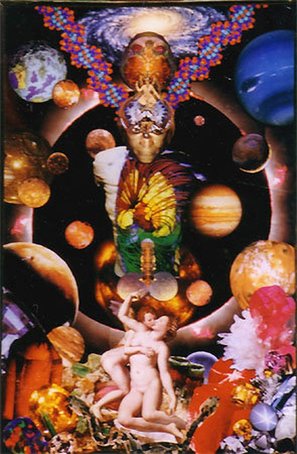
|
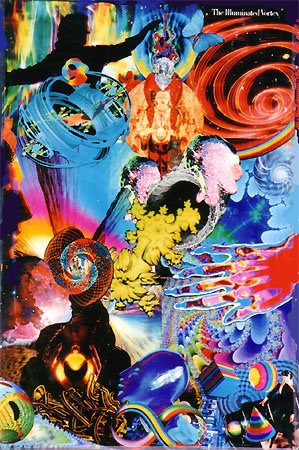
|
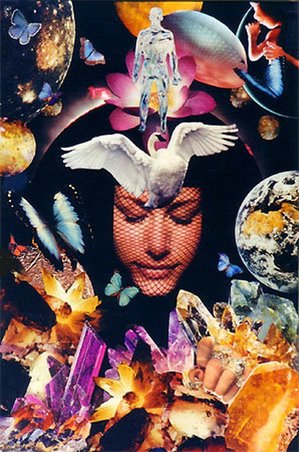
|
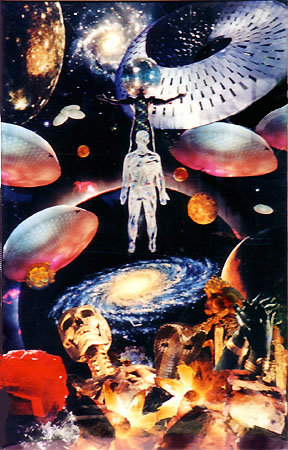
|
|
|
|
|
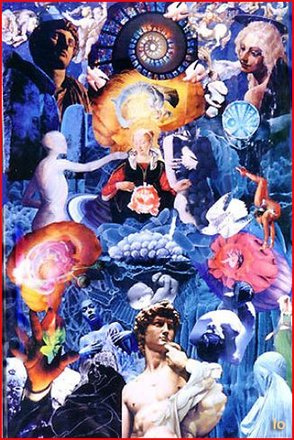
|
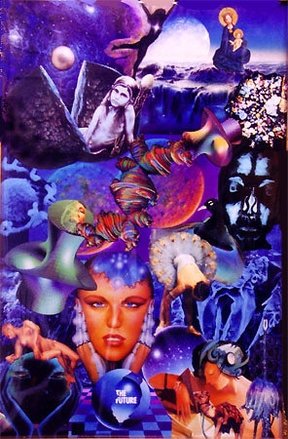
|
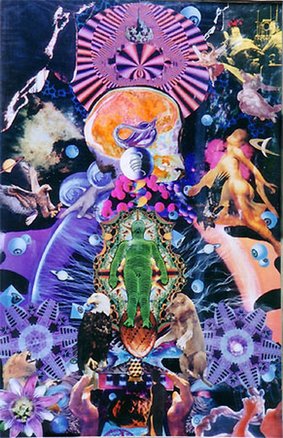
|
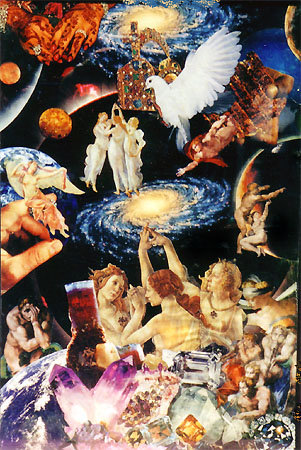
|
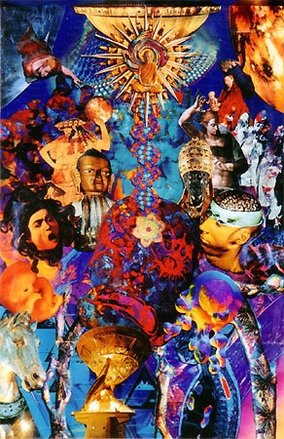
|
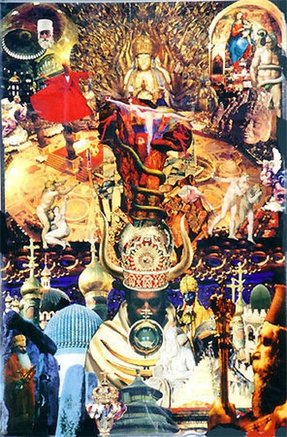
|
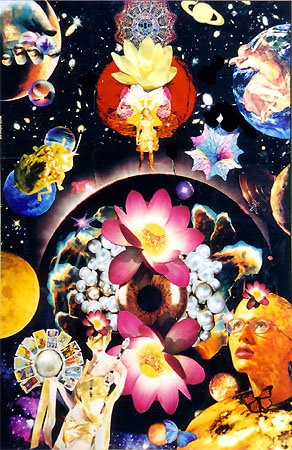
|
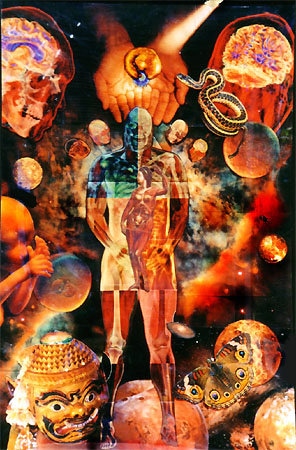
|
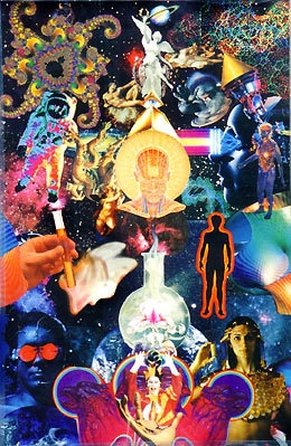
|
http://psychogenesisart.weebly.com/
Anima Mundi bids you welcome and acts as our tour-guide or hostess. She coaxes you deeper into the labyrinth of desire and fulfillment, where each of you can find your own resonance, the imagery which speaks the loudest or clearest, or beguiles with the mere whisper. To experience psychic reality means to be in soul, in the realm of the imagination, as if interacting with its inhabitants and locales. Inner visionary experience, be it wrathful or beatific, is an expression of soul. Through images the unconscious affects our worldview, health and relationships.
Soul is the middle world between gross materiality and the spiritual world. Matter, spirit, and ego fight over the soul. Yet soul is a primary experience, virtually our only way of being. Each wants its unique fantasy to reign uppermost. So, the first task is to distinguish soul from spirit, so the body may unite with and be enlivened by both. This is a psychological approach to art and life--giving voice to soul, living life as art. It means the return of a subjective feminine eye on reality. It means enlivening of our bodies and the world of nature with imagination.
When we see soul as the background of all phenomena, we becoming aware of the animating principle and develop a relationship with Her. All images arise either from body processes (instinct) or psychic forms (spirit). Whether instinct-controlled or spirit-controlled, they are related to physiological processes. They appear psychologically as images, but work physiologically. They produce emotional or visceral aspects, but not in any causal way. The images don't produce reactions.
The image is the entire psychophysical gestalt. The soul generates images unceasingly. The soul lives on images and metaphor, especially epistemological metaphors--how we know what we know. These images form the basis of our consciousness. All we can know comes through images, through our multi-sensory perceptions. So, this soul always stays close to the body, close to corporeality, to what "matters." Let the images come into your body. Embrace the image.
Anima Mundi bids you welcome and acts as our tour-guide or hostess. She coaxes you deeper into the labyrinth of desire and fulfillment, where each of you can find your own resonance, the imagery which speaks the loudest or clearest, or beguiles with the mere whisper. To experience psychic reality means to be in soul, in the realm of the imagination, as if interacting with its inhabitants and locales. Inner visionary experience, be it wrathful or beatific, is an expression of soul. Through images the unconscious affects our worldview, health and relationships.
Soul is the middle world between gross materiality and the spiritual world. Matter, spirit, and ego fight over the soul. Yet soul is a primary experience, virtually our only way of being. Each wants its unique fantasy to reign uppermost. So, the first task is to distinguish soul from spirit, so the body may unite with and be enlivened by both. This is a psychological approach to art and life--giving voice to soul, living life as art. It means the return of a subjective feminine eye on reality. It means enlivening of our bodies and the world of nature with imagination.
When we see soul as the background of all phenomena, we becoming aware of the animating principle and develop a relationship with Her. All images arise either from body processes (instinct) or psychic forms (spirit). Whether instinct-controlled or spirit-controlled, they are related to physiological processes. They appear psychologically as images, but work physiologically. They produce emotional or visceral aspects, but not in any causal way. The images don't produce reactions.
The image is the entire psychophysical gestalt. The soul generates images unceasingly. The soul lives on images and metaphor, especially epistemological metaphors--how we know what we know. These images form the basis of our consciousness. All we can know comes through images, through our multi-sensory perceptions. So, this soul always stays close to the body, close to corporeality, to what "matters." Let the images come into your body. Embrace the image.
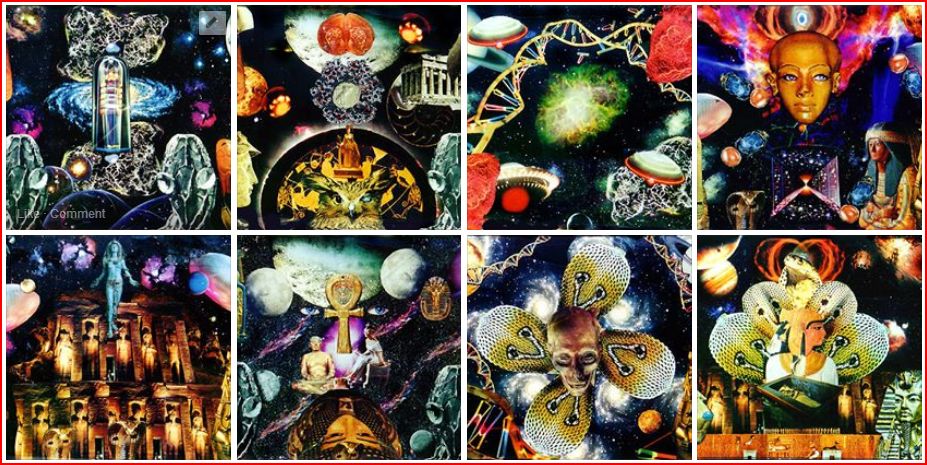
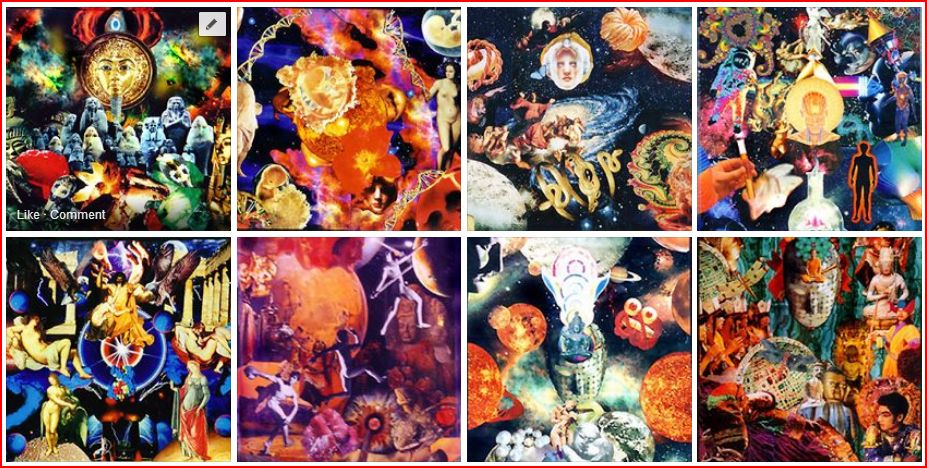
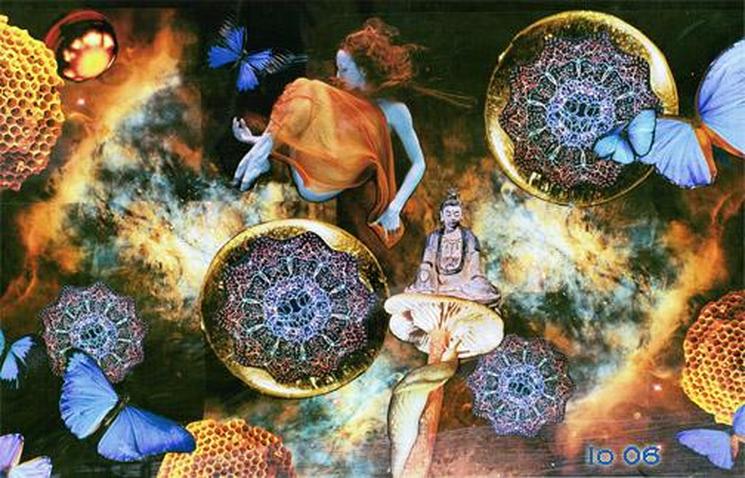
FLOATER
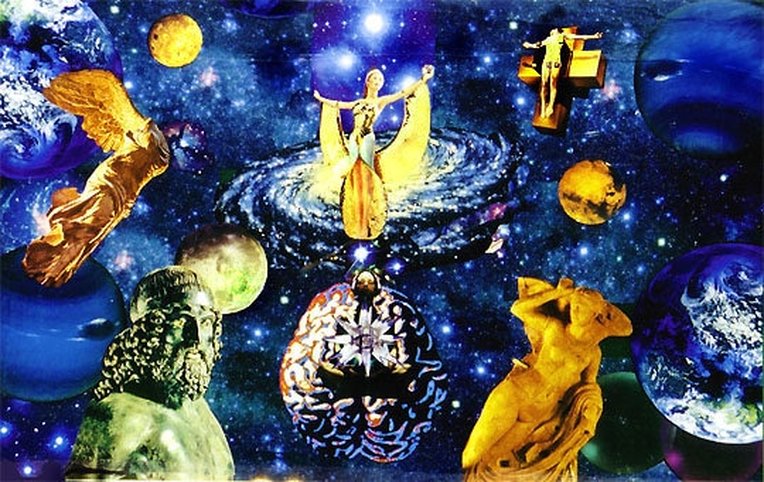
ANOTHER STARRY NIGHT
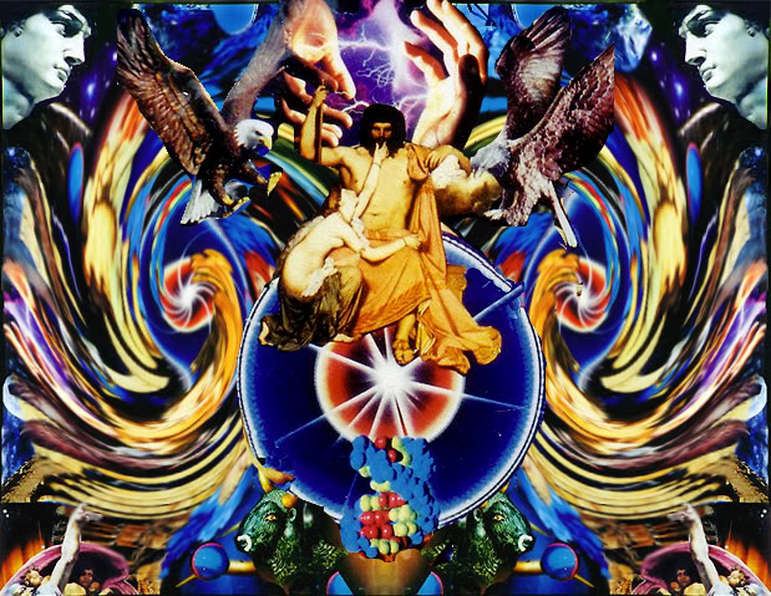
ZEUS
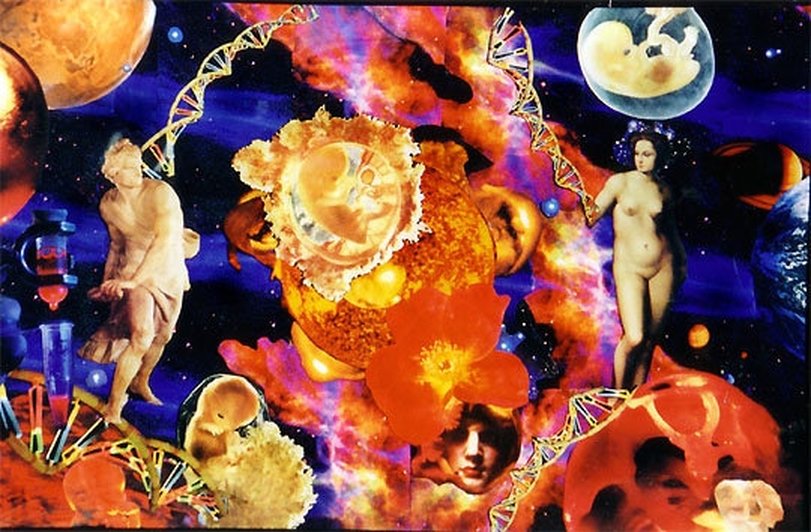
JACOB'S LADDER
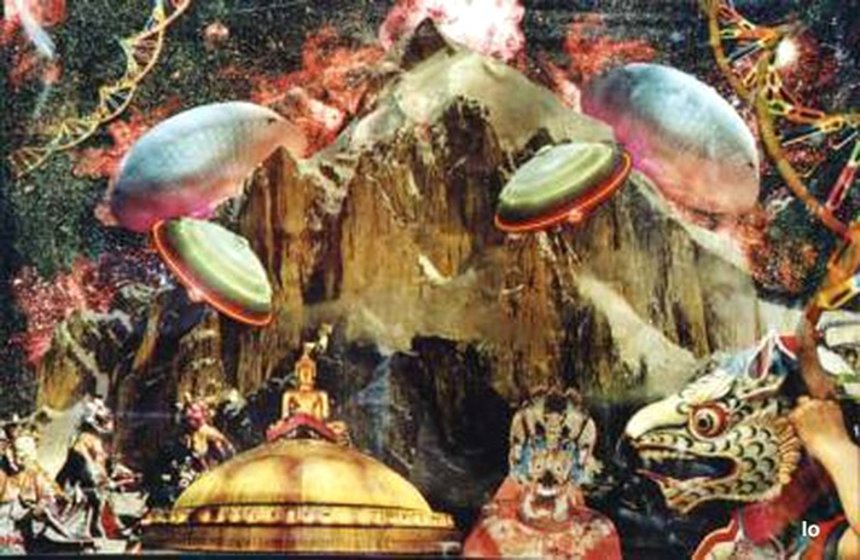
BIOFIELDS & TULPOIDS
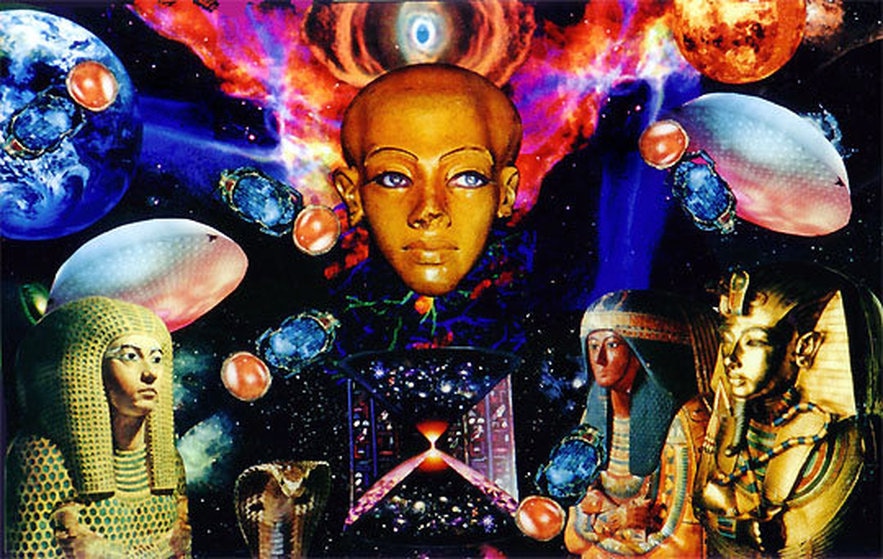
NUIT
ISIS UNVEILED
BEYOND THE GATES OF TIME
ANCIENTS
COMPLEXITY
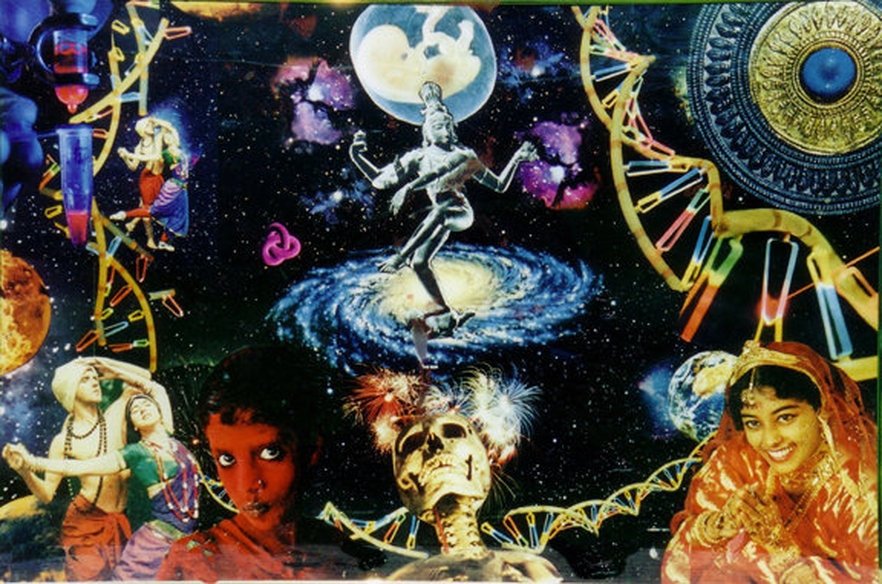
SHIVA DANCING
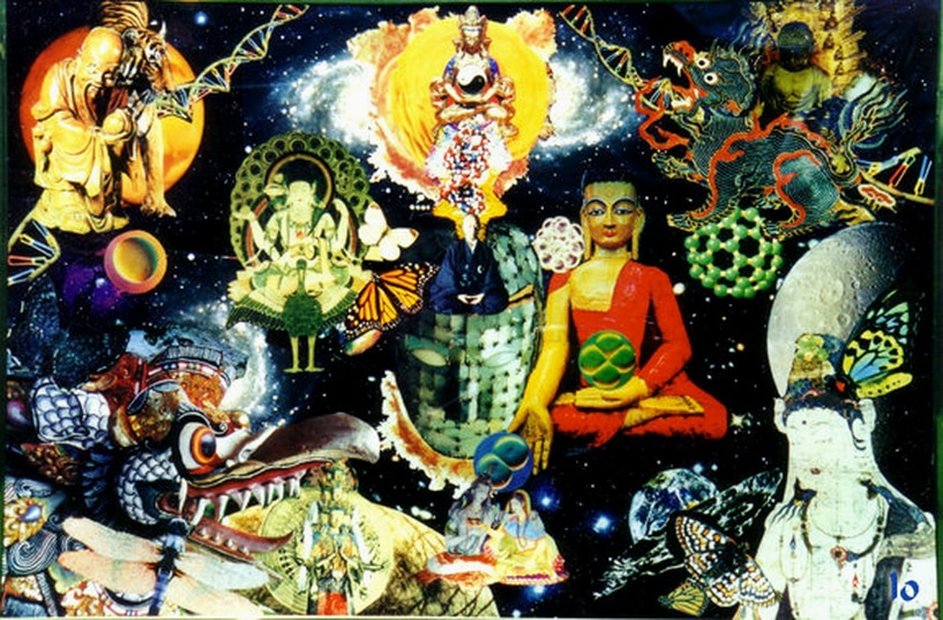
SECRET OF THE GOLDEN FLOWER
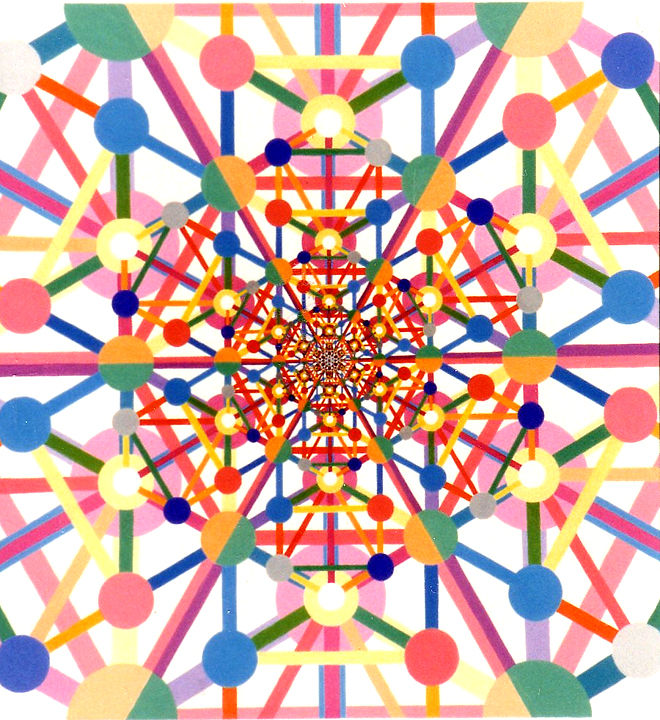
THE DIAMOND BODY
Gli interessati a collaborare potranno scrivere una email a : [email protected]
http://www.5avi.net/2016/05/15/altro-vegetali-sensibilita-intelligenza-comunicazione-delle-piante/
The light of Life: http://biophysics.sbg.ac.at/paper/biosem-yip-2006.pdf ;
Biofotoni : http://gsjournal.net/Science-Journals/Research%20Papers-Biomechanics/Download/6894;
Biophotons in plant’s roots: http://stke.sciencemag.org/content/9/452/ra106 ;
Transpersonal Biophotons: http://www.transpersonal.de/mbischof/englisch/webbookeng.htm
Human Biophotons : http://www.anatomyfacts.com/research/VanWijIntroduction.pdf
Biophoton interaction : http://www.u.arizona.edu/~kcreath/pdf/pubs/2005_KC_GES_SPIE_v5866p338.pdf ;
Biophotons communication: http://www.rexresearch.com/biophotons/BiophotonsandBiocommunication3.pdf ;
Light in shaping life: https://www.amazon.it/Light-shaping-life-Biophotons-medicine/dp/9081884328;
(c)2017, Iona Miller, All Rights Reserved
http://www.5avi.net/2016/05/15/altro-vegetali-sensibilita-intelligenza-comunicazione-delle-piante/
The light of Life: http://biophysics.sbg.ac.at/paper/biosem-yip-2006.pdf ;
Biofotoni : http://gsjournal.net/Science-Journals/Research%20Papers-Biomechanics/Download/6894;
Biophotons in plant’s roots: http://stke.sciencemag.org/content/9/452/ra106 ;
Transpersonal Biophotons: http://www.transpersonal.de/mbischof/englisch/webbookeng.htm
Human Biophotons : http://www.anatomyfacts.com/research/VanWijIntroduction.pdf
Biophoton interaction : http://www.u.arizona.edu/~kcreath/pdf/pubs/2005_KC_GES_SPIE_v5866p338.pdf ;
Biophotons communication: http://www.rexresearch.com/biophotons/BiophotonsandBiocommunication3.pdf ;
Light in shaping life: https://www.amazon.it/Light-shaping-life-Biophotons-medicine/dp/9081884328;
(c)2017, Iona Miller, All Rights Reserved
Everyday we witness the reckless extinction of species after species, culture after culture. We live at their expense, and some even find that acceptable. The planet has degraded and its fundamental resources such as water and soils depleted and mined out. Meanwhile the human population has bloomed like algae. Who is to say how long it is before human existence becomes untenable?
This is not a new topic, obviously. It has been the subject of earnest speculation for some time, even before public awareness of the global population bomb (see ZPG). In 1968, the Club of Rome formed a multidisciplinarian team to analyze the precarious predicament of mankind. As an experiment, this endeavor gets mixed reviews as the results have been used to justify another round of Western imperialism.
Recognizing the complex interactions, scientists, educators, economists, humanists, industrialists, and national and international civil servants from ten countries began to think and act globally. Their stated aims were to bring new understanding to policy-makers and the public, and to promote new global policy initiatives and action. This benign-seeming program got twisted into the agenda of the neo-con(servative) parties, and came under the umbrella known as New World Order, who’s hallmark is that absolute power corrupts absolutely. But they only have the power we give them by denying our own.
Predicament of Mankind
The institutions and patterns of thought of the (military/industrial/academic) World-Machine have created an interconnecting set of world-wide problems of an ecological, economic and political nature. Machine-minded think tanks, even if they are thinking globally, can only see entropic decay through their own worldview. They cannot think out of the box, unless there is a fundamental paradigm shift that is reflected in the sciences, and likely foreseen in the arts.
The energy shortage, rise of food prices, scandals in government, and unwinable wars against ideas like idiologies and ‘terrorism’ are the first harbingers of the approaching crisis. There are two routes from here: The route of stagnation and eventual total collapse, and the route of flexibility and growth, which could lead to a golden age. Chaos Theory reveals both catastrophe (bifurcation) and renewal are likely inevitable.
Rather than the obsolete paradigm of a ‘world machine’, we need to think in more organic terms of holistic self-organization – reorganization at a higher level -- as revealed in Chaos Theory, which demonstrates nature’s own creative way of evolutionary assembly. All things are simply connected.
Order emerges spontaneously and unpredictably from the creative edge of chaos – it emerges suddenly from disorder: from the unconscious chaos the concept finally forms, the artistic inspiration is captured, the photographic composition suddenly appears in the frame with just the proper atmosphere. Aesthetic principles of multisensory harmony reflect similar structuring.
With a change in paradigms that is fundamental not merely conceptual, the dangers and the possibilities are as great for us in this 21st century as they were for those in the sixteenth century. In chaos theory, the old system typically undergoes a catastrophic collapse before the new order emerges. The “new order” cannot be imposed on the old system by will nor intentionality.
When all the available world's arable land is required to feed the world's population , even with perfect world-wide systems of land use and distribution of food, there will inevitably be mass famine. Even if productivity is quadrupled it only gives us roughly 50 more years. Once all the land is used to full capacity and the soil mined-out, there is simply no more land. Once the non-renewable resources are gone, that's it. The geological processes that created those resources took hundreds of millions of years.
We are using them all up while simultaneously polluting the ecosphere for decades. The ecosphere is flexible, but not infinitely. We have made massive assaults on it including Frankensteinian experiments with little understanding of the ultimate effect. Sudden increases in the temperature of the earth and melting of ice caps, death of the oceans and rainforests that produce our oxygen are horrible possibilities that such worldwide pollution produces if exponentially continued long enough.
The shut down of the vast oceanic pump from melting fresh water near Greenland would usher in a new Ice Age. Other unpredictable catastrophes include collisions with meteors or comets, pole shifts, or the collapse of the ionosphere with solar scorching of the biosphere. With all this and more to fight against, you’d think we could just get along on our small blue planet, but such is not human nature.
With these scenarios in mind, the human race has a mandate to reinvent entropic technology and revision our existence with an ethically based negentropic technology, based in the proven notion of a virtually infinite universe of potential. Only in this way can we (all) become part of the solution, rather than the problem.
There are many psychic prophecies down through the centuries of a great worldwide war ending this period of history. When social groups become about equally powerful and equally dangerous to each other, some conclude it is time to put them under a common government, and a synthesized civilization. Yet, this process cannot be forced nor engineered.
We must avoid the specialized way of thinking that blindly leads toward these frightful collisions of ideology. We must have a tolerant humanist government – the democratic ideal we inherited from the Greeks whose philosophical culture and aesthetics was based on geometrical harmonies.
This dynamic existential aesthetic is what has come to be known lately as the “DaVinci Code”, that was foundational in the emergence of the Renaissance flowering. The democratic ideal shelters and even fosters idiosyncratic processes and thinking along the spectrum of potentiality that lead toward creative emergence – at the fringes of society and research.
Western civilization of the World-Machine has lost its direction and vitality in the Twentieth Century. There are numerous symptoms of this, ranging from crime in the streets, to the ugly unlivability of modern cities, to political corruption, to the pandering tendencies of the information/entertainment industries, to the thickening rigidity and irrelevance of schools and universities.
There is no longer any higher center in Western civilization, not religiously, aesthetically, or politically. Christian religion ceased to be vital in the 17th Century; Faustian consciousness has produced a fragmentation of 'higher' cultural worlds and Practical consciousness gives us the total impoverishment of the ordinary aesthetic environment that is one of the chief reasons for the boredom and alienation that most people feel in our cities.
The first sign of rigidity in the schools and universities probably came with their reaction to psychical research in the twenties and thirties. Today, swollen hierarchies of administrators absorb half the budget and contribute nothing but obstruction and useless regulation for faculty and students. No alternatives to materialism and specialism can be explored.
Humanist, empirical religionist, open learning schools are actually illegal most places. One of the symptoms of the corruption of Western civilization is that no one feels any higher responsibility anymore. This is especially evident in media.
"simplifying is harder. Complicating is easy, simplifying is difficult. To complicate just add, everything you want: Colors, shapes, actions, decorations, characters, environments full of things. Everyone is capable of complicating. Few are able to simplify. [...] to simplify you have to take off, and to remove you need to know what to remove, as the sculptor does when a chisel takes away all the material that is more than the sculpture he wants to do. [...] instead of adding it means recognizing the essence of things and telling them in their essentiality. This process leads out of time and fashions, the theorem has a date of birth, but for its essentiality is out of time. Simplification is the sign of intelligence, an ancient Chinese saying says, "what you cannot say in a few words can not be said in many "". Bruno Munari, written report