IONA MILLER
  • Home
  • PUBLICATIONS
  • ARTICLES 2017
    • MAJOR ARCANA
      • ARCANA VIDEOS
    • MYTHIC FORMS
      • NUIT
      • GEN-ISIS
      • SOBEK - Wild Psyche
      • KYBELE
      • Helios Uplifter
      • HELIOS TITAN
      • Aphrodite
      • THANATOS
    • ART & TRAUMA
    • PAINTING
    • DAIMON
    • ANIMA MUNDI
    • WORLD WEARY
    • INTERIORIZED VISION
    • TRANSFIXED
    • REFLECTIONS
    • CREATIVE APPROACH
    • SELF-EXPLORATION
    • SELF KNOWLEDGE
    • THEURGY
    • ART & SOUL
    • ESOTERICS
    • INDIVIDUATION
    • LABYRINTH
    • JUNGIAN QABALAH
    • THE BEAD GAME
    • DUNE MYTHS
    • NEW AGE CRITIQUE
    • PHILOSOPHERS STONE
    • BLACK MADONNA
    • ST. GERMAIN Film
    • DRAGON ARCHETYPE
    • TOTAL ECLIPSE
    • PROJECTS
      • PSYCHE
      • Sobek
      • Athena 2018
      • Ares
      • Apollon
      • Horus
    • Afterlife
    • Transformation
    • Transgressive Forces
    • Wisdom Light
    • Sacred Sex
    • TARANTISM
  • ABOUT
  • GENEALOGY
    • Here Be Dragons Home
      • DRAGONTREE
      • Myth Ancestors
      • EGYPT
      • Grail
      • CATHARS
    • 100 Generations
    • Kindred Spirits
    • Ancestors
    • Lineage
    • XX
  • GNOSIS
  • HEALING
    • Metaphors
    • Holo Healing
    • Microvibrations
  • Mind-Body
    • BODY & SOUL
  • Io Art
  • FRONTIER SCIENCE
    • SEDLAK
    • Pineal DMT
    • Bioholography
    • The Field
    • Holographic Archetypes
  • DREAMS
    • Dreamwallker
  • SACRED GEOMETRY
    • QABBALAH
      • DIAMOND BODY
  • ALCHEMY
    • PRIMA MATERIA
  • VIDEOS
  • ARCHIVES
    • Climate 2020
  • Journal
  • Contact
  • Wrestling Thanatos
  • Innate Imagery
  • SIRIUS RISING
  • UFO
  • OANNES
  • DREAMHEALING
  • SELF THERAPY
  • ART SOUL
  • PSYCHE
  • XYZ
  • EVENT HORIZON
  • HADES
  • Thanatos Myth
  • Home
  • PUBLICATIONS
  • ARTICLES 2017
    • MAJOR ARCANA
      • ARCANA VIDEOS
    • MYTHIC FORMS
      • NUIT
      • GEN-ISIS
      • SOBEK - Wild Psyche
      • KYBELE
      • Helios Uplifter
      • HELIOS TITAN
      • Aphrodite
      • THANATOS
    • ART & TRAUMA
    • PAINTING
    • DAIMON
    • ANIMA MUNDI
    • WORLD WEARY
    • INTERIORIZED VISION
    • TRANSFIXED
    • REFLECTIONS
    • CREATIVE APPROACH
    • SELF-EXPLORATION
    • SELF KNOWLEDGE
    • THEURGY
    • ART & SOUL
    • ESOTERICS
    • INDIVIDUATION
    • LABYRINTH
    • JUNGIAN QABALAH
    • THE BEAD GAME
    • DUNE MYTHS
    • NEW AGE CRITIQUE
    • PHILOSOPHERS STONE
    • BLACK MADONNA
    • ST. GERMAIN Film
    • DRAGON ARCHETYPE
    • TOTAL ECLIPSE
    • PROJECTS
      • PSYCHE
      • Sobek
      • Athena 2018
      • Ares
      • Apollon
      • Horus
    • Afterlife
    • Transformation
    • Transgressive Forces
    • Wisdom Light
    • Sacred Sex
    • TARANTISM
  • ABOUT
  • GENEALOGY
    • Here Be Dragons Home
      • DRAGONTREE
      • Myth Ancestors
      • EGYPT
      • Grail
      • CATHARS
    • 100 Generations
    • Kindred Spirits
    • Ancestors
    • Lineage
    • XX
  • GNOSIS
  • HEALING
    • Metaphors
    • Holo Healing
    • Microvibrations
  • Mind-Body
    • BODY & SOUL
  • Io Art
  • FRONTIER SCIENCE
    • SEDLAK
    • Pineal DMT
    • Bioholography
    • The Field
    • Holographic Archetypes
  • DREAMS
    • Dreamwallker
  • SACRED GEOMETRY
    • QABBALAH
      • DIAMOND BODY
  • ALCHEMY
    • PRIMA MATERIA
  • VIDEOS
  • ARCHIVES
    • Climate 2020
  • Journal
  • Contact
  • Wrestling Thanatos
  • Innate Imagery
  • SIRIUS RISING
  • UFO
  • OANNES
  • DREAMHEALING
  • SELF THERAPY
  • ART SOUL
  • PSYCHE
  • XYZ
  • EVENT HORIZON
  • HADES
  • Thanatos Myth
Search
Picture

cathars tree

Picture
Picture
MY CATHAR TREE
Iona Miller

https://web.archive.org/web/20170920011656/http://herebedragons.weebly.com/cathars--st-anthony.html

In the Cathar language of old Provence, a female elf was an albi (elbe or ylbi), and Albi was the name given to the main Cathar center in Languedoc. This was in deference to the matrilinear heritage of the Grail dynasty, for the Cathars were supporters of the original Albi-gens - the Elven Bloodline which had descended through the Dragon Queens of yore, such as Lilith, Miriam, Bathsheba and Mary Magdalene. It was for this reason that, when Simon de Montfort and the armies of Pope Innocent III descended upon the region in 1209, it was called the Albigensian Crusade. Through some 35 years, tens of thousands of innocent people were slaughtered in this brutal campaign - all because the inhabitants of the region were champions of the original concept of Grail kingship, as against the pseudo-style of monarchy which had been implemented by the papal machine.

Likewise, their Cathar successors: Cathar priests – known under the name “perfects” or “the perfect” – were dressed in black. Men had long hair, particularly the characteristic long red hair like Mary Magdalene. Their Perfects were considered living Christs. They were called the Good People. They sought only the light, through the Light-Bringer, who was the same as Christ and the archangel Michael. Cathars had a specific fascination with Mary Magdalene and the Languedoc tradition of Courtly Love.

The Cathars retained the Ring Lord culture and traditions, referring to the Messianic bloodline as the Elven Race, venerating them as the Shining Ones. In the language of old Provence, a female elf was an 'albi', and Albi was the name given to the main Cathar centre in Languedoc. This recognized the matrilinear heritage of the Grail dynasty, for the Cathars were supporters of the Albi-gens - the elven bloodline which had descended through the Grail queens such as Lilith, Miriam, Bathsheba and Mary Magdalene. The Shining Ones of the elven race were there to light the way. This is why their 1209 genocide was called the Albigensian Crusade.
  • Perfecti, Credentes, Patrons, or Military

Cathar Perfecti
  • Amiel Aicard (survived Montségur)
  • Guilhem Aicard *, - d16/3/1244, Montségur
  • Pons Ais *, - d16/3/1244, Montségur
  • [http://www.geni.com/people/Mansel-Jennings/1244, Montségur
  • Pèire Aura *, Belesta, (participant in the massacre at Avignonet, May 29, 1242) - d16/3/1244, Montségur
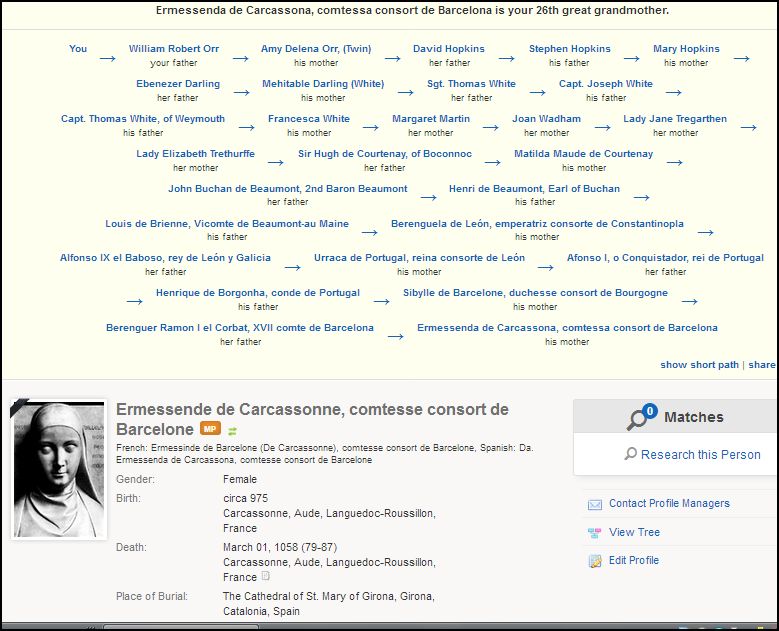
  • Pere Authié * (became bishop of Bouan; condemned and burnt in 1309 in Toulouse)
  • Bernat d'Auvezine *, - d16/3/1244, Montségur
  • Raimonde Barbe *, Mas Saintes-Puelles, , - d16/3/1244, Montségur
  • Guilhem Belibasta *, c1280, Cubières - d1321, Carcassonne (last known 'parfait')
  • Arnaud de Bensa *, - d16/3/1244, Montségur
  • Raimon de Belvis *, senyor d'Usson, - d16/3/1244, Montségur
  • Esclarmonda de Bessac *
  • Ramon Blasco *
  • Pèire Boué *
  • Etienne Boutarra *, - d16/3/1244, Montségur
  • Pèire de Bouville *, Toulouse
  • Bresilhac de Caihavel *, knight (participant in the massacre at Avignonet, May 29, 1242) - d16/3/1244, Montségur
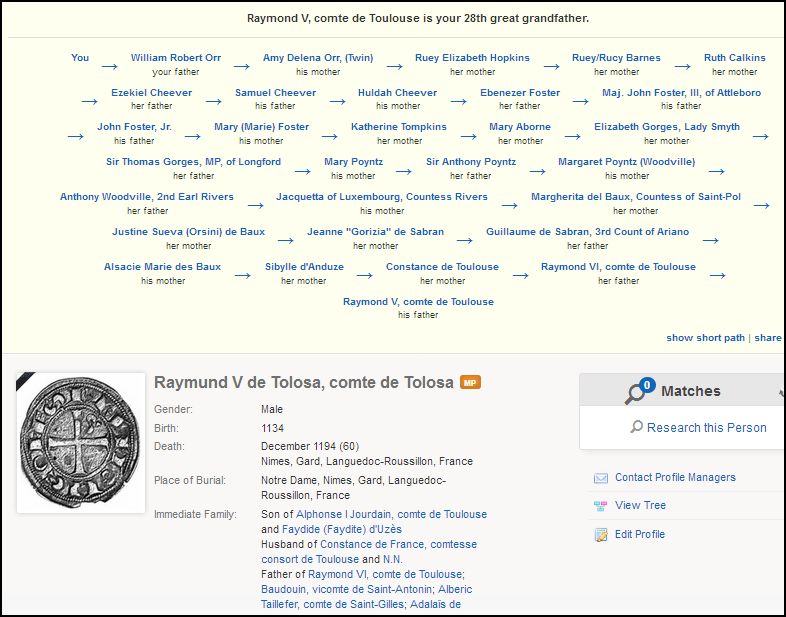
  • Pons Capelle *, - d16/3/1244, Montségur
  • Guiraud de Caraman *, - d16/3/1244, Montségur
  • Na Cardolha *, Toulouse
  • Arnaud des Casses *, seigneur de Casses, - d16/3/1244, Montségur
  • Ermessenda, vescomtessa de Castellbó
  • Joan de Combel *, chevalier de Laurac, - d16/3/1244, Montségur
  • Saissa de Congost *, , - d16/3/1244, Montségur
  • Raimonde de Cuq *, Lavelanet, - d16/3/1244, Montségur
  • Raimon David *
  • Guilhem Delpech *, - d16/3/1244, Montségur
  • Arnaud Domergues *, Laroques d'Olmes, - d16/3/1244, Montségur
  • Bruna Domergues *, - d16/3/1244, Montségur
  • Rixende Donat *, Toulouse, - d16/3/1244, Montségur
  • Faye de Durfort *
  • Aude de Fanjaus *
  • Guiraud Ferrier *, Sorèze
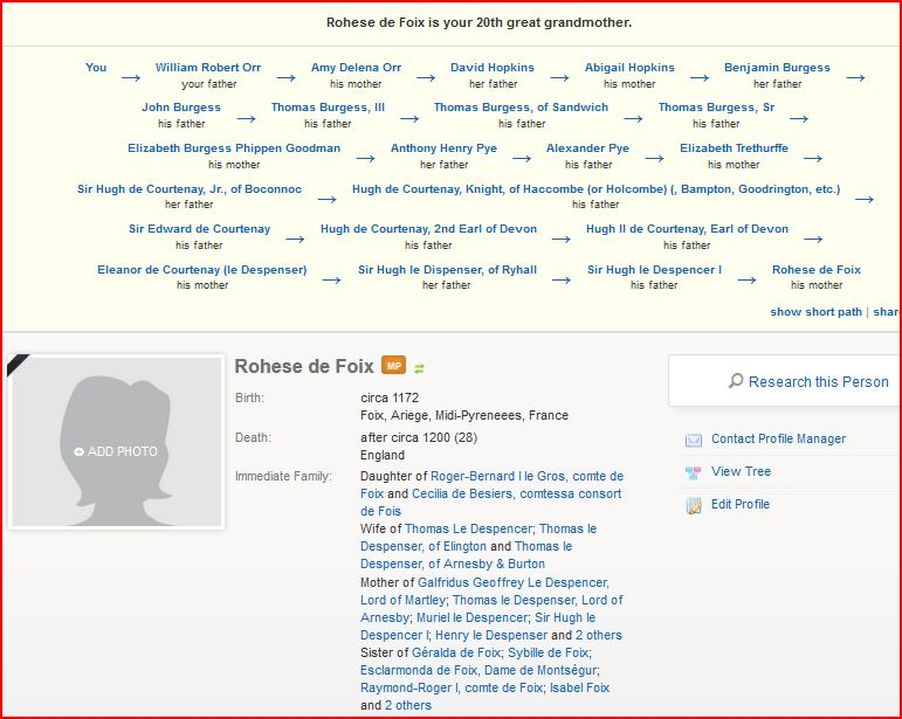
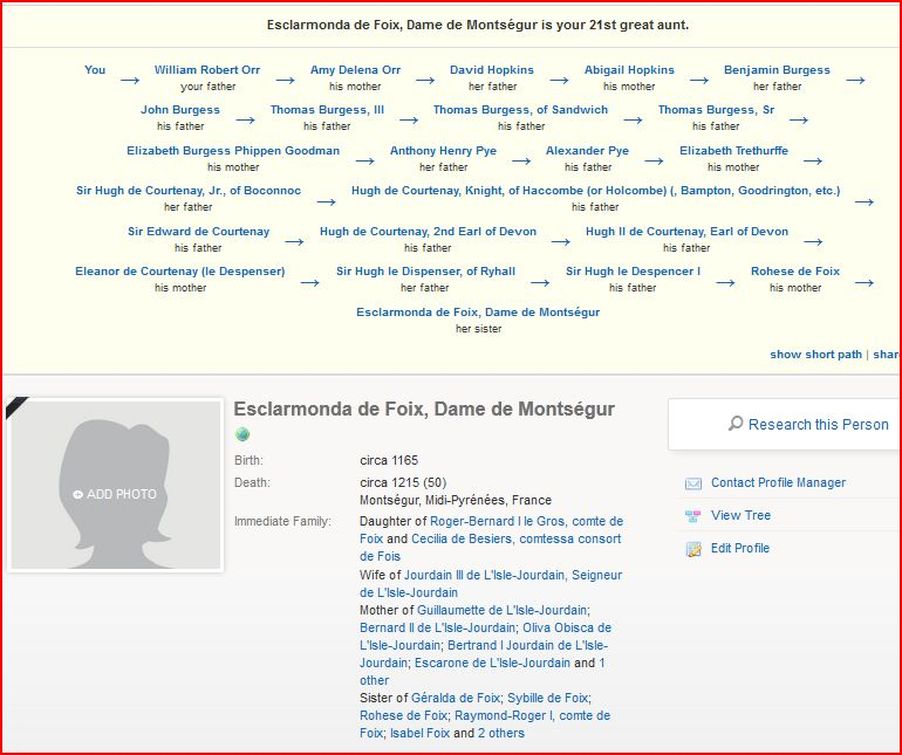
  • Esclarmonda de Foix *
  • Joan de la Garde *, - d16/3/1244, Montségur
  • Guillem Garnier *, - d16/3/1244, Montségur
  • Arnaud Raymond Gauti, knight from Sorèze and Durfort, (participant in the massacre at Avignonet, May 29, 1242), - d16/3/1244, Montségur
  • Arnaud Giffre *
  • Bernat Guilhem, - d16/3/1244, Montségur
  • [http://www.geni.com/people/Mansel-Jennings/1244, Montségur
  • Jordà Hunaud de Lanta *
  • [http://www.geni.com/people/Mansel-Jennings/1244, Montségur
  • Etienne Isarn, Casses, - d16/3/1244, Montségur
  • Raimon Isarn *, Toulouse, - d16/3/1244, Montségur
  • Guilhem d'Issus, seigneur de Montgaillard, - d16/3/1244, Montségur
  • Joan de la Garde *, - d16/3/1244, Montségur
  • Blanche de Laurac *
  • Bruna de Lahille *, - d16/3/1244, Montségur
  • [http://www.geni.com/people/Mansel-Jennings/1244, Montségur
  • Bertran de Maireville *
  • Raimon de Marseillan *, - d16/3/1244, Montségur
  • Guilhem d'En Marti *, Montferrier, (participant in the massacre at Avignonet, May 29, 1242), - d16/3/1244, Montségur
  • Felipa de Montcada *
  • Braida de Montserver *, - d16/3/1244, Montségur
  • Arsenda Narbona *, - d16/3/1244, Montségur
  • Guilhelm Narbona*, - d16/3/1244, Montségur
  • Pons Narbona *, Latour de Carol, - d16/3/1244, Montségur
  • Arnaud d'Orlhac *, - d16/3/1244, Montségur
  • Arnau Peire, * chanoine catholique de Saint Sernin, - d circa 1230
  • Guilhem Pèire-Duran *, Toulouse, - d16/3/1244, Montségur
  • Esclarmonda de Perella *, - d16/3/1244, Montségur
  • Forneira de Perella *
  • Michel du Pin *, Toulouse
  • Guilhem Prunel *
  • Guilhem Raou *, - d16/3/1244, Montségur
  • Alazais Raseire *
  • Bernat Rastel *
  • Joan Rei, Aint Paul Cap de Joux, - d16/3/1244, Montségur
  • Pèire Robert *, Miralpeis, - d16/3/1244, Montségur
  • Raimon Rival *
  • Martin Roland *, - d16/3/1244, Montségur
  • Raymonde de Saint Germain *
  • Bernat de Sant Marti, chevalier de Laurac (participant in the massacre at Avignonet, May 29, 1242), - d16/3/1244, Montségur
  • Raimon de Sant Marti *, - d16/3/1244, Montségur
  • Pèire Sirven *, - d16/3/1244, Montségur
  • Taparel *, , - d16/3/1244, Montségur
  • Rixende de Teilh *, - d16/3/1244, Montségur
  • Arnaud Teuly *, Limoux, - d16/3/1244, Montségur
  • Raomon Guilhem de Tournebouix *, (participant in the massacre at Avignonet, May 29, 1242), - d16/3/1244, Montségur
  • Raimon Trille *
  • Ermengarde d'Ussat *, - d16/3/1244, Montségur
  • Maurand el Vell *, Toulouse
  • Arnaud de Vilanova *, Toulouse
Cathar Credentes
  • Guillem Authié
  • Peytavi Boursier *, Toulouse
  • Raimon de Brouelles *
  • Barthélémy Boué *, Toulouse
  • Eudes de Castelnau * burnt abt 1198
  • Imbert de Castelnau *
  • Raimon Centoul *,
  • Joan Christofols, avocat à Moissac
  • Pèire Guilhem Delort *, Toulouse
  • Bernat Audric de Drémil *
  • Peire Esquivat *, Toulouse
  • Peire Embrin *, Toulouse
  • Etienne d'Espagne *, Toulouse
  • Blanche de Gameville *, Toulouse
  • Pons de Gameville *, Toulouse
  • Sicard de Gameville *, knight, Toulouse
  • Arnau Gui (el Vell) *, Toulouse
  • Guillem Bernat Hunaud de Lanta *
  • Raimon Hunaud *, senyor de Lanta
  • Dyas Isarn *, Toulouse
  • Raimona Isarn *, Toulouse
  • Pèire Jacqmars *, Toulouse
  • Peytavi Laurence *, Toulouse
  • Etienne Masse *, Toulouse
  • Vital Mège *, Cassemil
  • Cortesa Mercader *, Toulouse
  • Guilhem Mercader *, Toulouse
  • Falquet de Moissac *
  • Peyronnet de Montmaur *
  • Arnau de Mudagons *, Torreilles
  • Arnaud Peyrèire *, Toulouse
  • Arnaud Guilhem Peyrèire *, Toulouse
  • Bertran Peyrèire *, Toulouse
  • Alaman de Rouaix *
  • Bertran de Saissac *
  • Hug de Saissac *
  • Pere V de Saissac, XIII vescomte de Fenollet *
  • Joan Saladin *, Toulouse
  • Arnau Sicre
  • Bernat Signier
  • Isarn d Taix *, Pamiers
  • Bernat Raimon Teulier *, Toulouse
  • Joan Tisserand, * - d. Carcassonne
  • Ponç III de Vernet
Cathar Patrons
  • Bernat d'Alio *, senyor d'Usson
  • Arnaud d'Alio, senyor d'Usson
  • Bernat Ot d'Aniort *, senyor de Razès
  • Jaspert de Barberà *, senyor de Barberà, - d1278
  • Arnau I *, vescomte de Castellbó
  • Guilhem Laurenç de Castellbo (participant in the massacre at Avignonet, May 29, 1242)
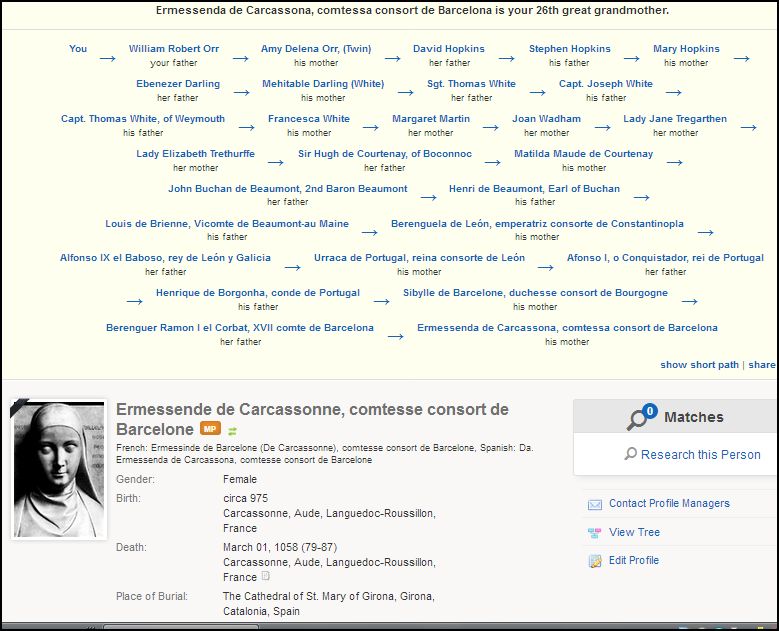
  • Guilhem Ramon de Josa *
  • Ramon de Josa *
  • Arnaud Roger de Mirapeis (participant in the massacre at Avignonet, May 29, 1242)
  • Pere Roger IX, senyor de Miralpeis
  • Ramon de Perella *, senyor de Montsegur
  • Bernat de Sant Marti, chevalier de Laurac (participant in the massacre at Avignonet, May 29, 1242)
  • Bernat Sermon II *, senyor d'Albedun
  • Benet de Tèrme
  • Raimon de Tèrme
  • Guilhem de Tèrme, senyor de Tèrme
  • Olivièr de Tèrme *, b1200 -d12/8/1275, Saint Jean d'Acre
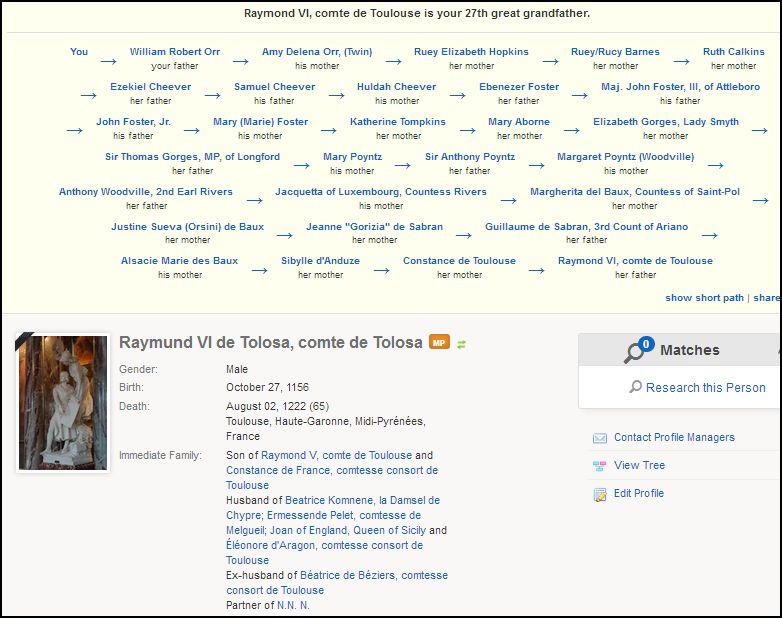
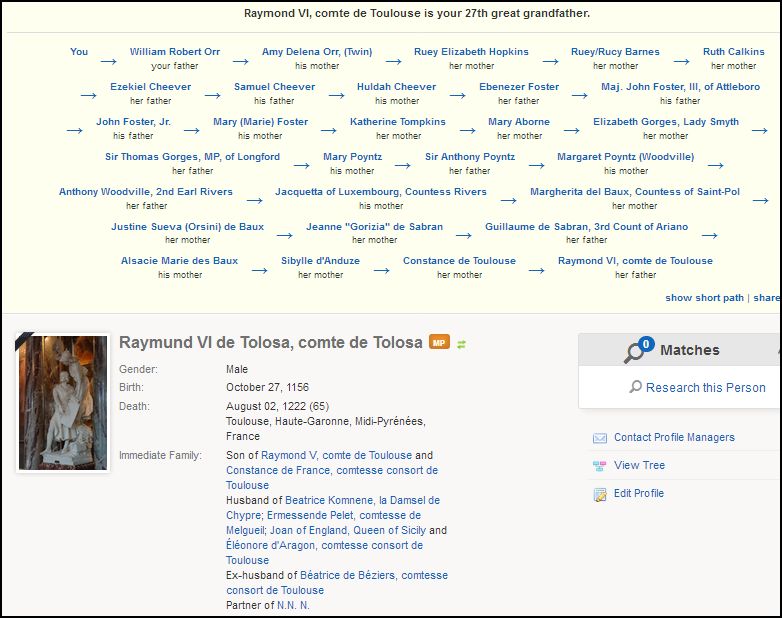
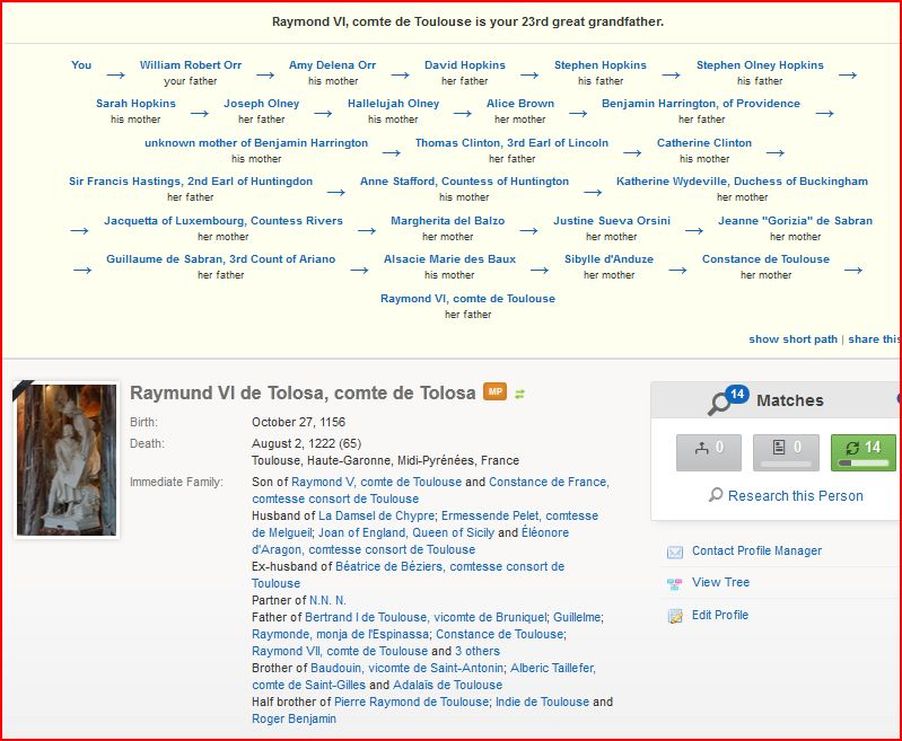
  • Raimon VI *, comte de Tolosa
  • Raimon Roger Trencavel *
  • Ramon Trencavel *
Cathar Military
  • Raimon d'Alfaro (participant in the massacre at Avignonet, May 29, 1242)
  • Guillem d'Aniort *
  • Barrau *, shield bearer for Bernat de Sant Marti) (participant in the massacre at Avignonet, May 29, 1242)
  • Guilhem de Lahille, chevalier de Laurac (participant in the massacre at Avignonet, May 29, 1242)

  • Guiraud de Pépieux, chevallier du Biterrois
(to be classified)
  • Felip d'Alayrac
  • Bernat d'Arzens
  • Guilhem Azemat (participant in the massacre at Avignonet, May 29, 1242)
  • Joan Azemat (participant in the massacre at Avignonet, May 29, 1242)
  • Guilhem Azema de Valls (participant in the massacre at Avignonet, May 29, 1242)
  • Guilhem de Balleguer
  • Raimon Bernat Barbe, Queille (participant in the massacre at Avignonet, May 29, 1242)
  • Pèire Roger de Belissen
  • Pèire Bomassip
  • Jordà de Cabarets
  • Pèire Rogièr de Cabarets
  • Gaillard de Calmont (participant in the massacre at Avignonet, May 29, 1242)
  • Blanche de Caramny
  • Bernat de Casnac
  • Raimon de Castellarnau
  • Robert de Castellrosselló
  • Guilhem Cathala
  • Joan Cathala (participant in the massacre at Avignonet, May 29, 1242)
  • Roger Cathala
  • Bernat Guilhem de Claira
  • Raimon de Corbera (participant in the massacre at Avignonet, May 29, 1242)
  • Arnau de Cos
  • Pèire de Cucugnan
  • Ferrou (participant in the massacre at Avignonet, May 29, 1242)
  • Guilhem Raimon Golairan (participant in the massacre at Avignonet, May 29, 1242)
  • Raimon de Josa
  • Pèire Roger de Latour de Lissac (participant in the massacre at Avignonet, May 29, 1242)
  • Guilhem del Mas
  • Jordà del Mas (participant in the massacre at Avignonet, May 29, 1242)
  • Alzieu de Massabrac (participant in the massacre at Avignonet, May 29, 1242)
  • Ot de Massabrac (participant in the massacre at Avignonet, May 29, 1242)
  • Pèire de Mazerolles (participant in the massacre at Avignonet, May 29, 1242)
  • Pèire Maury
  • Raimon de Miravall
  • Arnaud de Mudagons
  • Pèire de Nalzen (participant in the massacre at Avignonet, May 29, 1242)
  • Raimon de Na Vidal
  • Raimon de Narbona
  • Gaillard Ot (participant in the massacre at Avignonet, May 29, 1242)
  • Ot de Parestortes
  • Berenguer de Pi
  • Guilhem de Plaigne (participant in the massacre at Avignonet, May 29, 1242)
  • Pèire Raimon de Plaigne
  • Pèire de Pug Perduts
  • Sicard de Puivert (participant in the massacre at Avignonet, May 29, 1242)
  • Jordà de Quiders del Mas (participant in the massacre at Avignonet, May 29, 1242)
  • Guiraud de Rabat (participant in the massacre at Avignonet, May 29, 1242)
  • Imbert de Salles (participant in the massacre at Avignonet, May 29, 1242)
  • Pèire Vell (participant in the massacre at Avignonet, May 29, 1242)
  • Bernat de Vilanova
  • Jordà de Vilar (participant in the massacre at Avignonet, May 29, 1242)
  • Pèire Vital (participant in the massacre at Avignonet, May 29, 1242)
Picture
Picture
Picture
Picture
Picture
Picture
Picture
Picture
Early Christianity, itself, had psychoactive Communion rites, which were condemned as heretical, by the dominant Church established by Paul, but evidence indicates that the ecclesiastical elite as late as the Renaissance had reserved the psychoactive Eucharist for themselves, and vigorously prosecuted such sacraments by so-called heretical groups like the Cathars, as well as perpetuations of pre-Christian practices by persons accused of witchcraft. --Chris Bennett

The heretical Cathar sect in the 13th century was a particularly disturbing development to the medieval Church. Following an extreme form of dualism and practicing bizarre customs, the Cathars prompted the Albigensian crusade. Frassetto chronicles the crusade in detail, as well as the rise of a more aggressive inquisition that followed it. 


Who are the Cathers?
Catharism was a religious movement with Gnostic elements that originated around the middle of the 10th century, branded by the contemporary Roman Catholic Church as heretical. It existed throughout much of Western Europe, but its home was in Languedoc and surrounding areas in southern France. The Cathars were also sometimes labeled Albigensians.

Beliefs

Much of what one finds said of Cathar beliefs is based upon the claims and denunciations of their victorious orthodox opponents. In examining any declaration about Cathar beliefs, this historical fact must be held in balanced consideration.

It is commonly claimed that Catharism was based on the idea that the world is evil. This is rather a simplistic summary of a much more complex vision. It might better be said that the Cathars proclaimed there existed within humankind a spark of divine light. This light had fallen into captivity within a realm of corruption - identified with the material world.

This was a distinct feature of classical Gnosticism, of Manicheanism and of the theology of the Bogomils. This concept of the human condition within Catharism most probably was due to direct and indirect historical influences from these older and violently suppressed Gnostic movements. According to the Cathars, the world had been created by a lesser and evil deity known in Gnostic myth as the Demiurge. This creative force was not the "True God", though he made pretense of being the "one and only God" before whom was no other.

The Cathars identified this lesser deity, the Demiurge, with the being known by the name of Satan. (It should be noted that classical Gnosticism had not made this explicit link between the Demiurge and Satan). Essentially, the Cathars proclaimed that the God worshipped by orthodox Christianity was an imposter, and his church was a corrupt abomination deeply infused by the evils of the material realm.

The Cathars apparently believed that people could be reincarnated. Reincarnation was not however a desired event. The goal of the Cathar was liberation from the realm of limitation and corruption identified with material existence. The way to escape was to live an ascetic's life, a life dedicated to standing apart as much as possible from the material world and its many evils.

Those that did live this life were called 'Perfects' (Parfaits). By virtue of their noble dedication, they had the power to aid others to break free of material enslavement so that they might upon death achieve liberation and return to the realm of light that was their true source and ultimate destination. The Perfects themselves lived lives of unimpeachable frugality (this due to their belief that the material world was evil). Commonly, the wiping away of sin, called the consolamentum, was performed on someone about to die.

After receiving this, some believers were alleged (again, by their detractors) to stop eating, so that they could die faster, and with less taint from the world. The consolamentum was the major sacrament of the Cathar faith, marking entry to the ascetic life of the 'Perfects', or in modified form as an anointing of the dying, so that they would reincarnate as a 'Perfect'.

They did not perform any rite of marriage, as procreation (bringing more souls into the world) was frowned upon. It was as a result of this particular belief that the slanderous term "buggery" was coined (after the 'Bulgars', or 'Bougres') since if they were to give in to sexual temptation, this would at least ensure that no children resulted.

The Cathars held many beliefs that were odious to the rest of medieval society - but of course the Cathars themselves judged medieval society and its social and religious structures to be odious! They did not believe in the doctrine of the Trinity claiming it was an invention of the Roman Catholic Church. The Catharist concept of Jesus resembled modalistic monarchianism in the West and adoptionism in the East.

Modalistic monarchianism: Argued that the Trinity is one God with different modes of divine action rather than distinct persons.

Adoptionism is a minority Christian belief that Jesus was born of Joseph and Mary in the normal way. Jesus was adopted as God's son (Son of God) at his baptism.

The Western concept resembled the Oneness doctrine of the nature of God taught by Oneness Pentecostals and Swedenborgians today. Most Cathars, however, believed that Jesus had been an apparition, a ghost, that showed the way to God. They refused to believe that the good God could or would come in material form, since all physical objects were tainted by sin.

This specific belief is called docetism. Furthermore, they believed that the god of the Old Testament was the Devil, since he had created the world to keep them in obedience to Him. Some did not think that the rite of communion even blessed the bread, they did not accept the Catholic sacraments as valid. See Docetism

Women were treated as equals, because their physical form was irrelevant.

One of their ideas most repugnant to feudal Europe was the belief that oaths were a sin, because they attached you to the world. To call them a sin in this manner was seen as very dangerous in a society where illiteracy was wide-spread and almost all business transactions and pledges of allegiance were based on oaths.

Objection to the Cathars was not only theological, in as much of what the Cathars taught and practiced was considered to be very destabilizing in its effects on society. The dualism of the Cathars was also the basis of their moral teaching. Man, they taught, is a living contradiction. Hence, the liberation of the soul from its captivity in the body is the true end of our being. It was alleged by their opponents that suicide was customary among them in the form of the endura (starvation), however their is no historical evidence to suggest this.

Their Catholic enemies argued that extinction of bodily life on the largest scale consistent with human existence was considered the perfect aim and logical end of Cathar teaching. As generation propagates the slavery of the soul to the body, perpetual chastity should be practiced, by all Cathars, at all times. Matrimonial intercourse is unlawful; concubinage, being of a less permanent nature, is preferable to marriage. Abandonment of his wife by the husband, or vice versa, is desirable. Procreation was abhorred by the Albigenses even in the animal kingdom. Consequently, abstention from all animal food, except fish, was enjoined. Cathar

Perfects also practiced a diet very similar to strict vegetarianism, with one exception. They were required to avoid eating anything considered to be a by-product of sexual reproduction, including cheese, eggs, milk and butter. Having said this, they were allowed to eat fish, as little was then known about the mating habits of marine creatures which were generally believed to simply appear spontaneously in the sea.

Their belief in metempsychosis, or the transmigration of souls, the result of their logical rejection of purgatory, furnishes another explanation for the same abstinence. To this practice they added long and rigorous fasts. War and capital punishment were absolutely condemned in a crusading age. For these reasons and others, civil and religious authorities took a hard stance against the Cathars.

Suppression

In 1147, Pope Eugene III sent a legate to the affected district in order to arrest the progress of the Cathars. The few isolated successes of Bernard of Clairvaux could not obscure the poor results of this mission, and clearly shows the power of the sect in the south of France at that period. The missions of Cardinal Peter (of St. Chrysogonus) to Toulouse and the Toulousain in 1178, and of Henry, cardinal-bishop of Albano, in 1180-1181, obtained merely momentary successes. Henry of Albano's armed expedition, where he took the stronghold at Lavaur, did not extinguish the movement.

The persistent decisions of the councils against the Cathars at this period - in particular, those of the Council of Tours (1163) and of the Third Council of the Lateran (1179) - had scarcely more effect. By the time Pope Innocent III came to power in 1198, he had resolved to suppress the Cathari.

St Dominic encountered them while traveling, and tried to combat the strange doctrines. He had concluded that only the best of preachers could win over people who had falling in with the Cathari sect. This lead to the establishment on the Dominican Order in 1216. The order was to live up to the terms of his famous rebuke, "Zeal must be met by zeal, humility by humility, false sanctity by real sanctity, preaching falsehood by preaching truth."

At first Pope Innocent III tried pacific conversion, and sent a number of legates into the affected regions. They had to contend not only with the Cathars, the nobles who protected them, and the people who venerated them, but also with the bishops of the district, who rejected the extraordinary authority which the Pope had conferred upon his legates.

In 1204, Innocent III suspended the authority of the bishops in the south of France. Papal legate Peter of Castelnau, known for excommunicating the noblemen who protected the Cathars, excommunicated the Count of Toulouse as an abettor of heresy in 1207. Peter was then murdered near Saint Gilles Abbey in 1208 on his way back to Rome, according to the Catholic Encyclopedia, "probably at the connivance of Raymond VI, count of Toulouse". As soon as he heard of the murder, the Pope ordered his legates to preach the Albigensian Crusade against the Cathars.

This war threw the whole of the nobility of the north of France against that of the south, possibly instigated by a papal decree stating that all land owned by Cathars could be confiscated at will. As the area was full of Cathar sympathizers, this made the entire area a target for northern nobles looking to gain new lands. It is thus hardly surprising that the barons of the north flocked south to do battle for the Church.

In one famous incident in 1209, most of Beziers were slaughtered by the Catholic forces headed by the Papal legate. Arnaud-Amaury, the Abbot of Citeaux, was asked how to distinguish between the Catholic and Cathars, and allegedly answered, "Kill them all, God will know his own". The Catholic Encyclopedia denies these words were ever spoken.

The war also involved Peter II, the king of Aragon, who owned fiefdoms and had vassals in the area. Peter died fighting against the crusade on September 12, 1213 at the Battle of Muret.

The war ended in the Treaty of Paris (1229), by which the king of France dispossessed the house of Toulouse of the greater part of its fiefs, and that of B�ziers of the whole of its fiefs. The independence of the princes of the south was at an end. But in spite of the wholesale massacre of Cathars during the war, Catharism was not extinguished.

In 1215, the bishops of the Catholic Church met at the Fourth Council of the Lateran under Pope Innocent. One of the key goals of the council was to combat heresy.

The Inquisition was established in 1229 to root out the Cathars. Operating in the south at Toulouse, Albi, Carcassonne and other towns during the whole of the 13th century, and a great part of the 14th century, it succeeded in extirpating the movement. From May 1243 to March 1244, the Cathar citadel of Montsegur was besieged by the troops of the seneschal of Carcassonne and the archbishop of Narbonne.

On March 16, 1244 a large and symbolically important execution took place, where leaders of Catharism together with more than 200 Cathar laity were thrown into an enormous fire at the prat des cramats near the foot of the castle. Moreover, the church decreed severe chastisement against all laymen suspected of sympathy with Cathars (Council of Narbonne, 1235; Bull Ad extirpanda, 1252).

Hunted down by the Inquisition and abandoned by the nobles of the district, the Albigenses became more and more scattered, hiding in the forests and mountains, and only meeting surreptitiously. The people made some attempts to overthrow the Inquisition and the French, and insurrections broke out under the leadership of Bernard of Foix, Aimerv of Narbonne and Bernard Delicieux at the beginning of the 14th century. But at this point vast inquests were set on foot by the Inquisition, which increased its efforts in the district.

Precise indications of these are found in the registers of the Inquisitors, Bernard of Caux, Jean de St Pierre, Geoffroy d'Ablis, and others. The sect was exhausted and could find no more adepts, and after 1330 the records of the Inquisition contain few proceedings against Cathars.

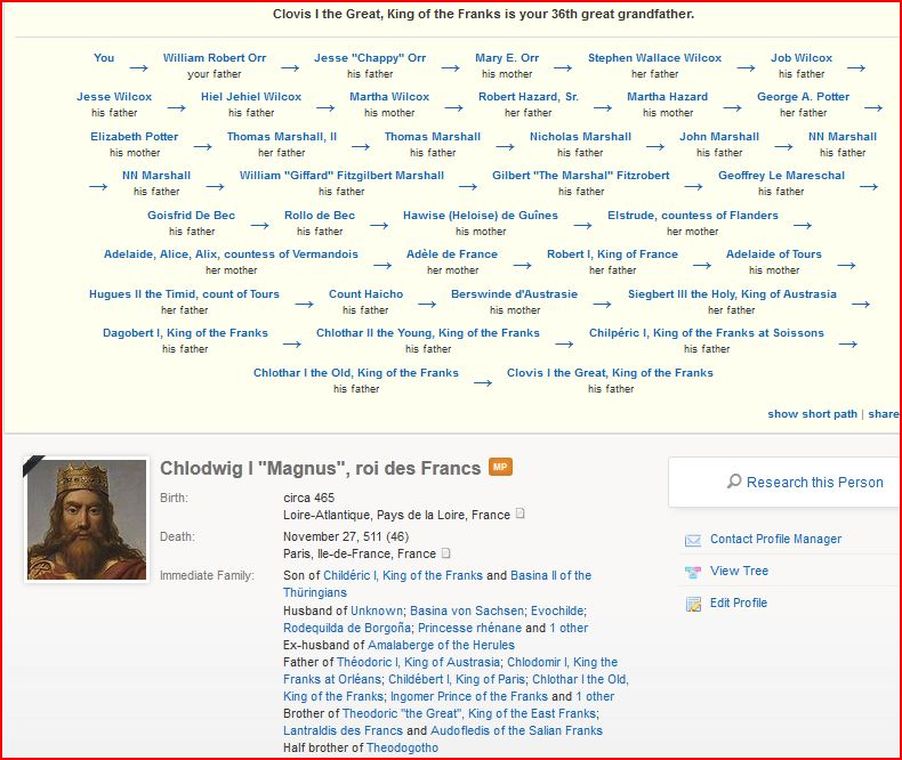
The last Cathar Perfect, Guillaume Belibaste, was executed in 1321. Other movements, such as the Waldensians and the pantheistic Brethren of the Free Spirit survived into the 14th and 15th century, until they were gradually replaced by, or absorbed into, early Protestant sects, such as the Hussites.

Extracts retrieved from "http://en.wikipedia.org/wiki/Cathar"
Picture
Picture
Picture
Picture
Picture
Picture
Picture
Picture
Picture
Picture
Picture
Cathars & St. Anthony
by Iona Miller, 2012-2015

The David Teniers painting mentioned by the parchments is assumed by Henry Lincoln to be Saint Anthony and Saint Paul, the only Teniers painting featuring Saint Anthony which does not show him enduring his famous temptation by demons - thus the words "no temptation." In this painting, the two saints are sitting in front of an altar upon which stands a crucifix and a skull. This indicates the nature of the tomb depicted in the Poussin painting. The image of a skull and a crucifix obviously implies Golgotha, and the fact that the life-size skull dwarfs the miniature crucifix implies the giant skull of Adam after which Golgotha, the location of the Cave of Treasures, was originally named. The painting shows one saint pointing up towards a descending dove that is carrying the holy host, a representation of the Grail stone. -Tracy Twyman http://www.hiddenmysteries.org/mysteries/reports/twyman.html

However, there are two St. Anthony's: one of Egypt and one from Padua, the later associated with healing, while the former was a famous monastic. So, might "no temptation" refer to the monk from Padua, rather than the Egyptian hermit, even though his icon is found at Rennes le Chateau? Their histories have been somewhat confounded. Both have statues in Rennes. Others have decoded the word GRAAL from the chosen statues:

St Germaine [female, not the 17th C. occultist]
St Roch
St Anthony the Hermit
St Anthony of Padua
St Luke (The pulpit is always associated with St Luke)
SanGRAAL?

From Oxford Dictionary of Saints (1978), p.26 : "Antony [the Hermit] was buried by his own choice in a place known to none. But by 561 his relics were found and translated to Alexandria. Much later, translations were claimed by Constantinople and by La Motte, where the Order of Hospitallers of Saint Antony was founded c.1100. This became a pilgrimage centre for those who suffered from ergotism (called St Antony's Fire). The hospitallers, who wore black robes with a blue Tau-cross, became widespread over much of Western Europe. They used to ride about, ringing little bells to attract alms; the bells were afterwards hung round the necks of animals to protect them from disease. By special privilege this order's pigs were allowed to roam freely in the streets, whence the emblems of pigs and bells in St Antony's later iconography... ...Feast 17th January"

From Rennes le Chateau, a Visitor's Guide (1993), p. 27 :  "St Antony Ermite. The presence in the church of this saint, who led an exemplary life may be intended to suggest a nearby location - 'La Grotte de l'Ermite' (the Hermit's Grotto). It is not simply chance which makes a ray of sunlight pass through the stained glass window opposite and illuminate the statue on precisely January 17th, the date on which he is celebrated, and on which he died at the age of 105."

Rennes le Château has a long history with the Merovingians. The most famous of all Merovingians was Mérovée's grandson Clovis I, who was king of the Franks between 481 and 511. It was under Clovis that the Merovingians first converted to Christianity creating a "new Roman empire - a Christian empire, based on the Roman Church and administered, on the secular level, by the Merovingian bloodline." Clovis was baptized by Saint Remy at Rheims. This alliance and Clovis' conversion created a schism within the Merovingian families. The Visigoths disagreed with it and Clovis fought them driving them back to Carcassone and eventually to their last remaining bastion, in the Razès, at Rhédae, which is now Rennes le Château.

Picture
Picture
We tend to only think about Rennes le Chateau because of the Cathars, (although there is more to the story).  . We tend to only think about St. Antony because of the Hospital Brothers, (although there is more to the story).  Spiritual Franciscans, a protest movement within the Franciscan order. Burr shows that the movement existed more or less as a loyal opposition in the late thirteenth century, but by 1318 Pope John XXII and leaders of the order had combined to force it beyond the boundaries of legitimacy. At that point the loyal opposition turned into a heretical movement and recalcitrant friars were sent to the stake.

St. Anthony [of Padua] lived and preached during the time of the Italian Cathars. He was known as the "hammer of heretics." The Hospital Brothers of St. Anthony, Order of St. Anthony or Canons Regular of St. Anthony of Vienne (Canonici Regulares Sancti Antonii, or CRSAnt), also Antonines, were a Roman Catholic congregation founded in 1095 or so, with the purpose of caring for those suffering from the common medieval disease of St. Anthony's fire. As a hermit and founder of monasticism, Anthony is identified with the "book of nature" and not writing. St. Anthony was the focus of a Roman Catholic Hospital Order which flourished from the 13th to 18th centuries and was responsible for treating the effects of ergot poisoning or St. Anthony's Fire.

BOTH the Cathars and the Brothers trace their origins to Constantinople and (therefore) to ELEUSIS.  Alaric ravaged Attica but spared Athens, which capitulated at once to the conqueror. In 396, he wiped out the last remnants of the Mysteries at Eleusis in Attica, ending a tradition of esoteric religious ceremonies that had lasted since the Bronze Age. Or did it just go further underground?

Church of Amor vs. Church of Roma

In any event, BOTH the Cathars and the Brothers were part of the *early* efforts to "undermine" the authority of the CATHOLIC Church by introducing *new* sacraments (i.e. the quest for "perfection") coming from the EAST.   And, obviously, BOTH resided in the Languedoc -- although on different sides of the Rhone and the Roman Church, which is why one "survived" the Albigensian Crusade and the other didn't. The heretics that lived in Southern France and Northern Spain were the ones targeted by the Crusade. After the Crusade, during the Inquisition, "underground survival" became much more than metaphorical. The last Cathar burned at the stake was caught near Rennes le Chateau.

As shown by their own records the Imperial Church began to ban glass, terracotta, wood and horn chalices from the Mass, at a fairly early date and by the 12th century all Chalices used in the offical Mass were Gold or Gilded Silver and incapable of becoming a Living Cup. Once this level of control was established, the Church began to persecute all the "Heretical" forms of Christianity that still knew the secret of a living God, with the living Cup. In response the Grail and King Arthur stories began to circulate through the western Christian medieval world, hiding the Secret of a magic Living cup in the only safe place left, in the stories told at a Nobles court or around the peasants evening fire, where no Inquisition could burn the texts, or stamp out the idea of a wondrous Magic Cup.

Historians still argue about Catharism's origins and its extent, but broadly speaking it believed in a ‘dualistic’ interpretation of the world. The belief was a God who is entirely good and spiritual; but ‘evil’ is the same as ‘unspiritual’. The material world we live in, with all its mess and muddle, cannot possibly come from God. In crude and popular terms Cathars believed that the Devil created the world. Salvation meant escape from the material, back to the purely spiritual. Strict Cathars lived very austere lives, and could appear very holy. By contrast, Catholic clergy were worldly and materialistic. The Franciscans were ideally placed to counter the influence of the Cathars by their austerity, combined with loyalty to the Catholic faith.

Some are working on the hypothesis that the Cathars *also* survived and "became" the Spiritual Franciscans (mostly in Italy), who then later turned into the Reformation and, in particular, the Calvinists (who later provided "shelter" to the Templars.) Spiritual Franciscans was a protest movement within the Franciscan order. Burr shows that the movement existed more or less as a loyal opposition in the late thirteenth century, but by 1318 Pope John XXII and leaders of the order had combined to force it beyond the boundaries of legitimacy. At that point the loyal opposition turned into a heretical movement and recalcitrant friars were sent to the stake. One issue they argued over was the consecration of the host. The Cathars also did not baptize like the Roman church.

Padua was the location of the school of Astronomy where Copernicus, the creator of the Heliocentrim theory, had once trained. St. Anthony of Padua is the patron saint for the recovery of lost things and in 1226 he attended a Franciscan chapter at Arles on the river Rhone (during the Albigensian crusade and a mere 18 years before the siege of Montségur). Arles was a town established by the Greeks in the 6th century BCE but expanded later by the Romans. Before St Anthony there had been friction between the Arian Christianity of the Visigoths and the Catholic bishops at Arles (one of them called Bishop Lucifer) that had been sent out from Rome and this led to the heresy in the Occitan culture. The Synod of Arles was the precursor to the later and more significant Council of Nicea.

Broadly speaking, the anti-Church in the West has consistently traced its routes back to the Eleusinian Mysteries (i.e. what became the Orthodox Church in the 2nd and 3rd Romes, as in Russia etc) -- which is why the "pre-history" of LSD is particularly important. This is also why the "KGB" role in the 60s -- as the source of both "blue-acid" LSD (that sparked the British "invasion") and the ergotamine precursor for the "underground" labs, out of Spofa in Prague -- remains the biggest *untold* story of our lifetimes. Magic chemistry has and continues to play an unsung part in history.

In its pure form, LSD (d-lysergic acid diethyl amide) is an odorless, colorless, and either tart-tasting (if in the tartrate form) or tasteless crystal substance. The major pharmaceutical company manufacturing pure LSD, for research purposes, is the Spofa United Pharmaceutical Works in Prague, Czechoslovakia, although it has been manufactured by many others. Besides Sandoz Pharmaceutical Company in Switzerland, there was the Eli Lilly & Company with the patent for the Garbrecht process (the most efficient process for the manufacture of LSD), and Farmitillia of Milan, Italy, which perfected the deep-vat cultivation of ergot, a mold that grows on rye, among other places, and serves as a source for lysergic acid monohydrate, the main precursor of LSD. In addition, a number of U.S. pharmaceutical firms make small amount of LSD for testing purposes.

LSD:  Eleusis --> Constantinople --> St. Petersburg/Languedoc (Cathars & Brothers) --> Prague/Munich --> San Francisco/London . . .

http://www.chymicalphilosophers.org/celestial-botany/

http://www.danmerkur.com/onlinewritings/Grail.PDF
Hidden Manna and the Holy Grail: The Psychedelic Sacrament in Arthurian Romance by Dan Merkur


http://www.danmerkur.com/onlinewritings/HidManna.PDF


THE GNOSTIC MYSTERIES & THE GRAIL

"Look at that blacksmith, for instance," went on Father Brown calmly; a good man, but not a Christian -- hard, imperious, unforgiving.  Well, his Scotch religion [Scotch Calvinism]  was made up by men who prayed on hills and high crags, and learnt to look down on the world more than to look up to heaven.  Humility is the mother of giants.  One sees great things from the valley; only small things from the peak." - G.K. Chesterton, from The Hammer of God

[John Keats wrote]: "Call the world if you please, 'The vale of Soul-making.' Then you will find the use of the world..."  From this perspective the human adventure is a wandering through the vale of the world for the sake of making soul.—James Hillman

Although the terms soul and spirit are sometimes used interchangeably, soul may denote a more worldly and less transcendent aspect of a person. According to psychologist James Hillman, soul has an affinity for negative thoughts and images, whereas spirit seeks to rise above the entanglements of life and death.  The words soul and psyche can also be treated synonymously, although psyche has more physical connotations, whereas soul is connected more closely to spirituality and religion.

The Portal (Psychomanteum)
Mention of a ritual process for contacting the dead can be found in the writings of the ancient Greeks. The writings described how individuals were guided through subterranean chambers over a series of several days, and finally taken into an area, a "necromanteum", containing what is believed to have been a large cauldron-type vessel. Water or oil filled the vessel providing a reflective surface for the initiated individual to contact the dead.

Necromanteion means "Oracle of Death", and the faithful came here to talk with their dead ancestors. Temple of Poseidon in Taenaron as well as those in Argolis, Cumae, and Herakleia in Pontos are known to have housed oracles of the dead, but the Necromanteion of Ephyra was the most important. It belonged to the Thesprotians, the local Epirot Greek tribe. According to Herodotus' account, it was to the Necromanteion that Periander, the 6th century BC tyrant of Corinth, sent legates to ask questions of his dead wife, Melissa. In Homer's Odyssey, the Necromanteion was also described as the entrance by which Odysseus made his nekyia. The ancient Greeks believed that the dead (in Greek: “Nekys”, “Nekroi") stayed in the earth as a perishable body while as a soul they were released and found their way to the Underworld through deep gorges, crevices and caves. The souls of the dead did not have ordinary consciousness but had other capabilities not possessed by the living such as the ability to know the future.


Ritual Use
Ritual use of the Necromanteion involved elaborate ceremonies wherein celebrants seeking to speak to the dead would start by gathering in the ziggurat-like temple and consuming a meal of broad beans, pork, barley bread, oysters, and a narcotic compound. Following a cleansing ceremony and the sacrifice of sheep, the faithful would descend through a chthonic series of meandric corridors leaving offerings as they passed through a number of iron gates. The nekyomanteia would pose a series of questions and chant prayers and the celebrants would then witness the priest arise from the floor and begin to fly about the temple through the use of Aeorema-like theatrical cranes.  The Necromanteion functioned until 167 BC when it was looted and destroyed by the Romans. The purpose of these procedures was presumably to strengthen the pilgrim’s defences against the psychologically powerful contact with the death experience. With yet more severe fasting and meditation the pilgrim would also stay in the northern room of the eastern corridor until the time of the oracle.

Then, together with a priest, he would enter the eastern corridor, would sacrifice a sheep and then, holding bloodless offerings in his hand, he would follow a meandering corridor with three ironclad gates, as many as the gates of Hades. He would leave some of his offerings there, and would offer the rest in the central hall, which was the place where the souls of the dead would appear. During the whole process the priest would chant prayers and evoke the dead. The long preparation in such an imposing environment, and the special fasting [and meditations] together with the faith in the appearance of the dead would induce the pilgrim to see the shadows of the dead.


Dr. Raymond Moody modified this process to fit more in the modern day. He coined the term "psychomanteum". Dr. Irene Blinston expanded and modified Dr. Moody's psychomanteum, and psychomanteum process, developing "The Portal".

Physical Description

The Portal is a very dark, dimly lit chamber varying in size. At one end of the chamber is a chair and at the other end a mirror. The mirror is tilted at an angle so the sitter is prevented from seeing his or her own reflection. The special mirror is the true portal.

Purpose of the Portal (psychomanteum) The primary focus of research of the psychomanteum team at the Institute of Transpersonal Psychology was the psychomanteum's effects on the reduction of the symptoms of grief associated with a lost loved one. However, there are many possible uses for the Portal (psychomanteum). The possible uses include:
  • Connection and communication with a deceased individual in order to say good-bye or apologize for something
  • Connection and communication with one's ancestors in order to ask questions or get advice
  • Connection and communication with one's higher self
  • Confronting and speaking your mind to a person who diminished you at some point in your life and has since died
  • Connection and communication with one's former self in cases of major life transformations
  • and so much more…

Here is the Book of thy Descent,
Here begins the Book of the Sangreal,
Here begin the terrors,
Here begin the miracles.


Picture
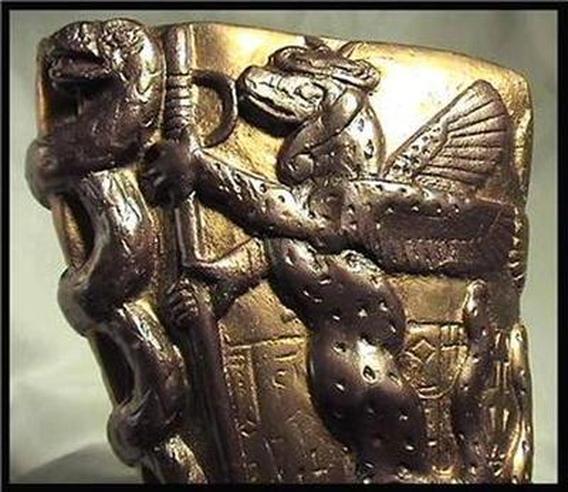
Sumerian Grail of Lagash - ritual cup. DRAGON CUP OF KING GUDEA Ancient Sumerian Votive Chalice.
  "The Tree of Life had also been linked with the serpent or dragon (winged serpent) for over 1,000 years before Genesis was written. In 2025 BC the cup of the Sumerian King Gudea of Lagash (see Chapter 5, Fig. 22) showed two winged dragons holding back a pair of opening doors to reveal a caduceus of uniting snakes, the incarnation of the god Ningizzida, one of the names given to the consort of the mother goddess, to whom the cup is inscribed: ‘Lord of the Tree of Truth’."

GODDESS DESCENT

Birth, Rebirth and Immortality are the perennial themes of ancient Mystery religions -- in metaphor "descent" (loss), "search" and "ascent". Rites and practices of Mystery religions take us deeper and deeper into the labyrinth or the underworld where we examine a series of unanswerable and awesome questions and, are, accordingly, altered by this willingness to enter and be worked upon by the elemental forces that live in the domain of the unknown and unknowable. This is not descending into chaos, though it feels chaotic when we are there. It is entering into domains that cannot be understood in the ways we generally seek and convey understanding. It is entering into worlds that operate by different laws altogether. Integrity is required and so we must be reconstituted; this is the way of transformation.

Rebirth requires descent into the realm of the transcendent Psyche. The same meme can be seen in modern culture in the new age Ascension Movement, which includes imaginative theories about the transformation of DNA, morphology and immortality with cosmological and astrotheological overtones. The Cathar mission was to ascend back to Heaven, i.e. break the cycle of incarnations. By accepting this cosmography and performing the consolamentum, one’s next death would end the soul’s odyssey and return it to Heaven.

In Babylonia, the month Tammuz honored same god, a Sumerian shepherd-god, Dumuzid or Dumuzi, the consort of Inanna or his Akkadian counterpart, consort of Ishtar.  Summer Solstice began a time of mourning in the Ancient Near East and Aegean. The Babylonians marked the decline in daylight hours and the onset of killing summer heat and drought with a six-day "funeral" for the god. Recent discoveries reconfirm him as an annual life-death-rebirth deity. Much like Osiris and Persephone, Tammuz rises from the dead annually, stays on earth for half the year, then descends to the Nether World for the other half.

From Sumeria's tales of Inanna to the Eleusinian Fields, there is evidence that such beliefs were compounded by altered states of consciousness, orchestrated through a variety of means and settings. Other themes include Royal Marriage, dreams and death.

Mesopotamian kings displayed their divine inheritance through symbols including the Tree of Life. It all begins with Inanna. This may be the origin of the scepter. Enki gives Inanna the throne of kingship and kingship itself. Therefore, the king was ritually married to Inanna to earn his divine right to rule. Power derived from Inanna is consolidated in the symbolism of the Tree of Life and the descent of Kings, as recorded in the King's list.

The Louvre exhibits a green libation vase, which was excavated from the ancient Mesopotamian city of Lagash.  The inscription on it, from King Gudea of Lagash circa 2025 BC, is a dedication to Ningizzida.  Also on the vase is an image of two entwined snakes on a rod.  Its origin may be from 4000 B.C. The rod is most likely to be Axis Mundi, the world tree, Yggdrasil, the tree of life.  Ningizzida, a fertility god, was also known as 'Lord of the Tree of Life'.  He was often depicted as a serpent with a human head, and later became a god of healing and magic.  His companion was Tammuz/Dumuzi, who personified the creative powers of spring with Inanna his consort with their family tree of divine dragon-kings.

Both Inanna and Persephone descended into the underworld. Persephone was mourned just like the dead Tammuz. Shadow aspects of the Feminine themes of [power] loss and rape were contained by the myth and modulated by seasonal ritual and initiatory renewal.

These mourning ceremonies were even observed near the Temple in Jerusalem. Prophet Ezekiel had a vision with  Yahweh's message about His people's apostate worship of idols:

"Then he brought me to the door of the gate of the Lord's house which was toward the north; and, behold, there sat women weeping for Tammuz. Then said he unto to me, 'Hast thou seen this, O son of man? turn thee yet again, and thou shalt see greater abominations than these." —Ezekiel 8:14-15

The initiations of the Demeter/Persephone cult are "visionary experiences", known to include psychotropic substances, the kykeon, though it remains unknown just what that psychedelic ingredient was. Conjecture centers around ergot rye mold and magic mushrooms, whose effects were known from shamanic Paleolithic times. Both Tammuz and St. Anthony were beseiged by "demons", and later the Cathar paradigm of good and evil, emphasised the malignant nature of the Archons. The Mysteries were a syncretic influence throughout the entire Mediterranean and they permeate culture down to our own time. How much more was this true in the Dark Ages?

The ascent to another way of being, the ascent of transformation, cannot occur without disintegration, without the process of breaking down completely -- being pulverized really, physically, emotionally, spiritually. If the container of self is not smashed, the vision cannot enter. The vision is the flash of light that re-organizes the self. Afterwards, if one is fortunate and graced by the generosity of the gods -- one reconstitutes, or is reconstituted, according to the laws and principles of a new life, a new dimension, a new world, a new universe.

Is this a means through which an experiential Gnostic vision of  God and the universe was attained? What kind of eucharist could produce a "descent", as well as terrors and miracles resulting in spiritual surety, particularly of a primordial feminine element of existence. It probably only exists in English, but the double entende of "descent" also hints toward a bloodline connection to the practices of the GRAAL.

The Grail legend became interwoven with legends of the Holy Chalice. The connection with Joseph of Arimathea and with vessels associated with the Last Supper and crucifixion of Jesus, dates from Robert de Boron's Joseph d'Arimathie (late 12th century) in which Joseph receives the Grail from an apparition of Jesus and sends it with his followers to Great Britain. Building upon this theme, later writers recounted how Joseph used the Grail to catch Christ's blood while interring him and how he founded a line of guardians to keep it safe in Britain.

The legend may combine Christian lore with a Celtic myth of a cauldron endowed with special powers. Celtic tradition has a magical and utilitarian cauldron, horn of plenty and platter that could never empty. It has roots in the same image as the Chalice, sacred vessel, that represents both the illuminating goal of the quest and the heroic quest itself.


VITRIOL


When it comes to the secrets of Rennes le Chateau, most researchers seem concerned with digging up artifacts in a local cave. Therefore, all kinds of geometrical and other revelatory decoding of paintings, etc. is rife. However, perhaps the emphasis should be on what went on in the caves of worship, rather than a search for relics and 'treasure'.

The deep dark space may lie within oneself, as an initiatory experience of the transcendent imagination, rather than a concrete find, though this interpretation does not rule that out. Here, we are not looking for a hole in the ground, but a whole within ourselves. The alchemical motto VITRIOL means: "Visita Interiora Terrae Rectificando Invenies Occultum Lapidem ("Visit the Interior Parts of the Earth; by Rectification Thou Shalt Find the Hidden Stone.") VITRIOL is the key to the transcendent Abyss.

  • THE EARLY GRAIL WAS NEVER A CHALICE Actually what Brown says is incorrect the early writers of the 12th and 13th centuries who wrote about the Grail did not mention the word SANGRAAL. But the fact is that everyone considers the Grail as a cup or Chalice because of total misinformation by Tennyson and Wagner. The early Grail writers NEVER regarded the SANGRAAL as a cup or chalice but merely as the GRAAL (anglicised to Grail) but as we shall see there is confusion amongst these writers as to what they thought it was. The very first writer to mention the Grail was Chrétien de Troyes, his book Conte de Graal. It was the last of his Arthurian romances and was probably composed between 1175 and 1190. What Chrétien considered to be the Graal could not possibly have been a cup. In his story Chrétien said that it contained a sacramental wafer and thus, the Host, represented it as a ciborium, a covered goblet surmounted by a cross, the normal receptacle of the Corpus Christi. It is certain that Chrétien considered it otherwise Helinand, abbot of Froidmont, who was a contemporary of Chrétien de Troyes writing about 1215 defined the word as 'sculelle lata et aliquantulum profunda, in qua preciosae dapes divitibus solent apponi' -  'a wide and slightly deep dish, in which costly viands are customarily placed for rich people'. Chrétien de Troyes died before completing the Conte de Graal. The first person to write about the Grail after Chrétien's poem mentioned a hundred boars heads on Grails. Later writers who mentioned the Grail,  Estoire and Queste del Saint Graal, saw fit to christianise the story and equated the Grail with the Last Supper containing the Paschal lamb. Clearly Chrétien de Troyes is referring to a container of considerable size, in fact he specifically mentions the fact later in the book that the vessel did not contain a Pike or a Lamprey or a Salmon which would have been a pointless remark if the Grail had been a cup or ciborium. In this story by Chrétien de Troyes a boy called Perceval who is later knighted sees a procession preceded by a bleeding lance at the Castle of the sick and lame Fisher King, Perceval does not learn that this Fisherman is a king until later but also learns that there is another lord in the castle that has not left his room for fifteen years. Chrétien de Troyes says this:

        "Then two squires came in, right handsome, bearing in their hands candelabra of fine gold and niello work, and in each candelabrum were at least ten candles. A damsel came in with these holding between her two hands a graal. She was beautiful, gracious, splendidly garbed, and as she entered with the grail in her hands, there was such a brilliant light that the candles lost their brightness, just as the stars do when the moon or the sun rises. After her came a damsel holding a carving-dish (tailleor) of silver. The grail which preceded her was of refined gold; and it was set with precious stones of many kinds, the richest and the costliest that exist in the sea or in the earth. Without question those set in the grail surpassed all other jewels. Like the lance, these damsels passed before the couch and entered the chamber.

    The youth watched them pass, but did not dare to ask concerning the grail and whom one served with it, for he kept in his heart the words of the wise nobleman. I fear that harm will come of this , because I have heard say that one can be too silent as well as be too loquacious. But for better or worse, the youth put no question."

It is good to question things even if someone purporting to be wise tells you to keep your mouth shut, because if you do you may cure many ills by questioning things. Perceval later finds out from another damsel who turns out to be his cousin that he has been a fool not to ask the question that his heart wanted so much to ask.

Whom does the Grail serve? This is an odd question which never really gets answered. It is generally assumed above that the brilliant light IS the Grail but Chrétien de Troyes does not necessarily say this and he later finds out the other lord whom Perceval has not met lives entirely upon a wafer and it is he whom the Grail serves. Perceval is troubled by his lack of what he considers to be common sense and later seeks a hermit from whom Perceval seeks atonement for his sins (although his sin appears to be nothing more than that he left his mother alone and she died of a broken heart and that he failed to ask the question Whom does the Grail serve?). A confession is given to the hermit and a forced acceptance of the Good Friday story of Jesus' crucifixion and resurrection is the penance for his sins..

The story is a classic gothic narrative and is clearly allegorical. The hermit doesn't offer a solution to Perceval's troubles, instead of resolving Perceval's difficulty he merely compounds them. We are not told that Perceval doesn't not recognise Jesus' sacrifice on the cross although apparantly Perceval later has combat with another knight on what is Good Friday which he had forgotten. A French scholar Albert Pauphilet sums up the confusion thus:

    "The old infirm king, whom a single question would have cured, was he, after all, not the only lord of a marvellous castle? Nor the only infirm one? For the other lord, his father, whom Perceval did not see, is even more an invalid than the Fisher King, for he has not left his chamber for fifteen years. Was he also to be healed by Perceval's question? But there is no mention of it....This old man was sustained by a single mass wafer, brought to him by the Grail, and yet, with every fresh course, the Grail reappears and passes into his chamber; why these repeated servings of a single wafer? Finally, the Host ought not to be placed in any but a liturgical vessel; behold, then, the Grail surreptitiously transformed into a ciborium or chalice, and a strange procession into the commencement of a Christian liturgy. But in that case, what do these unusual accessories signify, this lance, and above all this absence of a priest?"

Note that it is not the Grail that sustains the lord who hasn't left his chamber for fifteen years that Perceval didn't meet but what is contained IN the Grail that sustains him. We aren't told of the dire circumstances that transpired when Perceval didn't ask the question Whom does the Grail serve? which caused him to be a sinner and to seek atonement from the hermit. Your attention is also drawn to fact that the year of writing is around 1125 and yet it is a young woman who is bearing what has been later interpreted as administering the Eucharist. This is in direct violation of the doctrine of the Roman Church and yet as far as we know Chrétien de Troyes was not admonished for this.

The story of a traveller seeking something and being made welcome in a castle where he witnesses strange happenings who later goes to sleep only to find everyone gone in the morning is a well known story line from Celtic Legends. One such is the Irish allegorical stories called Echtra [a visit to another world]. Here a mortal hero visits a supernatural palace and witnesses strange happenings and awakes in the morning and finds his hosts and their dwellings have disappeared. An almost direct comparison with that of Conte de Graal is that of the story called 'Phantom's Frenzy'. [frenzy in this context means a kind of prophetic ecstasy] and is the story of Conn of the Hundred Battles who reigned in Ireland in the second century CE.

This story parallels Chrétien de Troyes in a number of ways and perhaps the bottom line is that the Irish Echtra speaks of the 'Sovranty'(sic) of Ireland and speaks of the four chief treasures of the Tuatha De Danann, the Irish Gods. Chrétien de Troyes speaks of the lance which accompanied the procession as that which will destroy the whole realm of Logres (England). In Conte de Graal an ugly damsel appears in a palace and appears to serve no purpose in the story. However later stories called Peredur and Perlesvaus tell us that in the court of King Arthur the bearer of the dish who passed before the hero in the castle is the same ugly damsel (Loathly Damsel) that appears later in Chrétien de Troyes who complains of his silence and failure to ask the question.

Several questions leap from this apparant parallel story. Why does the damsel change from being extremely ugly damsel to radiant and beautiful in the presence of the Grail? It appears that the Welsh author of Peredur received this story not from Conte de Graal but from an earlier story which Chrétien de Troyes also received the story from. Many authors feel that the damsel is the goddess Eriu [from whom Erie received its name]. The oldest account of her two forms comes from an Irish poem written in 1014. In this poem she is described as thin-shanked, grey haired, bushy browed 'As it were a flash from a mountain-side in the month of March, even so blazed her bitter eyes'. But after transformation her countenance bloomed like the crimson lichen of Leinster crags, her locks were like Bregon's buttercups. This grail bearing goddess is the country of Erie and the story written by Chrétien de Troyes is a throw back to a pagan story emanating from the west coast of Ireland but repeated throughout the Celtic world as an allegory.

But we still have the question 'Whom does the Grail serve?' 

Professor Helaine Newstead believes that the Fisher King is Bran the Blessed1 and his story resembles the Fisher Kings story in the following manner:

  1. Perceval's host was wounded through the thighs or the legs with a javelin. Bran the Blessed was wounded in the foot with a lance in battle. In the story however the words of Branwen translates as  'I was with Bran in Ireland; I saw when the Pierced Thigh was slain.'

  2. Chrétien de Troyes and the other Grail romancers say that the Fisher King entertained his guests sumptuously according to the Mabinogian Bran dispensed lavish hospitality.

  3. In Didot Perceval the Fisher King is called Bron.

  4. In Robert de Boron's Joseph Bron is called the 'Rich Fisher' and was instructed to set out with his followers to the West. The followers of Bran, in the company of his severed head [a parallel with the Templars here] journeyed to Gwales (Grassholm) the westernmost isle of Wales.

  5. In Perlesvaus2 Gawain feasted in the Fisher King's castle with twelve knights 'aged and haired and they did not seem to be so old as they were, for each was a hundred years old or more, and yet none seemed to be forty.' Bran's followers passed eighty years in a great hall in the midst of abundance and joy, yet 'none of them perceived that his fellow was older by that time than when they came there.'

It is clear that the concept of the Grail (Graal) comes from a Celtic word meaning, as Helinand, abbot of Froidmont, put it  'a wide and slightly deep dish, in which costly viands are customarily placed for rich people'. The sacred and less understandable aspect is what was carried in this dish.

1 - Others believe him to be Anfortas also known as BOAZ (strength)

2 - In the Perlesvaus the Grail (Graal) is not a material object and the Fisher King is called Messios which has a resemblance to the word Messiah and the Templars make their first appearance into the Grail story. Perhaps significantly Perlesvaus was written at a time when the Holy land was in the possession of the Saracens. The Perlesvaus lays great importance on Grail Lineage.

Perhaps the most enigmatic piece however comes right at the beginning of the Perlesvaus:

Here is the Book of thy Descent,
Here begins the Book of the Sangreal,
Here begin the terrors,
Here begin the miracles.


WHAT KIND OF EUCHARIST COULD PRODUCE SUCH AN EFFECT,  LIKE THAT OF ST. ANTHONY'S FIRE?


  • THE GRAIL BECOMES VESSEL CONTAINING A STONE.

    In the early 1200s the most important Grail romance is called Parzival, written by a Bavarian Knight called Wolfram von Eschenbach. i I is the most evocative Grail narrative of all. Once again the Templars feature prominently and they are portrayed as the Guardians of the Temple of the Grail located on Munsalvaesche (Mount of Salvation) which has been linked by many to the Cathar Castle of Montsegur. By now the story has changed dramatically. It still features the Fisher King but now he is a Priest King in the same manner as Jesus and officiates at the Grail Mass precisely the same as the Last Supper.

    Wolfram stated unequivocally that Chrétien de Troyes' version of the Grail story was wrong and he gave the source of his story from someone he called Kyot le Provenzale, apparantly a Templar scribe [non-combatant] who wrote of an earlier Grail manuscript from Arabia written by a man called Flegetanis. described as: "a scholar of nature, descended from Solomon, and born of a family which had long been Israelite until baptism became our shield against fire and hell".

    Again great importance is stressed by Wolfram on Grail Lineage and he introduces Perceval's son Lohengrin. He also names the Grail Bearer as Repanse de Schoye. He describes her thus: "She was clad in the silk of Arabia, and she bore, resting on a green silk cloth, the perfection of earthly paradise, both roots and branches. It was a thing men call the Grail, which surpassed every ideal."

Wolfram described this as the 'stone of youth and rejuvenation' It was called Lapsit Exillis (or Lapis Elixis) a variant of Lapis Elixir, the alchemical 'Philosophers Stone'. He described it thus:

"By the power of that stone the Phoenix burns to ashes, but the ashes speedily restore him to life again. Thus doth the Phoenix moult and change its plumage, after which he is bright and shining as before."

At the Fisher King's sacrament of the Eucharist, the Grail Stone records the names of those called to its service. But it is possible for everyone to read those names:

"Around the end of the stone, an inscription in letters tells the name and lineage of those, be they maids or boys, who are called to make the  journey to the Grail. No one needs to erase the inscription, for as soon as it has been read it vanishes."

Wolfram wrote of the King of Septimania (the area which included Rennes le Chateau) Guilhelm de Gellone and said that the original Flegetanis manuscript was held by the House of Anjou. Wolfram located the Grail Castle in the Pyrenees. He also mentioned Edinburgh (Tenabroc) which of course is very close to the Chapel of Rosslyn.

Rene d'Anjou gave Christopher Columbus (real name Colon) his first ship's commission, and it is from Rene that the familiar Cross of Lorraine derives. The cross, with its two horizontal bars, became the lasting symbol of Free France and was the emblem of the French Resistance during World War II. Among Rene's most prized possessions was a magnificent Egyptian cup of red crystal, which he obtained in Marseilles. It was said to have been used at the [ROYAL]  wedding of Jesus and Mary Magdalene, bearing the later inscription (translated):

  "He who drinks well will see God.
He who quaffs at single draught will see God and the Magdalene."


CATHARSIS
Blood, Sex & Cathartic Rebirth
Cathar Rite
The Cathar Rite is a version of the oldest rite on Earth,
from the “Eleusinian Mysteries”

The Great Arcanum


cathar-, cathart-, cathars-
(Greek: to purge, to purify, or to cleanse; purification; cleansing) acatharsia Filthy, unclean; uncleanliness, filth, foulness. Catharist From Ecclesastical history, a member of any of various sects aiming at purity.
catharsis
1. From Greek katharos, "pure"; katharirien, katharsis; "to purge" and then Latin catharticus.
2. In medicine, purgation, especially for the digestive system.
3. A purifying release of the emotions or of tension, especially through art or drama.
4. In psychoanalysis, cathartic technique relieves tension and anxiety by bringing repressed material to consciousness. cathartic

1. From Greek, katharsis, through Late Latin catharticus; inducing catharsis; that is, purgative or cleansing.
2. A cathartic agent, especially a laxative. cathartical To be cathartic or purifying. Catherine, Catharine, Katherine, Katharine Said to be a connection to Greek katharos, "pure"; to be pure.

http://www.geni.com/projects/Cathar-Credentes/5184

http://home.eckerd.edu/~oberhot/cathar.htm
http://www.philipcoppens.com/catharism.html

  "He who drinks well will see God. He who quaffs a single draught will see God and the Magdalene."

The word Cathars has the same etymology as catharsis, derived from the Greek katharos, "pure". This alone turns our attention toward Greek mysteries in relation to the Cathars, echoed in their Perfecti and their honoring of the Feminine in their "heretical" [sic] Gnostic dualist religion. Cathars got their name from the word catharsis, not the other way around. Catharsis is a synonym for purification:  ablution, absolution, atonement, baptism, bathing, catharsis, depuration, disinfection, distillation, expiation, expurgation, forgiveness, grace, lavation, laving, lustration, purgation, purge, purifying, rarefaction, rebirth, redemption, refinement, regeneration, salvation, sanctification, washing.

Cathars were associated with the Merovingians and the pre-Christain pagan religion. The central tenet of Cathar theology, on which historians are unanimous, is that it is dualistic, that is, that it denies the universal pre-eminence of a Good God and posits in opposition an Evil Principle, Satan, who is the creator of the material universe. Some writers contend Catharism was not a Christian heresy at all but another dualistic religion entirely. Cathars did not believe that there needed to be a priestly intermediary between themselves and God. Threads of Cathar belief questioned the material existence of Jesus, hence his death and resurrection, since these were material manifestations. They also rejected the idea of hell and purgatory and infant baptism.

There was a strong current of dualism in the early Church, especially in the East, best exemplified by Manicheanism which had a great following from Turkestan to Carthage during the first millennium. St. Augustine was himself a Manichean from 373 until 382. While it could not be denied than Mani, a Persian, was greatly influenced by the Zoroastrianism of his own land, the central thesis of orthodox Christianity itself—the death and resurrection of Christ—echoes the stories of Tammuz and Adonis from Near-Eastern mythology.

The Babylonian Cult, invented by Nimrod and his queen, Semiramis, was a system claiming the highest wisdom and revealing the most divine secrets. This cult was characterized by the word "MYSTERY" because of its system of mysteries. Besides confessing to the priests at admission, one was compelled to drink of " mysterious beverages," says Salverte (Des Sciences Occultes, page 259). Indispensable to those who sought initiation into these mysteries, the "mysterious beverages" were composed of wine, honey, water, and flour. They had an intoxicating nature, and until the aspirants dimmed their understanding and prepared them for what they were to see and hear. The method was to introduce privately, little by little, information under seal of secrecy and sanction of oath that would be impossible to reveal otherwise.

Because of the ancient link to the Eleusinian mysteries, entheogenic theory might be applied to Catharism as well, though evidence wiped out by the genocides makes proof elusive. Such powerful psychoactive potions propel revelatory mind states with profound spiritual and intellectual ramifications. Transcendental experiences are the basis of Gnosis.


Church of Amor Against Church of Roma

Whatever their ultimate antecedents, there is general agreement that the immediate spiritual ancestors of the Cathars were the Bogomils of Bulgaria, who formed a bridge to Western Europe for the religious ideas of Asia Minor. In the Middle Ages there was substantial trade between East and West, and with the transport of goods came powerful religious concepts. It is often suggested that cloth merchants were the first carriers of Catharist teachings. The merchants and artisan guilds, especially the weavers and paper-makers, were always great supporters of Catharism.
French Albigensian refugees who introduced paper-making into England.

Whether their dualism was absolute or mitigated, all Cathars believed the world to be an evil place where human souls, created by God, were imprisoned in matter created by Satan. There was no Hell or Purgatory other than the earth, and the goal of the spiritual life was to free the soul from the material world so that it could be re-united with its spirit which dwelt with God. If the soul failed in this effort, it would migrate after death to another body to try again. This doctrine of metempsychosis has prompted some speculation that the Cathars were actually Buddhists, in light of their similar ascetic practices, but there is no evidence of any direct influence.

Their conviction that the world is a scene of unmitigated evil led to certain logical conclusions for those who wished to escape from the bonds of matter. At its height there were probably no more than a few thousand of these ascetic Cathar Perfects (Latin: perfecti; French: parfaits). But they were supported and honored by many more ordinary Believers (Latin: credentes; French: croyants) who postponed their dedication until the time of death.

By far the most important religious ceremony of the Cathars was the Consolamentum by which an ordinary Believer became a Perfect. It was the Cathar baptism, administered without water by a Perfect, and also carried the characteristics of confirmation and holy orders. Receipt of the Consolamentum was considered essential to a Cathar's salvation, but it was given only when a Believer was prepared to abandon his worldly life and adhere to the austere regimen and constant devotion of a Perfect. Consequently, most Cathars delayed the Consolamentum until they were on their deathbeds. Attending the dying and administering the Consolamentum was one of the major duties of the Perfects, and they met these obligations often at great personal risk.

To the Cathars, the Consolamentum was no mere ceremony but constituted the reception by a man or woman of his or her spirit, which was previously separated from body and soul. One who sought this transcendent experience while still healthy was required to undergo a rigorous, one-year probation known as Abstinentia, to insure that the applicant had the strength and resolve to live the demanding life of a Perfect. For once the Consolamentum was received, the body became a veritable temple of the spirit to be preserved inviolate. A Perfect was required to abstain completely from sexual intercourse and from all animal food, including fish. During three days of every week they consumed only bread and water and also observed three forty-day periods each year of more severe dietary restrictions.

A cathartic is a medication that stimulates evacuation; a purgative or laxative, that may also be cathartic of the psyche, the purging of the emotions or relieving of emotional tensions,recalibrating ones relationship to the whole of existence. Catharsis has been recognized as a healing, cleansing, and transforming experience throughout history, and has been used in cultural healing practices -- all the way back to Sumeria and Inanna's descent and into the Eleusinian Mysteries.

The Eleusinian Mysteries, held annually in honor of Demeter and Persephone, were the most sacred and revered of all the ritual celebrations of ancient Greece. They were instituted in the city of Eleusis, some twenty-two kilometers west of Athens, possibly as far back as the early Mycenaean period, and continued for almost two thousand years.

Large crowds of worshippers from all over Greece (and later, from throughout the Roman empire) would gather to make the holy pilgrimage between the two cities and and participate in the secret ceremonies, generally regarded as the high point of Greek religion. As Christianity began to spread, the Mysteries were condemned by the early Church fathers; yet the rites continued for hundreds of years more and exercised considerable influence on the formation of early Christian teachings and practices.

Our sources of information regarding the Eleusinian Mysteries include the ruins of the sanctuary there; numerous statues, bas reliefs, and pottery; reports from ancient writers such as Aeschylos, Sophokles, Herodotus, Aristophanes, Plutarch, and Pausanias--all of whom were initiates--as well as the accounts of Christian commentators like Clement of Alexandria, Hippolytus, Tertullian, and Astorias. Yet for all this evidence, the true nature of the Mysteries remains shrouded in uncertainty because the participants did, with remarkable consistency, honor their pledge not to reveal what took place in the Telesterion, or inner sanctum of the Temple of Demeter.

To violate that oath of secrecy was a capital offense. (Aeschylos, for example, once had to fear for his life on account of coming too close to revealing forbidden truths.) For these reasons, scholars today must make use of circumstantial evidence and inferences, with the result that there is still no consensus as to what did or did not take place. Hence, we shall sometimes be forced to engage in the tentative weighing of alternative hypotheses, without always reaching definite conclusions.

Indeed, according to some scholars, "Demeter and Cybele were but local forms of the Great Mother worshipped under diverse names all over Greece" (Harrison 158; Baring and Cashford 369). In the early part of this century, Foucart theorized, on the basis of statements by classical authors (e.g., Herodotus Bk. 2) as well as the discovery at some Mycenaean sites of Egyptian figurines and small artifacts, that the cult of Demeter in Greece originally derived, in whole or in part, from Egypt. Further support for this hypothesis comes from certain remarkable parallels between the myth of Isis (especially in the version presented by Plutarch in his Isis and Osiris, chs. 15 and 16) and that of Demeter (as recounted in the "Hymn to Demeter,"). Among the details of these parallels are episodes in both stories involving infant princes who almost gain immortality--but not quite--at the hands of the respective goddesses.

The Mysteries were rituals of death and rebirth, both seasonal and personal.  The mystai (or initiates) “died” to the old
self just as seeds “die” awaiting germination in the earth, and then, like the sprouting grain, the new souls were reborn into the company of those who had gone before (epoptai). In the rebirth was an implicit affirmation of immortality, a hope closer in concept to the Christian belief than to the traditional Olympian system. In fact, in the Mysteries the virgin mother bears the savior for mankind.

The Mysteries were also bound up with the lunar and solar cycles—with the dying of the sun in winter and the rebirth of the light in the birth of the son. Some of these rituals and their elements must have been inherited from Near Eastern sources going back another four or five thousand years and transmitted through Crete and the Minoans in the Bronze Age. Other elements arrived from the north from as early as Paleolithic times in the rituals of the nomadic hunting tribes. The soul struggled just as the individual did to deal with its earthly and divine situation. It sought release through the perfection of its divine attributes, striving for rhythm (eurhythmia) and harmony (eurharmostia) with the gods.

The initiates would rest, purify themselves, and maintain either a partial or complete fast. It is believed that they would break their fast as evening approached by drinking a special beverage known as the "kykeon," consisting of meal and water mixed with fresh pennyroyal mint leaves (the same brew that Demeter drank, as recounted in the Hymn, lines 210-11). Obviously, the grain in the drink was a symbol of Persephone, the eternal goddess who dies, goes under the ground [descends], and then comes back to life again.

By means of stylized gestures and ritual moves in which the initiates themselves participated, it would have been possible to evoke a profound, even trance-like sense of union with the divine. Yet another controversy concerns the question whether or not a hieros gamos, or Sacred Marriage, also featured in these rites. There are three or four pieces of circumstantial evidence, most of them originating in the statements of early Christian Fathers, which have been used to infer the existence of an ieros gamos: (1) According to Clement of Alexandria, Demeter was sometimes referred to as "Brimo" (the Mighty, the Raging), on account of her anger toward Zeus (Protreptikos II, 14; Loeb 35). (2)

Hippolytus of Rome (third century) reports that "At night in Eleusis, [the Hierophant] appearing in the midst of many fires, proclaims the great and secret mystery, saying, 'The Holy Brimo has borne a sacred child, Brimos,' that is, the mighty (f.) [has borne] the mighty (m.)" (Philosophoumena V, 38-41; Migne 3150). (3) Asterios of Amaseia (fourth century), in a diatribe against the pagans' barbaric and obscene rituals, asked the following rhetorical questions: "Are not the height and culmination of your religion those Eleusinian Mysteries, whose vanities the people of Attica, and indeed all Greece, gather to celebrate? Is there not in that place a dark underground chamber [katabasion], where the Hierophant meets with the High Priestess alone? Are not the torches then extinguished, and do not the vast multitudes believe it is for their own salvation--what those two do together in the darkness?" (Asterios, in Migne 324) (4) In his commentary on Plato's Timaeus, Proklos Diadochos (fifth century) recounts the following: "In the ceremonies of Eleusis they would cry, raising their eyes to the heavens, 'rain' [hye], and then, lowering them to the earth, 'be fruitful' [kye]" (Timaios 293C; Festugiére 34).

On the basis of this evidence, many investigators have concluded that some form of Sacred Marriage probably took place at the Mysteries, and that this ceremony culminated in the symbolic birth (or rebirth) of a son. There are various proposals as to who that child might have been: possibly Iacchos, the tutelary deity whose statue accompanied the dual goddesses on the pilgrimage from Athens to Eleusis; Ploutos, the god of wealth who sprang, according to Hesiod and Homer, from the union of Demeter and the mortal Iasion of Crete; Dionysos-Zagreus, a Cretan deity, who according to Orphic tradition was the offspring of Persephone and Zeus; Triptolemos, an early prince of Eleusis much represented on vases and urns; or even Persephone herself. Perhaps, indeed, the "child" represents a mystical merging and identification of all these together.

It is well known that the Mysteries continued for almost two thousand years, during which time the Greek world evolved tremendously in both intellectual and religious aspects. The greatest intellects of the ancient world testified repeatedly to the salvific power of participation in the Mysteries--why then assume that those secret rites and teachings would not also have adapted to the times, so as to contain allusions to the deepest spiritual insights of which their devotees were capable?

Scholars disagree widely over the significance, much less the contents [ergot?, divine mushroom?], of the kykeon. Some have maintained that it must have had a sacramental character involving a communion with, or assimilation of, the spirit of the deity (Loisy 69; Jevons 365ff.). On the other hand, Mylonas doubts that it had any such "mystic" significance, although he acknowledges that the drinking of the kykeon was an "act of religious remembrance" involving "an observance of an act of the Goddess" (259f.). Even with muted interpretation, the similarity to the Christian Eucharist is striking.
Ego Death: Chaos as the Universal Solvent

As to the composition of the drink, it is generally agreed that it can have had no alcoholic content, since the Hymn expressly states that Demeter did not partake of wine. Yet it has been suggested that there might have been an admixture of some other intoxicating ingredients. Psychedelic substances have been suggested, and as in the case of Siberian shamanism, perhaps these substances were purified by passing them through the digestion of animals such as reindeer to remove the noxious toxic effects.

Pigs were sacred to the cult. On the sixteenth of Boedromion (September 24), early in the day, throughout Athens the cry was heard, “Mystai to the sea.” A procession formed in which each initiate took a sacrificial pig to the sea, washed both it and himself, sacrificed the pig, and then buried the body in a deep pit. This sacrifice enacted a symbolic death for each initiate—a letting of blood and a burial in which the personal self or ego died so that the new, greater self could be born at Eleusis during the secret nocturnal ceremony.

The sacrifice of the pig was a significant act. The death of the animal, especially on such a personal, individual basis—one for each participant—created a genuine psychological space within the initiate, an emptiness that had to be filled or replaced with something else. The intention was that the space would be filled with light, signaling the birth of a new life for the soul. The death and burial of the pig forced the initiate to strip away the old, material view of existence and to live with the resulting emptiness until it was filled, more than a week later, with a new spiritual realization.

Ergot may have been a mycotoxin found in pig feed, perhaps fed spoiled grain. Mycotoxins are secondary metabolites produced by the molds. These vary among the species of mold, which in turn may thrive under different conditions and favor different grains, in the field and in storage. Wind blown spores infect flowering grains and grasses. Rye and triticale are most susceptible but barley, wheat and oats may also be infected. Ergot favours cool, wet weather. This parasitic fungus of the Claviceps genus does its damage in the field, replacing one or more kernels in a mature grain head with a hard, dark mass called a sclerotia.

In addition to the reduced yields, numerous poisonous alkaloids and amines are produced. There are four primary alkaloids that are toxic to pigs. In common with other mycotoxins depressed, feed intake and, subsequently, growth are initial symptoms of ergot alkaloid poisoning. The effect of feeding ergot-contaminated grain to pigs is not consistent, and ultimately depends on both the ergot content and the alkaloid concentration. Additional effects may include, convulsions, lack of coordination, respiratory distress, rapid pulse, excessive salivation, vomiting and tremors. A high level of toxin intake results in vasoconstriction and subsequently dry gangrene of hooves, ears and tails. Rye ergot reduces lactation in sows. This may by caused by a reduction in plasma concentration of hormones such as prolactin. Ergot poisoning may also induce spontaneous abortions. Unsuitable for consumption, maybe such pigs were then ritually thrown into pits.

Increased intake of ergot-contaminated feed caused a severe reduction in the growth performance of weaned pigs with or without an effect on feed intake. This indicates that low levels of ergot in feed, although it may not result in overt symptoms, will impair growth rate and days to market. The negative impacts may ultimately be seen in the inefficient use of facilities, lower productivity and, potentially, higher susceptibility to disease. At 1800 mg alkaloid/ kg ergot, piglets cannot tolerate more than 0.10% ergot
sclerotia in their diet. http://www.omafra.gov.on.ca/english/livestock/swine/facts/info_ergot.htm

ALL psychedelics initially lead to a testing or trial of purgation and purification, during the ego death phase where one may, indeed, feel assailed by demons under the crushing weight of the transcendent imagination, until the 'reality navigator' gives up and gives in to the transcendent experience of naked awareness. http://ionamiller.weebly.com/universal-solvent.html

The initiates were now exposed to the horrors of the underworld—to its darkness, uncertainty, fear, and loneliness. Even in a crowd, this experience must have left each participant feeling isolated and empty from this temporary but vivid separation from all that was ordinary and familiar. For the next two days the individual was exposed to the drama of the Demeter-Persephone myth, until the initiate experiences the emotional and psychic release from the dark night of the soul and is reborn to the light.

Joseph Campbell speculated that the grains of wheat may have contained small quantities of ergot, a natural hallucinogen often occurring in cereal products (video: "From Darkness to Light"). This hypothesis is rendered less plausible, however, by the extremely volatile character of ergot infections (as in Saint Anthony's fire), which would have been difficult if not impossible to control safely.

Ergot has been known and used for many centuries, and it was even described in an Assyrian tablet as the "noxious pustule in the ear of grain." In ancient times ergot was also known as "mad grain" and "drunken rye." Then later in European history, there were periodic plagues, which had many symptoms, depending on the dosage of ergot. The possible effects were (mild to severe): (1) burning and convulsions, (2) hallucinations with imaginary sounds, (3) gangrene and loss of limbs, (4) permanent insanity, and, occasionally, (5) death. The initial burning sensation led to the Latin name ignis sacer, which means holy fire. This human malady was so horrible that in 1093 a religious order was founded in southern France to help those afflicted; St. Anthony was the patron saint, so the malady, now called ergotism, was then named St. Anthony's fire.


Saint Anthony's Fire

It seems not only possible, but plausible, that monks used to treating outbreaks of St. Anthony's Fire might also learn something of the salvific effect of small amounts of ergot, perhaps purified by some method. They were in a perfect position to notice the effects of dosge and other variables on the population, at large.

Also known as 'sacred fire' and 'invisible fire,' ergotism is the effect of long-term ergot poisoning, traditionally due to the ingestion of the alkaloids produced by the Claviceps purpurea fungus which infects rye and other cereals, and more recently by the action of a number of ergoline-based drugs. It is also known as ergotoxicosis, ergot poisoning and Saint Anthony's Fire. Ergot poisoning is one proposed explanation of bewitchment. Convulsive symptoms include painful seizures and spasms, diarrhea, paresthesias, itching, mental effects including mania or psychosis, headaches, nausea and vomiting. Usually the gastrointestinal effects precede central nervous system effects.

Ergot contains lycergic acid (a key component of LSD) and causes some suffers extreme hallucinations in conjunction with either the gangrenous or convulsive symptoms. The hallucinations were also often accompanied by strange jerky dancing, jumping, screaming, insomnia and disorientation. All of which could be easily interpreted as symptoms of witchcraft or possession.

As well as seizures there can be hallucinations resembling those produced by LSD (lysergic acid diethylamide, to which the ergot alkaloid ergotamine is an immediate precursor and therefore shares some structural similarities), although ergot's hallucinations more strongly resemble a delirious and psychotic state, whereas LSD is not psychotomimetic. THE ROAD TO ELEUSIS: Unveiling the Secret of the Mysteries by R. Gordon Wasson, Albert Hofmann, and Carl A. P. Ruck is the classic psychedelic text on this subject. http://ergotism.info/en/eleusis.pdf

The ancient Order of Saint Anthony – headquartered in Basle, Switzerland – were among the first to formally investigate it, under the guise of Vatican emergency – during to famous Saint Anthony’s Fire period. However, ergot has been investigated through the centuries – well-known to initiates and included in pharmacopaeia’s and herbals. Dr. Albert Hofmann, knowing of it’s mythical and legendary attributes – and investigating it’s effects on specific blood flow around the uterus, as well as it’s other effects as a poison – “stumbled upon LSD-25, after 25 preparations with the molecule. It has been estimated that at least 50% of street LSD today is LSD-49, an somewhat similar and perhaps more stable chemical.

Catharism

Catharism brings forward the wonderful inseparable synthesis – the sunny God-man, Theoanthropos, Seraphite.  The sacral aim of the incarnation is to enter into Love which is impossible to reach in Heavens. Heavenly reincarnation core (cathars named it ‘solar plexus’) contains all the wonderful that the man has acquired in his previous experience. And when the explosion comes, the soul is divinized instantly, reaching the heights of sanctity. Gershom Scholem, one of the great scholars of the Kabbalah, wrote that the Cathars had influenced the Kabbalists in the area and that it seems likely the doctrine of metempsychosis (transmigration of the souls) which found its way into the Bahir, was probably due to the influence of the Manichean Cathars.

A god-man is sent [descent] to the world from the Deity with the sacral aim. The man descends from Heaven to enter the Love which is impossible to reach in Heaven. He comes back to Heaven to gain the Love greater than he has reached on Earth.

The cathar perspective of divinization through the passions' sphere: Against three traps of Elohim, the Cathar church opens the wonderful perspective of the divinization through the passions' sphere which is the experience of the Marriage Bed. The Deity realizes his divinity inside the man, regardless of anything. And more he loves him, greater are the sorrows which the man is doomed to. The myrrh oils of sticking are produced in the passions' sphere, for the greater unity in One of God and a man – theogamy.

But the Cathar church knows: the adaptative re-modelling has not affected the deep origin of the person. Not more than 15 out of 100 of his immortal components come down to the Earth. The Evil One could damage not more than five out of 15, that’ quite restorable.
The image of the person after the second adaptative re-modelling should pass rehabilitation, restoration. Be restored by the Holy Spirit this time.

144 kingdoms of God, 144 castles –one another finer
The Catharism teaches about 144 internal pantries and about 12 immortal bodies of the person (they correspond to 144 spectra of Sacred Grail).
Thus devilish potential is forbidden (cosmic luciferism aspires to open it), and divine potential of the person is unsealed (through suffering).


Sacred Grail Whitening of a nacreous bone
The treasury of Cathar universe says: a person is created in the Chalice. As there is nothing except for love, and there is nobody except for our Father and our Mother, – there is nothing except for the Chalice. All the rest – a temple, a cross, holy passions – serves the Chalice.

The Chalice can never be one-compound, it flows and is constantly multiplied. Blood of Christ (one million last drops) has been collected in the Chalice in Joseph of Arimathea's hands. Then the Sacred Grail is enriched with a reciprocal drop of Divine Mother (Marriage feast on Nightingale mountain) and 200 million reciprocal drops of martyrs of the Cathar–Solovki Golgotha.

Last drop is unique
The last drop shed in the Chalice – is the most precious extract in the person. Poisoned by adaptative re-modelling, a man miraculously exhales the last drop in a treasury of Grail – the ambrosia of divine composition. In his death groan exhales completeness of love which he could not achieve on the earth.

Consuming of white pollen, relics formation
In church of the Chalice there are no liturgies and masses, but a mystical meal at the Round table. Grail is stored in the holy being and become apparent at the mystical meals of Great Church of Love. It feeds immortal bodies and gives a perfect bliss. It is a “sacred manna” that feeds directly from the Deity.

Catharsis Catharsis (purification) is an ancient mystical term. Its origin is universal and goes back to esoteric schools of Atlantis. Cathars' catharsis is complete purification, unconditional preference of divine purity, a degree of the pure (cathar) and perfect in purity.

Catharsis assumes heroic efforts
By his abused nature, spoilt by the second adapting remolding, the man is caught in the net of the devil. He is ill, doomed to failure. He is facing calamities.
The complete catharsis, the perfect purity is required for divinization. Catharsis assumes heroic efforts in overcoming fatal programs, the ability to confront one to one the force of the devil with the force of Our Most High.

Components of the Cathar catharsis:
1. The introspection (from ‘intro’ - internal, and ‘spectrum’ - light). Entering internal castles, looking into your inner self.
2. Holy Passions (Strastnoe). Purifying sufferings.
3.  Unified prayers (vs. abstract and distant ones).
4. Ascetic zeal. Ablution on holy sources, bows.
5. Pure nutrition. Fasting as an aspect of purification.
6. Multiplying love towards the fellow-creature.
7. Universum - the charters of Supreme Wisdom imprinted in immortal bodies and archetypes.

Way to transfiguration of the inner self
Catharsis excludes confession in front of the Terrible and Punishing One. The praxis of purification is based on living in a community (gradula) under the guidance of perfect elders, prophets and trainers revealing the  way to transfiguration of the inner self. Passing through catharsis under the guidance of perfects, we get transfigured; and being pure we go back to the lap of our Father.


Universum as following the ways of  Supreme Wisdom
Universum - the manifestation of Sophia, of Supreme Wisdom of the All Highest. Archetype - active manifestation of Universum in the God-man world process. Following the divine archetype imprinted in the man, there are personal archetypes (manifestation of the man in God-mankind), national archetypes etc.
There are archetypal universal categories such as holy kindness (bonhomism), eternal virginity, obedience to perfect elders, incessant perfecting, the vow of continuous work on oneself.

The world found in the charters of  Universum
There is the world found in the charters of Universum, opposed to personal opinions, fears, disagreements, splits (sown by Lucifer). Entering its gates, the man finds peace and many friends because Universum charters do not require any laws or legal doctrines.

Categories of  Universum:
1. The man is the subject of divinization.
2. There is only one power - the power of love-Minne.
3. The Divinity indisputably lives in the man, even in case of extreme abandonment. 
4. Strastnoe (the suffering transforming into the state of beatitude). Each soul is invited to suffering, keeping her ties with Мinne.
5. The battle: there is no soul which would not fight against the prince of this world. Spiritual people fight a deadly battle with him.
6. The Last Drop. The majority of holy souls (even if they have not reached perfection), pour out the last drop in their pre-mortal experience.
7 Chalice in Universum.
8. Cross appointed from above.
9.Christ and Mother of God in Universum, manifested in all true world religions.
10.The Great Church of Love. In reincarnation prospective it unifies us with righteous fathers and mothers, senior and younger brothers and sisters of all epochs and cultures. 

Consolamentum Consolamentum (lat. consolo – 'consolation') in the Catharism can be understood in two ways:
La acumulación del Espíritu Santo
1. The Sacrament of acquisition of the Holy Spirit (La acumulación del Espíritu Santo). The Divinity revealed lifelong in 144 internal castles. The rebirth against the molding of the prince of this world, interdiction on covenants with the devil. Rehabilitation and return to the Father's lap.

Opening of the posthumous light tunnel for the soul
2. The light tunnel leading back to the spheres of Our Father (against ‘the third trap’).
Souls wish to return to the Universe of our Father ‘Amma Maria’. The light tunnel should open to those who know the secrets of the Heavens, the Earth and the man.

Bonhomism, holy kindness Sanctity is connected with growing potential of overwhelming kindness
Sanctity is not shaped by ascetic deeds or imitation of book samples, but by the growing potential of kindness – the over-heavenly kindness. 
The measure of the divine potential is – kindness multiplication. Bonhomism assumes the molding of the new man – in the image of the kindest of the kind Father, the kindest of the kind Mother, the kindest of the kind Christ, the kindest of the kind church.

The original purity is in the nature of  Godman
The original sin is inherent to demiurge, and the original purity to Godman. Born from the pure Father, he is originally and unconditionally pure. And when the man is released from chimeras, fears, thoughts – he shines with the principal original kindness of our Father. 

For this purpose it is necessary to change one's inner composition, having passed through metanoia and having made vows of catharsis to the last minute and of obedience to spiritual charters of Universum.

Reincarnation prospective leaves the man fearless. This is actually the very eternal life, without inert lulling boundaries of 'eternity'. The zealot abides in incessant ascending and descending dynamics, until his divine potential is realized, and until the last soul does not get out of Lucifer's net.

3 categories or reincarnation prospective
In wider sense, reincarnation prospective includes the following categories:
1) reincarnation screen : reading and looking at what is happening in reincarnation prospective: the understanding that the places  you are visiting and  the  people you are meeting you have already  seen and  visited before.
2) reincarnation memory
3) reincarnation conscience , i.e. innate spirituality.


The Cathars were a gnostic Christian sect that arose in the 11th century, an offshoot of a small surviving European gnostic community that emigrated to the Albigensian region in the south of France. They deemed themselves "pure", taking vows of chastity, poverty and non-violence.

As the Catholic Church became the dominant religious force in France, discontentment as the behaviour of the clergy grew. Far from being pillars of morality, priests were living lives of debauchery where abstinence and distance from Earthly belongings had little room. It was not uncommon for them to selling salvation to the highest bidder and accumulate large amounts of property and personal wealth.

By the early 13th century, Catharism was the majority religion in the area, supported by the nobility as well as the common people. Naturally, the Roman Catholic Church could not tolerate the existence of this sect although accounts differ on whether it considered the Cathars to be Christian heretics or simply not Christians at all. The ironically named Pope Innocent III called a formal Crusade against the Cathars. There followed over forty years of war against the indigenous population.

During this period some 500,000 Languedoc men women and children were massacred; the Counts of Toulouse and their vassels were dispossessed and humiliated, their lands annexed to France. Educated and tolerant Languedoc rulers were replaced by relative barbarians; the Dominican Order was founded and the Inquisition was established to wipe out the last vestiges of resistance; persecutions of Languedoc Jews and other minorities were initiated; the high culture of the Troubadours was lost; lay learning was discouraged; tithes were enforced; the Languedoc started its economic decline, and the language of the area, Occitan, started its descent from one of the foremost languages in Europe to a regional dialect.

At the end of the extirpation of the Cathars, the Church had convincing proof that a sustained campaign of genocide can work. It also had the precedent of an internal Crusade within Christendom, and the machinery of the first modern police state. This crusade was one of the greatest disasters ever to befall Europe. Catharism is often said to have been completely eradicated by the end of the fourteenth century. Yet there are more than a few vestiges even today, apart from the enduring memory of their martydom and the ruins of the famous "Cathar castles" like Montségur,
 Cathars said “Every 700 years the Laurel grows green again” Rounded up and burned at Montsegur on Mar 16, 1244 on the Roman festival “Liberalia”, the Cathars (Normans) got revenge on D-Day on the beaches of Normandy 700 years later. Cathar “Consolementum” is a spiritual baptism by [St. Anthony's?] fire administered by the “Elect”, a priest called “Parfait” claiming descent from the original Apostles of Jesus Christ. The Jesuits had not formally formed yet so that would have been Pope Clement (Cathars have their own list of Elect) who claimed physical laying on of hands from Peter. 1 October 1311 the Council of Vienne convened; Pope Clement V in concert with King Phillip, upon hearing allegations against Knights Templars of Jerusalem disbanded the Catholic order and bequeathed their property to Knights of St John of Jerusalem aka SMOM (Sovereign Military Order of Malta) “Hospitallers”.

The 52nd Parallel at Glastonbury Tor and Stonehenge is the symbolic birthplace of King Arthur; today symbolized by the Aquarian Cross (Cross of Jupiter/Zeus). The Royal Wedding of William and Catharine (Norse=Norman=Cathar=Catharsis meaning “Discharge of pent up emotion”) on St Catharine of Sienne’s Day April 29th named (St Catharine was a Third Order Dominican Nun; Dom=Sun=Dominion; St Catharine’s Monastery sits at the base of Egypt’s fake Mt Sinai) was a symbolic joining of England and Scotland under the Auspices of the Augur (Augurs are of Sabine origin) Rev. Rowan Williams, Anglican Archbishop of Canterbury and an ordained Celtic Druid Priest. Walpurgisnacht followed the wedding;
Psychedelic Worship in the South of France

Alet-les-Bains is located near a hot springs in Aude in the south of France. The village is roughly one and a half hours from the sea and one hour from a winter sports centre. To each side of the village, the mountains come to a height of 750 metres above sea level. Access to the SNCF can be found at the Alet-les-Bains train station.

History The origins of the abbey of Alet-les-Bains are unknown other than that of a priory in the eighth century. It was likely founded by Béra, viscount of Razés. By the twelfth century, it had much influence and a large number of pilgrims. In 1318, the abbey became a bishopric in order to continue the fight against the cathars; as it stayed until the French revolution. The diocese had eighty Parishes and spanned from Formiguères to Saint-Paul-de-Fenouillet. A wall, with 4 gates, built in the twelfth century to protect the abbey can still be seen today.

In the sixteenth century, during the wars of religion, the Huguenots burnt and destroyed the abbey. In the seventeenth century, Nicolas Pavillon, bishop of Alet who stood up against the government of Louis XIV; could have found the means to repair the abbey, but did not feel that given the poverty of the people in his diocese, it would be acceptable. He did however build a bridge that spans Aude, in 1662 and gave an improved system of irrigation, as well as a seminar.

The thirty-fifth and last bishop of Alet, Charles de la Cropte de Chanterac, who opened the "Grande route" (Big road) Limoux-Quillan, also built a new portion of the bishopric, which he attached to the oldest part of the bishopric, which dates from the twelfth century and is now preserved. By climbing a flight of stairs, one would come to the first floor where one can see the beautiful and large synod hall as well as the library. The bishopric and its three hectares of gardens span a large portion of the old abbey.

By the separation of church and state, the bishopric became the property of the persons who lived in his estates, which were dispersed around the region. The buildings were used until the beginning of this century.

Saint Salvayre – the diminutive hamlet 5 kms from Alet-les-Bains is illustrated by an intriguing and enchanting chapel in its sanctum. At each angle of the facade of the chapel, lie eight Gargoyle-type figures.

These, are representations of ethereal guardians of the portal or doorway. (1) So it would seem the chapel is [IMG]/images/stories/Robsphotos/IMG_0862.jpg[/IMG]sited on a vortex or a strong telluric current analogous to the effect a Leyline induces, as it goes on its merry way. (Interestingly, two Scottish sites: the crypt in Roslyn Chapel and the Chapel of Iona Abbey both contain vortices).

[IMG]/images/stories/Robsphotos/IMG_0820.jpg[/IMG]As one enters, a clear Greek cross shape to the chapel emerges, and it is evident to the eye of the beholder, that the chapel is of antiquity – the flagstones on the floor attest to this; perhaps it has come through another guise or another incarnation and has morphed or evolved into a catholic chapel. Curiously, there is no holy water font at the entrance. And whilst some might regard the churches of Esperaza, Rennes-les-Bains, Bugarach, or indeed Rennes-le-Chateau, as carrying the remnants of a Gnostic or alternative tradition, they all have the ubiquitous holy water font. Additionally, there are technically no 'Stations of the Cross' here.

So this chapel is a genuine exception to the norm – an aberration perhaps – a sole trader in the nomenclature of church architecture. Could there be a reason for this? A message being conveyed? Could the architects have been conveying the concept with no water font, that to bless oneself is superfluous in the order of things? Or are these the signs/the indicators that whilst nominally it's a Catholic chapel, subliminally below the surface, it's operating on another plane. In addition, could the absence of the Stations of the Cross convey something: that the Crucifixion story isn't quite what we have been taught and inculcated through the lens of time?

I had read anecdotes in a number of books including by Jean Markale and Val Wineyard of people reporting strong energies from the altar and I had also been told by a Danish Travel Writer of a chapel whose altar gave off electric impulses and was a Temple to Isis. (Of course, the Romans worshipped Isis, and some believe this is a Sanctuary to Isis, so perhaps the Romans established the sanctuary and it morphed into a Christian place of worship?). Was this the chapel I had wondered? So, as if a magnet were radiating its hypnotic spells for me, I sallied forth like a wandering minstrel to it. I spread my arms out – radiating them out like 'The Da Vinci man', as I am want to do at megalithic sites, to elicit the energies from the front, but nothing happened. But when doing it from the back, an amazing, magical tingling came into my hands; this was sustained with the intrepidness of a dagger's force. My hands were dancing as if they were a pendulum or doing levitation above the 'Holy of Holies.' (Curiously, the electric amplification was only perceptible from the uncovered part. It was not produced over the altar cloth). So could this pertain to electrical conductivity, in that the cloth covering, filters out the current into a receptacle?
[IMG]/images/stories/Robsphotos/IMG_0839.jpg[/IMG][IMG]/images/stories/Robsphotos/IMG_0812.jpg[/IMG][IMG]/images/stories/Robsphotos/IMG_0819.jpg[/IMG][IMG]/images/stories/Robsphotos/IMG_0822.jpg[/IMG]
My friend made a pendulum out of an elastic and a small ring dangling in the air, to test the energies or phenomena taking place, akin to dowsing; it was responding, seemingly to a force, will or locomotion of its own. The third member of this trio of searchers (the most rational and logical of the three of us), confirmed the dazzling display before our eyes and hands. “There was strong magnetic activity as if the stone was in some way magnetised,” he said.


 [B]  A FEW INTERESTING PERMUTATIONS[/B]

           (1) Significance of Leylines

           (2) Druidic power points and sacred area for Neolithic people

           (3) Reputed burial place of Jesus.

If, as seems evident, the chapel and particularly around the altar, is poised tantalisingly at a vortex, could there be strong leylines running through here? As a corollary from this, Alet-les-Bains below San Salvayre is sited over the second biggest underwater lake in France, so are we looking at a hydro/water connexion and resonator at work, extending as far as here? The fact that there is a menhir called 'Pierre Droite' in close proximity and that there is also part of a menhir, which has now been moulded into a roadside pyramid-type structure, attests to it being an area used by Neolithic people, and tapped into by the druids as subtle power points; hence an effect of combustion is at work. Alternatively, could some sort of cerebral downloading of sleeping consciousness be effected by the powerful and magical energies at the altar of the chapel?

At this juncture, it is timely to consider the 'Burial of Jesus' paradigm. Of the four reputed candidates for Jesus' tomb in the area, Saint Salvayre is perhaps the one with the greatest credentials. According to local tradition, the body of Jesus was buried in secret in a hidden cavern perhaps 200 metres from the hamlet of Saint Salvayre. This was best illustrated by Pierre Silvain in his book [I]Jesus Barabba: The Angel of the Last Judgement: First Revelation.[/I]  This in itself adds to the intriguing cocktail – an ornate appendage to the tapestry. But what has often struck me as odd, is that there are no reports of anyone digging, exploring or searching for treasures around here. And why would Jesus be buried in secret? In a deeply Gnostic, Arian area, he wouldn't have been deemed to be divine – but human; hence, there wouldn't have been a need arising from a covert secrecy, to bury him in secret.

[B] THE MAGIC CHEMISTRY OF SAN SALVAYRE'S ENERGIES[/B]

I returned to the back of the altar and once again the magic mushroom effect was elicited. The deep rhythmic tingling, electric bolts and energetic currents were also going through me. I felt a mesmeric exhilaration – almost a euphoric existential ecstasy, as if I were being literally recharged. A giddiness – like a drunken inebriation cut a swathe through me! As if I were ready to embark on an escapade of ethereal delights. But I moved away as it was so intense. It was then a curious after effect kicked in: my right hand became very sore; first around the back and the wrist; then circulating around the other side, as if a river veering and swaying, to the centre of my palm. It was almost as if the hand were taking on the persona of a human heart which is rendered heartbroken at being taken away from its long lost lover or soul friend!

A final curiosity in this maelstrom is the belief that Christian Rosenkreutz – enigmatic founder of the Rosicrucians – is buried in Saint Salvayre. (For such a diminutive hamlet, it is a rumour mill extraordinaire – a lynchpin for the burial tombs of the unusual and famous). Perhaps the mystical Rosa Crucae – the Rose Cross is sending scorch marks onto the consciousness of the beholders here. The velocity of alchemy – so integral to this sacred area – is being powered and prized open in the brisk dashing energies erupting from the 'Holy of Holies.'

The Chapel of Saint Salvayre, contains a jewel, which is a most positive energiser – rich and benevolent. Nowhere else in this region is there an equal to equate the magical elixir – the magic mushroom effect of the electric energies emanating from its altar. Why was it built where it is? Who built it and for what purpose? What source is the energy (ies) tapping into?

[B]THE ESOTERIC PARAPHERNALIA[/B]

One of my friends spotted an Ankh key on the ground to the right of the altar. In addition, at the rear wall of the chapel, deposited in one of the niches between the fissures of the wall, was a type of amulet resembling a Triple Spiral in its design. Does this suggest someone is trying to balance the scales swaying at the gateway to this cross-meridional vortex or portal? The Keys of Knowledge and wisdom are prodding the live wires. Or does it reinforce the concept of it being a Pagan Sanctuary dedicated to Isis?

“All is strange in this church; its lay out as well as its decoration” ( Abbe J. Giry from [I]Les Corbieres[/I]).

[B] THE MYSTICAL LORE OF ITS ENVIRONS[/B]

It's a curious piece of Fortean lore, that as alluded to in my book, [I]The Prism of Rennes, [/I]in 'Alet, the enigma & Nostradamus,' there is the curious tale of the “Rain of Gold”; so could the whole mountain – Alet at the bottom and Saint Salvayre at the top, be a huge portal or vortex, in which a kind of tumble drier effect is at work? This Seal of captivation encloses something else: the strange names of some of the hills or environs of Saint Salvayre: L'homme mort, Misegre, not to mention Saint Salvayre (Holy Saviour itself!). Could it be that they are clues pointing us to Jesus and his connexion to the area? The seal of captivation is tightened, by the enigmatic and unusual picture of Jesus on the back wall; this could be another sign: that Jesus was here. And indeed by Alet-les-Bains being a Kabbalistic cipher which incorporates the Jewish dimension to the area. Perhaps the way of Holy Saviour is where the Priest King lies?

The Chapel of Saint Salvayre contains an electricity that erupts in the sunburst of the mind's eye. Its altar is the epicentre – as it should be – of this veritable vortex and portal, and the epicentre of the whole location. There is magic here, an insoluble, immaterial, ethereal magic which can lift the humble wayfarer to beautiful heights; to wondrous vistas in the deft and subtle energy of its vibrations. It is enriching and priceless which can burgeon the most prosaic of beings. It is the unsung king of the High Aude. To paraphrase Jesus: “Faith can move mountains” and the electric energies of Saint Salvayre can move mountains!

[B]SOURCES[/B]

(1)[LINK=http://www.audeinsolite.free.fr/saint-salvare.htm]www.audeinsolite.free.fr/saint-salvare.htm[/LINK]

Roibeard McElroy

[LINK=/meltthecelt-insightsofachameleon.blogspot.com]meltthecelt-insightsofachameleon.blogspot.com[/LINK]

The book [I]Prism of Rennes


Copyright © 2010-2020 Iona Miller, All Rights Reserved.
FAIR USE NOTICE
This site may contain some copyrighted material which has not been specifically authorized by the copyright owner. We are making such material available in our efforts to advance understanding of environmental, political, human rights, economic, democracy, scientific, and social justice issues. This constitutes a 'fair use' of any such copyrighted material as provided for in section 107 of the US Copyright Law, in accordance with Title 17 U.S.C. Section 107. The material on this site is distributed without profit to those who have expressed a prior interest in receiving the included information for research and educational purposes.
Powered by Create your own unique website with customizable templates.
  • Home
  • PUBLICATIONS
  • ARTICLES 2017
    • MAJOR ARCANA
      • ARCANA VIDEOS
    • MYTHIC FORMS
      • NUIT
      • GEN-ISIS
      • SOBEK - Wild Psyche
      • KYBELE
      • Helios Uplifter
      • HELIOS TITAN
      • Aphrodite
      • THANATOS
    • ART & TRAUMA
    • PAINTING
    • DAIMON
    • ANIMA MUNDI
    • WORLD WEARY
    • INTERIORIZED VISION
    • TRANSFIXED
    • REFLECTIONS
    • CREATIVE APPROACH
    • SELF-EXPLORATION
    • SELF KNOWLEDGE
    • THEURGY
    • ART & SOUL
    • ESOTERICS
    • INDIVIDUATION
    • LABYRINTH
    • JUNGIAN QABALAH
    • THE BEAD GAME
    • DUNE MYTHS
    • NEW AGE CRITIQUE
    • PHILOSOPHERS STONE
    • BLACK MADONNA
    • ST. GERMAIN Film
    • DRAGON ARCHETYPE
    • TOTAL ECLIPSE
    • PROJECTS
      • PSYCHE
      • Sobek
      • Athena 2018
      • Ares
      • Apollon
      • Horus
    • Afterlife
    • Transformation
    • Transgressive Forces
    • Wisdom Light
    • Sacred Sex
    • TARANTISM
  • ABOUT
  • GENEALOGY
    • Here Be Dragons Home
      • DRAGONTREE
      • Myth Ancestors
      • EGYPT
      • Grail
      • CATHARS
    • 100 Generations
    • Kindred Spirits
    • Ancestors
    • Lineage
    • XX
  • GNOSIS
  • HEALING
    • Metaphors
    • Holo Healing
    • Microvibrations
  • Mind-Body
    • BODY & SOUL
  • Io Art
  • FRONTIER SCIENCE
    • SEDLAK
    • Pineal DMT
    • Bioholography
    • The Field
    • Holographic Archetypes
  • DREAMS
    • Dreamwallker
  • SACRED GEOMETRY
    • QABBALAH
      • DIAMOND BODY
  • ALCHEMY
    • PRIMA MATERIA
  • VIDEOS
  • ARCHIVES
    • Climate 2020
  • Journal
  • Contact
  • Wrestling Thanatos
  • Innate Imagery
  • SIRIUS RISING
  • UFO
  • OANNES
  • DREAMHEALING
  • SELF THERAPY
  • ART SOUL
  • PSYCHE
  • XYZ
  • EVENT HORIZON
  • HADES
  • Thanatos Myth